



What Is a Shareholder Agreement?
A shareholder agreement is a private contract among the shareholders of a corporation — and usually the corporation itself — that defines how the shareholders will exercise their ownership rights, how transfers of shares are restricted, how decisions are made, and how disputes between owners are resolved. While the corporation's articles of incorporation and bylaws govern the entity's legal existence and internal procedures, the shareholder agreement governs how the human beings who own the corporation actually behave toward each other and the company.
In a closely held corporation — meaning a corporation with a small number of shareholders whose shares are not publicly traded — the shareholder agreement is arguably the single most important governance document. The bylaws set out the legally required mechanics of meetings and elections, but they leave the most consequential questions unanswered: What if a shareholder wants to sell to an outsider? What if a majority shareholder wants to force a sale of the company? What if two 50% owners disagree on a critical business decision? What if a shareholder dies, divorces, retires, or is fired from the company? The shareholder agreement is where the answers go.
A typical shareholder agreement does several things at once. It restricts the transfer of shares so the corporation does not end up with unwanted outside owners. It commits the shareholders to vote their shares in particular ways on specified matters — most commonly the election of directors, but also major transactions like mergers, asset sales, and amendments to the certificate of incorporation. It grants minority shareholders information rights and protective provisions that prevent the majority from taking advantage. It spells out drag-along and tag-along rights that align everyone's interests when the company is sold. And it provides mechanisms for resolving deadlocks when shareholders cannot agree.
In venture-backed startups, the "shareholder agreement" is typically split across several documents that together perform the same functions: an investors' rights agreement, a voting agreement, and a right of first refusal and co-sale agreement, each conforming to the National Venture Capital Association model forms. In closely held family businesses, professional service corporations, and bootstrapped startups, all of these provisions are typically consolidated into a single shareholder agreement that is easier to read, amend, and enforce.
Whether you are forming a new corporation with a few founders, accepting an outside investor for the first time, restructuring ownership of a family business, or formalizing the governance of an existing corporation that has been operating without one, our attorney-reviewed shareholder agreement templates give you a thorough framework that addresses the most common provisions. Each template can be configured for the size and structure of your corporation and the laws of your state of incorporation.
Voting Control
Locks in board composition and commits shareholders to vote together on critical matters
Transfer Restrictions
Keeps unwanted outsiders, ex-spouses, and creditors from acquiring shares in the corporation
Minority Rights
Gives minority shareholders information access and protective provisions against oppression
Shareholder Agreement Form Preview
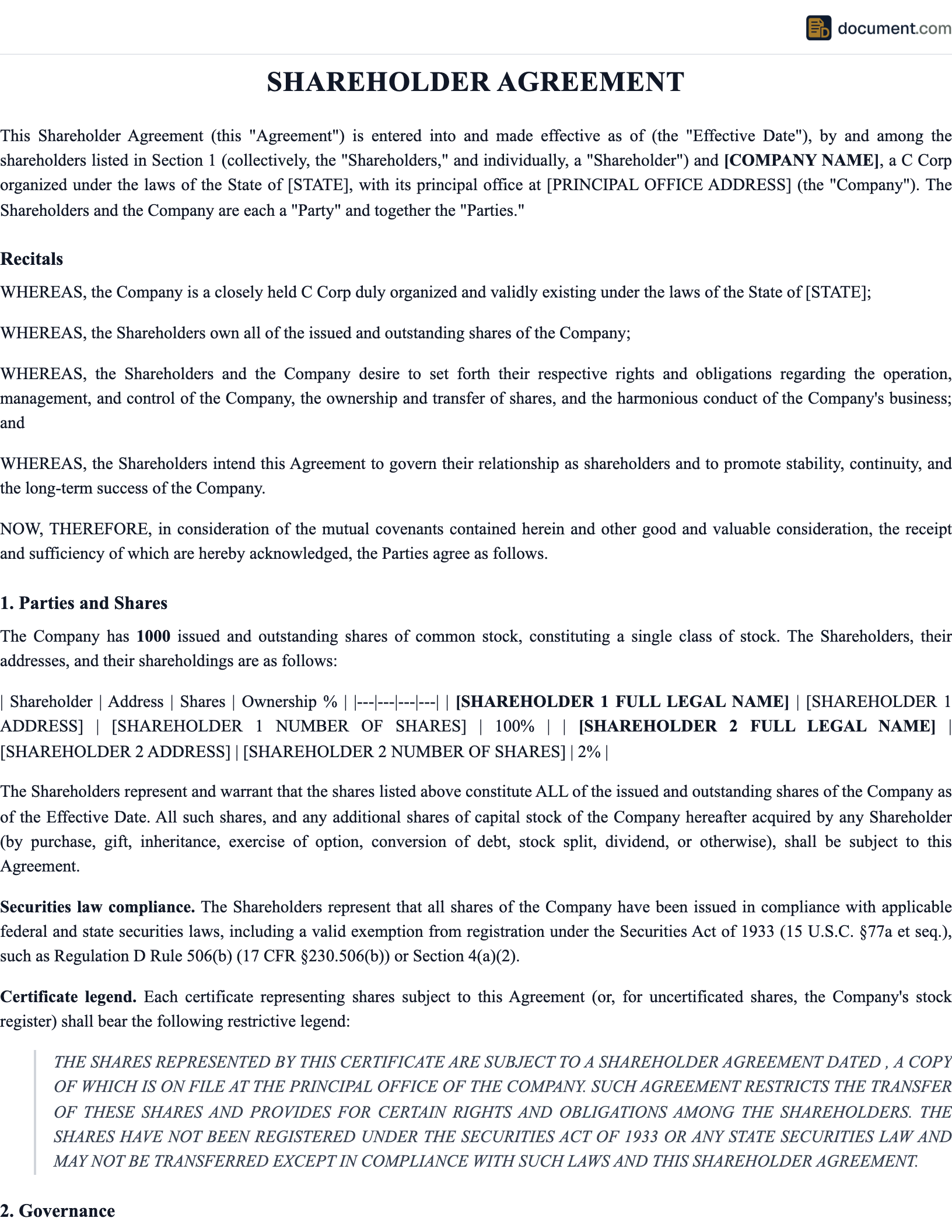
Below is a preview of the major sections of a typical shareholder agreement for a closely held corporation. Your finished document will be fully formatted and customized for your shareholders, share structure, and state of incorporation.
Shareholder Agreement
Closely Held Corporation
Section 1: Corporation & Shareholders
Section 2: Board Composition
The Board shall consist of three (3) directors. Hannah Levesque shall serve as Chair. Each Shareholder agrees to vote all shares to elect Hannah Levesque, Imani Okonkwo, and Theo Marchetti to the Board for so long as each holds at least 10% of the outstanding shares.
Section 3: Transfer Restrictions
No Shareholder shall transfer any Shares to any third party without first complying with the Right of First Refusal procedure set forth in Section 4. Any purported transfer in violation of this Section shall be null and void.
Section 4: Reserved Matters
Transfer Restrictions
Transfer restrictions are the heart of any closely held shareholder agreement. They keep ownership concentrated, prevent unwanted outsiders, and give the corporation and other shareholders the chance to consolidate ownership when one shareholder wants to exit.
Right of First Refusal (ROFR)
A selling shareholder must first offer the shares to the corporation, the other shareholders, or both, on the same terms an outside buyer is offering. If the inside buyers decline, the seller is free to complete the outside sale.
Right of First Offer (ROFO)
A selling shareholder must offer the shares to inside buyers before even soliciting outside offers. Less restrictive on the seller than a ROFR but more restrictive on outside buyers.
Permitted Transferees
Some transfers are exempted from restriction — typically transfers to spouses, descendants, family trusts, or wholly owned entities of the shareholder, provided the transferee signs a joinder.
Prohibited Transferees
Some agreements prohibit transfers to specific categories of people: competitors, foreign nationals (for S-corp protection), or anyone whose ownership would terminate the corporation's tax election.
Voting & Drag/Tag-Along
Voting provisions commit shareholders to support specific outcomes on matters that come before the shareholders for a vote. Drag-along and tag-along rights coordinate exits.
Voting for Directors
Each shareholder agrees to vote their shares to elect designated directors so the agreed board composition is maintained over time.
Approval of Major Transactions
Shareholders commit to vote in favor of (or against) specified corporate actions: mergers, asset sales, charter amendments, dissolution.
Drag-Along Rights
Allow majority shareholders to force minority shareholders into a sale of 100% of the company on the same terms — eliminates holdouts.
Tag-Along (Co-Sale) Rights
Allow minority shareholders to participate proportionally when a majority shareholder sells to an outside buyer — prevents being left with a new majority owner.
Pre-emptive Rights
Give existing shareholders the right to participate in future stock issuances pro rata, preserving their percentage ownership and preventing dilution.
Minority Protections
Minority shareholders are uniquely vulnerable in closely held corporations. Without protective provisions, the majority can dilute, freeze out, or otherwise marginalize smaller owners with little recourse.
Protective Covenants
Specified actions require supermajority or unanimous shareholder consent — often including issuance of new shares, sale of assets, charter changes, executive compensation.
Information Rights
Quarterly and annual financial statements, access to books and records, operating reports — even when state corporate law would not require them.
Board Representation
A guaranteed seat on the board for minority shareholders or specific share classes.
Mandatory Distributions
A requirement that the corporation distribute a minimum percentage of net income to shareholders, typically tied to S-corp tax obligations.
Put Rights
The right of minority shareholders to force the corporation or majority to repurchase their shares at a stated price after a defined period.
Anti-Dilution
Adjustments that protect against new issuances at a price below the minority's purchase price.
Shareholder Agreement vs Bylaws
| Feature | Shareholder Agreement | Bylaws |
|---|---|---|
| Type | Private contract | Internal governance document |
| Adopted By | Shareholders signing | Board (or shareholders) |
| Amendable By | All signing shareholders | Board or shareholders per bylaws |
| Transfer Restrictions | Yes (typical) | Rare |
| Voting Commitments | Yes | No |
| Required by Statute | No | Yes (most states) |
How to Create a Shareholder Agreement
- 1
Identify all current shareholders
List every shareholder with the number and class of shares held. Confirm all are willing to sign.
- 2
Review the existing charter and bylaws
The shareholder agreement should be consistent with the certificate of incorporation and bylaws.
- 3
Negotiate transfer restrictions
ROFR, ROFO, permitted transferees, prohibited transferees, mandatory buybacks at death or termination.
- 4
Set board composition and voting commitments
Designate director seats, voting agreements, and protective provisions.
- 5
Define minority protections
Information rights, supermajority approval thresholds, mandatory distributions, anti-dilution.
- 6
Add drag-along and tag-along rights
Coordinate exit mechanics so all shareholders are aligned when the company is sold.
- 7
Plan for deadlock and disputes
Include shotgun, mediation, or arbitration clauses to prevent paralysis.
- 8
Sign, legend share certificates, and store
All shareholders sign, transfer restrictions are noted on share certificates, and the original is kept in the corporate records.
Key Components
Recitals & Definitions
Identifies the corporation and the parties, defines key terms.
Share Ownership Schedule
An exhibit listing each shareholder, share class, and number of shares.
Transfer Restrictions
ROFR, ROFO, permitted transferees, mandatory buybacks.
Voting Agreement
Commitments about how shares will be voted on specified matters.
Board Composition
Designated director seats and procedures for replacing directors.
Reserved Matters
Decisions requiring supermajority or unanimous shareholder approval.
Information Rights
Financial statements, operating reports, and inspection rights.
Drag-Along & Tag-Along
Coordinated exit rights when the company is sold.
Pre-emptive Rights
Anti-dilution protection for existing shareholders.
Deadlock Resolution
Shotgun, mediation, arbitration, or judicial procedures.
Termination
Events that end the agreement (typically IPO, dissolution, or unanimous consent).
Joinder Mechanism
Procedure for adding new shareholders to the agreement.
Deadlock Resolution
Deadlocks are most common in 50/50 corporations or when supermajority approval is required and one block of shareholders refuses to consent. Without contractual mechanisms, a deadlocked corporation can grind to a halt and end up in court seeking judicial dissolution.
- Escalation to senior management or outside advisors before any party can invoke a buyout
- Mandatory mediation by an agreed-upon neutral mediator
- Binding arbitration under AAA, JAMS, or another arbitral institution
- Independent tiebreaking director appointed jointly or by an outside body
- Texas Shoot-Out (shotgun) — one party offers to either buy the other out or be bought out at the same price
- Russian Roulette — binary version where the offeree must either accept the offered price or buy the offeror at that same price
- Put/call mechanism — automatic exit at a formula price after a deadlock period
- Judicial dissolution as a last resort when no other mechanism produces a result
Sample Shareholder Agreement Language
SECTION 2 — TRANSFER RESTRICTIONS. No Shareholder shall sell, transfer, assign, pledge, hypothecate, or otherwise dispose of any Shares (or any interest therein) except in compliance with this Section. Any purported transfer in violation of this Section shall be null and void ab initio, shall not be recognized by the Corporation, and shall not be reflected in the share register.
SECTION 3 — RIGHT OF FIRST REFUSAL. If any Shareholder (the "Selling Shareholder") receives a bona fide written offer from a third party to purchase any of the Selling Shareholder's Shares (the "Outside Offer") that the Selling Shareholder desires to accept, the Selling Shareholder shall promptly deliver written notice of the Outside Offer to the Corporation and to the other Shareholders. The Corporation shall have thirty (30) days to elect to purchase all or any portion of the offered Shares on the same terms; any Shares not purchased by the Corporation shall be offered to the other Shareholders pro rata for an additional thirty (30) days.
SECTION 5 — VOTING AGREEMENT. Each Shareholder agrees that, until termination of this Agreement, the Shareholder shall vote all Shares now or hereafter owned or controlled by such Shareholder to elect to the Board of Directors the persons designated by the holders of a majority of each class of stock represented on the Board, and to vote in favor of any other corporate action approved in accordance with this Agreement.
SECTION 8 — RESERVED MATTERS. Notwithstanding any other provision of this Agreement, the Charter, or the Bylaws, the Corporation shall not, and the Shareholders shall vote their Shares not to, take any of the following actions without the affirmative vote or written consent of Shareholders holding at least seventy-five percent (75%) of the outstanding Shares: (i) authorize, issue, or sell any equity securities; (ii) approve the sale, merger, or dissolution of the Corporation; (iii) amend the Charter or Bylaws; (iv) declare or pay any dividend or distribution; (v) incur indebtedness in excess of $500,000; (vi) hire, terminate, or compensate any executive officer; (vii) enter into any related-party transaction.
SECTION 12 — DRAG-ALONG. If Shareholders holding more than fifty percent (50%) of the outstanding Shares (the "Drag Sellers") approve a Sale of the Corporation, the remaining Shareholders shall be required to (i) sell all of their Shares on the same terms and at the same price per share as the Drag Sellers, (ii) execute all documents reasonably required to effectuate the Sale, and (iii) make customary representations and warranties limited to ownership of and authority to sell their Shares.
Frequently Asked Questions
Official Resources
Ready to Lock In Governance?
Build a shareholder agreement tailored to your corporation in minutes.
Create Shareholder Agreement