



What Are Corporate Bylaws?
Corporate bylaws are the foundational governance document that establishes the internal rules, procedures, and organizational structure of a corporation. While the articles of incorporation create the corporation as a legal entity under state law, the bylaws provide the operating manual that directors, officers, and shareholders rely on for the daily governance of the business. Bylaws are to a corporation what an operating agreement is to an LLC — the comprehensive internal rulebook that translates the bare framework of the charter document into actionable governance procedures.
The bylaws address the most fundamental questions of corporate governance: How many directors sit on the board, how are they elected, and what is their term of office? How are board meetings called and conducted? What officers does the corporation have, what are their duties, and how are they appointed and removed? When is the annual shareholder meeting held, and what notice must be given? How is stock issued, transferred, and canceled? What constitutes a quorum for board and shareholder action? How can the bylaws themselves be amended? Without clear answers to these questions, the corporation cannot function effectively — decisions may be challenged, authority may be unclear, and disputes may be difficult to resolve.
Unlike the articles of incorporation, bylaws are not filed with the state and are not part of the public record. They are an internal, private document maintained in the corporation's records. However, the bylaws are binding on all directors, officers, and shareholders, and they carry significant legal weight. Courts regularly enforce bylaw provisions, and failure to follow the bylaws can result in corporate actions being invalidated, directors facing personal liability, and the corporate veil being pierced. The bylaws should be consistent with the articles of incorporation — if there is a conflict, the articles generally control because they are the higher-authority document.
Bylaws are adopted at the organizational meeting immediately following incorporation, typically by the incorporator or the initial board of directors. After adoption, the bylaws can generally be amended by either the board of directors or the shareholders, depending on the provisions of the articles and the bylaws themselves. Most state statutes (following the Model Business Corporation Act) give both the board and shareholders authority to amend bylaws, but the articles can reserve this power exclusively to the shareholders. Shareholder-adopted bylaws generally cannot be overridden by the board unless the shareholders specifically authorize it.
Our attorney-reviewed bylaws templates are customized for each state's corporation statute and tailored to your specific corporate type — whether you are operating a standard for-profit corporation, a nonprofit organization, an S-Corporation with specific tax election requirements, or a close corporation with simplified governance needs. Each template includes comprehensive provisions for board governance, officer roles, meeting procedures, stock administration, and amendment processes.
Board Governance
Define board structure, election procedures, meeting rules, and director responsibilities
Corporate Formalities
Establish the procedures that protect the corporate veil and maintain legal compliance
Stakeholder Protection
Protect shareholder rights with clear voting, notice, and amendment procedures
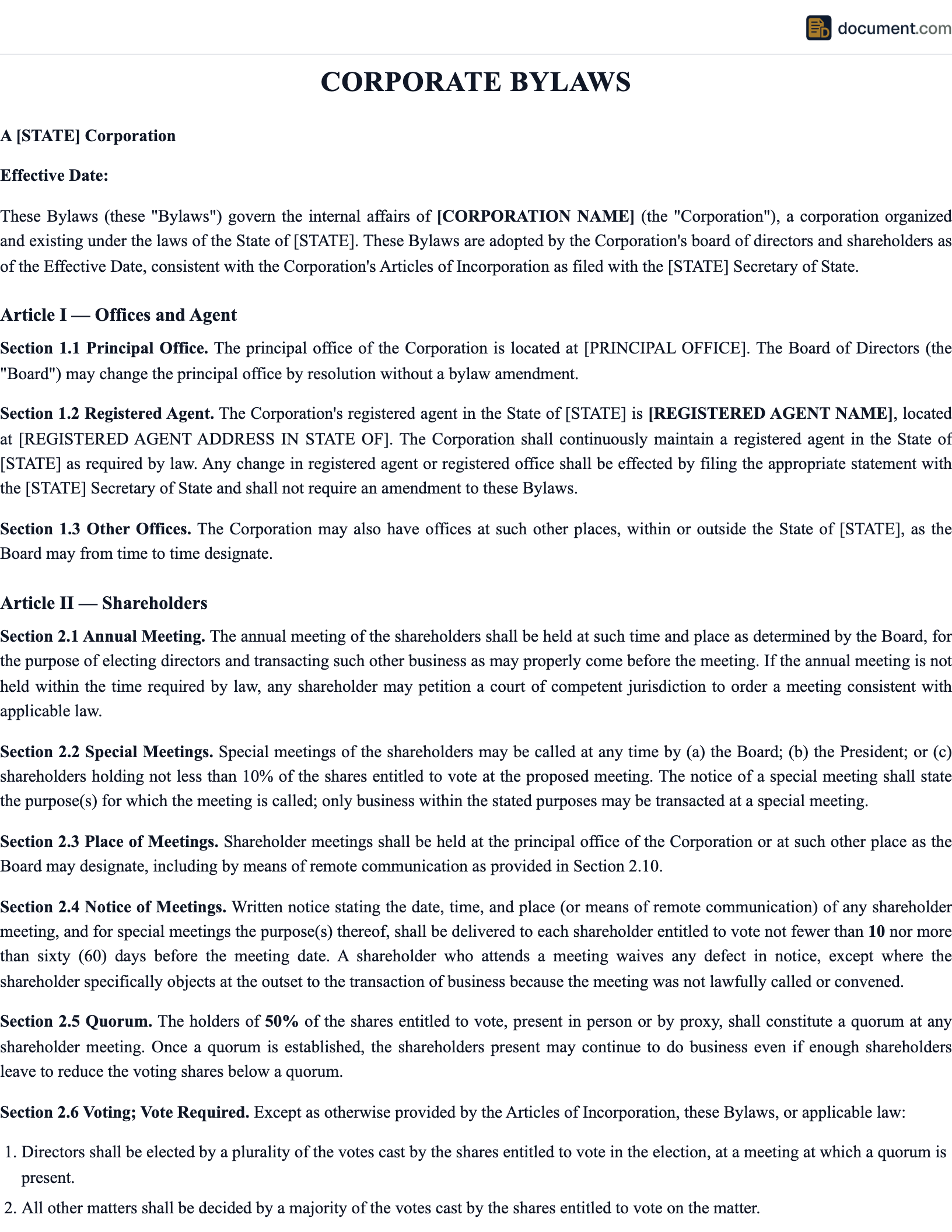
Corporate Bylaws Form Preview
Below is a visual preview of the key articles and sections included in a standard set of corporate bylaws. Your completed document will include all articles fully drafted and customized for your state and corporate type.
Bylaws
of Corporation Name, Inc.
Article I: Offices
Principal office address, registered agent, additional offices
Article II: Shareholders
Annual and special meetings, notice requirements, quorum, voting, proxies, record date, written consent
Article III: Board of Directors
Number, election, term, vacancies, removal, meetings, quorum, committees, compensation
Article IV: Officers
President, Secretary, Treasurer duties; appointment, removal, compensation, delegation
Article V: Stock
Certificates, transfers, record holders, lost certificates, dividends, stock ledger
Article VI: Indemnification
Director and officer indemnification, advancement of expenses, insurance
Article VII: General Provisions
Fiscal year, corporate seal, checks, contracts, loans, amendments, severability
Types of Corporate Bylaws
Different corporate types require bylaws tailored to their specific governance needs, regulatory requirements, and operational structures. Each type addresses the unique challenges and legal requirements of its corporate category.
Standard Corporate Bylaws
Standard corporate bylaws are designed for C-Corporations and S-Corporations and cover the full range of governance provisions required for a for-profit corporation. These bylaws establish the board of directors' structure (number of directors, term of office, classification if desired), officer positions and duties, shareholder meeting procedures (including annual meeting requirements, notice provisions, quorum rules, and voting procedures), stock issuance and transfer provisions, dividend policies, indemnification provisions for directors and officers, and the amendment process. Standard bylaws should be comprehensive enough to handle both routine governance and unusual situations such as director removal, vacancy filling, and emergency provisions.
Nonprofit Corporation Bylaws
Nonprofit bylaws differ significantly from for-profit bylaws because nonprofit corporations have different governance requirements, stakeholder structures, and regulatory obligations. Nonprofit bylaws must address membership provisions (if the organization has voting members), board composition requirements (including independent director requirements), committee structures (audit committee, governance committee, program committees), conflict of interest policies (required by the IRS for Form 1023 applicants), compensation policies (to prevent private inurement), and provisions ensuring compliance with tax-exempt status requirements. Many states also impose specific governance requirements on nonprofits, such as minimum board size, term limits, and restrictions on the percentage of directors who can be compensated employees of the organization.
S-Corp Bylaws
S-Corporation bylaws are standard corporate bylaws with additional provisions specifically designed to protect the corporation's S-Corporation tax election. Because S-Corp status has strict eligibility requirements (maximum 100 shareholders, only one class of stock, only U.S. citizen or resident shareholders, no corporate or partnership shareholders), the bylaws should include transfer restrictions that prevent stock transfers to ineligible shareholders, provisions limiting the corporation to a single class of stock (with permitted voting/non-voting variations), consent requirements for any action that could jeopardize the S-Corp election, and procedures for making distributions that account for each shareholder's tax liability arising from the corporation's pass-through income.
Close Corporation Bylaws
Close corporation bylaws are designed for closely held corporations — typically businesses with a small number of shareholders (often family members or business partners) who are actively involved in management. Many states have close corporation statutes that allow these entities to operate with reduced corporate formalities — for example, eliminating the requirement for a board of directors and allowing shareholders to manage the corporation directly (similar to an LLC), reducing meeting requirements, and simplifying record-keeping obligations. Close corporation bylaws reflect these simplified governance needs while still maintaining the formalities necessary to protect the corporate veil. They typically include buy-sell provisions that restrict stock transfers to keep ownership within the existing shareholder group.
Bylaws vs Other Corporate Documents
Corporate governance involves multiple documents that work together. Understanding what each document does — and where bylaws fit in the hierarchy — is essential for maintaining proper corporate governance.
Bylaws vs Articles of Incorporation
Corporate Bylaws
- - Private internal document
- - Detailed operating procedures and governance rules
- - Amended by board or shareholder vote
- - Governs how the corporation operates
- - Can be changed without government filing
Articles of Incorporation
- - Public document filed with the state
- - Basic structural provisions (name, shares, agent)
- - Amended by state filing with fee
- - Establishes the corporation's legal existence
- - Controls if there is a conflict with bylaws
Bylaws vs Shareholder Agreement
Corporate Bylaws
- - Applies to all shareholders, current and future
- - Adopted by the board or shareholders as a body
- - Focuses on governance procedures
- - Required for proper corporate governance
- - Amended by corporate action (vote)
Shareholder Agreement
- - Applies only to signatory shareholders
- - Negotiated contract between specific parties
- - Focuses on ownership rights and restrictions
- - Optional but common in closely held corps
- - Amended by consent of all parties
When to use both: Most closely held corporations benefit from having both bylaws (for formal governance procedures) and a shareholder agreement (for ownership rights such as buy-sell provisions, drag-along/tag-along rights, preemptive rights, and board representation). The shareholder agreement binds only its signatories, while the bylaws govern all shareholders.
Bylaws vs LLC Operating Agreement
Corporate Bylaws
- - Governs a corporation
- - More rigid structure required by statute
- - Must include board and officer provisions
- - Does not address profit allocation directly
- - Amended by board or shareholder vote
LLC Operating Agreement
- - Governs an LLC
- - Maximum flexibility in structure
- - No board or officer requirement
- - Covers profit/loss allocation and capital accounts
- - Amended by member vote
How to Create Corporate Bylaws
Bylaws should be adopted at the organizational meeting immediately following incorporation. Follow these steps to create bylaws that provide effective governance while maintaining the corporate formalities necessary to protect the corporate veil.
Determine Your Board Structure
Decide the number of directors (most states require at least one; the MBCA default is one), how directors will be elected (by shareholders at the annual meeting), their term of office (typically one year unless you use a classified/staggered board), and how vacancies will be filled (by remaining directors or by shareholders). Consider whether to establish board committees — an audit committee, compensation committee, and nominating/governance committee are standard for larger corporations and required for publicly traded companies.
Define Officer Positions and Duties
Specify the officer positions your corporation will have (President/CEO, Secretary, Treasurer/CFO at minimum), the duties and authority of each officer, how officers are appointed (typically by the board), how they can be removed (with or without cause by board resolution), and whether the same person can hold multiple offices. The bylaws should clearly define each officer's authority to sign contracts, execute documents, and bind the corporation.
Establish Meeting Procedures
Set the rules for both board and shareholder meetings: when the annual shareholder meeting is held, how special meetings are called and by whom, what notice is required (and how it is delivered), what constitutes a quorum, how votes are counted (majority of votes cast, plurality for director elections, etc.), whether proxy voting is allowed, and whether action can be taken by written consent without a meeting. Also address whether meetings can be held by telephone or video conference — this is permitted in most states and increasingly essential for distributed teams.
Address Stock Administration
Include provisions for how stock certificates are issued (or whether the corporation will use uncertificated/book-entry shares), how stock transfers are recorded, what happens when a certificate is lost or destroyed, who maintains the stock ledger, and how the record date for shareholder entitlements is determined. For S-Corps, include transfer restrictions that prevent stock from being transferred to ineligible shareholders. For close corporations, include a legend requirement on stock certificates noting transfer restrictions.
Include Indemnification and Insurance Provisions
Draft indemnification provisions that protect directors and officers from personal liability for actions taken in good faith on behalf of the corporation. Most states permit corporations to indemnify directors and officers to the maximum extent allowed by law, and the bylaws should include mandatory indemnification for directors and officers who are successful in defending against claims (as required by most state statutes). Also address the corporation's authority to purchase directors and officers (D&O) insurance, which provides an additional layer of protection beyond the corporation's indemnification obligation.
Adopt and Record the Bylaws
Present the bylaws for adoption at the organizational meeting of the board of directors (or by written consent of the incorporator or initial directors). Record the adoption in the corporate minutes. Keep the original signed bylaws in the corporate records book along with the articles of incorporation, stock ledger, and meeting minutes. Provide copies to all directors and officers. Whenever the bylaws are amended, file the amendment with the corporate records and update all copies.
Key Components of Corporate Bylaws
Comprehensive bylaws cover every major aspect of corporate governance. Here are the essential articles and provisions that should be included in every set of corporate bylaws.
Board of Directors
- - Number and qualifications of directors
- - Election procedures and term of office
- - Classified/staggered board provisions
- - Vacancy filling procedures
- - Removal with or without cause
- - Director compensation and expense reimbursement
- - Board committee structure and authority
Meetings & Voting
- - Annual and special shareholder meetings
- - Regular and special board meetings
- - Notice requirements and waiver provisions
- - Quorum requirements for board and shareholders
- - Voting thresholds and procedures
- - Proxy voting and written consent
- - Remote participation (telephone/video)
Officers
- - Required and optional officer positions
- - Duties and authority of each officer
- - Appointment and removal procedures
- - Signing authority for contracts and checks
- - Officer compensation
- - Delegation of duties
- - Vacancy and succession
Stock & Dividends
- - Stock certificate issuance and form
- - Transfer procedures and restrictions
- - Lost or destroyed certificate replacement
- - Stock ledger maintenance
- - Record date determination
- - Dividend declaration authority and procedures
- - Uncertificated/book-entry share provisions
Indemnification
- - Mandatory indemnification for successful defense
- - Permissive indemnification for settlement
- - Advancement of legal expenses
- - D&O insurance authorization
- - Non-exclusivity of indemnification rights
- - Indemnification of employees and agents
General Provisions
- - Fiscal year designation
- - Corporate seal (if used)
- - Books and records maintenance
- - Amendment procedures
- - Conflict of interest policy
- - Emergency bylaws
- - Severability and governing law
Legal Requirements for Corporate Bylaws
Corporate bylaws must comply with the corporation statute of the state of incorporation and be consistent with the articles of incorporation. Understanding the legal framework ensures your bylaws are enforceable and your corporate governance is legally sound.
Model Business Corporation Act (MBCA)
The MBCA, adopted in whole or in part by approximately 32 states, provides the framework for bylaw requirements. Section 2.06 requires the incorporator or initial board to adopt initial bylaws. Section 10.20 gives the board the power to adopt, amend, or repeal bylaws (unless the articles reserve this power to the shareholders). Section 10.22 provides that shareholders always have the power to amend or repeal bylaws, and shareholder-adopted bylaws that limit the board's authority can only be modified by the shareholders. The MBCA also establishes default rules for meeting notice, quorum, voting, and other governance procedures that apply unless the bylaws provide otherwise. Our templates comply with MBCA requirements where applicable and incorporate state-specific variations.
Bylaw Consistency with Articles of Incorporation
Bylaws must be consistent with the articles of incorporation. If there is a conflict between the two documents, the articles generally control because they are the higher-authority corporate document filed with the state. Common conflicts arise when bylaws attempt to authorize more shares than the articles authorize, create board or officer positions not contemplated by the articles, establish voting thresholds that conflict with those in the articles, or modify provisions that the articles designate as non-amendable without shareholder approval. When drafting or amending bylaws, always cross-reference the articles of incorporation to ensure consistency. If a conflict is discovered, the appropriate remedy is usually to amend the articles to match the desired governance structure, as the bylaws alone cannot override the articles.
Key State Considerations
- Delaware: DGCL Section 109 gives the board the power to adopt, amend, or repeal bylaws, subject to any provision in the certificate of incorporation. Shareholders always retain the power to amend bylaws. Delaware allows broad flexibility in bylaw provisions, including advance notice bylaws for shareholder proposals and director nominations, forum selection bylaws, and exclusive jurisdiction provisions.
- California: Requires at least one director (three if the corporation has three or more shareholders). California law imposes specific requirements for cumulative voting in director elections for corporations with certain numbers of shareholders, and has specific notice requirements for shareholder meetings (10-60 days).
- New York: Requires that bylaws be consistent with the Business Corporation Law. New York has specific requirements for quorum (majority of shares entitled to vote) and allows action by written consent only if unanimous (unlike Delaware, which allows majority consent). New York also requires specific provisions for shareholder access to corporate records.
- Texas: Under the Texas Business Organizations Code, bylaws may contain any provisions for managing the business and regulating the affairs of the corporation that are not inconsistent with law or the certificate of formation. Texas allows one-person boards and permits the same person to hold all officer positions.
Sample Corporate Bylaws
Below is a condensed preview of a standard set of corporate bylaws. This sample shows the structure and key provisions included in our attorney-reviewed templates.
BYLAWS
of [Corporation Name], Inc.
ARTICLE I — OFFICES
Section 1.01. Principal Office. The principal office of the Corporation shall be located at [Address]. The Board of Directors may change the location of the principal office from time to time.
ARTICLE II — SHAREHOLDERS
Section 2.01. Annual Meeting. The annual meeting of shareholders shall be held on the [date] of each year, or at such other time as determined by the Board of Directors, for the purpose of electing directors and transacting such other business as may properly come before the meeting...
Section 2.04. Quorum. The holders of a majority of the shares entitled to vote at a meeting, present in person or represented by proxy, shall constitute a quorum. If a quorum is present, the affirmative vote of a majority of the shares represented at the meeting and entitled to vote on the subject matter shall be the act of the shareholders...
ARTICLE III — BOARD OF DIRECTORS
Section 3.01. Number and Qualifications. The business and affairs of the Corporation shall be managed by a Board of Directors consisting of [number]directors. Directors need not be shareholders of the Corporation or residents of the state of incorporation...
Section 3.03. Regular Meetings. Regular meetings of the Board may be held without notice at such time and place as shall be determined from time to time by the Board...
ARTICLE IV — OFFICERS
Section 4.01. Officers. The officers of the Corporation shall be a President, a Secretary, and a Treasurer, each of whom shall be elected by the Board of Directors. The Board may also elect or appoint one or more Vice Presidents and such other officers as the Board may from time to time determine...
ARTICLE VI — INDEMNIFICATION
Section 6.01. Indemnification. The Corporation shall indemnify any person who was or is a party to any action, suit, or proceeding by reason of the fact that such person is or was a director or officer of the Corporation, to the fullest extent permitted by the[State] Business Corporation Act...
ARTICLE VII — AMENDMENTS
Section 7.01. By Board of Directors. The Board of Directors shall have the power to adopt, amend, or repeal the Bylaws of the Corporation by the affirmative vote of a majority of the directors then in office at any regular or special meeting of the Board...
Section 7.02. By Shareholders. The shareholders shall have the power to adopt, amend, or repeal the Bylaws of the Corporation by the affirmative vote of the holders of a majority of the outstanding shares entitled to vote...
Frequently Asked Questions
Find answers to common questions about corporate bylaws, governance procedures, board structure, and the role bylaws play in corporate compliance.
Official Resources
For additional information on corporate governance, bylaws, and director responsibilities, consult these official and reputable resources.
ABA - Model Business Corporation Act
Official MBCA text and commentary from the American Bar Association
Delaware Division of Corporations
Delaware corporate law resources and filing information
IRS - Nonprofit Governance
IRS guidance on governance practices for tax-exempt organizations
NACD - Corporate Directors
National Association of Corporate Directors governance resources
Nolo - Corporate Bylaws Guide
Free legal guide to understanding and drafting corporate bylaws
SBA - Running Your Business
Small Business Administration guide to corporate compliance and management
Create your Corporate Bylaws in under 10 minutes.
Answer a few questions and download a compliant, attorney-drafted document ready for your state.