



What Are Corporate Minutes?
Corporate minutes are the official written record of what happens at a meeting of a corporation's board of directors, its shareholders, or one of its committees. They are not a verbatim transcript and they are not informal notes — they are a deliberate, structured account of who attended, what was discussed, what decisions were made, and how the votes went. Every state corporate code requires corporations to maintain minutes of board and shareholder meetings as part of their permanent records, and the minute book is one of the first things any sophisticated lawyer, lender, investor, or acquirer asks to see during due diligence.
Corporate minutes serve several purposes at once. First and most fundamentally, they document that the corporation is acting as a real, separate legal entity rather than as the personal alter ego of its owners. The absence of meeting records is a key factor courts use when deciding whether to "pierce the corporate veil" — that is, whether to disregard the corporation's separate existence and hold its owners personally liable for corporate debts. Second, minutes establish that directors are exercising their fiduciary duties of care and loyalty: by recording the deliberation and the vote on important decisions, the minutes create contemporaneous evidence that directors actually considered the matter. Third, minutes provide an unambiguous record for third parties — banks, regulators, the IRS, courts — to verify that a particular action was authorized by the corporation.
The corporate secretary is the officer formally responsible for preparing and maintaining minutes. In a public company or large private corporation, the secretary is usually a senior executive or in-house lawyer with a dedicated staff to support the function. In a small closely held corporation, the secretary role is often held by a director, an outside attorney, or a co-founder who wears multiple hats. Whoever holds the role, the secretary signs the final minutes and is the custodian of the corporate minute book — the bound volume (or, today, the electronic equivalent) that contains all minutes, written consents, and resolutions for the life of the corporation.
Minutes record decisions, not discussion. The point is to create a clear, defensible account of what the body actually agreed to — not a transcript of every comment made along the way. Good minutes summarize the topics presented, name the directors who proposed and seconded each motion, record the vote count, and quote the text of any resolution adopted. They do not need to attribute every comment, repeat sales pitches by management, or capture every nuance of debate. In fact, overly detailed minutes can create legal risk by surfacing offhand comments that look damaging in litigation years later.
Whether you are a startup founder running your first organizational meeting, a corporate secretary preparing for the annual shareholder meeting, or a small business owner documenting an important decision through written consent, our attorney-reviewed minutes templates give you the right structure for the right meeting type. Each template includes the procedural elements — notice, quorum, voting, signatures — that state corporate codes require, plus the formatting that lenders, auditors, and acquirers expect to see.
Veil Protection
Maintains the corporate formalities that keep owners shielded from personal liability
Audit-Ready
Satisfies state corporate code, IRS, and SBA recordkeeping requirements
Fiduciary Evidence
Documents that directors exercised the duty of care in making important decisions
Corporate Minutes Form Preview
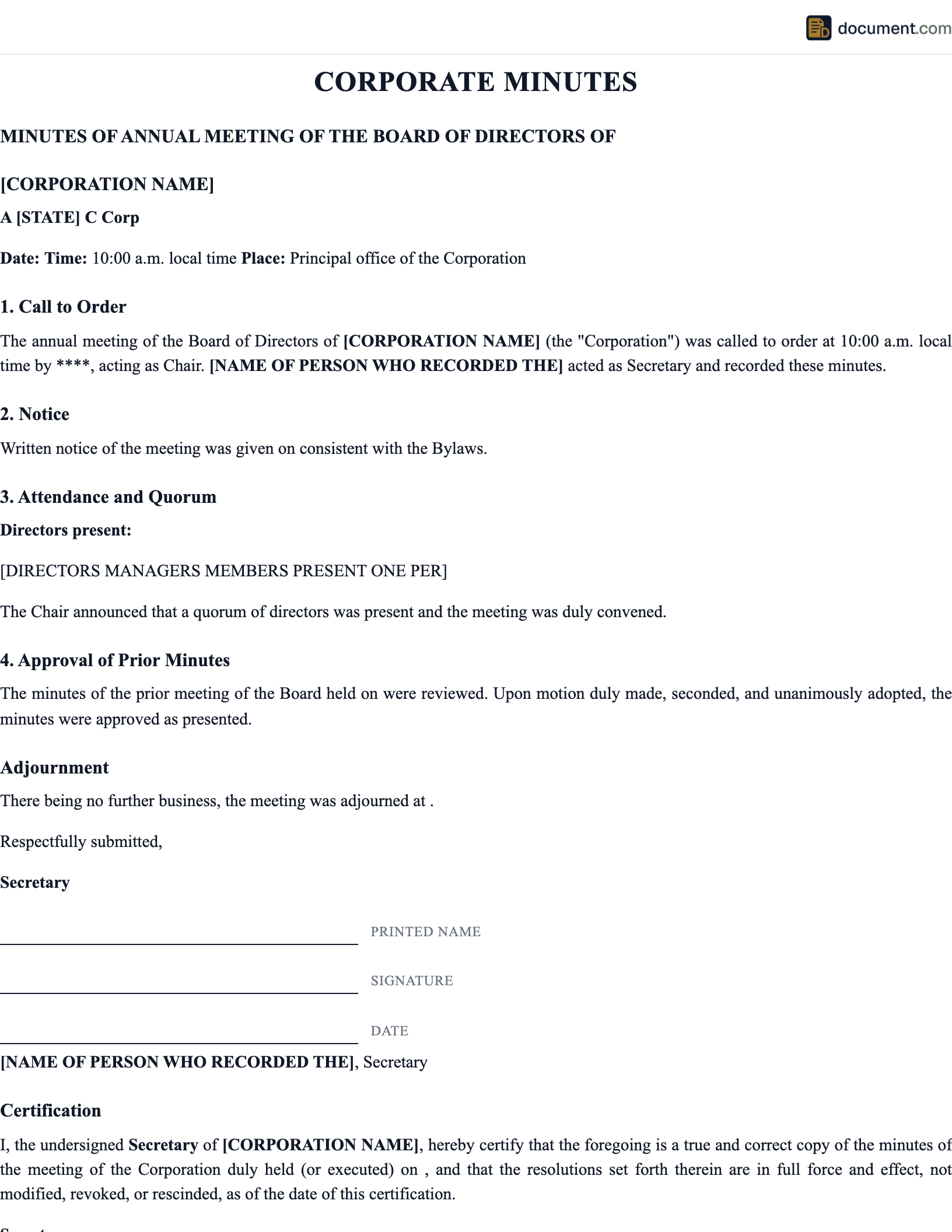
Below is a preview of the structure of our board meeting minutes template. Your completed minutes will be a fully formatted, professional document with the right procedural elements for your meeting type and state.
Minutes of Board of Directors
Quarterly Meeting
Section 1: Meeting Logistics
Section 2: Attendance & Quorum
Section 3: Agenda Items
Section 4: Resolutions Adopted
Section 5: Adjournment & Signature
Secretary Signature
Types of Corporate Minutes
Different meetings call for different minute formats. Choose the type that matches the meeting body, the meeting purpose, and the procedural rules in your bylaws and state corporate code.
Minutes vs Other Corporate Records
Corporate minutes sit alongside several other governance documents, each serving a distinct purpose. Together they make up the corporation's permanent records.
| Document | Purpose | When Created |
|---|---|---|
| Corporate Minutes | Record what happened at a meeting | After every formal meeting |
| Corporate Resolution | Formal text of a single decision | Within minutes or as standalone document |
| Written Consent | Action without a meeting | In lieu of a meeting |
| Bylaws | Internal rules of governance | At incorporation, amended over time |
| Articles of Incorporation | Public charter filed with the state | At incorporation |
| Stock Ledger | Record of share ownership | Updated on every issuance or transfer |
How to Take Corporate Minutes
Taking good minutes is a learnable skill, not an art. Follow these eight steps before, during, and after the meeting to produce minutes that are accurate, complete, and defensible.
Prepare in Advance
Get the agenda from the chair, review the bylaws for procedural requirements, confirm notice was properly given, and prepare a roster of expected attendees so you can quickly check off arrivals.
Record Logistics at the Start
Note the date, time, location (or virtual platform), the chair, the secretary, and the names of all directors or shareholders present, absent, and present by proxy. Confirm and record that a quorum is present.
Document Notice and Waivers
Confirm that notice of the meeting was given as required by the bylaws, or that any required notice has been waived in writing. The minutes should explicitly state that notice was proper.
Capture Decisions, Not Discussion
For each agenda item, record what was discussed at a high level, the text of any resolution, who proposed and seconded it, and the vote count. Avoid recording verbatim debate or attributing every comment.
Handle Conflicts of Interest
If a director has a conflict of interest in any matter being voted on, the minutes should record the disclosure and whether the conflicted director recused themselves from the vote.
Note Executive Sessions Carefully
If the board enters executive session, record only the topic and the time of entry and exit. Detailed executive session minutes should be kept separately and handled with appropriate confidentiality.
Record Adjournment and Sign
Note the time of adjournment, then prepare clean draft minutes for circulation. The secretary signs the final approved version, and the chair often co-signs depending on bylaws.
Distribute and Approve
Circulate draft minutes promptly to all directors for review, then formally approve them at the next regular meeting. File the approved version in the corporate minute book.
What to Include in Corporate Minutes
Every well-drafted set of corporate minutes includes the following elements. Missing any of them can compromise the value of the minutes as a legal record.
Meeting Logistics
Date, time, location (or remote platform), and meeting type.
Attendance
Directors or shareholders present, absent, and present by proxy.
Notice and Quorum
Confirmation that proper notice was given and a quorum was present.
Approval of Prior Minutes
Motion and vote to approve minutes of the previous meeting.
Reports
Summary of management, committee, or financial reports presented.
Resolutions
Text of every resolution adopted with mover, seconder, and vote count.
Conflict Disclosures
Any conflicts of interest disclosed and recusals from voting.
Executive Session
Note of any executive session, with topic and time but not detailed content.
Adjournment and Signatures
Time of adjournment and signature of the secretary (and chair if required).
Retention Requirements
Corporate minutes should be retained permanently as part of the corporation's permanent records. Every state corporate code requires corporations to maintain a complete book of minutes, and most require those minutes to be available for inspection by directors and shareholders on reasonable notice. The minute book is also one of the first items requested in any due diligence review, IRS audit, or litigation involving the corporation.
Modern corporate practice has largely moved from physical bound minute books to secure electronic minute books maintained in dedicated governance software or in a structured document management system. Either approach is acceptable so long as the records are complete, tamper-evident, and accessible. The key is consistency: pick a single authoritative repository, file every set of minutes there as soon as they are approved, and ensure that successor secretaries inherit the full archive when the role changes hands.
Attorney-Client Privilege and Minutes
Portions of corporate minutes that reflect communications with corporate counsel for the purpose of obtaining legal advice can be protected by the attorney-client privilege. However, the protection is narrower than people often assume. The privilege generally extends only to substantive accounts of legal advice given to the board, not to the underlying business decisions discussed in the meeting or to factual information shared with counsel.
Best practice for handling privileged matters in board meetings is to enter executive session, document only the fact that legal advice was received (without describing its content), and rely on counsel's separate notes for the detailed record. Mixing privileged and non-privileged content in the same minutes risks waiving privilege over the entire document if it is later produced in litigation. When in doubt, consult counsel about how to handle sensitive matters in the minutes themselves.
Sample Corporate Minutes
Below is a condensed example of board minutes for a fictional corporation's quarterly meeting. Use it as a reference for format, language, and the level of detail appropriate for a typical board meeting record.
MINUTES OF THE BOARD OF DIRECTORS
Cascade Robotics, Inc. — A Delaware Corporation
Quarterly Meeting — March 14, 2026
A meeting of the Board of Directors of Cascade Robotics, Inc. (the "Corporation") was held on March 14, 2026, beginning at 10:00 a.m. Pacific Time at the Corporation's headquarters in Bellevue, Washington and via Zoom video conference.
1. CALL TO ORDER AND ATTENDANCE
The meeting was called to order by Yolanda Hartman, Chair. The Secretary, Caleb Rodriguez, recorded that the following directors were present: Hartman, Rodriguez, Mehta, Okonkwo, and Beaumont. Directors Tanaka and Larsen were absent and excused. A quorum was present and the meeting proceeded.
2. NOTICE AND WAIVER
The Secretary confirmed that notice of the meeting had been given to all directors in accordance with the Corporation's bylaws. Written waivers of notice from the absent directors were received and filed with the records of the meeting.
3. APPROVAL OF PRIOR MINUTES
Upon motion duly made by Director Mehta and seconded by Director Okonkwo, the minutes of the December 12, 2025 quarterly meeting were unanimously approved as circulated.
4. CEO REPORT
Chief Executive Officer Rohan Mehta presented the quarterly operating report, including key financial metrics, customer acquisition, and product roadmap. Directors discussed the report and asked questions of management.
5. APPROVAL OF FY26 OPERATING BUDGET
Chief Financial Officer Priya Mendes presented the proposed FY26 operating budget. After discussion, upon motion duly made by Director Mehta and seconded by Director Beaumont, the following resolution was unanimously adopted (5-0):
RESOLVED, that the FY26 operating budget presented by the Chief Financial Officer is hereby approved in the form circulated to the Board prior to the meeting.
6. AUTHORIZATION OF SERIES B FINANCING
The Chief Executive Officer presented the proposed terms of the Series B Preferred Stock financing. Outside counsel from Wilson Sonsini Goodrich & Rosati was present by Zoom and answered questions from the Board. Upon motion duly made by Director Okonkwo and seconded by Director Rodriguez, the following resolution was unanimously adopted (5-0):
RESOLVED, that the Corporation is hereby authorized to issue up to $12,000,000 of Series B Preferred Stock on substantially the terms presented to the Board, and the officers of the Corporation are authorized to take all actions necessary or appropriate to consummate the financing.
7. EXECUTIVE SESSION
At 12:18 p.m., the Board entered executive session to discuss CEO compensation and a personnel matter. Management was excused from the meeting. Executive session ended at 12:38 p.m. and management was invited to rejoin.
8. ADJOURNMENT
There being no further business, upon motion duly made and seconded, the meeting was adjourned at 12:42 p.m.
Respectfully submitted,
Caleb Rodriguez, Secretary
Frequently Asked Questions
Answers to the most common questions about taking corporate minutes, board vs shareholder minutes, written consents, and minute book retention.
Official Resources
For authoritative information on corporate governance, recordkeeping, and director duties, consult these resources.
Delaware Division of Corporations
Most-used corporate jurisdiction in the U.S. — DGCL and corporate filings
SEC - Corporation Finance
Securities and Exchange Commission corporate governance guidance
ABA Business Law Section
American Bar Association resources on corporate governance and recordkeeping
NACD - National Association of Corporate Directors
Director education and corporate governance best practices
Society for Corporate Governance
Professional association for corporate secretaries and governance professionals
IRS - Required Records for Nonprofits
Recordkeeping requirements for tax-exempt organizations
Model Business Corporation Act
ABA model statute followed by approximately 30 states
SBA - Business Structures
Small Business Administration guide to corporate forms and recordkeeping
Create your Corporate Minutes in under 10 minutes.
Answer a few questions and download a compliant, attorney-drafted document ready for your state.