
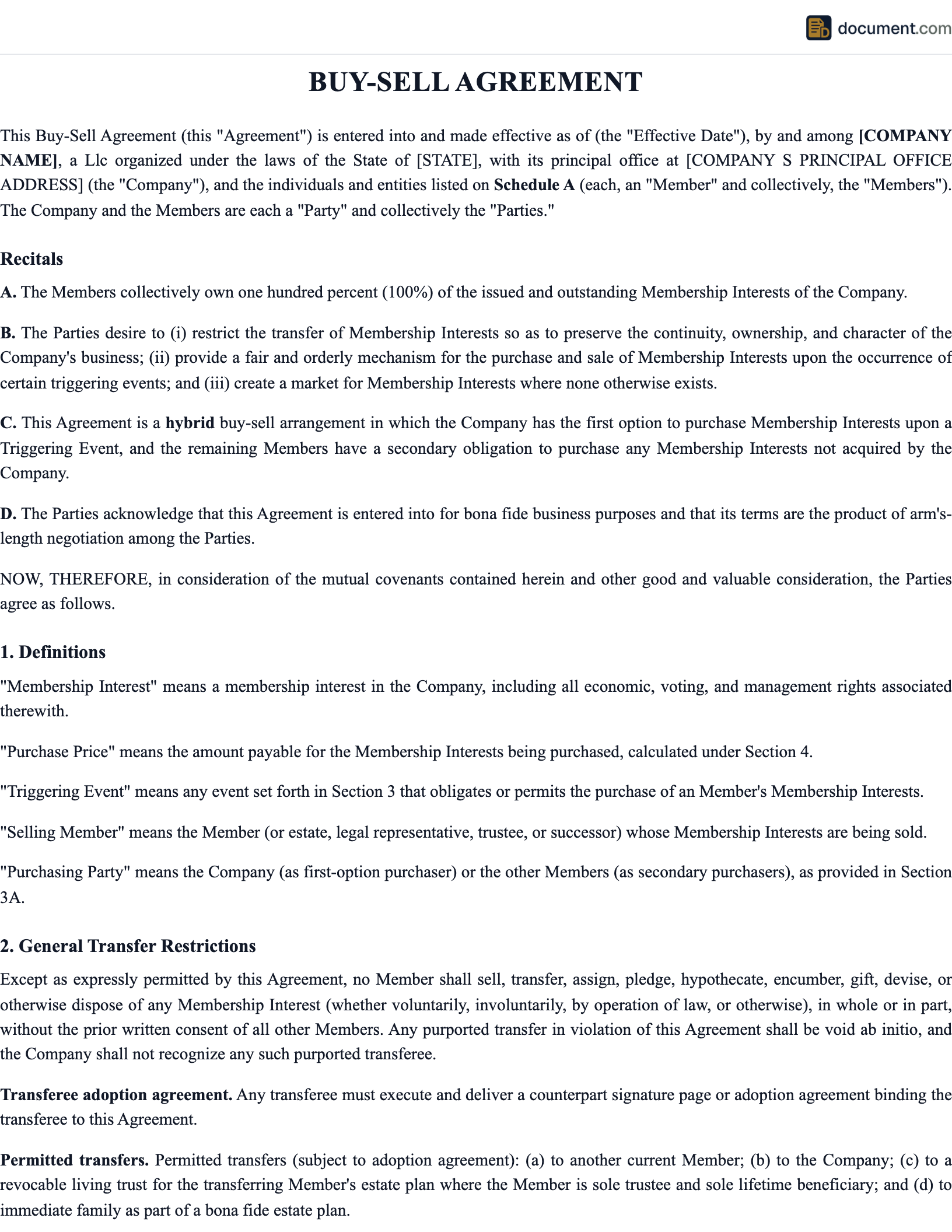



What Is a Buy-Sell Agreement?
A buy-sell agreement — sometimes called a buyout agreement, business continuation agreement, or business prenup — is a binding contract among the co-owners of a closely held business (and usually the business itself) that governs what happens to an owner's equity interest when a specified triggering event occurs. It answers the questions every co-owned business will eventually face: If one of us dies, becomes disabled, divorces, retires, goes bankrupt, or simply wants out, who gets the shares, what are they worth, and how is the buyout paid for? Locking those answers in while everyone is still healthy and on speaking terms is the entire point of the document.
Without a buy-sell, the default rules of state corporate law, partnership law, probate, and marital-property law take over — usually with messy results. The deceased owner's shares pass through probate to a spouse, children, or trust beneficiaries who may have no interest in or aptitude for running the business. A divorcing owner's shares can end up partly owned by an ex-spouse. A bankrupt owner's interest can be sold to creditors or competitors at fire-sale prices. A retiring founder may have no way to extract value from decades of sweat equity. Each of these scenarios can rapidly destroy the surviving owners' control of the company they built.
A well-drafted buy-sell agreement prevents these outcomes by creating an obligation (or option) for the entity, the remaining owners, or both to purchase the departing owner's interest at a pre-agreed price and on pre-agreed terms. It typically pairs that purchase obligation with a funding mechanism — most commonly life-insurance proceeds for death triggers, disability buyout insurance for disability triggers, and installment notes or sinking funds for retirement and voluntary departures. The agreement also restricts owners from transferring shares to outsiders without first offering them back to the company or the other owners through a right of first refusal.
Buy-sells are essential for any business with more than one owner: closely held C-corporations and S-corporations, multi-member LLCs, general partnerships, limited partnerships, and professional practices. They are particularly important when owners have different ages, family situations, financial positions, or risk tolerances, because those differences mean each owner's exit triggers will arrive at different times and create different liquidity needs. Even husband-and-wife co-owned businesses benefit from a buy-sell, because it coordinates the business succession plan with the couple's estate plan.
Whether you operate a two-partner consulting firm, a six-shareholder manufacturing company, a family farm with three generations of owners, or a professional practice with rotating partners, our attorney-reviewed buy-sell templates give you the structural framework to protect the business and every family that depends on it. Each template is configurable for cross-purchase, redemption, hybrid, or wait-and-see structures, with state-specific execution language and the optional clauses most often required by lenders, insurers, and the IRS.
Continuity Protection
Keeps shares from passing to spouses, heirs, ex-spouses, or creditors who have no role in the business
Guaranteed Liquidity
Insurance funding turns illiquid private equity into cash exactly when an owner's family needs it most
Valuation Certainty
A pre-agreed price formula ends the disputes that drive most post-death business litigation
Buy-Sell Agreement Form Preview
Below is a preview of the major sections found in a typical buy-sell agreement. Your completed document will be fully formatted, professionally styled, and customized for the structure you choose, the owners and entity involved, and the laws of your state.
Buy-Sell Agreement
Cross-Purchase Structure
Section 1: Parties & Company
Section 2: Triggering Events
Section 3: Valuation Method
Annual stipulated value certificate signed by all owners; if not updated within 18 months, the price defaults to an independent appraisal by a qualified business valuator.
Section 4: Funding
Each owner shall purchase and maintain term life insurance on the lives of the other owners in face amounts sufficient to fund their pro-rata share of the buyout obligation.
Disability buyouts shall be funded by a disability buyout insurance policy with a 90-day elimination period.
Lifetime transfers may be paid in cash at closing or via a 5-year promissory note at the applicable federal rate.
Section 5: Signatures
Types of Buy-Sell Agreements
Buy-sell agreements are typically classified by who is obligated to purchase the departing owner's interest. The right structure depends on the number of owners, the entity type, the funding strategy, and the tax outcomes the owners want to achieve.
Cross-Purchase Agreement
Surviving owners individually buy the departing owner's interest, often funded by life insurance policies each owner holds on the others
Stock-Redemption (Entity-Purchase) Agreement
The company itself purchases the departing owner's interest, simplifying funding for businesses with many owners
Triggering Events
Triggering events are the circumstances that activate the purchase obligations and rights in the agreement. Practitioners often refer to the "five Ds," but a thorough buy-sell contemplates more than that. For each trigger, the agreement should specify whether the buyout is mandatory or optional, who is obligated to purchase, the price (which may differ by trigger), and the payment timeline.
Death
Triggers a mandatory purchase by the entity or surviving owners, almost always funded by life insurance with proceeds paid directly into the buyout.
Disability
Activates after a stated elimination period (typically 90 to 180 days) of total disability, often verified by an independent physician and funded by disability buyout insurance.
Divorce
Requires the divorcing owner to repurchase any shares that would otherwise be awarded to the spouse, with spousal consent obtained at signing to prevent later disputes.
Departure (Retirement / Voluntary Withdrawal)
Often subject to a longer payment schedule than death triggers (5 to 10 years) and sometimes a discounted price to reflect the elective nature of the exit.
Disqualification
Loss of a professional license, conviction of a felony, expulsion from a professional society, or other disqualifying event — common in law, medical, and accounting practices.
Bankruptcy
Treats the filing of a bankruptcy petition (or assignment for the benefit of creditors) as an automatic offer to sell, preventing creditors from acquiring an interest in the business.
Deadlock
In two-owner companies, allows one owner to invoke a 'shotgun' or Texas Shoot-Out clause to force a buyout when the owners cannot agree on a major decision.
Third-Party Offer
Triggers a right of first refusal: any owner receiving a bona fide outside offer must first offer the shares to the company and the other owners on the same terms.
Valuation Methods
How the buyout price is calculated is the single most contested aspect of any buy-sell. Different methods trade off simplicity, accuracy, and cost.
Stipulated Value (Agreed Price Certificate)
The owners sign an annual certificate stating the agreed value of the company. Simple and cheap, but notoriously stale — owners forget to update it, and the certificate price often falls out of sync with reality after a few years.
Formula Method
Price is calculated mechanically — for example, book value plus 3 times trailing-twelve-month EBITDA, or 1.2 times annual revenue. Objective and self-updating, but rigid: a formula calibrated for a healthy business may produce absurd results during a downturn or after an acquisition.
Independent Appraisal
A qualified business valuator (typically credentialed as ASA, CVA, or ABV) appraises the company at the time of the triggering event. The most accurate method but the slowest and most expensive, and can be a source of dispute when each side hires its own appraiser.
Hybrid (Stipulated with Appraisal Fallback)
The owners maintain an annual stipulated value, but if the certificate is more than 12 to 24 months stale at the time of a triggering event, the price automatically falls back to an independent appraisal. The most popular structure for closely held businesses.
Funding the Buyout
A buy-sell without a credible funding mechanism is just a wish. Most agreements layer several funding sources to handle the different triggering events.
Life insurance
The cornerstone for death-triggered buyouts. Proceeds arrive tax-free, in a lump sum, exactly when needed. Term policies are inexpensive when owners are young and healthy.
Disability buyout insurance
Specialized policies that pay a lump sum or installments after a stated elimination period to fund a disability buyout — usually paired with monthly disability income coverage for the disabled owner.
Sinking fund
A reserve account funded annually by the company to handle retirement and voluntary departure buyouts that cannot be insured.
Installment promissory note
The departing owner accepts a promissory note (often 5 to 10 years, secured by the purchased interest) when cash on hand is insufficient — common for retirement triggers.
Bank financing
External financing arranged at the time of the buyout. Reliable for healthy businesses but exposes the company to lender approval and credit market risk at the worst possible time.
Buy-Sell vs Other Documents
| Document | Primary Purpose | Overlap with Buy-Sell |
|---|---|---|
| Shareholder Agreement | Governs corporate governance, voting, and rights between shareholders | Often contains the buy-sell provisions inside it |
| LLC Operating Agreement | Governs the operation of an LLC and members' rights | Typically embeds transfer restrictions and buyout terms |
| Partnership Agreement | Governs the rights and duties of partners in a partnership | Includes buyout provisions for partner withdrawal or death |
| Founders' Agreement | Sets early-stage roles, vesting, and IP ownership among founders | Usually includes founder vesting and repurchase rights |
| Stock Purchase Agreement | Governs a single transaction to buy or sell shares | Used to document the actual closing of a buy-sell transaction |
How to Create a Buy-Sell Agreement
- 1
Identify the parties and entity
List every current owner, the entity itself, and (where applicable) each owner's spouse for spousal consent. Confirm everyone is competent and willing to sign.
- 2
Choose the structure
Select cross-purchase, redemption, hybrid, or wait-and-see based on owner count, entity type, and tax goals.
- 3
Define the triggering events
Walk through the five Ds plus bankruptcy, deadlock, and right of first refusal. For each, decide whether the buyout is mandatory or optional.
- 4
Pick a valuation method
Choose stipulated value, formula, appraisal, or hybrid. Document the method in detail and execute the first stipulated-value certificate the day the agreement is signed.
- 5
Layer in the funding plan
Apply for the necessary life and disability buyout insurance, set up sinking funds, and document any installment-note terms.
- 6
Address tax and estate-planning fit
Coordinate with each owner's estate plan, S-corp election, §754 election, and IRC §2703 considerations for family-owned businesses.
- 7
Execute and store the document
Sign, notarize where required, attach spousal consents, legend the share certificates, and keep the original with the corporate records.
- 8
Review annually
Update the stipulated-value certificate each year and revisit the entire agreement after major business or family changes.
Key Components
Recitals & Definitions
Identifies the entity, owners, ownership percentages, and defines key terms like 'Triggering Event' and 'Purchase Price'.
Transfer Restrictions
Prohibits owners from transferring shares to outsiders without first complying with the agreement's right of first refusal and consent requirements.
Triggering Events Schedule
Lists every event that activates the buyout and specifies whether each is mandatory or optional.
Valuation Mechanism
Spells out exactly how the purchase price is calculated, including any annual certificate, formula inputs, or appraisal procedure.
Payment Terms
Cash at closing, promissory note schedule, interest rate, security, and acceleration on default.
Insurance Funding Provisions
Requires owners or the company to maintain specified policies, designates ownership and beneficiaries, and addresses what happens if a policy lapses.
Spousal Consent
Each owner's spouse acknowledges the agreement to prevent marital-property claims in divorce or death.
Closing Procedures
Documents to be delivered, escrow procedures, and timeline for completing the buyout.
Dispute Resolution
Mediation and binding arbitration provisions to keep disputes out of court and resolved quickly.
Amendment & Termination
How the agreement can be modified (typically requires unanimous owner consent) and what events terminate it.
Legal Requirements
Buy-sell agreements are governed primarily by state contract and corporate law, with important federal tax overlays. To be enforceable and effective:
- All current owners must sign — a partial agreement leaves the non-signing owner free to ignore the buyout terms.
- The entity itself should be a party so its purchase obligations are clearly binding.
- Spousal consents should be obtained in community-property states and recommended in all states.
- The agreement should be referenced in a legend on share certificates or membership units to put third parties on notice.
- For valuation to be respected for federal estate-tax purposes, the agreement must satisfy the requirements of IRC §2703.
- The agreement must comply with the buy-back, dividend, and corporate-distribution rules of the state of incorporation.
- Insurance funding arrangements should be coordinated with state insurance laws, especially regarding insurable interest.
- S-corporation buy-sells must avoid creating a second class of stock, which would terminate the S election.
Sample Buy-Sell Agreement Language
RECITALS. The Owners collectively own all of the issued and outstanding equity interests of the Company. The Owners and the Company desire to provide for the orderly transfer of equity interests upon the occurrence of certain events and to assure continuity in the management and ownership of the Company.
SECTION 1 — TRANSFER RESTRICTIONS. No Owner shall sell, assign, transfer, pledge, encumber, or otherwise dispose of any equity interest in the Company except in strict accordance with the terms of this Agreement. Any purported transfer in violation of this Section shall be null and void ab initio and shall not be recognized by the Company.
SECTION 2 — DEATH OF AN OWNER. Upon the death of any Owner, the Company (or, in a cross-purchase structure, the surviving Owners pro rata) shall purchase, and the estate of the deceased Owner shall sell, all equity interests of the deceased Owner at the Purchase Price determined under Section 5, payable in accordance with Section 6.
SECTION 5 — PURCHASE PRICE. The Purchase Price shall equal the value most recently set forth in the Agreed Value Certificate executed by all Owners; provided, however, that if no such Certificate has been executed within the eighteen (18) months immediately preceding the Triggering Event, the Purchase Price shall be determined by an independent appraisal performed by a business valuator credentialed by the American Society of Appraisers or the National Association of Certified Valuators and Analysts.
SECTION 12 — SPOUSAL CONSENT. Each Owner shall cause his or her spouse to execute the Spousal Consent attached as Exhibit A, by which the spouse acknowledges the terms of this Agreement and agrees to be bound by its transfer restrictions and purchase obligations to the extent of any community, marital, or quasi-marital interest the spouse may hold or later acquire.
Frequently Asked Questions
Official Resources
Ready to Protect Your Business?
Build a buy-sell agreement tailored to your owners, structure, and state in minutes.
Create Buy-Sell Agreement