
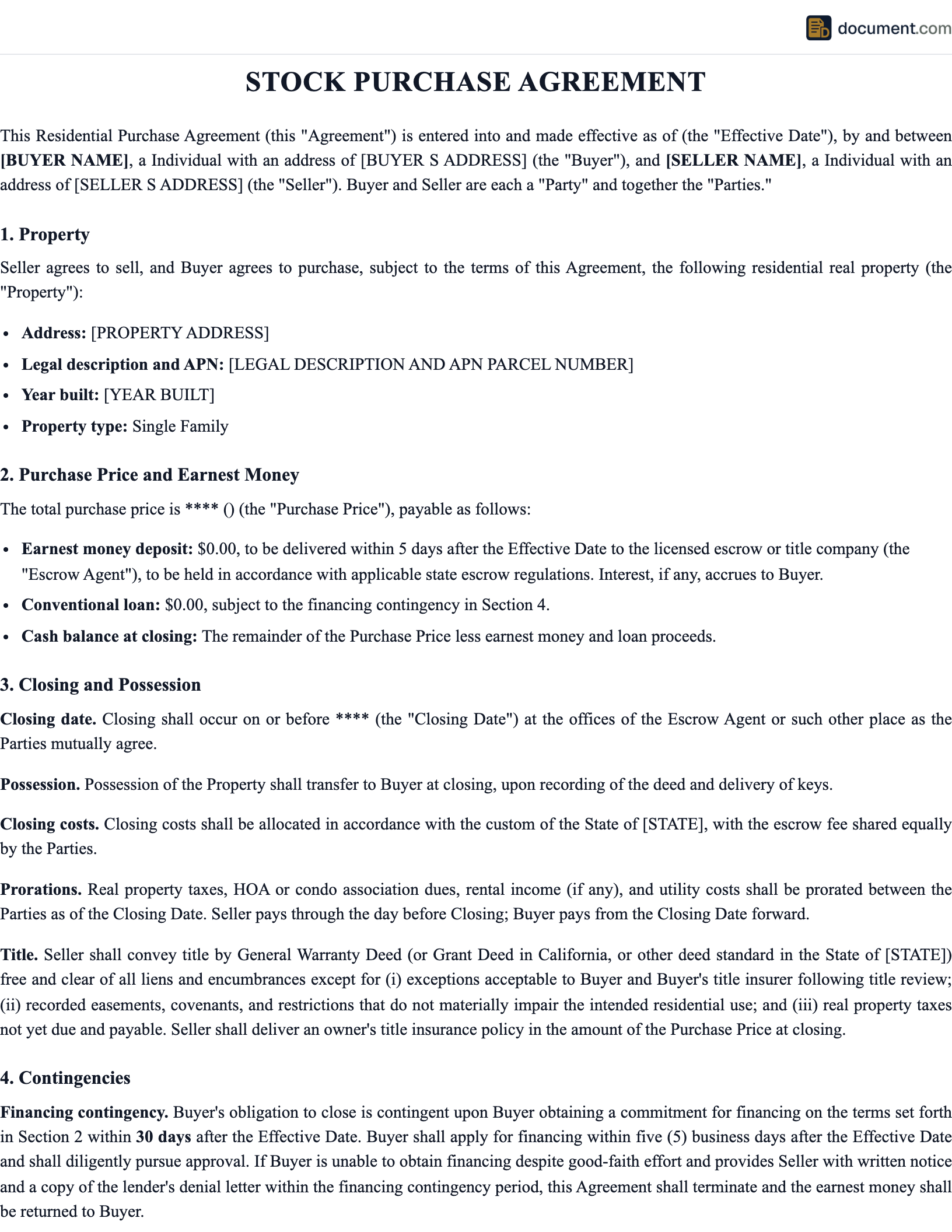



What Is an Stock / Equity Purchase Agreement?
An stock purchase agreement (APA) is a legal contract used when a buyer acquires specific assets of a business rather than purchasing the business entity itself. Instead of buying shares of stock or membership interests, the buyer cherry-picks which assets to acquire — such as equipment, inventory, customer lists, intellectual property, and goodwill — and which liabilities to assume.
This structure gives the buyer significant control over what they're acquiring and, more importantly, which liabilities they're NOT taking on. For the seller, an asset sale means retaining the business entity (including any liabilities not assumed by the buyer) and potentially facing different tax treatment than a stock sale.
Asset purchase agreements are among the most complex business transaction documents. They require careful attention to purchase price allocation (for tax purposes), bulk transfer compliance, lien searches, and detailed schedules identifying every asset and liability involved in the transaction.
Selective Acquisition
Choose which assets to buy and which liabilities to assume
Tax Benefits
Stepped-up basis allows depreciation of purchased assets
Liability Protection
Buyer generally avoids the seller's undisclosed liabilities
Stock / Equity Purchase Agreement by State
Each state has different requirements for asset purchases, including sales tax rates, UCC filing procedures, bulk transfer laws, and personal property tax obligations. Select your state for a template tailored to your jurisdiction.
Asset Purchase vs. Stock Purchase Comparison
Choosing between an asset purchase and a stock purchase is one of the most consequential decisions in any business acquisition. Here's a detailed comparison:
| Factor | Asset Purchase | Stock Purchase |
|---|---|---|
| What is acquired | Specific assets selected by buyer | All shares of the company |
| Liabilities | Only assumed liabilities | ALL liabilities transfer |
| Tax basis | Stepped-up basis (purchase price) | Carryover basis (seller's original) |
| Complexity | More complex (retitle each asset) | Simpler (share transfer only) |
| Contracts/licenses | Must be assigned (consent needed) | Stay with entity automatically |
| Buyer preference | Usually preferred by buyers | Less preferred (more risk) |
| Seller preference | Less preferred (potential double tax) | Usually preferred by sellers |
Tangible vs. Intangible Assets
Understanding the distinction between tangible and intangible assets is essential for an asset purchase because the type of asset affects sales tax, depreciation, and purchase price allocation.
Tangible Assets
Physical assets you can touch — typically subject to sales tax
- Equipment and machinery
- Inventory and raw materials
- Furniture, fixtures, and supplies
- Vehicles and rolling stock
- Leasehold improvements
Intangible Assets
Non-physical assets — generally not subject to sales tax
- Goodwill and going concern value
- Customer lists and relationships
- Trademarks, patents, copyrights
- Non-compete agreements
- Trade secrets and proprietary processes
Allocation of Purchase Price (IRS Form 8594)
When you purchase business assets, the IRS requires both buyer and seller to allocate the total purchase price among seven defined asset classes using the residual method. This allocation determines the tax treatment for both parties and must be reported on IRS Form 8594.
Critical: Both Parties Must Agree on Allocation
The buyer and seller must report the same purchase price allocation on their respective Form 8594 filings. Inconsistent allocations will trigger IRS scrutiny. Negotiate the allocation as part of the purchase agreement and include it as a binding schedule.
| Asset Class | Description | Tax Treatment |
|---|---|---|
| Class I | Cash and cash equivalents | Face value |
| Class II | CDs, government securities, foreign currency | Fair market value |
| Class III | Accounts receivable, mortgages, credit card receivables | Fair market value |
| Class IV | Inventory | Ordinary income to seller |
| Class V | Equipment, furniture, fixtures, land, buildings | Depreciable over useful life |
| Class VI | Section 197 intangibles (non-compete, customer lists) | Amortizable over 15 years |
| Class VII | Goodwill and going concern value | Amortizable over 15 years |
UCC Bulk Transfer & Lien Searches
Before closing an asset purchase, the buyer must conduct thorough lien searches and determine whether the state's bulk transfer laws apply to the transaction.
UCC Lien Search
A UCC lien search reveals all recorded security interests (liens) on the seller's assets. These are filed as UCC-1 financing statements with the state's filing office (typically the Secretary of State). Any existing liens must be released before or at closing, or the buyer risks inheriting encumbered assets. The search should cover the seller's legal name and any prior names or DBAs.
Bulk Transfer Compliance
In states that have adopted UCC Article 6, the buyer of a "major part" of a business's assets must notify the seller's creditors before the sale closes. This typically requires obtaining a list of the seller's creditors and sending written notice 10-45 days before closing. Failure to comply can make the buyer liable for the seller's debts. About half of U.S. states have repealed Article 6 — check your state's specific requirements.
Assumed Liabilities in an Asset Purchase
One of the primary advantages of an asset purchase is that the buyer can choose which liabilities to assume. Here's how to structure this critical part of the agreement:
Commonly Assumed Liabilities
- Trade accounts payable (current)
- Customer deposits and prepayments
- Assigned lease obligations
- Warranty claims on sold products
- Accrued PTO for retained employees
Commonly Excluded Liabilities
- Pending or threatened lawsuits
- Tax liabilities (income, payroll, sales)
- Environmental remediation costs
- Employee benefit obligations (pension, COBRA)
- Product liability claims pre-closing
Frequently Asked Questions
Find answers to common questions about stock purchase agreements, tax implications, and legal requirements.
Create your Stock Purchase Agreement in under 10 minutes.
Answer a few questions and download a compliant, attorney-drafted document ready for your state.