



What Is a Bill of Sale?
A bill of sale is a written instrument that evidences the transfer of title to identified personal property from a seller to a buyer for stated consideration. The Uniform Commercial Code Article 2, enacted in 49 states (Louisiana follows civil-law sales rules under Louisiana Civil Code articles 2438-2659), governs the underlying contract. Title to the goods passes when the parties intend it to pass, and absent a contrary agreement, that intent is presumed at the time and place at which the seller completes physical delivery (UCC § 2-401(2)). The bill of sale is the written record of that intent, and in litigation it functions as a contemporaneous account of the transaction that displaces later contradictory testimony under the parol evidence rule (UCC § 2-202).
The Statute of Frauds embedded in UCC § 2-201 requires a writing signed by the party against whom enforcement is sought for any sale of goods at $500 or more (raised to $5,000 in the few states that adopted the 2003 UCC revisions). The writing need not state every term: it must show that a contract was made, identify the parties, and contain a quantity term. A bill of sale satisfies the Statute of Frauds for any sale within the threshold and reduces the risk of post-sale dispute for sales below it. Federal law layers on additional disclosure requirements for specific property classes: the Truth in Mileage Act (49 U.S.C. § 32705) requires odometer disclosure for vehicles under 20 years old; 33 C.F.R. § 181.27 requires the hull identification number on boats manufactured after November 1, 1972.
Title transfer vs bill of sale (DMV titling rules)
A bill of sale is not a substitute for a state title. For untitled goods (furniture, electronics, jewelry, livestock, business equipment, most construction tools), title passes by delivery and the bill of sale is the only documentation needed. For titled property, the bill of sale supports the state title-transfer process but does not effect it. Vehicles are titled under each state's motor vehicle code (California Vehicle Code §§ 5600-5907; Texas Transportation Code § 501.071; Florida Statute § 319.22), with the buyer required to apply for a new title within a state-set window (10 days in California, 30 days in Texas, 30 days in Florida) using the seller-signed reassignment plus the bill of sale and a state-prescribed application form (REG 227 in California, Form 130-U in Texas, HSMV 82040 in Florida). Boats over a state-set length (typically 16 feet) are titled by the state wildlife or marine agency. Aircraft are titled federally with the FAA Aircraft Registration Branch under 14 C.F.R. Part 47, and the bill of sale must follow AC Form 8050-2. Manufactured homes are titled in roughly 30 states and treated as real property in the others.
As-is vs implied warranty under UCC § 2-316
Every sale of goods by a merchant carries the implied warranty of merchantability under UCC § 2-314, and any sale where the seller knows of the buyer's particular purpose carries the implied warranty of fitness for that purpose under UCC § 2-315. To exclude these warranties, the seller must either use language conspicuous to a reasonable person mentioning merchantability (UCC § 2-316(2)) or rely on the safe harbor in UCC § 2-316(3)(a), which permits exclusion through the words “as is,” “with all faults,” or similar language that calls the buyer's attention to the disclaimer. Magnuson-Moss Warranty Act (15 U.S.C. §§ 2301-2312) preempts as-is disclaimers for consumer products if the seller offers any written warranty; several states (Connecticut, Maine, Maryland, Massachusetts, Mississippi, Vermont, West Virginia, the District of Columbia) prohibit as-is disclaimers entirely for consumer goods. For private party sales between non-merchants, as-is is the default presumption, but the bill of sale should still recite the disclaimer in conspicuous language to defeat any later claim.
Notarization requirements by state
Notarization for vehicle bills of sale is mandatory in nine states: Louisiana (La. R.S. § 32:707), Maryland (Md. Transp. Code § 13-105), Montana (Mont. Code § 61-3-201), Nebraska (Neb. Rev. Stat. § 60-159), New Hampshire (RSA § 261:148), Ohio (R.C. § 4505.06), Pennsylvania (75 Pa. C.S. § 1111), West Virginia (W. Va. Code § 17A-3-4), and Wyoming (Wyo. Stat. § 31-2-103). The remaining 41 states accept a non-notarized bill of sale at the DMV but typically require the seller's signature on the title reassignment to be notarized for any out-of-state title application. Boats follow the same general pattern under each state's wildlife or marine code. Aircraft bills of sale on FAA Form 8050-2 do not require notarization but must be signed in ink. Firearm private-party transfers do not require notarization under federal law, but California, Colorado, Connecticut, Delaware, Hawaii, Illinois, Maryland, Massachusetts, Nevada, New Jersey, New Mexico, New York, Oregon, Rhode Island, Vermont, Virginia, Washington, and the District of Columbia require the transfer to go through a federally licensed dealer for the federal background check under 18 U.S.C. § 922(t).
Sales tax obligations (use tax, gift exemption)
Sales tax on private-party vehicle sales is computed against the price stated on the bill of sale in 45 of the 50 states. Rates run from 2.9 percent (Colorado state base) to 7.25 percent (California state base, often higher with local add-ons). Five states (Alaska, Delaware, Montana, New Hampshire, Oregon) impose no state sales tax. Most states deter under-reporting through a fair market value floor (the DMV will assess tax against a reference value, typically Kelley Blue Book or NADA, if the stated price is more than 25 to 30 percent below market). Genuine gifts between qualifying relatives are exempt in roughly 35 states under documented gift-affidavit procedures (California Form REG 256, Texas Form 14-317, Florida Form HSMV 82040). Federal gift tax under IRC §§ 2501-2524 applies separately above the $19,000 annual exclusion (2025) per donee, with reporting on Form 709 required even when no tax is owed. Misrepresenting a sale as a gift to evade state sales tax is tax fraud under each state's revenue code.
Legal Protection
Written proof of sale protects both buyer and seller
Ownership Record
Documents the exact date and terms of transfer
Tax Documentation
Required for calculating sales tax and registration fees
Types of Bill of Sale
Each property class triggers a different set of statutory disclosures and identifier requirements. Vehicles need a 17-character VIN and the federal odometer disclosure under 49 U.S.C. § 32705. Boats need the 12-character hull identification number under 33 C.F.R. § 181.27. Aircraft use FAA Form 8050-2 under 14 C.F.R. Part 47. Firearms require background-check routing through a federal firearms licensee under 18 U.S.C. § 922(t) in 18 jurisdictions. Livestock require the seller's brand and registry papers plus, for horses, a current Coggins test under 9 C.F.R. § 75.4. Pick the form that matches the property to get the correct fields and disclosures.
Vehicle Bill of Sale
Cars, trucks, SUVs
Motorcycle Bill of Sale
Motorcycles and mopeds
Boat / Watercraft Bill of Sale
Boats, vessels, personal watercraft
Firearm Bill of Sale
Handguns, rifles, and shotguns
Trailer Bill of Sale
Utility, travel, and cargo trailers
ATV / Off-Road Bill of Sale
ATVs and side-by-sides
Horse / Livestock Bill of Sale
Horses, cattle, and other livestock
Aircraft Bill of Sale
Airplanes, helicopters, ultralight aircraft
Mobile Home Bill of Sale
Manufactured and mobile homes
Electronics Bill of Sale
Computers, phones, cameras, and devices
Business / Equipment Bill of Sale
Business assets, machinery, and tools
General / Personal Property Bill of Sale
Furniture, household items, other
As-Is Bill of Sale
Property sold with no warranty
Bicycle Bill of Sale
Bikes, e-bikes, and cycling gear
Cat Bill of Sale
Cat / kitten transfers
Dirt Bike Bill of Sale
Off-road dirt bikes
Equipment Bill of Sale
Industrial or commercial equipment
Even Trade Bill of Sale
Property swapped with no cash consideration
Furniture Bill of Sale
Furniture and household items
Gifted Car Bill of Sale
Vehicle gifted with $0 consideration
Golf Cart Bill of Sale
Golf carts and low-speed vehicles
Jet Ski Bill of Sale
Jet skis and personal watercraft
Lawn Mower Bill of Sale
Lawn tractors and mowers
Livestock Bill of Sale
Cattle, sheep, goats, and farm animals
Notarized Bill of Sale
Notary-required bill of sale
RV Bill of Sale
Motorhomes and RVs
Scooter Bill of Sale
Scooters and mopeds
Semi-Truck Bill of Sale
Semi-trucks and tractor units
Snowmobile Bill of Sale
Snowmobiles and snow machines
Tractor Bill of Sale
Farm tractors and implements
UTV Bill of Sale
Utility task vehicles and side-by-sides
How to Write a Bill of Sale
A bill of sale has six working parts. The first three (parties, property description, price) satisfy the Statute of Frauds under UCC § 2-201. The fourth (condition and warranty disclaimer) determines whether the seller faces residual liability under UCC §§ 2-314 and 2-315. The fifth (warranty of title) shifts the risk of an unknown lien from buyer to seller under UCC § 2-312. The sixth (execution) makes the document enforceable. Skip any one and the document either fails the Statute of Frauds, exposes the seller to implied warranty liability, or fails at the DMV.
Identify the Buyer and Seller
State the full legal name and current street address of each party. For an entity (LLC or corporation) include the registered name as filed with the Secretary of State plus the title and printed name of the signatory authorized to bind the entity. Driver's license number is typically required for vehicle bills of sale in California (REG 227), Texas (Form 130-U), and Florida (HSMV 82040) because the DMV uses it to match the buyer to a verified identity. P.O. boxes are accepted in most states for the buyer but not in California or Florida for the seller because the seller's address is the address of record for any post-sale registration notice.
Describe the Property in Detail
Use identifiers a court could use to distinguish the item from any similar one. Vehicles: 17-character VIN (federal standard since 1981 under 49 C.F.R. § 565.13), year, make, model, body type, color, and odometer reading. Boats: 12-character hull identification number under 33 C.F.R. § 181.27, length, year, hull material, propulsion type, and engine make/model/serial. Aircraft: tail number (N-number), make, model, serial number, year, and engine hour meter reading. Firearms: make, model, caliber, and serial number. Livestock: registered name and registry number, breed, sex, color, markings, microchip number, and Coggins test date for horses. Insufficient description fails UCC § 2-501 identification and lets the seller substitute a different item without breach.
State the Purchase Price and Payment Terms
State the total consideration in numbers and words ($5,000.00 / Five Thousand and 00/100 Dollars). Note the payment method (cash, certified check, wire transfer, ACH). Cash payments above $10,000 trigger the IRS Form 8300 reporting requirement under 26 U.S.C. § 6050I, and the recipient business must file within 15 days. For installment sales, state the down payment, installment schedule, interest rate (which must comply with the state usury ceiling, typically 10 to 18 percent annual), and the consequence of default. State whether the seller retains a security interest under UCC Article 9, which requires a separate security agreement and a UCC-1 financing statement filed with the Secretary of State.
Disclose the Condition of the Property
State whether the sale is as-is or with warranty. As-is requires the conspicuous language safe-harbored by UCC § 2-316(3)(a) (the words "as is," "with all faults," or similar) plus disclosure of any known material defects. Connecticut, Maine, Maryland, Massachusetts, Mississippi, Vermont, West Virginia, and the District of Columbia prohibit as-is disclaimers entirely for consumer-goods sales by merchants. The Magnuson-Moss Warranty Act (15 U.S.C. § 2308) bars as-is disclaimers if the seller offers any written warranty on the same product. For private-party sales between non-merchants, as-is is the default but should still be recited in conspicuous language to defeat later claims of implied warranty under UCC §§ 2-314 (merchantability) and 2-315 (fitness for particular purpose).
Include the Warranty of Title
Under UCC § 2-312, every sale of goods carries an implied warranty that the seller conveys good title, free of any security interest or lien of which the buyer at the time of contracting has no knowledge. The bill of sale should restate this warranty expressly: the seller warrants ownership, the right to sell, and that the property is free of liens, security interests, and encumbrances. For vehicles with an outstanding loan, the seller must coordinate payoff with the lender before transfer and record the payoff in the bill of sale; the lender holds a perfected security interest under UCC Article 9 that survives sale until released. UCC § 2-312(2) allows the seller to disclaim warranty of title only by specific language or by circumstances giving the buyer reason to know the seller does not claim full title.
Sign, Date, and Notarize (If Required)
Both parties sign and date the bill of sale. The seller's signature is the one that matters under UCC § 2-201, but mutual signatures eliminate the question of whether the buyer accepted the as-is and warranty terms. Each party retains a signed original. Notarization is required for vehicle bills of sale in Louisiana, Maryland, Montana, Nebraska, New Hampshire, Ohio, Pennsylvania, West Virginia, and Wyoming. For sales subject to title reassignment (vehicles, boats, aircraft, manufactured homes in titling states), the seller also signs the back of the title at the same time. The buyer files the title application within the state-set deadline (10 to 30 days) along with the bill of sale, prior title, and any required odometer disclosure under 49 U.S.C. § 32705.
Key Components of a Bill of Sale
Ten elements appear in any complete bill of sale. The first six are necessary to satisfy the Statute of Frauds under UCC § 2-201 and to give the DMV enough information to record the title reassignment. The next two (warranty disclaimer and warranty of title under UCC § 2-312) allocate risk between buyer and seller. The federal odometer disclosure (49 U.S.C. § 32705) is mandatory for vehicles less than 20 years old. Notarization is mandatory in nine states for vehicle bills of sale and recommended in every state for high-value transactions to defeat later forgery defenses.
| Component | Description |
|---|---|
| Seller Information | Full legal name, address, and contact details of the seller |
| Buyer Information | Full legal name, address, and contact details of the buyer |
| Property Description | Detailed description with identifying numbers (VIN, serial, hull ID) |
| Sale Price | Total amount in numbers and words, including payment method |
| Date of Sale | The exact date the transaction takes place |
| Condition / As-Is Clause | Statement of the property's condition and any warranty or as-is terms |
| Warranty of Ownership | Seller confirms they own the property and it's free of liens |
| Odometer Disclosure | Required for motor vehicles under 20 years old: current mileage at time of sale per 49 U.S.C. § 32705 |
| Signatures | Dated signatures from both buyer and seller |
| Notarization | Required in some states for certain property types |
Legal Requirements for a Bill of Sale
Bill of sale requirements operate on three layers: federal disclosure mandates that apply uniformly (odometer under 49 U.S.C. § 32705, firearms background check under 18 U.S.C. § 922(t) in transfer-state jurisdictions, FAA aircraft registration under 14 C.F.R. Part 47), the Uniform Commercial Code Article 2 sales rules adopted in 49 states (Louisiana follows civil-law sales under Civil Code articles 2438-2659), and state-specific motor-vehicle and wildlife titling statutes that prescribe forms, fields, and notarization. A document that satisfies one layer but fails another is enforceable between the parties yet rejected by the DMV at registration.
Federal odometer disclosure (49 U.S.C. § 32705)
The Truth in Mileage Act and 49 C.F.R. § 580 require the seller of any motor vehicle less than 20 years old (raised from 10 years effective January 1, 2021) to deliver a written odometer disclosure to the buyer at the time of sale. The disclosure must state the current mileage, whether the reading is the actual mileage, whether the actual mileage exceeds the mechanical limit (now uncommon since electronic odometers), and whether the reading is in excess of mechanical limits. False or missing odometer disclosure carries a federal civil penalty of $10,000 per violation and treble damages (minimum $10,000) in a private civil action under 49 U.S.C. § 32710.
Statute of Frauds (UCC § 2-201)
Sales of goods at $500 or more are unenforceable absent a writing signed by the party against whom enforcement is sought, sufficient to indicate that a contract was made and to identify the parties and the subject matter. The writing must contain a quantity term but need not state every other term. Three exceptions cover (1) specially manufactured goods not suitable for resale, (2) admissions in pleadings or testimony, and (3) goods accepted or paid for. A bill of sale satisfies the writing requirement and removes the Statute of Frauds defense entirely. Several states adopted the 2003 UCC revisions raising the threshold to $5,000, but the original $500 threshold remains the prevailing rule.
State titling and notarization rules
- Vehicle title transfer deadlines: California 10 days (Cal. Veh. Code § 5901), Texas 30 days (Tex. Transp. Code § 501.0234), Florida 30 days (Fla. Stat. § 319.23), New York 30 days (NY VTL § 2113). Late filing typically triggers a $25 to $100 penalty plus interest on the sales tax.
- Notarization for vehicle bills of sale: Required by statute in Louisiana, Maryland, Montana, Nebraska, New Hampshire, Ohio, Pennsylvania, West Virginia, and Wyoming. The other 41 states accept a non-notarized bill of sale but typically require notarization on the title reassignment for out-of-state applications.
- Boat title and registration: Boats over a state-set length (16 feet in most states, 13 feet in Texas) are titled by the state wildlife or marine agency. The Coast Guard documents larger commercial vessels under 46 U.S.C. § 12103.
- Firearm transfer rules: Federal law (18 U.S.C. § 922) bars sales to prohibited persons (felons, persons subject to qualifying domestic-violence orders, persons adjudicated mentally defective). Eighteen jurisdictions (California, Colorado, Connecticut, Delaware, Hawaii, Illinois, Maryland, Massachusetts, Nevada, New Jersey, New Mexico, New York, Oregon, Rhode Island, Vermont, Virginia, Washington, District of Columbia) require private transfers to route through a federally licensed dealer for the NICS background check.
- Aircraft registration: All civil aircraft must be registered with the FAA Aircraft Registration Branch in Oklahoma City under 14 C.F.R. Part 47, using AC Form 8050-2 (bill of sale) and AC Form 8050-1 (registration application).
Sales tax and use tax
Forty-five states impose sales or use tax on private-party vehicle sales, computed against the consideration stated on the bill of sale. State rates run from 2.9 percent (Colorado) to 7.25 percent (California) before local add-ons that push effective rates above 10 percent in many jurisdictions. Five states (Alaska, Delaware, Montana, New Hampshire, Oregon) impose no state sales tax on vehicle sales, though Alaska local jurisdictions may. Most states deter under-reporting through a fair-market-value floor: the DMV will assess tax against a published value (Kelley Blue Book or NADA Guides) if the stated price is more than 25 to 30 percent below market. Genuine gifts between qualifying relatives are exempt in roughly 35 states under documented gift-affidavit procedures (California REG 256, Texas Form 14-317, Florida HSMV 82040). Misrepresenting a sale as a gift to evade tax is criminal under each state's revenue code.
Implied warranties under UCC §§ 2-312 to 2-315
Every sale of goods carries an implied warranty of title under UCC § 2-312 (the seller owns the goods free of liens of which the buyer has no knowledge), an implied warranty of merchantability under UCC § 2-314 (when the seller is a merchant in goods of that kind), and an implied warranty of fitness for a particular purpose under UCC § 2-315 (when the seller knows the buyer's particular purpose and the buyer relies on the seller's skill). The merchantability and fitness warranties can be disclaimed by conspicuous as-is language under UCC § 2-316(3)(a) in most states. The warranty of title can be disclaimed only by specific language or circumstances giving the buyer reason to know the seller does not claim full title (UCC § 2-312(2)).
Sample Bill of Sale
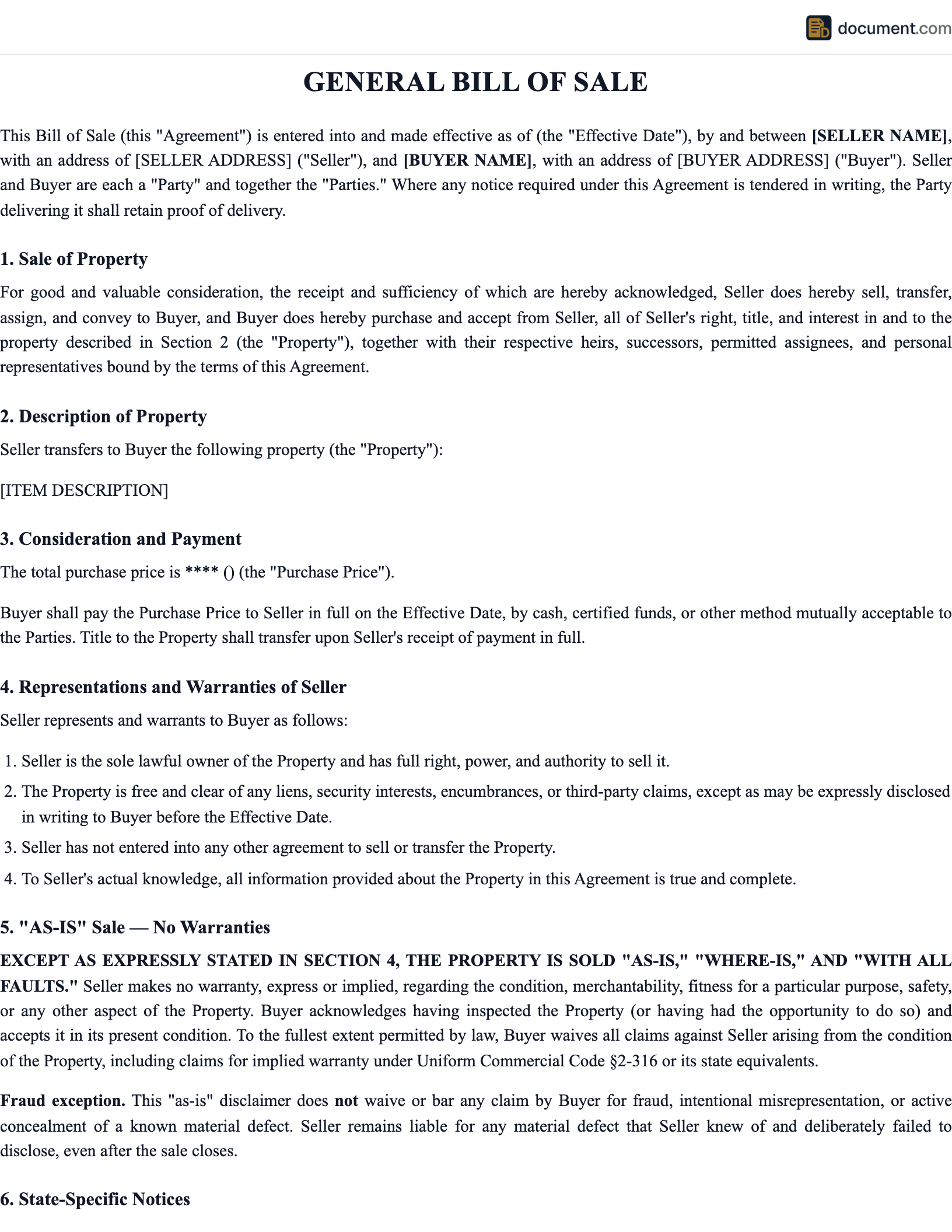
The general bill of sale below shows the four anchor sections common to any property class: parties, property description, consideration, and condition (with the as-is disclaimer satisfying UCC § 2-316(3)(a)). Vehicle, boat, aircraft, firearm, and livestock variants add the property-specific identifiers and federal disclosures (odometer under 49 U.S.C. § 32705, hull identification under 33 C.F.R. § 181.27, FAA registration under 14 C.F.R. Part 47, NICS routing under 18 U.S.C. § 922(t), Coggins under 9 C.F.R. § 75.4) plus the warranty of title under UCC § 2-312 and the seller's notarized signature where required.
BILL OF SALE
General Personal Property
This Bill of Sale is made on[Date], between:
SELLER:
Name: [Seller Name]
Address: [Seller Address]
BUYER:
Name: [Buyer Name]
Address: [Buyer Address]
1. PROPERTY DESCRIPTION
The Seller hereby sells, transfers, and delivers to the Buyer the following property:[Item Description]
2. PURCHASE PRICE
The total purchase price is $[Amount]([Amount in Words] Dollars), paid by [Payment Method].
3. CONDITION
The property is sold "AS-IS" with no warranties, expressed or implied, regarding the condition, fitness, or merchantability of the property...
Frequently Asked Questions
Common questions on UCC § 2-201 writing requirements, the difference between a bill of sale and a state title, notarization rules in the nine mandatory states, vehicle title transfer deadlines, the warranty of title under UCC § 2-312, and the federal odometer disclosure obligation.
Create your bill of sale in under 5 minutes.
Pick the type of property, answer a few questions, and download an attorney-drafted, state-specific document.