
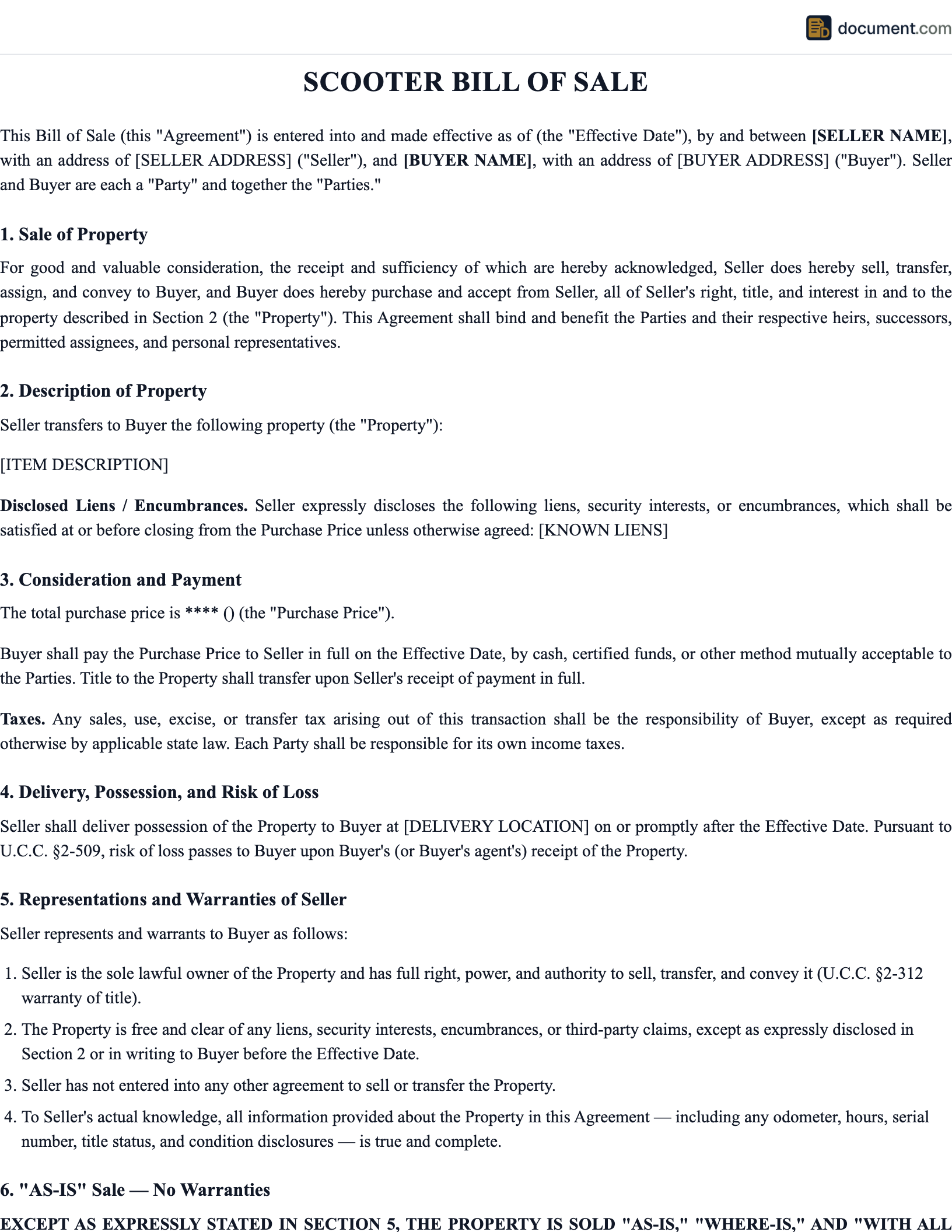



What Is a Moped & Scooter Bill of Sale?
A moped and scooter bill of sale is the written instrument that records the private transfer of a two- wheeled motorized vehicle. UCC § 2-201 (the Statute of Frauds for sale of goods) makes contracts for the sale of goods of $500 or more unenforceable absent a writing signed by the party to be charged. Most scooter sales clear that threshold, so the bill of sale is the document that converts the deal into an enforceable contract. State DMV registration practice independently requires the bill of sale to issue title or a moped registration card; the federal Truth in Mileage Act requires it to satisfy the odometer-disclosure rule under 49 CFR Part 580 for vehicles 20 years old or newer.
Engine displacement and motor wattage drive classification at the DMV. Most states title scooters 50cc and above as motorcycles or motor-driven cycles but exempt mopeds 50cc or less from full titling, issuing instead a registration card or sticker (Florida Stat. § 320.01(28); Ohio Rev. Code § 4501.01(L); Pennsylvania Title 75 Pa.C.S. § 102; Illinois 625 ILCS 5/1-148.2). The bill of sale should record the exact cc displacement so the buyer can determine the licensing class (Class M endorsement at 150cc and above in most states; moped or M2 endorsement between 51cc and 149cc; standard driver's license under 50cc).
For street-legal scooters from Honda, Vespa, Yamaha, Piaggio, NIU, and Super Soco, the 17-character VIN required by NHTSA 49 CFR Part 565 is the core registration field. The DMV cross-checks the VIN on the bill of sale against the frame stamping, the prior title, and the NMVTIS (National Motor Vehicle Title Information System) under 49 U.S.C. § 30502. A single transposed digit blocks registration. For pre-1981 imports and sub-50cc models without a federal VIN, record the manufacturer's frame number.
Federal law classifies kick-style electric scooters separately. The Consumer Product Safety Act and 15 U.S.C. § 2085 distinguish Low-Speed Electric Bicycles (LSEB) under 750 watts and 20 mph from motor vehicles subject to NHTSA Federal Motor Vehicle Safety Standards. Most states do not title or register kick-style e-scooters but may impose helmet, lighting, and operating-area rules. State implementation varies: California Veh. Code § 21223 governs e-scooter operation; New York V&T Law § 125 added e-scooter classifications in 2020 with helmet requirements for riders under 18.
UCC § 2-201 Statute of Frauds and federal odometer disclosure
UCC § 2-201 requires a signed writing for any sale of goods of $500 or more; the writing must identify the parties, the goods, the quantity, and signify the parties' bargain. Price and other terms may be supplied by extrinsic evidence under § 2-204. Federal odometer disclosure under 49 CFR Part 580 requires the seller to state the mileage reading, certify it as actual mileage or note that it exceeds mechanical limits or is not actual, and sign the disclosure at transfer. The 2019 amendment effective January 1, 2021, extended the disclosure requirement from 10 years to 20 years for vehicles manufactured on or after January 1, 2011. Civil penalties run up to $10,000 per violation under 49 U.S.C. § 32710 plus treble damages or $10,000 (whichever is greater) in private actions.
DMV titling thresholds and federal LSEB classification
State DMV rules differ on the moped/scooter/motorcycle classification threshold but converge on three brackets. Under 50cc: most states issue a moped registration card or sticker without full titling and waive the motorcycle endorsement (Florida Stat. § 320.01(28); Pennsylvania Title 75 Pa.C.S. § 1116). Between 51cc and 149cc: most states title and require a moped or M2 endorsement. 150cc and above: full motorcycle classification requiring Class M endorsement and insurance. For electric scooters, the federal LSEB classification under 15 U.S.C. § 2085 (under 750W and 20 mph) generally exempts the device from motor-vehicle treatment. Above the federal threshold, NHTSA Federal Motor Vehicle Safety Standards apply, and the device is registered as an electric motorcycle.
VIN Verification
17-character federal VIN matches frame stamp
CC Displacement
Determines license class and titling rules
Odometer Disclosure
Required under federal Truth in Mileage Act
How to Write a Moped / Scooter Bill of Sale
Follow these six steps to create a form that will be accepted by any state DMV.
Capture Buyer and Seller Information
Full legal names, addresses, driver's license numbers, and phone numbers for both parties. A minor buyer must be co-signed by a parent or guardian to create an enforceable contract.
Identify the Scooter
Year, make, model (PCX150, Vespa GTS 300, Yamaha Zuma 125, NIU NQi GTS), color, engine displacement in cc, and wattage for electric scooters. Note whether it is ICE or electric.
Record the VIN and Frame Number
Write the full 17-character VIN from the steering neck or frame tube. Double-check against the existing title. For pre-1981 imports and sub-50cc models without a federal VIN, record the manufacturer's frame number.
Complete Odometer Disclosure
Record the exact odometer reading and check the box for 'actual mileage,' 'exceeds mechanical limits,' or 'not actual mileage.' This is a federal requirement for vehicles under 20 years old under the Truth in Mileage Act (TIMA).
State Price, Payment, and Condition
Write the full purchase price in numerals and words. Note payment method. Include an as-is clause and disclose any title brands (salvage, rebuilt, flood). List included accessories such as helmets, top cases, chargers, or extra keys.
Sign, Date, and Notarize if Required
Both parties sign and date. A handful of states (Louisiana, Nebraska, Montana, West Virginia, Wyoming, Maryland, others for mopeds) require notarized bills of sale. Check your state DMV requirements before finalizing.
Key Components
| Field | Description |
|---|---|
| Buyer & Seller | Full legal names, addresses, driver's license numbers |
| Year / Make / Model | Honda PCX150, Vespa Primavera 150, Yamaha Zuma 125, NIU NQi |
| Engine Displacement | Exact cc (e.g., 49cc, 125cc, 300cc) or motor watts for electric |
| VIN | 17-character federal VIN from steering neck or frame |
| Odometer | Mileage + TIMA disclosure checkbox |
| Title Brand | Clean / salvage / rebuilt / flood / non-repairable |
| Color | Primary body/frame color |
| Accessories | Helmet, top case, chargers, service records, extra keys |
| Sale Price | Amount in numerals and words, payment method |
| As-Is Clause | Conspicuous warranty disclaimer |
| Signatures / Notary | Both parties, notarized if state requires |
Scooter & Moped Types Covered
50cc Moped
Small-displacement two-wheelers capped at roughly 30 mph. In most states, 50cc mopeds do not require a motorcycle endorsement and may be exempt from titling.
Gas Scooter (125–250cc)
Mid-range gas scooters from Honda (PCX150, Forza), Yamaha (Zuma), Vespa (Primavera, GTS), and Piaggio. Typically street-legal and titled in all 50 states.
Maxi-Scooter (300cc+)
Large-frame touring scooters like the Honda Silver Wing, Yamaha TMAX, Suzuki Burgman 400/650. Treated as motorcycles for licensing and insurance.
Electric Scooter (Seated)
Street-legal electric mopeds and scooters from NIU, Genuine Buddy, Vespa Elettrica, and Super Soco. Must meet DOT standards and carry a VIN.
Electric Stand-Up Scooter
Kick-style e-scooters from Bird, Lime, Xiaomi, Segway-Ninebot, and Apollo. Usually NOT titled or registered, but some states (NY, CA) impose speed and helmet rules.
Vintage / Collector Scooter
Vespa P-series, Lambretta, and classic Honda Elite often require a special title application and frame inspection due to age.
Kick / Push Scooter
Non-motorized adult kick scooters. No title, no registration, but a simple bill of sale still helps document high-value purchases.
Moped vs. Scooter vs. Motorcycle
| Factor | Moped (≤50cc) | Scooter (51–249cc) | Motorcycle (250cc+) |
|---|---|---|---|
| Top Speed | ~30 mph | 55–75 mph | 100+ mph |
| Title Required | Varies by state | Yes | Yes |
| License | Standard driver's license | Class M or moped endorsement | Class M endorsement |
| Helmet Law | Varies | Usually required | Usually required |
| Insurance | Sometimes exempt | Required | Required |
| Highway Legal | No | Depends on state | Yes |
| Typical Price | $800 – $2,500 | $2,500 – $7,000 | $5,000 – $30,000 |
Form Preview
Section 1: Buyer and seller identification
Section 2: Scooter description: year, make, model, color
Section 3: VIN and engine displacement
Section 4: Odometer disclosure (TIMA)
Section 5: Sale price and payment
Section 6: Title brand disclosure and as-is clause
Section 7: Signatures, dates, notary block
Sample Moped / Scooter Bill of Sale
MOPED / SCOOTER BILL OF SALE
Private Two-Wheel Vehicle Transfer
Dated [Date], between:
SELLER:
Name: [Seller]
BUYER:
Name: [Buyer]
1. VEHICLE
Year: [YYYY] Make: [Make] Model: [Model]
Engine: [cc] cc Color: [Color]
VIN: [17-char VIN]
2. ODOMETER DISCLOSURE
Reading: [Miles]
☐ Actual ☐ Exceeds limits ☐ Not actual
3. PRICE
$[Amount]
Official Resources
Frequently Asked Questions
Create your Scooter Bill of Sale in under 10 minutes.
Answer a few questions and download a compliant, attorney-drafted document ready for your state.