



What Is a Motorcycle Bill of Sale?
A motorcycle bill of sale is a legal document that records the private sale and transfer of a motorcycle from one party to another. It serves as proof of purchase and is required by the Department of Motor Vehicles (DMV) in most states to complete a title transfer and register the motorcycle under the new owner's name.
Unlike a standard vehicle bill of sale, a motorcycle bill of sale captures information specific to two-wheeled motor vehicles — including the engine number, engine displacement in cubic centimeters (CC), motorcycle type (sport bike, cruiser, touring, etc.), and frame number. These details help the DMV verify the motorcycle's identity and ensure proper classification for registration and insurance purposes.
Whether you're buying a used Harley-Davidson cruiser, selling a sport bike, transferring a vintage motorcycle within the family, or purchasing a scooter, a properly completed motorcycle bill of sale protects both parties and streamlines the registration process. Many states also require motorcycle-specific endorsements and safety course completion, which are separate from the bill of sale but important to the overall transaction.
Motorcycle-Specific
Captures VIN, engine number, CC displacement, and motorcycle type
Odometer Disclosure
Federal law requires mileage reporting on all motorcycle sales
Liability Protection
Protects sellers from tickets and accidents after the sale
Motorcycle Bill of Sale by State
Motorcycle registration and titling requirements differ from state to state. Some states require a motorcycle endorsement before you can register a bike, others mandate safety inspections, and a handful require notarization of the bill of sale. Select your state below for a template that addresses your DMV's specific motorcycle requirements.
How to Write a Motorcycle Bill of Sale
A motorcycle bill of sale must contain specific information to be accepted by the DMV and hold up in court. Follow these steps to ensure your document is thorough and compliant with state requirements.
Record Buyer and Seller Information
Include the full legal names, current mailing addresses, and phone numbers of both the buyer and seller. Some states also require driver's license numbers. If the motorcycle has multiple owners listed on the title, all owners must sign the bill of sale.
Describe the Motorcycle
Enter the year, make, model, and color. Record the full 17-character VIN from the steering neck or frame. Include the engine number (stamped on the engine case), engine displacement in CC, and the motorcycle type (sport bike, cruiser, touring, etc.). Verify the VIN on the motorcycle matches the title exactly — any discrepancy will delay the transfer.
Complete the Odometer Disclosure
Federal law requires the seller to disclose the odometer reading at the time of sale. Indicate whether the mileage is accurate, the odometer has exceeded its mechanical limits, or the reading is not the actual mileage. Motorcycles 20+ years old or with a GVWR over 16,000 lbs may be exempt in some states, though most motorcycles are well under this weight.
Document the Sale Price and Payment
State the agreed purchase price in both numerals and written form. Note the payment method — cash, cashier's check, bank transfer, or financing. If the motorcycle is a gift, write "$0 — Gift" as the sale price. The stated price determines the sales tax owed at registration. Understating the price to reduce taxes is illegal in every state.
State the Condition and Warranty Terms
Most private motorcycle sales are "as-is," meaning the buyer accepts the motorcycle in its current condition with no warranty. If the bike has known issues — engine problems, frame damage, electrical issues — disclose them. Confirm the motorcycle is free of liens and that the seller has full authority to sell. Note any aftermarket modifications or custom work.
Sign, Date, and Notarize If Required
Both buyer and seller must sign and date the bill of sale. Print two copies — one for each party. Check your state's notarization requirements. The buyer should also receive the signed motorcycle title, any service records, and a spare key if available. The seller should file a notice of transfer with the DMV to protect against future liability.
Key Components of a Motorcycle Bill of Sale
A motorcycle bill of sale must include specific information that the DMV and courts expect. Missing any of these elements could delay your title transfer or leave you unprotected.
| Component | Description |
|---|---|
| Buyer & Seller Names | Full legal names and addresses of both parties |
| Year, Make, Model | E.g., 2022 Kawasaki Ninja ZX-6R, Green |
| VIN | 17-character Vehicle Identification Number from the steering neck |
| Engine Number | Serial number stamped on the engine crankcase |
| CC Displacement | Engine size in cubic centimeters (e.g., 600cc, 1200cc) |
| Motorcycle Type | Sport bike, cruiser, touring, dual-sport, scooter, etc. |
| Odometer Reading | Current mileage with accuracy statement (federal requirement) |
| Sale Price | Amount in numbers and words, payment method |
| Date of Sale | Exact date the transaction occurs |
| As-Is / Warranty | Condition statement, known defects, and any warranty terms |
| Lien Statement | Seller confirms the motorcycle is free of liens and encumbrances |
| Signatures | Dated signatures of buyer and seller (and notary if required) |
Motorcycle Types Covered
Our motorcycle bill of sale templates work for every type of two-wheeled motor vehicle. Different motorcycle types may have different registration and insurance requirements in your state:
Note About Scooters, Mopeds, and Dirt Bikes
Scooters and mopeds under 50cc may have different titling requirements than full-size motorcycles in many states. Some states do not require titles for mopeds or off-road-only dirt bikes. Check your state's specific classification rules — our state pages have details for each jurisdiction.
Sport Bike
High-performance motorcycles designed for speed, acceleration, and agility — includes supersport and sport-touring models
Cruiser
Low-seat, relaxed riding position bikes like Harley-Davidson, Indian, and metric cruisers
Touring
Full-size motorcycles built for long-distance riding with luggage, fairings, and passenger comfort
Dual-Sport / Adventure
Street-legal motorcycles capable of off-road riding — also called ADV or enduro bikes
Scooter / Moped
Step-through frame motorized two-wheelers, typically 49cc to 650cc — may have different titling rules
Dirt Bike
Off-road motorcycles — note that non-street-legal dirt bikes may not require a title in some states
Custom / Chopper
Modified or custom-built motorcycles — may require a VIN inspection or specially constructed vehicle title
Vintage / Classic
Motorcycles over 25 years old that may qualify for antique registration and reduced fees
Sample Motorcycle Bill of Sale
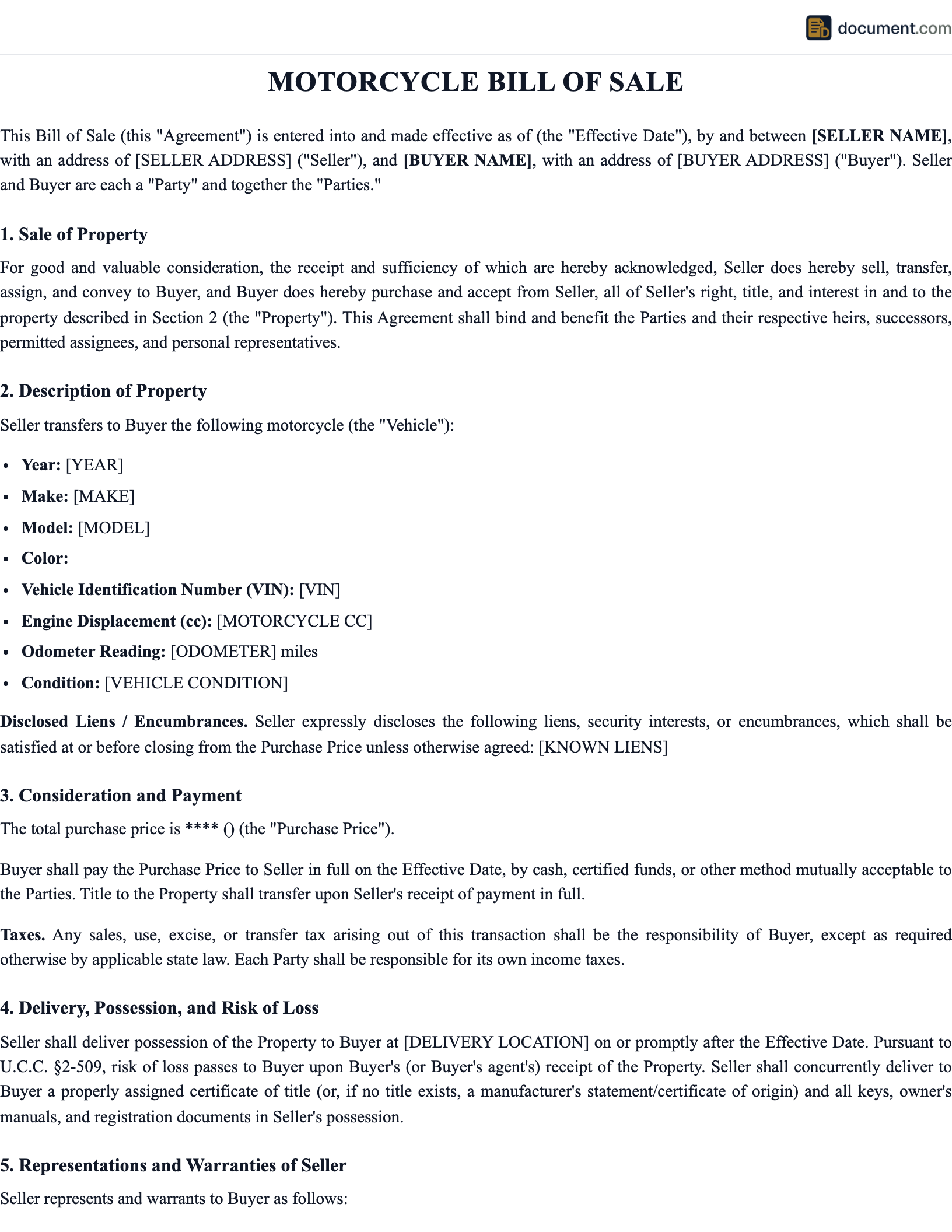
Below is a preview of our motorcycle bill of sale template. Your customized document will include all fields required by your state's DMV, plus motorcycle-specific details like engine number and CC displacement.
MOTORCYCLE BILL OF SALE
Private Party Motorcycle Transfer Document
This Motorcycle Bill of Sale is entered into on[Date]between:
SELLER:
Name: [Seller Name]
Address: [Seller Address]
BUYER:
Name: [Buyer Name]
Address: [Buyer Address]
1. MOTORCYCLE DESCRIPTION
Year: [Year] Make: [Make] Model: [Model]
VIN: [17-digit VIN]
Engine Number: [Engine #]
Engine CC: [CC] Type: [Motorcycle Type]
Color: [Color]
Odometer: [Miles] miles
2. SALE PRICE
Sale Price: $[Amount]
Payment Method: [Method]
3. CONDITION
This motorcycle is sold "AS-IS" with no warranties...
Motorcycle Bill of Sale FAQ
Answers to common questions about motorcycle bills of sale, title transfers, and DMV requirements.
Create your Motorcycle Bill of Sale in under 10 minutes.
Answer a few questions and download a compliant, attorney-drafted document ready for your state.