
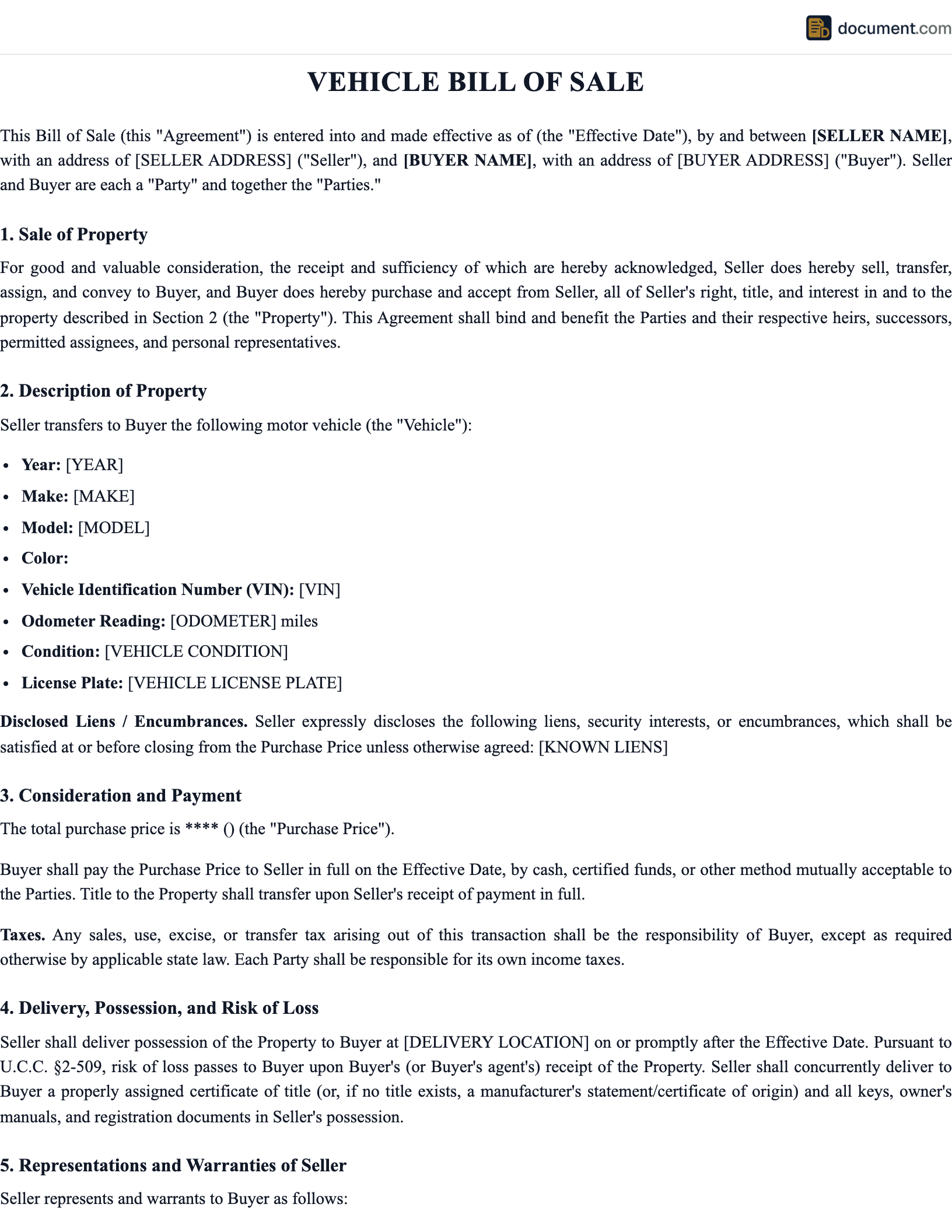



What Is a Vehicle Bill of Sale?
A vehicle bill of sale is a legal document that records the sale and transfer of a motor vehicle from one party to another. It serves as proof of purchase and is typically required by the Department of Motor Vehicles (DMV) to complete a title transfer and register the vehicle in the new owner's name.
Unlike a general bill of sale, a vehicle bill of sale includes specific automotive information such as the Vehicle Identification Number (VIN), odometer reading, and vehicle condition. Federal law requires an odometer disclosure statement for all motor vehicle sales, making this one of the most regulated types of bills of sale.
Whether you're selling a used car, buying a truck from a private seller, or transferring ownership of a family vehicle, a properly completed vehicle bill of sale protects both parties and streamlines the DMV registration process. Many states provide their own bill of sale forms, and some require specific state forms to be used.
DMV Required
Required in most states for title transfer and registration
Odometer Disclosure
Federal law requires mileage reporting on all vehicle sales
Liability Protection
Protects sellers from tickets and accidents after the sale
Vehicle Bill of Sale by State
Each state has different requirements for vehicle bills of sale. Some states provide mandatory forms, others accept any format with required information, and a few states require notarization. Select your state below for a template that meets your DMV's specific requirements.
How to Write a Vehicle Bill of Sale
A vehicle bill of sale must contain specific information to be accepted by the DMV and hold up legally. Follow these steps to ensure your document is complete and compliant.
Record Buyer and Seller Information
Include the full legal names, current mailing addresses, and phone numbers of both the buyer and seller. Some states also require driver's license numbers. If the vehicle has multiple owners listed on the title, all owners must sign the bill of sale.
Identify the Vehicle
Provide the year, make, model, body style, color, and Vehicle Identification Number (VIN). The VIN is a unique 17-character code found on the dashboard, door jamb, and title. Always verify the VIN on the physical vehicle matches the title. Include the license plate number and engine number if required by your state.
Complete the Odometer Disclosure
Federal law requires the seller to disclose the odometer reading at the time of sale. You must indicate whether the mileage is accurate, whether the odometer has exceeded its mechanical limits, or whether the reading is not the actual mileage (e.g., if the odometer was replaced). Vehicles with a gross weight over 16,000 lbs or that are 20+ years old may be exempt in some states.
Document the Sale Price and Payment
State the agreed purchase price in both numerals and written form. Note the payment method — cash, cashier's check, bank transfer, or financing. If the vehicle is a gift, write "$0 — Gift" as the sale price. The stated price determines the sales tax the buyer will owe at registration. Understating the price to reduce taxes is illegal.
State the Condition and Warranty Terms
Most private vehicle sales are "as-is," meaning the buyer accepts the vehicle in its current condition with no warranty. If known issues exist (engine problems, body damage, check engine light), disclose them. Sellers should confirm the vehicle is free of liens and that they have full authority to sell it. If there's an existing loan, explain how it will be paid off.
Sign, Date, and Notarize If Required
Both buyer and seller must sign and date the bill of sale. Print two copies — one for each party. Check your state's notarization requirements. The buyer should also receive the signed vehicle title, a release of liability form, and any maintenance records. The seller should file a notice of transfer with the DMV to protect against future liability.
Key Components of a Vehicle Bill of Sale
A vehicle bill of sale must include specific information that the DMV and courts expect. Missing any of these elements could delay your title transfer or leave you unprotected.
| Component | Description |
|---|---|
| Buyer & Seller Names | Full legal names and addresses of both parties |
| Vehicle Year, Make, Model | E.g., 2020 Toyota Camry SE, Silver |
| VIN | 17-character Vehicle Identification Number |
| Odometer Reading | Current mileage with accuracy statement (federal requirement) |
| Sale Price | Amount in numbers and words, payment method |
| Date of Sale | Exact date the transaction occurs |
| As-Is / Warranty | Condition statement and any warranty terms |
| Lien Statement | Seller confirms the vehicle is free of liens and encumbrances |
| Signatures | Dated signatures of buyer and seller (and notary if required) |
DMV Requirements by State
After completing your vehicle bill of sale, you'll need to complete the title transfer at your local DMV. Here's what the buyer typically needs to bring:
Seller Reminder: File a Release of Liability
After selling your vehicle, immediately file a release of liability (also called a notice of transfer or notice of sale) with your state's DMV. This protects you from parking tickets, toll violations, and accidents that occur after the sale. Many states allow you to file online.
- Signed Bill of Sale: Both parties' signatures, notarized if required by your state
- Signed Title: The seller signs the back of the title to transfer ownership
- Odometer Disclosure: Federal requirement for all motor vehicle sales
- Smog/Emissions Certificate: Required in California, Arizona, and several other states
- Proof of Insurance: Must have insurance before registering in most states
- Registration Fee + Sales Tax: Varies by state, based on the sale price in the bill of sale
Vehicle Types Covered
Our vehicle bill of sale templates work for all types of motor vehicles:
Car / Sedan
Standard passenger vehicles including sedans, coupes, hatchbacks, and convertibles
Truck / Pickup
Pickup trucks, box trucks, and commercial trucks
SUV / Crossover
Sport utility vehicles and crossover models
Van / Minivan
Passenger vans, minivans, and cargo vans
Motorcycle
Street bikes, cruisers, sport bikes — see also our dedicated motorcycle bill of sale
RV / Camper
Recreational vehicles, motorhomes, and camper vans
Classic / Antique
Vehicles over 25 years old that may qualify for special registration
Salvage Title Vehicle
Vehicles with rebuilt or salvage titles — additional disclosures required
Sample Vehicle Bill of Sale
Below is a preview of our vehicle bill of sale template. Your customized document will include all fields required by your state's DMV.
VEHICLE BILL OF SALE
Motor Vehicle Transfer Document
This Vehicle Bill of Sale is entered into on[Date]between:
SELLER:
Name: [Seller Name]
Address: [Seller Address]
BUYER:
Name: [Buyer Name]
Address: [Buyer Address]
1. VEHICLE DESCRIPTION
Year: [Year] Make: [Make] Model: [Model]
VIN: [VIN]
Color: [Color]
2. ODOMETER DISCLOSURE
Current mileage: [Miles]
☐ Actual mileage ☐ Exceeds mechanical limits ☐ Not actual mileage
3. SALE PRICE
$[Amount]([Amount in Words] Dollars)
Frequently Asked Questions
Find answers to common questions about vehicle bills of sale, title transfers, and DMV requirements.
Create your Vehicle Bill of Sale in under 5 minutes.
Select your state, answer a few questions, and download a DMV-ready document with federal odometer disclosure built in.