



What Is a Boat Bill of Sale?
A boat bill of sale is a legal document that records the sale and transfer of a watercraft from one party to another. It serves as proof of purchase and is typically required by state wildlife, marine, or natural resources agencies to complete a title transfer and register the vessel in the new owner's name.
Unlike a general bill of sale, a boat bill of sale includes specific maritime information such as the Hull Identification Number (HIN), engine specifications, hull material, vessel length, and propulsion type. The HIN is the watercraft equivalent of a car's VIN — a unique 12-character code that identifies the manufacturer, serial number, and production date of every boat built after 1972.
Whether you're selling a fishing boat, buying a jet ski from a private seller, or transferring ownership of a sailboat, a properly completed boat bill of sale protects both parties and streamlines the registration process. Boats over a certain size may also qualify for U.S. Coast Guard documentation, which is a federal alternative to state registration.
State Registration
Required in all 50 states for motorized watercraft
HIN Verification
12-character hull identification on every manufactured boat
Liability Protection
Protects sellers from accidents and liability after the sale
Boat Bill of Sale by State
Each state has different requirements for boat bills of sale. Most states require registration through a wildlife, natural resources, or marine agency rather than the DMV. Some states require titles for all motorized boats, while others only title boats above a certain length or horsepower. Select your state below for a template that meets your specific requirements.
How to Write a Boat Bill of Sale
A boat bill of sale must contain specific information to be accepted by your state's registration agency and hold up legally. Follow these steps to ensure your document is complete and compliant.
Record Buyer and Seller Information
Include the full legal names, current mailing addresses, and phone numbers of both buyer and seller. If the boat title lists multiple owners, all owners must sign the bill of sale. Some states also require driver's license numbers.
Identify the Watercraft
Provide the vessel's year, make, model, overall length, hull material (fiberglass, aluminum, wood, inflatable), hull type (open, cabin, pontoon), and the Hull Identification Number (HIN). The HIN is a 12-character code found on the starboard side of the transom. Always verify the HIN on the boat matches the title. Include the current registration number if applicable.
Record Engine and Propulsion Details
Document the engine make, model, horsepower, fuel type (gasoline, diesel, electric), and serial number. Indicate whether it is an inboard, outboard, or sterndrive (I/O) engine. If the boat has multiple engines, list each one separately. For sailboats, note whether an auxiliary motor is included and its specifications.
Document the Sale Price and Payment
State the agreed purchase price in both numerals and written form. Note the payment method — cash, cashier's check, bank transfer, or financing. If the boat includes a trailer, specify whether the trailer price is included or separate. The stated price determines the sales tax the buyer will owe at registration. If the boat is a gift, write "$0 — Gift."
State the Condition and Warranty Terms
Most private boat sales are "as-is," meaning the buyer accepts the vessel in its current condition. Disclose any known defects — hull damage, engine issues, water intrusion, or electrical problems. Confirm the vessel is free of liens and that the seller has full authority to sell it.
Sign, Date, and Notarize If Required
Both buyer and seller must sign and date the bill of sale. Print two copies — one for each party. Check your state's notarization requirements. The buyer should also receive the signed boat title, registration card, and any maintenance or survey records. Register the vessel promptly with your state's marine or wildlife agency.
Key Components of a Boat Bill of Sale
A boat bill of sale must include specific information that state agencies and courts expect. Missing any of these elements could delay your registration or leave you unprotected.
| Component | Description |
|---|---|
| Buyer & Seller Names | Full legal names and addresses of both parties |
| Vessel Year, Make, Model | E.g., 2021 Boston Whaler 230 Outrage |
| Hull Identification Number (HIN) | 12-character code from the transom |
| Vessel Length & Hull Material | Overall length, fiberglass/aluminum/wood/inflatable |
| Engine Details | Make, HP, fuel type, serial number, inboard/outboard |
| Sale Price | Amount in numbers and words, payment method |
| Date of Sale | Exact date the transaction occurs |
| As-Is / Warranty | Condition disclosure and any warranty terms |
| Lien Statement | Seller confirms the vessel is free of liens |
| Signatures | Dated signatures of buyer and seller (notary if required) |
Boat Registration Requirements
After completing your boat bill of sale, you'll need to register the vessel with your state's wildlife, marine, or natural resources agency. Here's what the buyer typically needs:
Seller Reminder: Notify Your State Agency
After selling your boat, notify your state's registration agency of the sale. This protects you from liability for accidents, environmental violations, or fees that may occur after the transfer. Many states allow you to file a notice of transfer online.
- Signed Bill of Sale: Both parties' signatures, notarized if required by your state
- Signed Title: The seller signs the title to transfer ownership of the vessel
- HIN Verification: The hull identification number must match on the boat, title, and bill of sale
- Proof of Insurance: Some states require liability insurance before registration
- Registration Fee + Sales Tax: Varies by state and vessel size
- Invasive Species Decal: Required in many states for aquatic invasive species prevention
Boat Types Covered
Our boat bill of sale templates work for all types of watercraft:
Sailboat
Sailing vessels including daysailers, cruising sailboats, catamarans, and racing yachts
Motorboat / Powerboat
Center consoles, bowriders, cabin cruisers, and sport boats with inboard or outboard motors
Jet Ski / PWC
Personal watercraft including jet skis, WaveRunners, and Sea-Doos
Pontoon Boat
Flat-deck pontoon and tritoon boats for leisurely cruising and entertaining
Fishing Boat
Bass boats, flats boats, bay boats, and offshore fishing vessels
Kayak / Canoe
Human-powered paddlecraft — generally exempt from titling but may need registration with a motor
Yacht
Large recreational vessels typically over 40 feet, often requiring Coast Guard documentation
Houseboat
Residential and recreational floating homes with living quarters and propulsion
Official Boating Resources
Use these official federal and industry resources to verify requirements, check vessel history, and access important boating information.
Sample Boat Bill of Sale
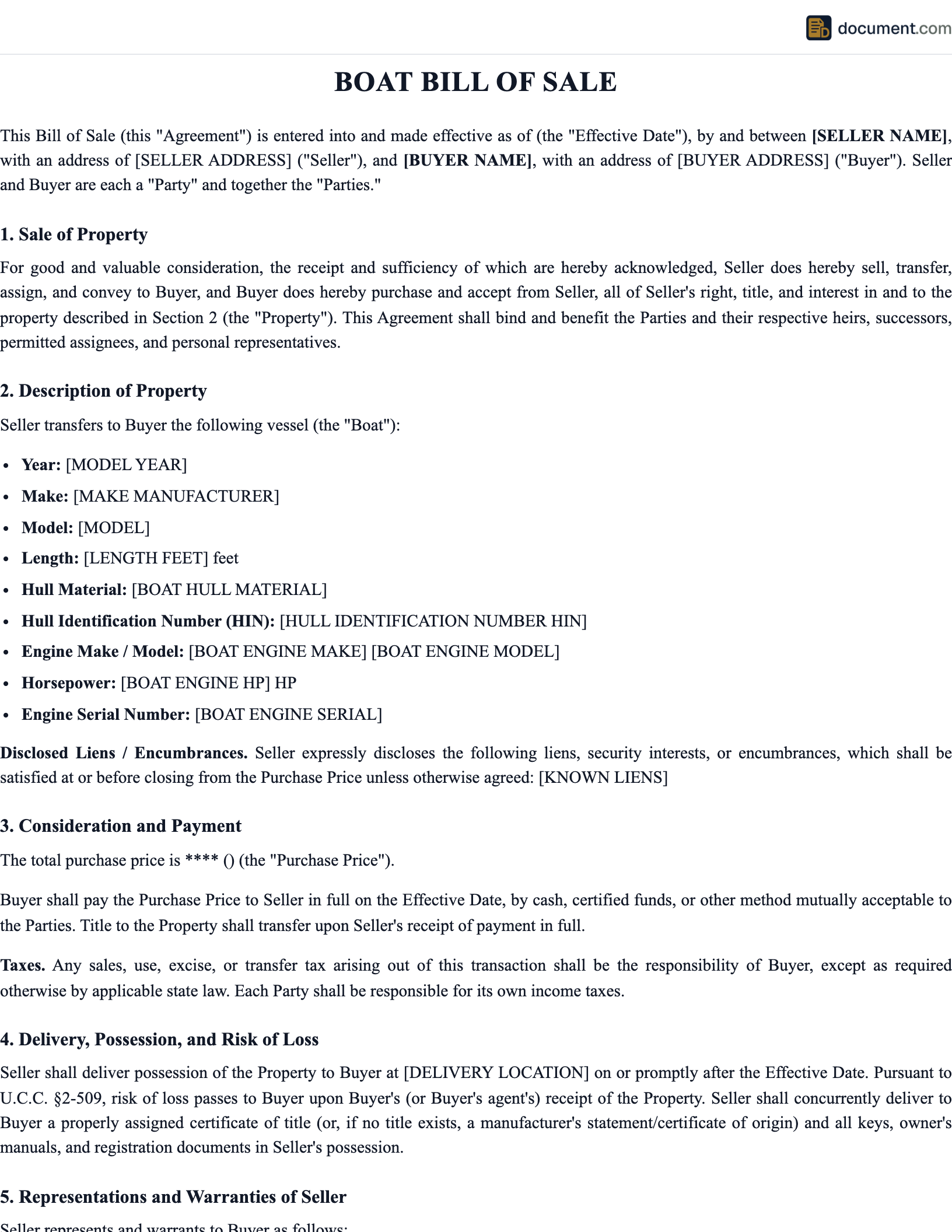
Below is a preview of our boat bill of sale template. Your customized document will include all fields required by your state's registration agency.
BOAT / WATERCRAFT BILL OF SALE
Vessel Transfer Document
This Boat Bill of Sale is entered into on[Date]between:
SELLER:
Name: [Seller Name]
Address: [Seller Address]
BUYER:
Name: [Buyer Name]
Address: [Buyer Address]
1. VESSEL DESCRIPTION
Year: [Year] Make: [Make] Model: [Model]
HIN: [HIN]
Length: [Length] ft Hull: [Material]
2. ENGINE INFORMATION
Engine Make: [Make] HP: [HP]
Serial #: [Serial]
3. SALE PRICE
$[Amount]([Amount in Words] Dollars)
Frequently Asked Questions
Find answers to common questions about boat bills of sale, vessel registration, and title transfers.
Create your Boat Bill of Sale in under 10 minutes.
Answer a few questions and download a compliant, attorney-drafted document ready for your state.