



What Is a Trailer Bill of Sale?
A trailer bill of sale is a legal document that records the sale and transfer of a trailer from one party to another. It serves as proof of purchase and is typically required by the Department of Motor Vehicles (DMV) to complete a title transfer and register the trailer in the new owner's name.
Unlike a vehicle bill of sale, a trailer bill of sale does not require an odometer disclosure (trailers do not have odometers). Instead, it focuses on trailer-specific details such as the VIN or serial number, Gross Vehicle Weight Rating (GVWR), trailer type, number of axles, hitch type, and overall dimensions. Many states have weight-based thresholds that determine whether a trailer must be titled, making GVWR one of the most important fields.
Whether you're selling a utility trailer, buying an enclosed cargo trailer, trading a travel trailer, or transferring a flatbed between family members, a properly completed trailer bill of sale protects both parties and streamlines the registration process at the DMV.
DMV Required
Required in most states for title transfer and trailer registration
GVWR Documentation
Weight rating determines titling requirements in many states
Liability Protection
Protects sellers from liability and disputes after the sale
Trailer Bill of Sale by State
Each state has different requirements for trailer bills of sale. Some states require titling only above certain weight thresholds, others require titles for all trailers, and a few states do not title trailers at all. Select your state below for a template that meets your DMV's specific requirements.
How to Write a Trailer Bill of Sale
A trailer bill of sale must contain specific information to be accepted by the DMV and hold up legally. Follow these steps to ensure your document is complete and compliant.
Record Buyer and Seller Information
Include the full legal names, current mailing addresses, and phone numbers of both the buyer and seller. Some states also require driver's license numbers. If the trailer has multiple owners listed on the title, all owners must sign the bill of sale.
Identify the Trailer
Provide the year, make, model, and color. Record the VIN or serial number from the trailer's identification plate (usually on the tongue or frame). Include the trailer type (utility, enclosed, travel, flatbed, etc.), overall length, number of axles, and hitch type (bumper pull, gooseneck, fifth wheel, or pintle). For homemade trailers, note this and include any assigned VIN.
Record the GVWR (Gross Vehicle Weight Rating)
The GVWR is the maximum weight the trailer can safely carry including its own weight and cargo. This number is found on the trailer's VIN plate or manufacturer's label. The GVWR is critical because many states only require titling for trailers above a certain weight threshold (e.g., 1,000 lbs, 2,000 lbs, or 3,000 lbs depending on the state).
Document the Sale Price and Payment
State the agreed purchase price in both numerals and written form. Note the payment method — cash, cashier's check, bank transfer, or financing. If the trailer is a gift, write "$0 — Gift" as the sale price. The stated price determines the sales tax the buyer will owe at registration. Understating the price to reduce taxes is illegal.
State the Condition and Warranty Terms
Most private trailer sales are "as-is," meaning the buyer accepts the trailer in its current condition with no warranty. If known issues exist (frame damage, rust, wiring problems, tire wear, brake issues), disclose them. Confirm the trailer is free of liens and that the seller has full authority to sell it.
Sign, Date, and Notarize If Required
Both buyer and seller must sign and date the bill of sale. Print two copies — one for each party. Check your state's notarization requirements. The buyer should also receive the signed trailer title (if applicable), a lien release (if there was a loan), and any maintenance records. The seller should keep a copy of the bill of sale for their records.
Key Components of a Trailer Bill of Sale
A trailer bill of sale must include specific information that the DMV and courts expect. Missing any of these elements could delay your title transfer or leave you unprotected.
| Component | Description |
|---|---|
| Buyer & Seller Names | Full legal names and addresses of both parties |
| Trailer Year, Make, Model | E.g., 2022 Big Tex 70PI, 16-foot utility |
| VIN / Serial Number | 17-character VIN or manufacturer serial number from the frame plate |
| GVWR | Gross Vehicle Weight Rating — determines titling requirements |
| Trailer Type | Utility, enclosed cargo, travel/RV, flatbed, boat, horse, dump, car hauler |
| Dimensions & Axles | Overall length, width, number of axles, hitch type |
| Sale Price | Amount in numbers and words, payment method |
| Date of Sale | Exact date the transaction occurs |
| As-Is / Warranty | Condition statement and any warranty terms |
| Lien Statement | Seller confirms the trailer is free of liens and encumbrances |
| Signatures | Dated signatures of buyer and seller (and notary if required) |
Trailer Types Covered
Our trailer bill of sale templates work for all types of trailers:
Utility Trailer
Open-deck trailers for landscaping, construction materials, and general hauling
Enclosed Cargo Trailer
Fully enclosed trailers for moving, tool storage, and weather-protected transport
Travel / RV Trailer
Travel trailers, fifth wheels, pop-up campers, and recreational towables
Flatbed Trailer
Flat-deck trailers for heavy equipment, lumber, and oversized loads
Boat Trailer
Purpose-built trailers for transporting boats, jet skis, and watercraft
Horse Trailer
Livestock trailers designed for horses, cattle, and other animals
Dump Trailer
Hydraulic-lift trailers for gravel, dirt, demolition debris, and bulk materials
Car Hauler
Open or enclosed trailers for transporting vehicles, race cars, and equipment
Trailer Titling & Registration Requirements
After completing your trailer bill of sale, you'll need to title and/or register the trailer at your local DMV. Requirements vary significantly by state:
Important: Weight Thresholds Vary by State
Many states only require trailer titles above a certain GVWR. For example, Indiana exempts trailers under 3,000 lbs, while Michigan's threshold is 2,500 lbs. Some states like California and Texas title all trailers regardless of weight. Always check your state's specific threshold before completing a trailer sale.
- Signed Bill of Sale: Both parties' signatures, notarized if required by your state
- Signed Title: If the trailer was previously titled, the seller signs it over to the buyer
- MCO (for new trailers): Manufacturer's Certificate of Origin if purchased from a dealer
- VIN Inspection: May be required for out-of-state trailers or homemade trailers
- Valid Photo ID: Driver's license or state-issued identification
- Registration Fee + Sales Tax: Varies by state, based on the sale price in the bill of sale
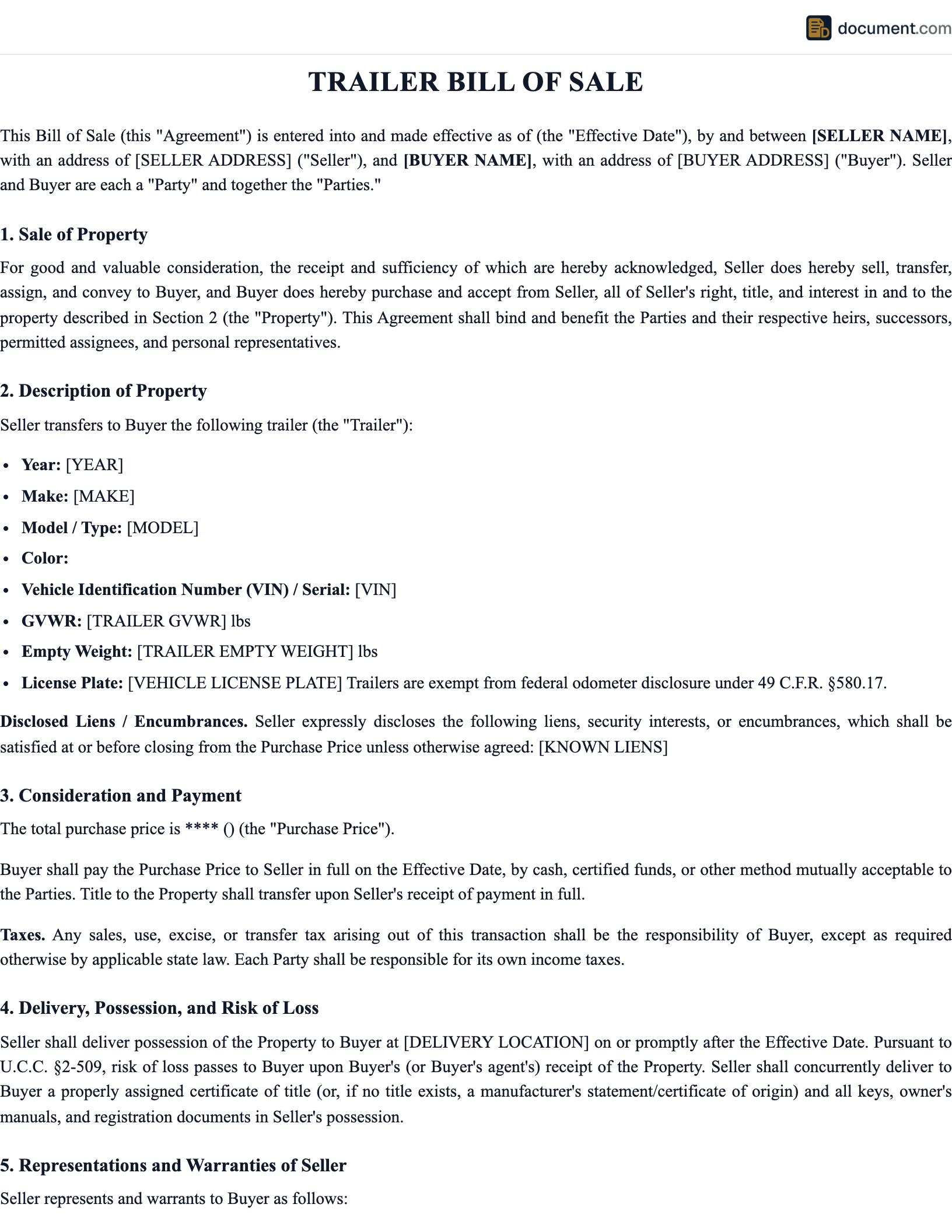
Sample Trailer Bill of Sale
Below is a preview of our trailer bill of sale template. Your customized document will include all fields required by your state's DMV.
TRAILER BILL OF SALE
Trailer Transfer Document
This Trailer Bill of Sale is entered into on[Date]between:
SELLER:
Name: [Seller Name]
Address: [Seller Address]
BUYER:
Name: [Buyer Name]
Address: [Buyer Address]
1. TRAILER DESCRIPTION
Year: [Year] Make: [Make] Model: [Model]
VIN/Serial #: [VIN]
Trailer Type: [Type] Color: [Color]
2. SPECIFICATIONS
GVWR: [Weight] lbs Length: [Length] ft
Axles: [#] Hitch Type: [Hitch]
3. SALE PRICE
$[Amount]([Amount in Words] Dollars)
Frequently Asked Questions
Find answers to common questions about trailer bills of sale, titling, registration, and DMV requirements.
Create your Trailer Bill of Sale in under 10 minutes.
Answer a few questions and download a compliant, attorney-drafted document ready for your state.