



California Vehicle Bill of Sale Overview
California is the largest vehicle market in the United States, and its DMV handles millions of title transfers every year. While the California Department of Motor Vehicles primarily relies on the signed title (pink slip) and REG 262 form for transfers, a bill of sale is a crucial supplementary document that records the sale price, vehicle condition, and terms agreed upon by both parties.
What sets California apart from most states is its statewide smog check requirement. The seller must provide a valid smog certificate at the time of sale — and the smog check must have been completed within the preceding 90 days. This rule applies to virtually all gasoline-powered vehicles, though diesels from 1997 and older, electric cars, and vehicles four model years old or newer are exempt. If you're selling in an enhanced testing area (most urban counties), the smog check must be performed at a STAR-certified station.
California also has one of the shortest transfer deadlines at just 10 days, combined with sales tax rates that can exceed 10% in parts of Los Angeles, the Bay Area, and other metropolitan regions. Between the smog requirement, the tight transfer window, and the high tax burden, thorough documentation is more important here than in almost any other state. Our California-specific template covers all of these nuances.
7.25%
State sales tax
10 Days
Transfer deadline
No
Notarization required
Yes
Smog check required
California DMV Requirements
The California DMV processes title transfers at its field offices throughout the state. With the 10-day deadline, it's worth scheduling an appointment online at dmv.ca.gov as soon as you complete the sale — walk-in wait times can be long.
Important: California's 10-Day Transfer Rule
California law requires the buyer to apply for a title transfer within 10 calendar days of the purchase date. This is one of the shortest windows in the country. Late penalties start at $30 and increase over time. Book your DMV appointment immediately after buying the vehicle — the date on your bill of sale starts the clock.
What the Seller Must Provide
- Signed Title (Pink Slip): Sign the title on the designated line, fill in the buyer's name, sale date, sale price, and odometer reading
- Valid Smog Certificate: The seller must provide a smog certificate dated within 90 days of the sale. The seller pays for the smog check
- Bill of Sale: A completed bill of sale documenting the purchase price, vehicle details, and signatures of both parties
- Odometer Disclosure: Federal requirement — record the mileage on the title or a separate disclosure form
- Release of Liability (REG 138): The seller should file this with the DMV within 5 days of the sale to avoid future liability
What the Buyer Must Bring to the DMV
- Signed Title: With the seller's signature and all transfer fields completed
- Smog Certificate: Valid within 90 days (unless the vehicle is exempt)
- REG 262 Form: Vehicle/Vessel Transfer and Reassignment Form (if needed for additional space)
- Bill of Sale: Documenting the sale price and terms
- Valid Photo ID: California driver's license or state ID
- Proof of Insurance: California minimum liability coverage ($15,000/$30,000/$5,000)
- Payment: Title fee ($23), registration (varies by vehicle value), and use tax (7.25% state + local)
How to Fill Out a California Vehicle Bill of Sale
California has more paperwork requirements than most states for vehicle transfers. Here's how to complete the bill of sale portion accurately.
Enter Seller Information
Provide the seller's full legal name exactly as it appears on the California title (pink slip), along with their current address and phone number. If multiple people are listed on the title, check whether they are joined by "and" (both must sign) or "or" (either can sign alone). California titles often list registered owners and legal owners separately — the registered owner is the one who signs the title for transfer.
Enter Buyer Information
Record the buyer's full legal name and California address. The county where the buyer registers the vehicle determines the local tax rate added to the 7.25% base. Registering in San Francisco means different local rates than registering in San Diego or Sacramento. The DMV calculates the exact amount based on the buyer's address.
Describe the Vehicle
Enter the year, make, model, body type, and color. Record the full 17-character VIN from the dashboard or driver's door jamb. Verify it matches the title and the vehicle identification number plate on the car. You can use the NHTSA VIN Decoder to confirm the vehicle specs. Also note the license plate number if the seller's plates are still on the vehicle.
Record the Odometer Reading
Document the current mileage and indicate whether the reading is accurate, has exceeded mechanical limits, or is not the actual mileage. This federal odometer disclosure is required on the title for vehicles less than 20 model years old with a GVWR under 16,000 lbs. Given California's large used car market, odometer fraud is something to watch for — verify the mileage against maintenance records when possible.
State the Sale Price
Write the agreed purchase price in both numbers and words. California's DMV uses this figure to calculate the use tax owed. With combined rates as high as 10.75% in some areas, the tax on a $20,000 vehicle could exceed $2,000. For gift transfers between eligible family members, write "$0 — Gift" and complete a REG 256 (Statement of Facts) to claim the tax exemption.
Sign and Date
Both the buyer and seller sign and date the bill of sale. California does not require notarization for private party vehicle sales, so signatures alone are sufficient. Print two copies — one for each party. The buyer should visit the DMV within 10 days to avoid late fees. The seller should file a Notice of Transfer and Release of Liability (REG 138) online at dmv.ca.gov within 5 days of the sale.
California Title Transfer Process
California's transfer process has more moving parts than most states because of the smog certification requirement and the various DMV forms involved. Here's the step-by-step flow.
Seller Obtains Smog Certificate
Seller pays for and obtains a smog check certificate within 90 days of the sale (unless exempt)
Complete the Sale
Sign the pink slip, complete the bill of sale, exchange the smog certificate, payment, and keys
Seller Files Release of Liability
Seller submits REG 138 online at dmv.ca.gov within 5 days to avoid future liability for the vehicle
Buyer Gets Insurance
Obtain California minimum liability insurance ($15,000/$30,000/$5,000) before visiting the DMV
Buyer Visits the DMV Within 10 Days
Bring signed title, smog certificate, bill of sale, ID, insurance, and payment for fees and use tax
California Vehicle Sales Tax & Fees
California's vehicle costs are among the highest in the nation. The 7.25% base state rate is just the floor — local district taxes bring the effective rate to 8-10% or more in most metro areas. Registration fees also factor in the vehicle's value.
| Fee / Tax | Amount |
|---|---|
| State Use Tax | 7.25% of sale price (base rate) |
| Local District Tax | 0-3.5% additional (total 7.25-10.75%) |
| Title Transfer Fee | $23 |
| Base Registration Fee | $72 |
| Vehicle License Fee (VLF) | 0.65% of vehicle's depreciated value |
| Transportation Improvement Fee | $25 - $175 (based on market value) |
| Smog Check | $30 - $80 (paid by seller) |
| Smog Abatement Fee | $25 (for smog-exempt vehicles under 4 years old) |
| Late Transfer Penalty | $30+ (after 10 days, increases over time) |
Sample California Vehicle Bill of Sale
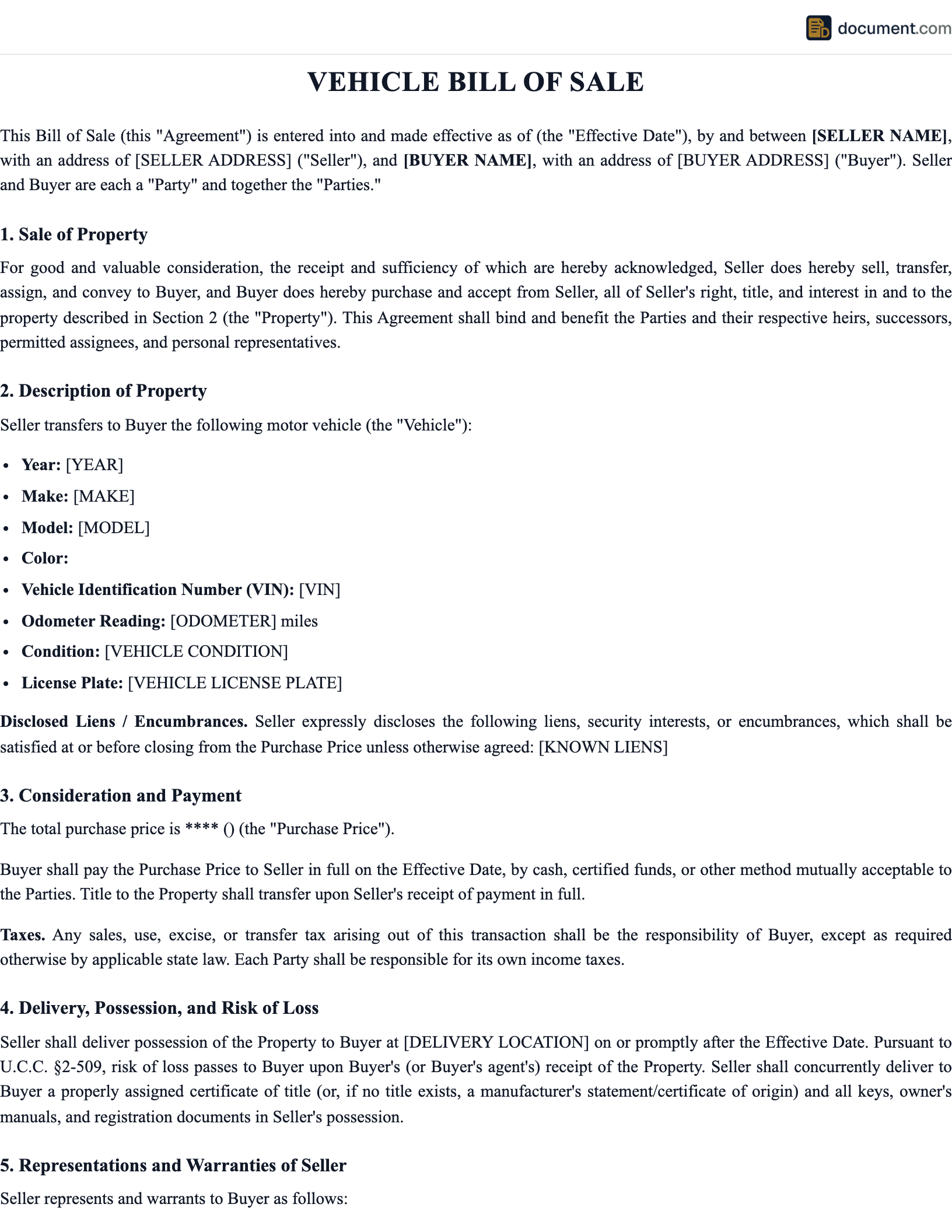
Here's a preview of our California-specific vehicle bill of sale. The completed document includes all details the CA DMV expects for a private party transfer.
STATE OF CALIFORNIA
VEHICLE BILL OF SALE
Private Party Motor Vehicle Transfer
SELLER:
Name: [Seller Name]
Address: [California Address]
County: [County]
BUYER:
Name: [Buyer Name]
Address: [California Address]
County: [County]
VEHICLE INFORMATION
Year: [Year] Make: [Make] Model: [Model]
VIN: [17-digit VIN]
Odometer: [Miles] miles
Sale Price: $[Amount]
Smog Certificate: [Date of Smog Check]
California Vehicle Bill of Sale FAQ
Answers to common questions about California's smog requirements, DMV transfer process, use tax, and title transfer procedures.
Official California Resources
Use these official state and federal resources to schedule DMV appointments, look up smog stations, and verify California-specific requirements.
California Department of Motor Vehicles
Title transfers, appointments, forms, and fee calculators
California Title Transfer Guide
Official step-by-step instructions, required forms, and fees
NHTSA — Odometer Fraud Prevention
Federal odometer disclosure requirements and fraud reporting
NICB VINCheck — Free Vehicle History
Check if a vehicle has been reported stolen or salvaged
NHTSA VIN Decoder
Decode any VIN to verify year, make, model, and specifications
IRS — Vehicle Sale Tax Reporting
Federal tax implications of selling a vehicle
Other California Bill of Sale Templates
Need a bill of sale for something other than a car in California? We offer templates for every type of property transfer in the Golden State.
California Boat Bill of Sale
Boats, jet skis, and watercraft
California Motorcycle Bill of Sale
Motorcycles, scooters, and mopeds
California Trailer Bill of Sale
Utility, travel, and cargo trailers
California Firearm Bill of Sale
Handguns, rifles, and shotguns
California General Bill of Sale
Furniture, electronics, and personal property
California ATV Bill of Sale
ATVs, UTVs, and off-road vehicles
California Horse Bill of Sale
Horses, cattle, and livestock
California Mobile Home Bill of Sale
Manufactured and mobile homes
Create your California vehicle bill of sale in minutes.
Answer a few questions and download your CA DMV-compliant document. Covers smog certification, odometer disclosure, and the 10-day transfer deadline — the form the Golden State expects.