
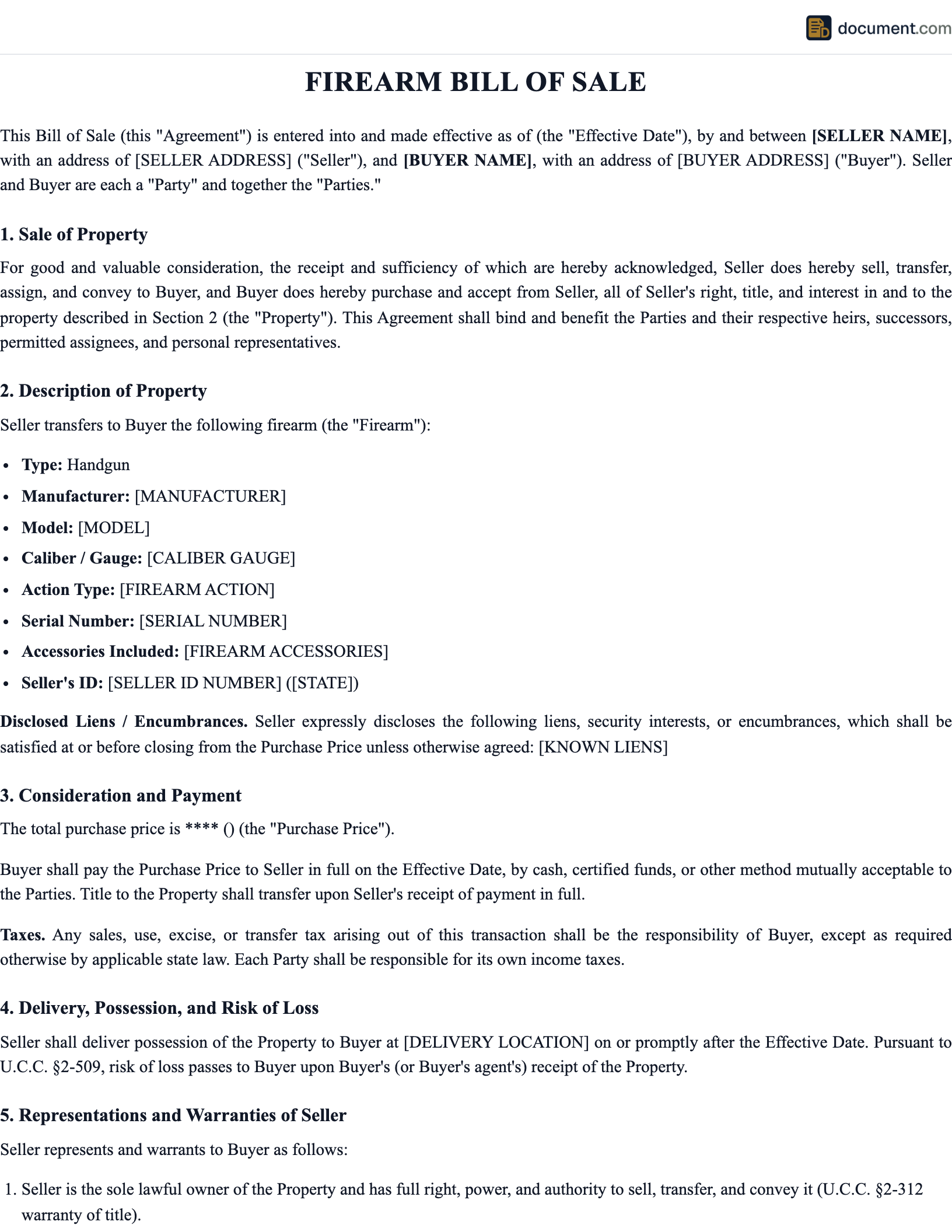



California Firearm Bill of Sale Overview
California has the strictest firearm laws in the nation. All firearm transfers — including private sales, gifts, and loans lasting more than 30 days — must be conducted through a licensed dealer (FFL). Both parties must appear at the dealer, the buyer must pass a background check, and there is a mandatory 10-day waiting period before the buyer can take possession.
California requires all firearm buyers to possess a valid Firearm Safety Certificate (FSC), obtained by passing a written test at a licensed dealer for $25. All firearms are registered with the California Department of Justice (DOJ) at the time of transfer. California also maintains a roster of handguns certified for sale — only handguns on this roster can be sold by dealers (though private party transfers of off-roster handguns are legal).
California bans the sale and possession of assault weapons (as defined by California Penal Code 30510-30530), .50 BMG caliber rifles, magazines holding more than 10 rounds, and has strict regulations on suppressors (generally prohibited). The state also has a one-handgun-per-30-day purchase limit and requires reporting of lost or stolen firearms within 5 days.
Yes
Private sale BG check
10 days
Waiting period
Yes
Registration required
Yes
Permit to purchase
California Firearm Transfer Requirements
California's firearm transfer laws are the most comprehensive in the nation. All private sales must go through an FFL:
Important: ALL Transfers Through an FFL
In California, there is no such thing as a purely private firearm sale. Every transfer — sales, gifts, and loans over 30 days — must go through a licensed dealer who will process the background check, register the firearm with the CA DOJ, and hold it for the 10-day waiting period. Violating this requirement is a misdemeanor.
Seller Requirements
- FFL Transfer Required: All sales must go through a licensed dealer — no exceptions for private party transfers
- Both Parties Present: Both buyer and seller must appear at the FFL with valid ID
- DROS Form: The dealer will complete a Dealer's Record of Sale (DROS) form with the CA DOJ
- 10-Day Waiting Period: The firearm cannot be released to the buyer until 10 days after the DROS is submitted
Buyer Requirements
- Firearm Safety Certificate: Must possess a valid FSC ($25, obtained by passing a written test at an FFL)
- Background Check: Must pass a background check through the CA DOJ
- Proof of Residency: Must provide proof of California residency (utility bill, rental agreement, etc.)
- Valid ID: Must present a valid California driver's license or ID card
- Safe Storage Demonstration: Must demonstrate safe handling and possession of a DOJ-approved firearm safety device
How to Fill Out a California Firearm Bill of Sale
Follow these steps to properly complete your California firearm bill of sale. Our template guides you through each field to ensure compliance with California and federal requirements.
Enter Seller Information
Include the seller's full legal name, current California mailing address, date of birth, and government-issued ID number (driver's license or state ID). This information is critical for establishing a clear chain of custody for the firearm.
Enter Buyer Information
Include the buyer's full legal name, current California address, date of birth, and ID number. Verify the buyer's ID is valid and current. Confirm the buyer is a California resident — selling to an out-of-state resident in a private sale is a federal crime.
Describe the Firearm
Record the firearm's make (manufacturer), model, serial number, caliber or gauge, type (handgun, rifle, shotgun), barrel length, and finish/color. The serial number is the most important identifier — verify it matches the physical firearm exactly.
State the Sale Price
Enter the agreed purchase price in both numbers and words. Note the payment method. If the firearm is a gift, write "$0 — Gift." If a trade, describe the items exchanged.
Include Eligibility Statement
The buyer should sign a statement affirming they are legally eligible to purchase and possess firearms under both federal and California law, that they are not a prohibited person, and that they are a resident of California.
Sign, Date, and Keep Copies
Both parties must sign and date the bill of sale. Print at least two copies — one for each party. Keep your copy indefinitely as there is no statute of limitations on ATF firearm traces. Remember that the transfer must also be processed through an FFL with a background check.
California Firearm Transfer Process
California requires private firearm transfers to include a background check. Here's the step-by-step process:
Verify Both Parties' Eligibility
Check IDs to confirm both parties are California residents and of legal age. The seller should have no reason to believe the buyer is a prohibited person.
Visit a Licensed Dealer (FFL)
Both parties must appear at an FFL. The dealer will process the background check as required by California law.
Complete Background Check
The FFL will run a background check. There is a 10 days waiting period before the buyer can take possession.
Complete and Sign the Bill of Sale
Fill in all fields including the serial number, both parties' information, and the sale price. Both parties sign and date.
Exchange Payment and Firearm
Complete the payment and transfer the firearm. Each party keeps their signed copy of the bill of sale.
Store Your Records Securely
Keep your copy of the bill of sale in a safe place indefinitely. This is your proof of legal transfer if the firearm is ever traced.
California Firearm Transfer Fees & Costs
Here are the typical costs associated with a private firearm transfer in California:
| Fee / Cost | Amount |
|---|---|
| DROS Fee (Background Check) | $37.19 (paid to FFL) |
| FFL Transfer Fee | $10-$100+ (set by individual dealer) |
| Firearm Safety Certificate | $25 (valid 5 years) |
| Firearm Registration | Automatic (via DROS process) |
| CCW Permit | Varies by county ($40-$200+) |
| Sales Tax | 7.25% state + local (up to ~10.75%) |
Sample California Firearm Bill of Sale
Below is a preview of our California-specific firearm bill of sale. Your customized document will include all fields required by California and federal law.
STATE OF CALIFORNIA
FIREARM BILL OF SALE
Private Party Firearm Transfer Document
SELLER:
Name: [Seller Name]
Address: [California Address]
DOB: [Date of Birth] ID#: [DL Number]
BUYER:
Name: [Buyer Name]
Address: [California Address]
DOB: [Date of Birth] ID#: [DL Number]
FIREARM INFORMATION
Make: [Manufacturer] Model: [Model]
Serial #: [Serial Number]
Caliber: [Cal/Gauge] Type: [Handgun/Rifle/Shotgun]
Sale Price: $[Amount]
California Firearm Bill of Sale FAQ
Answers to common questions about California firearm bills of sale, private transfers, and state requirements.
Official California Resources
Use these official state and federal resources to verify California firearm transfer requirements and access government information.
California DOJ — Bureau of Firearms
California firearm laws, DROS, FSC, and registration
California Legislative Information — Penal Code
California Penal Code including firearm statutes
ATF — Bureau of Alcohol, Tobacco, Firearms and Explosives
Federal firearm regulations and compliance
California DOJ — Firearms FAQ
Frequently asked questions about California firearm laws
Other California Bill of Sale Templates
Need a different type of bill of sale for California? We offer state-specific templates for every type of property transfer.
California Vehicle Bill of Sale
Cars, trucks, and SUVs
California Boat Bill of Sale
Boats, jet skis, and watercraft
California Motorcycle Bill of Sale
Motorcycles, scooters, and mopeds
California Trailer Bill of Sale
Utility, travel, and cargo trailers
California General Bill of Sale
Furniture, electronics, and personal property
California ATV Bill of Sale
ATVs, UTVs, and off-road vehicles
California Horse Bill of Sale
Horses, cattle, and livestock
California Mobile Home Bill of Sale
Manufactured and mobile homes
Create your California Firearm Bill of Sale in under 5 minutes.
Answer a few questions and download a California-compliant document, ready for the state agency.