
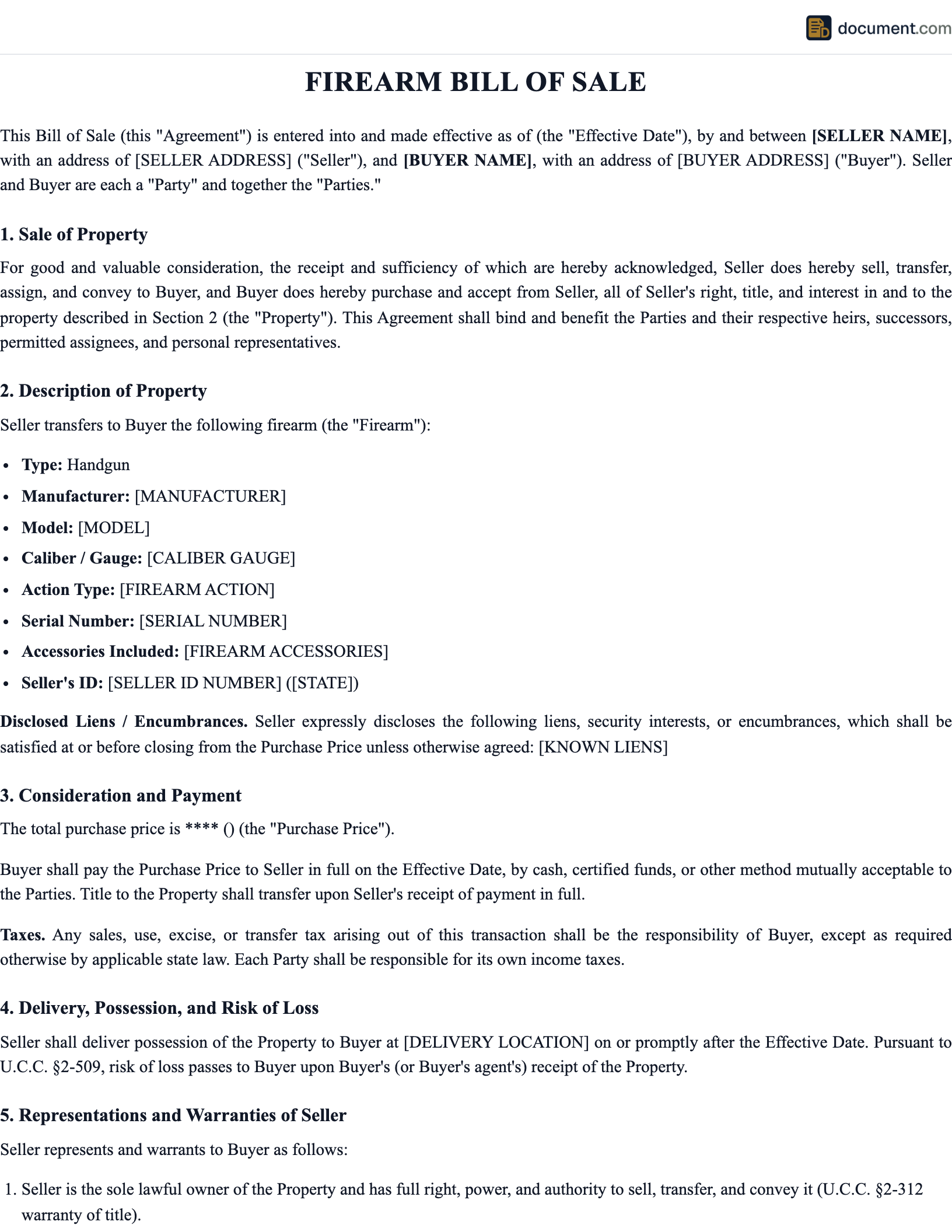



What Is a Firearm Bill of Sale?
A firearm bill of sale is a legal document that records the private sale or transfer of a firearm from one individual to another. It serves as proof that the transaction occurred, documents the firearm's identifying information (including the serial number), and helps both parties demonstrate that the transfer was conducted lawfully.
Unlike vehicle sales where the DMV creates a centralized record, most private firearm sales have no government-maintained paper trail. This makes a bill of sale especially important — it may be the only documentation proving when the firearm changed hands and that the seller verified the buyer's eligibility. If the firearm is later recovered at a crime scene, ATF traces will lead back to the last registered owner, and a bill of sale can prove you lawfully transferred it.
Firearm transfer laws vary dramatically by state. Some states require all private sales to go through a licensed dealer with a background check, while others have minimal requirements for private transactions between residents. Regardless of your state's laws, a properly completed firearm bill of sale is a critical layer of legal protection for any private sale.
Serial Number Record
Documents make, model, caliber, and serial number of the firearm
Legal Protection
Proves lawful transfer if the firearm is later involved in an investigation
ATF Compliance
Helps demonstrate compliance with federal and state firearm transfer laws
Firearm Bill of Sale by State
Firearm transfer laws vary significantly by state. Some states require universal background checks for all private sales, others require them only for handguns, and many have no requirements beyond federal law. Select your state below for a template that addresses your state's specific firearm transfer requirements.
How to Write a Firearm Bill of Sale
A firearm bill of sale must contain specific information to provide meaningful legal protection. Follow these steps to ensure your document is thorough and compliant.
Record Buyer and Seller Information
Include the full legal names, current mailing addresses, dates of birth, and government-issued ID numbers (typically driver's license numbers) of both the buyer and seller. This information helps verify identities and can be critical if law enforcement needs to trace the firearm's ownership history.
Identify the Firearm
Provide the firearm's make (manufacturer), model, serial number, caliber or gauge, type (handgun, rifle, shotgun), barrel length, and overall condition. The serial number is the most critical piece of information — it is the unique identifier that ATF uses to trace firearms. If the firearm is an antique manufactured before 1899, note this as it may affect transfer requirements.
Verify Buyer Eligibility
While private sellers are not required by federal law to conduct a background check (unless your state requires one), you should not sell to someone you know or have reason to believe is a prohibited person. Include a statement in which the buyer affirms they are legally eligible to purchase and possess firearms under both federal and state law. Check that the buyer is a resident of your same state — private interstate sales are illegal.
Document the Sale Price and Payment
State the agreed purchase price in both numerals and written form. Note the payment method — cash, cashier's check, or bank transfer. If the firearm is being gifted, note "$0 — Gift" as the price. If trading, describe the items exchanged and their agreed values. The sale price may be relevant for insurance purposes and state sales tax if applicable.
Include Condition and Warranty Statement
Most private firearm sales are "as-is," meaning the buyer accepts the firearm in its current condition. State whether the firearm is new, used, or refurbished. Note any known defects, modifications, or issues (e.g., aftermarket parts, cosmetic damage). Include an explicit as-is clause to protect the seller from warranty claims.
Sign, Date, and Keep Copies
Both buyer and seller must sign and date the bill of sale. Print at least two copies — one for each party. Keep your copy indefinitely, as there is no statute of limitations on firearm traces. If your state requires the transfer to go through an FFL, bring the bill of sale to the dealer along with the firearm. Some sellers also choose to photocopy the buyer's ID for their records.
Key Components of a Firearm Bill of Sale
A firearm bill of sale must include specific information to serve as effective legal documentation. Missing any of these elements could undermine its value as proof of a lawful transfer.
| Component | Description |
|---|---|
| Buyer & Seller Names | Full legal names, addresses, dates of birth, and ID numbers |
| Firearm Make & Model | Manufacturer name and model designation (e.g., Smith & Wesson M&P Shield) |
| Serial Number | Unique identifier engraved on the firearm — critical for ATF traces |
| Caliber / Gauge | Ammunition type (e.g., 9mm, .45 ACP, 12 gauge, .308 Winchester) |
| Firearm Type | Handgun, rifle, or shotgun — determines applicable regulations |
| Sale Price | Amount in numbers and words, payment method |
| Date of Sale | Exact date the transfer occurs |
| Eligibility Statement | Buyer affirms they are not a prohibited person under state or federal law |
| Signatures | Dated signatures of both buyer and seller |
Federal & ATF Requirements
Federal law governs the baseline rules for firearm transfers nationwide. The Bureau of Alcohol, Tobacco, Firearms and Explosives (ATF) enforces these regulations. Understanding federal requirements is essential whether you are buying or selling a firearm.
Important: Know Your Buyer
Even in states that do not require background checks for private sales, it is a federal crime to sell a firearm to anyone you know or have reasonable cause to believe is a prohibited person. This includes convicted felons, domestic violence offenders, and unlawful drug users. When in doubt, conduct the sale through an FFL with a background check.
- Private Sales Between State Residents: Federal law allows private individuals to sell firearms to other residents of the same state without going through an FFL, unless state law requires it
- Interstate Sales Prohibited: Private individuals cannot sell or transfer firearms to residents of another state — all interstate transfers must go through an FFL
- Minimum Age: Federal law sets the minimum age at 18 for long guns (rifles/shotguns) and 21 for handguns when purchased from an FFL. Private sale minimums may differ by state
- NFA Items: Short-barreled rifles, short-barreled shotguns, suppressors, and machine guns require ATF Form 4 transfer, a $200 tax stamp, and an extensive background check regardless of whether the transfer is private or through a dealer
- Antique Firearms Exempt: Firearms manufactured before 1899 and certain replica black powder firearms are not considered "firearms" under the Gun Control Act and are exempt from most federal transfer regulations
Firearm Types Covered
Our firearm bill of sale templates work for all types of firearms, with fields tailored to each type:
Handgun / Pistol
Semi-automatic pistols, revolvers, and derringers — subject to the strictest regulations in many states
Rifle
Bolt-action, semi-automatic, and lever-action rifles for hunting and sport shooting
Shotgun
Pump-action, semi-automatic, and break-action shotguns for hunting and home defense
Antique / Collector Firearm
Firearms manufactured before 1899 or replicas — often exempt from federal background check requirements
Black Powder / Muzzleloader
Muzzle-loading rifles and pistols — generally exempt from federal firearm transfer regulations
AR-Style / Modern Sporting Rifle
Semi-automatic rifles — subject to additional restrictions in some states including assault weapon bans
Curio & Relic Firearm
Firearms at least 50 years old or certified by ATF as having collector value — special FFL available
NFA Items
Short-barreled rifles, short-barreled shotguns, suppressors — require ATF Form 4 transfer and $200 tax stamp
Sample Firearm Bill of Sale
Below is a preview of our firearm bill of sale template. Your customized document will include all fields required by your state's firearm transfer laws.
FIREARM BILL OF SALE
Private Party Firearm Transfer Document
This Firearm Bill of Sale is entered into on[Date]between:
SELLER:
Name: [Seller Name]
Address: [Seller Address]
Date of Birth: [DOB] ID #: [DL #]
BUYER:
Name: [Buyer Name]
Address: [Buyer Address]
Date of Birth: [DOB] ID #: [DL #]
1. FIREARM DESCRIPTION
Make: [Make] Model: [Model]
Serial Number: [Serial #]
Caliber/Gauge: [Cal.] Type: [Handgun/Rifle/Shotgun]
2. BUYER ELIGIBILITY STATEMENT
The Buyer affirms that they are not prohibited from purchasing or possessing firearms under federal or state law, that they are a resident of the state of[State], and that they are at least [18/21] years of age.
3. SALE PRICE
$[Amount]([Amount in Words] Dollars)
Frequently Asked Questions
Find answers to common questions about firearm bills of sale, private transfers, and federal and state requirements.
Official Resources
Use these official federal and industry resources to verify firearm transfer requirements, check background check laws, and access government forms.
ATF — Bureau of Alcohol, Tobacco, Firearms and Explosives
Federal firearm regulations, forms, and compliance information
FBI NICS — National Instant Criminal Background Check System
Background check system used by FFLs for firearm purchases
ATF FFL Lookup — Find a Licensed Dealer
Search for licensed firearm dealers in your area for transfers
ATF Forms Library — Form 4473 and More
Download ATF Form 4473, Form 4, and other federal firearm forms
Giffords Law Center — State Gun Laws
Comprehensive state-by-state gun law database and analysis
NRA-ILA — State Gun Laws
State-by-state firearm law summaries and legislative updates
Create your Firearm Bill of Sale in under 10 minutes.
Answer a few questions and download a compliant, attorney-drafted document ready for your state.