



North Carolina Firearm Bill of Sale Overview
North Carolina requires a Pistol Purchase Permit issued by the county sheriff or a valid Concealed Handgun Permit (CHP) for all handgun purchases, including private sales. This permit involves a background check. Long gun private sales do not require a background check or permit.
The Pistol Purchase Permit is free and obtained from the county sheriff's office. It involves a background check and is valid for 5 years (one purchase per permit). CHP holders are exempt from needing a separate purchase permit. North Carolina does not require firearm registration.
North Carolina has no assault weapons ban and no magazine capacity restrictions. NFA items are legal with proper federal registration. The state issues CHPs through county sheriffs. North Carolina has a castle doctrine and stand-your-ground law.
Yes
Private sale BG check
None
Waiting period
No
Registration required
Yes
Permit to purchase
North Carolina Firearm Transfer Requirements
Here's what you need to know about firearm transfers in North Carolina:
Important: Background Check Required
North Carolina requires background checks for private firearm sales. All transfers must be conducted through a licensed dealer. Failure to comply with this requirement may result in criminal penalties. Even with a background check, it is illegal to sell to a known prohibited person.
Seller Requirements
- FFL Transfer: North Carolina requires private sales to go through a licensed dealer for a background check
- Both Parties Present: Both buyer and seller must appear at the FFL with valid identification
- Bill of Sale: Complete a bill of sale documenting the firearm and transaction details
- No Prohibited Buyers: Do not sell to anyone you know or suspect is prohibited from possessing firearms
Buyer Requirements
- North Carolina Residency: Must be a current North Carolina resident with valid state ID
- Purchase Permit: Yes (Pistol Purchase Permit for handguns, or CHP) — obtain before initiating the purchase
- Background Check: Must pass a background check processed through the FFL
- Not Prohibited: Must not be a prohibited person under federal or state law
- Retain Bill of Sale: Keep your copy as proof of legal purchase and ownership
How to Fill Out a North Carolina Firearm Bill of Sale
Follow these steps to properly complete your North Carolina firearm bill of sale. Our template guides you through each field to ensure compliance with North Carolina and federal requirements.
Enter Seller Information
Include the seller's full legal name, current North Carolina mailing address, date of birth, and government-issued ID number (driver's license or state ID). This information is critical for establishing a clear chain of custody for the firearm.
Enter Buyer Information
Include the buyer's full legal name, current North Carolina address, date of birth, and ID number. Verify the buyer's ID is valid and current. Confirm the buyer is a North Carolina resident — selling to an out-of-state resident in a private sale is a federal crime.
Describe the Firearm
Record the firearm's make (manufacturer), model, serial number, caliber or gauge, type (handgun, rifle, shotgun), barrel length, and finish/color. The serial number is the most important identifier — verify it matches the physical firearm exactly.
State the Sale Price
Enter the agreed purchase price in both numbers and words. Note the payment method. If the firearm is a gift, write "$0 — Gift." If a trade, describe the items exchanged.
Include Eligibility Statement
The buyer should sign a statement affirming they are legally eligible to purchase and possess firearms under both federal and North Carolina law, that they are not a prohibited person, and that they are a resident of North Carolina.
Sign, Date, and Keep Copies
Both parties must sign and date the bill of sale. Print at least two copies — one for each party. Keep your copy indefinitely as there is no statute of limitations on ATF firearm traces. Remember that the transfer must also be processed through an FFL with a background check.
North Carolina Firearm Transfer Process
North Carolina requires private firearm transfers to include a background check. Here's the step-by-step process:
Verify Both Parties' Eligibility
Check IDs to confirm both parties are North Carolina residents and of legal age. The seller should have no reason to believe the buyer is a prohibited person.
Visit a Licensed Dealer (FFL)
Both parties must appear at an FFL. The dealer will process the background check as required by North Carolina law.
Complete Background Check
The FFL will run a background check. If approved, the transfer can proceed.
Complete and Sign the Bill of Sale
Fill in all fields including the serial number, both parties' information, and the sale price. Both parties sign and date.
Exchange Payment and Firearm
Complete the payment and transfer the firearm. Each party keeps their signed copy of the bill of sale.
Store Your Records Securely
Keep your copy of the bill of sale in a safe place indefinitely. This is your proof of legal transfer if the firearm is ever traced.
North Carolina Firearm Transfer Fees & Costs
Here are the typical costs associated with a private firearm transfer in North Carolina:
| Fee / Cost | Amount |
|---|---|
| Background Check Fee | Varies ($10-$40 typically) |
| FFL Transfer Fee | $10-$75 (set by dealer) |
| Firearm Registration | Not required |
| Carry Permit | Varies — contact issuing agency |
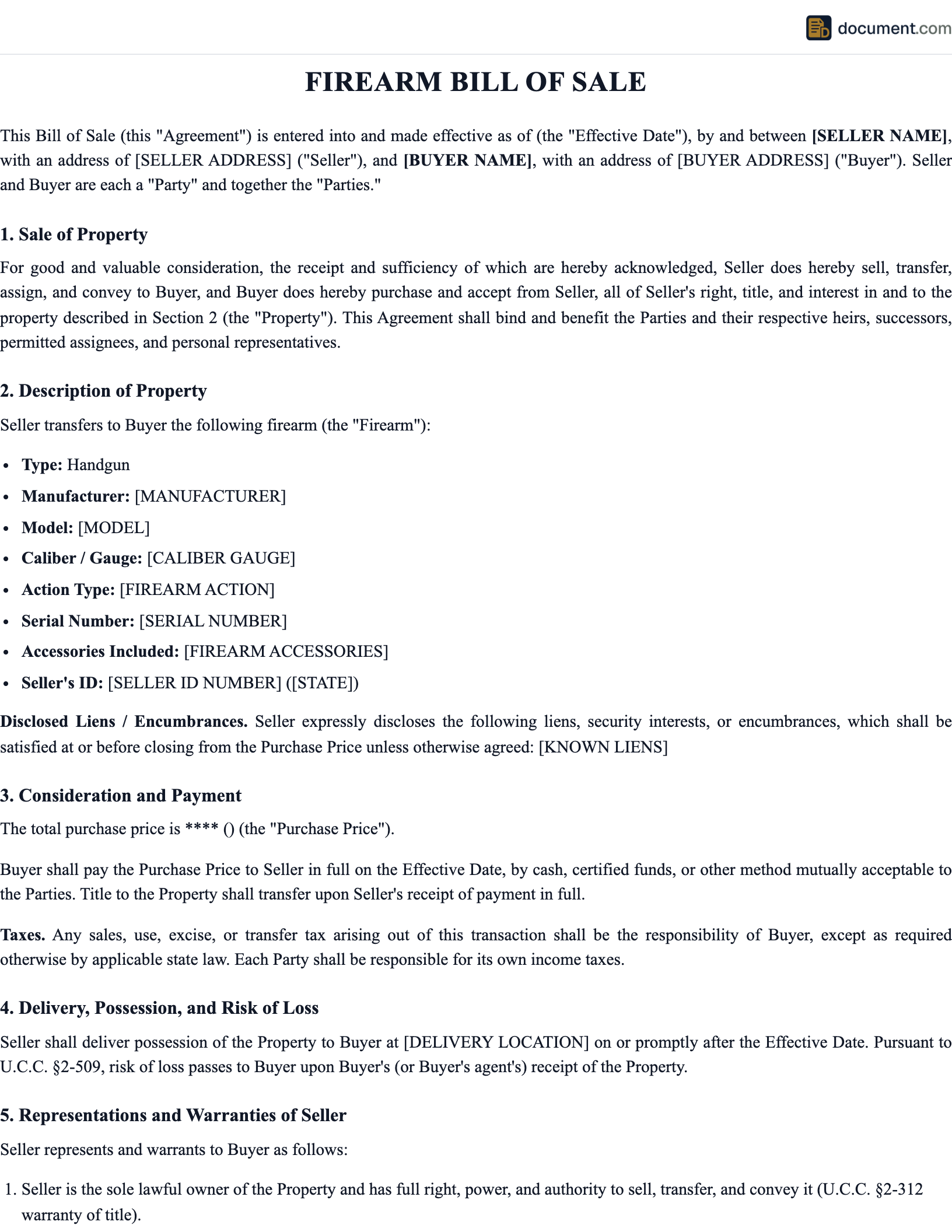
Sample North Carolina Firearm Bill of Sale
Below is a preview of our North Carolina-specific firearm bill of sale. Your customized document will include all fields required by North Carolina and federal law.
STATE OF NORTH CAROLINA
FIREARM BILL OF SALE
Private Party Firearm Transfer Document
SELLER:
Name: [Seller Name]
Address: [North Carolina Address]
DOB: [Date of Birth] ID#: [DL Number]
BUYER:
Name: [Buyer Name]
Address: [North Carolina Address]
DOB: [Date of Birth] ID#: [DL Number]
FIREARM INFORMATION
Make: [Manufacturer] Model: [Model]
Serial #: [Serial Number]
Caliber: [Cal/Gauge] Type: [Handgun/Rifle/Shotgun]
Sale Price: $[Amount]
North Carolina Firearm Bill of Sale FAQ
Answers to common questions about North Carolina firearm bills of sale, private transfers, and state requirements.
Official North Carolina Resources
Use these official state and federal resources to verify North Carolina firearm transfer requirements and access government information.
Other North Carolina Bill of Sale Templates
Need a different type of bill of sale for North Carolina? We offer state-specific templates for every type of property transfer.
North Carolina Vehicle Bill of Sale
Cars, trucks, and SUVs
North Carolina Boat Bill of Sale
Boats, jet skis, and watercraft
North Carolina Motorcycle Bill of Sale
Motorcycles, scooters, and mopeds
North Carolina Trailer Bill of Sale
Utility, travel, and cargo trailers
North Carolina General Bill of Sale
Furniture, electronics, and personal property
North Carolina ATV Bill of Sale
ATVs, UTVs, and off-road vehicles
North Carolina Horse Bill of Sale
Horses, cattle, and livestock
North Carolina Mobile Home Bill of Sale
Manufactured and mobile homes
Create your North Carolina Firearm Bill of Sale in under 5 minutes.
Answer a few questions and download a North Carolina-compliant document, ready for the state agency.