



Texas Vehicle Bill of Sale Overview
Texas is the largest state in the country for private vehicle sales, and the Lone Star State has a well-defined process for transferring vehicle ownership. A bill of sale is an essential part of every private party vehicle transaction in Texas, documenting the sale price, vehicle details, and the agreement between buyer and seller.
The Texas Department of Motor Vehicles (TxDMV) oversees vehicle titling and registration, but all transactions are processed through county tax assessor-collector offices. Texas is unique in that it uses a Standard Presumptive Value (SPV) system for calculating sales tax on private party vehicle purchases. This means the tax may be based on the SPV rather than the sale price you write on your bill of sale, whichever amount is higher.
In addition to a bill of sale, Texas requires sellers to complete Form 130-U (Application for Texas Title and/or Registration) and have the seller's signature notarized on the title. County tax assessor-collector offices handle all title transfers, registration, and tax collection across the state's 254 counties.
6.25%
State sales tax
30 Days
Transfer deadline
Yes*
Notarization (title)
Select
Emissions (counties)
TxDMV Requirements
Texas has specific requirements for private party vehicle transfers. The process involves multiple documents and is handled through county tax assessor-collector offices across the state.
Important: Standard Presumptive Value (SPV)
Texas calculates sales tax based on the Standard Presumptive Value (SPV) or the sale price, whichever is higher. The SPV is determined by TxDMV using comparable sales data. Check the SPV of any vehicle before purchase at txdmv.gov. If you disagree with the SPV, you may submit a certified appraisal within 20 days.
What the Seller Must Provide
- Signed Vehicle Title: The seller must sign the title assignment on the back and have the signature notarized. Fill in the buyer's name, sale date, sale price, and odometer reading
- Bill of Sale: A completed bill of sale with vehicle details, VIN, sale price, and both parties' information
- Form 130-U: Application for Texas Title and/or Registration, completed and signed by the seller with a notarized signature
- Odometer Disclosure: Federal requirement — must be stated on the title for vehicles less than 20 years old
- Lien Release: If the vehicle had a lien, a release from the lienholder is required
What the Buyer Must Bring to the County Office
- Signed & Notarized Title: With the seller's notarized signature and completed assignment
- Completed Form 130-U: With the seller's notarized signature
- Bill of Sale: Signed by both buyer and seller
- Valid Photo ID: Texas driver's license or state-issued ID
- Proof of Insurance: Texas minimum liability coverage required
- Passing Vehicle Inspection: Current Texas state inspection (safety + emissions if in an applicable county)
- Payment: Title fee ($33), registration ($51.75+), and 6.25% sales tax
How to Fill Out a Texas Vehicle Bill of Sale
Follow these six steps to complete your Texas vehicle bill of sale. Our template walks you through every field so your document is accepted at any Texas county tax assessor-collector office.
Enter Seller Information
Provide the seller's full legal name exactly as it appears on the Texas title, current mailing address, and phone number. If there are multiple owners listed on the title, check whether the title shows "and" (all owners must sign) or "or" (any owner can sign). Include the seller's Texas driver's license number for additional identification.
Enter Buyer Information
Provide the buyer's full legal name as it should appear on the new Texas title, current address, and contact details. The buyer's county of residence determines which tax assessor-collector office will process the title transfer and may also affect whether emissions testing is required.
Describe the Vehicle
Record the year, make, model, body style, and color. Enter the full 17-character VIN from the dashboard plate or driver's door jamb — verify it matches the title exactly. Any VIN discrepancy will halt the transfer at the county office. Include the Texas license plate number if the vehicle is currently registered.
Record the Odometer Reading
Write down the current odometer mileage at the time of sale and indicate whether the reading is actual, exceeds mechanical limits, or does not reflect the true mileage. This is a federal requirement under NHTSA regulations. The odometer reading must also be recorded on the title. Vehicles 20 years old or older and those over 16,000 lbs GVWR are exempt.
State the Sale Price
Enter the agreed sale price in both numbers and words. Remember that Texas taxes based on the Standard Presumptive Value (SPV) or the sale price — whichever is higher. If the vehicle is a gift, indicate "$0 — Gift" and complete Form 14-317 (Affidavit of Motor Vehicle Gift Transfer) to qualify for the $10 gift tax instead of the standard 6.25%.
Sign and Date
Both the buyer and seller sign and date the bill of sale. Print at least two copies — one for each party. The seller must also sign the title assignment and have it notarized. Complete Form 130-U and have the seller's signature on that form notarized as well. Many county tax offices provide notary services on-site. Take all documents to the county tax assessor-collector within 30 days.
Texas Title Transfer Process
After completing the bill of sale and having the title notarized, the buyer must visit their county tax assessor-collector's office to finalize the transfer. Texas processes all title and registration transactions at the county level through these offices.
Complete the Sale
Sign the bill of sale, complete and notarize the title assignment and Form 130-U, exchange payment and keys
Get Insurance & Inspection
Obtain Texas liability insurance and get a passing state inspection (safety + emissions if in an applicable county)
Visit Your County Tax Assessor-Collector
Bring the notarized title, completed Form 130-U, bill of sale, proof of insurance, and photo ID
Pay Fees and Taxes
Title fee ($33), registration ($51.75 base + county fees), and 6.25% sales tax on SPV or sale price
Receive Your New Title and Registration
Texas issues a new title in the buyer's name — you may receive a temporary tag while the title is processed
Texas Vehicle Sales Tax & Fees
Texas charges a flat 6.25% motor vehicle sales tax on private party purchases, with no additional local taxes on vehicles. However, the tax is calculated on the Standard Presumptive Value or the actual sale price — whichever is higher. Here's a full breakdown of costs:
| Fee / Tax | Amount |
|---|---|
| Motor Vehicle Sales Tax | 6.25% of SPV or sale price (whichever is higher) |
| Title Transfer Fee | $33 |
| Registration Fee | $51.75 base + county fees |
| State Inspection | $7.00 (safety) / $18.50-$39.75 (emissions areas) |
| Gift Tax | $10 (with Form 14-317 for qualifying gifts) |
| Duplicate Title | $2 (certified copy via Form VTR-34) |
| Late Transfer Penalty | Penalties accrue after 30 days |
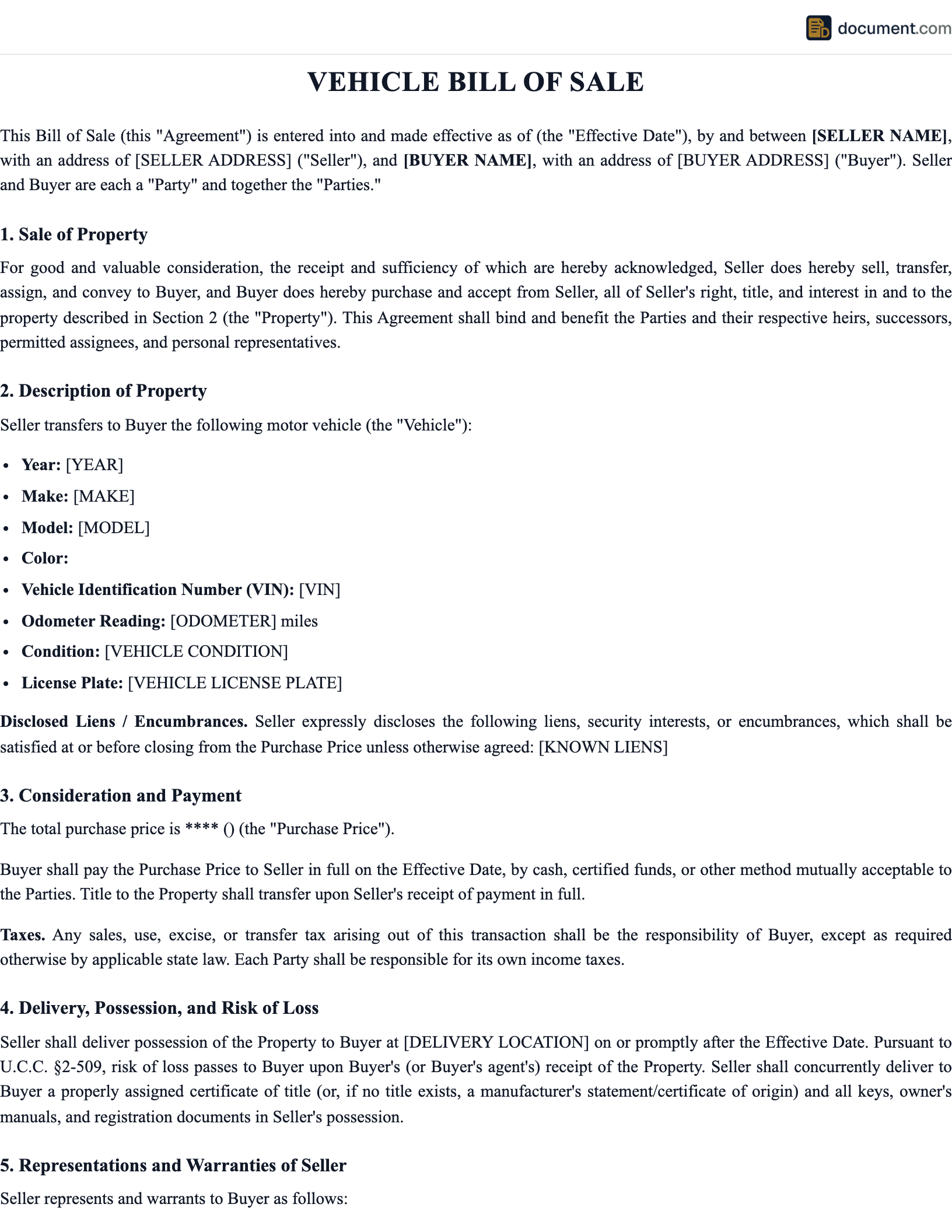
Sample Texas Vehicle Bill of Sale
Below is a preview of our Texas-specific vehicle bill of sale. Your completed document will include all fields required by Texas county tax assessor-collector offices and complement Form 130-U.
STATE OF TEXAS
VEHICLE BILL OF SALE
Private Party Motor Vehicle Transfer
SELLER:
Name: [Seller Name]
Address: [Texas Address]
County: [County]
BUYER:
Name: [Buyer Name]
Address: [Texas Address]
County: [County]
VEHICLE INFORMATION
Year: [Year] Make: [Make] Model: [Model]
VIN: [17-digit VIN]
Odometer: [Miles] miles
Sale Price: $[Amount]
Texas Vehicle Bill of Sale FAQ
Answers to common questions about Texas vehicle bills of sale, title transfers, and TxDMV requirements.
Official Texas Resources
Use these official state and federal resources to verify requirements, find your county tax assessor-collector, and access government forms for your Texas vehicle transaction.
Texas Department of Motor Vehicles (TxDMV)
Title transfers, registration, and SPV lookup
TxDMV Standard Presumptive Value Calculator
Look up your vehicle's SPV for tax calculation
Texas Comptroller — Motor Vehicle Tax
Motor vehicle sales tax rates and exemptions
NHTSA — Odometer Fraud Prevention
Federal odometer disclosure requirements and fraud reporting
NICB VINCheck — Free Vehicle History
Check if a vehicle has been reported stolen or salvaged
NHTSA VIN Decoder
Decode any VIN to verify year, make, model, and specifications
Other Texas Bill of Sale Templates
Need a different type of bill of sale for Texas? We offer state-specific templates for every type of property transfer.
Texas Boat Bill of Sale
Boats, jet skis, and watercraft
Texas Motorcycle Bill of Sale
Motorcycles, scooters, and mopeds
Texas Trailer Bill of Sale
Utility, travel, and cargo trailers
Texas Firearm Bill of Sale
Handguns, rifles, and shotguns
Texas General Bill of Sale
Furniture, electronics, and personal property
Texas ATV Bill of Sale
ATVs, UTVs, and off-road vehicles
Texas Horse Bill of Sale
Horses, cattle, and livestock
Texas Mobile Home Bill of Sale
Manufactured and mobile homes
Create your Texas Vehicle Bill of Sale in under 5 minutes.
Answer a few questions and download a Texas-compliant document, ready for the state agency.