



What Is an RV Bill of Sale?
An RV bill of sale is the written record of a private sale of a recreational vehicle from one owner to another. RVs are unusually complex transactions because the term "RV" covers everything from a $5,000 pop-up camper to a $400,000 diesel pusher motorcoach, and every category is regulated a little differently. The bill of sale ties a buyer to a specific VIN, a specific price, a specific date, and the specific systems and accessories that came with the rig.
Drivable motorhomes — Class A, Class B, and Class C — are titled as motor vehicles, which means a federal odometer disclosure is required and the DMV process tracks closely with selling a car. Towable RVs — travel trailers, fifth wheels, pop-up campers, toy haulers, and truck campers — are titled as trailers in most states, with no odometer requirement but with their own GVWR and length-based fee structures.
Because RVs combine a motor vehicle, a residence, a propane system, a 12-volt electrical system, a 120-volt shore-power system, fresh and waste plumbing, and often slide-outs and a generator, the bill of sale should explicitly note the condition of each major system and any known defects. A car bill of sale that just lists VIN and mileage isn't enough for a 38-foot fifth wheel with three slides and an Onan generator.
A complete RV bill of sale also serves the buyer at the DMV, the bank, and the insurance company. Lenders use it to confirm collateral value, insurers use it to set agreed-value coverage, and the state uses it to assess use tax. Whether you are buying a 1990s Class C from a neighbor or selling a brand-new fifth wheel to a stranger from Craigslist, the bill of sale is the spine of the entire deal.
All RV Types
Motorhomes, travel trailers, fifth wheels, pop-ups, and camper vans
Odometer Compliant
Federal odometer disclosure for all drivable motorhomes
Systems Disclosure
Slide-out, propane, generator, and waste system condition fields
Motorhomes vs Towables: Different Documents, Different Rules
The single most important question on an RV bill of sale is which side of the drivable/towable line the rig falls on. Everything else flows from that answer.
| RV Type | Titled As | Odometer? |
|---|---|---|
| Class A Motorhome | Motor vehicle | Yes (federal) |
| Class B Camper Van | Motor vehicle | Yes (federal) |
| Class C Motorhome | Motor vehicle | Yes (federal) |
| Travel Trailer | Trailer | No |
| Fifth Wheel | Trailer | No |
| Pop-up / Toy Hauler | Trailer | No |
| Truck Camper (slide-in) | Personal property (varies) | No |
How to Create an RV Bill of Sale
RV transactions are larger and more complex than most vehicle sales. Following these six steps gives both parties protection and a smooth DMV experience.
Identify the RV Class and VIN
Write the year, manufacturer, model, and class. For motorhomes, capture both the chassis make (Ford F-53, Freightliner XCR, Mercedes Sprinter) and the coach maker (Winnebago, Tiffin, Thor, Newmar). Record the VIN from the door jamb or driver's pillar and verify it character-by-character against the title. For trailers, the VIN is usually on a plate riveted to the front frame.
Capture Length, GVWR, and Slide Count
States use length and GVWR to assign registration class and fees. Note the overall length (including hitch on trailers), the GVWR sticker reading from the driver's door pillar, and the number of slide-outs. These fields also help insurance companies write accurate policies.
Record Mileage and Generator Hours
For motorhomes, record the chassis odometer and the generator hour meter separately. Generator hours matter as much as miles on a Class A — a coach with 30,000 miles and 4,000 generator hours has lived a hard life. For towables, skip mileage and capture the dry weight and CCC (cargo carrying capacity) instead.
Disclose Slides, Propane, and Roof Condition
Add a short systems disclosure section. Confirm whether all slides extend and retract properly, whether the propane system has been pressure-tested, and whether the roof has any known soft spots or active leaks. These three areas generate the majority of post-sale disputes, so being explicit up front is worth a few extra lines on the document.
Handle Any Existing Lien
RV loans run 10–20 years, so a lien is the rule, not the exception. If the seller still owes money, do not hand over a check until you have a written lien-release plan. The cleanest method is for the buyer to pay the lender directly and have the lender release the lien on the spot. Note the loan payoff arrangement on the bill of sale.
Sign, Notarize If Required, Hand Over Documents
Both parties sign and date. In Louisiana, Maryland, Montana, Nebraska, and West Virginia, a notary must witness the signatures. Even where notarization is optional, it's a smart investment on a high-value rig. The seller hands over the title, the registration, the manuals, and any extended warranty paperwork.
Key Components of an RV Bill of Sale
Every field below should appear on a complete RV bill of sale.
| Component | Description |
|---|---|
| Buyer & Seller | Names, addresses, phone numbers |
| Year, Make, Model, Class | E.g., 2019 Tiffin Allegro Bus 45OPP, Class A |
| Chassis Make | For motorhomes (Freightliner, Ford, Spartan) |
| VIN | 17-character vehicle ID |
| Length & GVWR | Overall length and gross vehicle weight rating |
| Odometer & Generator Hours | Both readings for motorhomes |
| Slide-Out Count & Status | Number of slides and condition disclosure |
| Propane Recert Date | DOT propane tank certification |
| Sale Price | Numerals and words, with payment method |
| Lien Statement | Free of liens or lien-release plan |
| As-Is Clause | No-warranty language and known defect disclosures |
| Signatures | Dated; notarized in some states |
Titling, Registration, and Inspections
After the bill of sale is signed, the buyer has a short window — usually 10 to 30 days depending on the state — to title and register the RV. Bring the bill of sale, the signed-over title, the current registration, and a valid photo ID.
Buyer Tip: Get a Pre-Purchase Inspection
A $400–$1,200 NRVIA-certified inspection on a high-value RV can uncover roof leaks, slide problems, propane issues, and chassis rust that easily cost ten times the inspection fee to repair. Build the inspection into the deal before signing the bill of sale.
- Title Transfer: Seller signs the title over to the buyer (motorhomes and most trailers)
- Use Tax: Calculated from sale price on the bill of sale
- Safety Inspection: Required in some states for motorhomes over a weight threshold
- Emissions Test: Required for gas motorhomes in CA, AZ, NV, IL, and other states
- Insurance: Buyer must have coverage before driving the RV home
- Trip Permit: Required to drive an out-of-state RV across state lines unregistered
Sample RV Bill of Sale
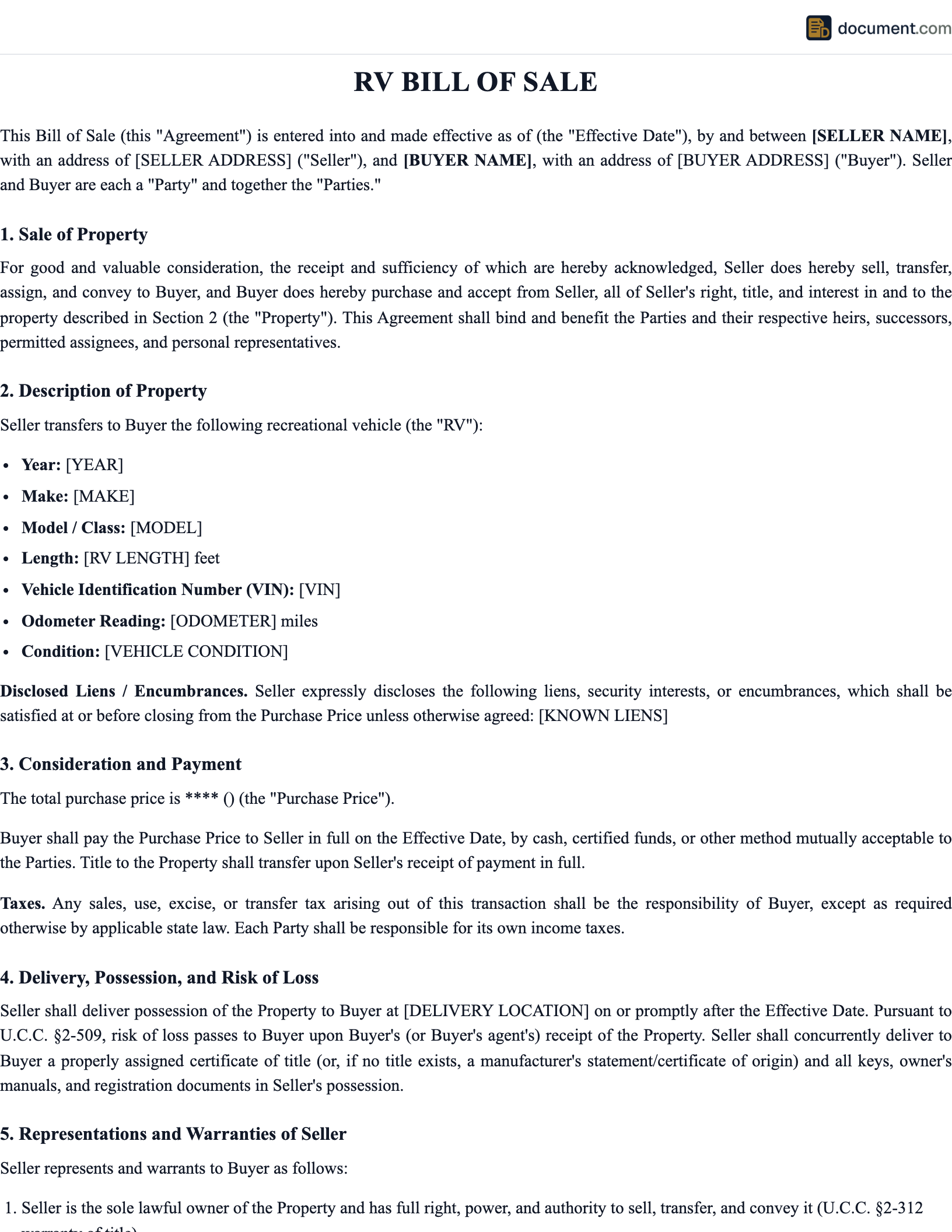
Here is a preview of the completed RV bill of sale. Your final document is customized to your state's titling requirements.
RV BILL OF SALE
Recreational Vehicle Transfer Document
This RV Bill of Sale is entered into on[Date]between:
SELLER:
Name: [Seller Name]
Address: [Seller Address]
BUYER:
Name: [Buyer Name]
Address: [Buyer Address]
1. RV DESCRIPTION
Year: [Year] Make: [Tiffin] Model: [Allegro Bus]
Class: ☐ A ☐ B ☐ C ☐ Travel Trailer ☐ Fifth Wheel
VIN: [VIN]
Length: [ft] GVWR: [lbs]
2. ODOMETER & GENERATOR (motorhomes)
Mileage: [Miles]
Generator hours: [Hrs]
3. SYSTEMS DISCLOSURE
Slides functional: ☐ Yes ☐ No Propane recertified: ☐ Yes ☐ No
Roof condition: [Notes]
4. SALE PRICE
$[Amount]([Amount in Words] Dollars)
Frequently Asked Questions
Common questions buyers and sellers ask about RV bills of sale, motorhome titling, and towable registration.
Official Resources
Authoritative resources for RV titling, inspection, and consumer protection.
- RV Industry Association (RVIA): Standards body for the RV industry; certifies builders and publishes safety codes.
- National RV Inspectors Association (NRVIA): Find certified pre-purchase inspectors nationwide.
- NHTSA Odometer Disclosure Rule: Federal requirement for all drivable motorhomes.
- U.S. DOT Propane Cylinder Rules: Recertification requirements for portable propane tanks.
- Your State DMV: Title transfer, fees, and inspection requirements vary by state.
Create your Rv Bill of Sale in under 10 minutes.
Answer a few questions and download a compliant, attorney-drafted document ready for your state.