



What Is a Transfer-on-Death Deed?
A transfer-on-death deed (TOD deed), also called a beneficiary deed in several states, is a real estate instrument that names a beneficiary who automatically takes title to the property the instant the owner dies — with no probate, no court petition, and no waiting period. The deed is signed, acknowledged before a notary, and recorded in the land records of the county where the property is located, but it has no effect on ownership, use, or control of the property during the owner's lifetime. Only at the owner's death does the recorded deed spring into operation and pass title, by force of statute, to the surviving beneficiary.
The TOD deed is a modern estate-planning invention. Missouri enacted the first statute in 1989, and over the next three decades more than thirty additional states and the District of Columbia followed suit, most by adopting some version of the Uniform Real Property Transfer on Death Act drafted by the Uniform Law Commission in 2009. The instrument was created to give homeowners a probate-avoidance tool as simple as the "payable-on-death" designation that has long been available for bank accounts and the "transfer-on-death" registration available for brokerage accounts, stocks, and vehicles.
The defining feature of a TOD deed is that it is fully revocable and non-vesting during the owner's life. The owner keeps every stick in the bundle of property rights: the right to occupy, rent, sell, mortgage, gift, improve, or destroy the property; the right to claim homestead and senior property tax exemptions; and the right to change their mind about the beneficiary at any time. The beneficiary, by contrast, has no present interest, no right to enter the property, no right to an accounting, and no standing to object to how the owner uses or encumbers the land. This is a sharp departure from a traditional life estate deed or an outright lifetime gift, both of which immediately vest rights in the recipient and can interfere with the owner's ability to sell or refinance.
When the owner dies, the beneficiary takes title subject to all existing liens, mortgages, judgments, and encumbrances — the TOD deed is not a shield against the owner's creditors. The beneficiary completes the transfer by recording an affidavit of death together with a certified copy of the death certificate, and (in states such as California, Colorado, and Nevada) a preliminary change of ownership report for the county assessor. The entire post-death administration typically takes days to weeks, not months to years, and costs only the recording fees — usually under $100 — rather than the 3 to 7 percent of gross estate value that probate commonly consumes.
Probate Avoidance
Real estate passes directly to the beneficiary outside probate, saving months and thousands in court costs.
Full Lifetime Control
You keep every right of ownership while alive — sell, refinance, or revoke at any time.
Stepped-Up Basis
Beneficiary receives the full IRC Section 1014 basis step-up at your death, just like property passing under a will.
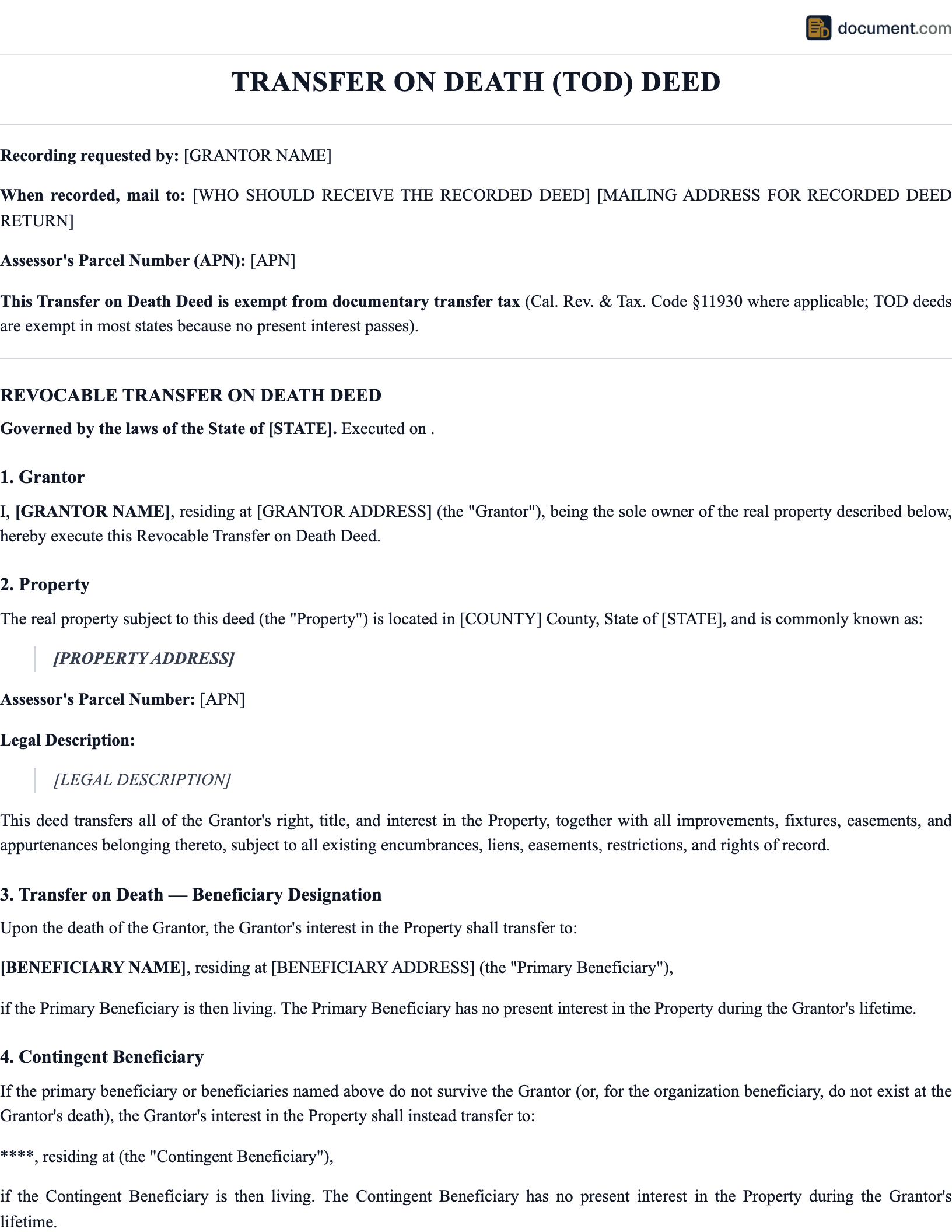
TOD Deed Form Preview
Below is a visual mock-up of the recorded form your TOD deed will follow. The actual document is customized to your state's statutory format, legal description, recording margins, and notarization requirements.
Transfer-on-Death Deed
Pursuant to the Uniform Real Property Transfer on Death Act
Section 1: Recording Information
Section 2: Owner (Transferor/Grantor)
Section 3: Designated Beneficiary
Section 4: Legal Description of Property
Section 5: Statutory Operative Language
Section 6: Execution & Acknowledgment
Grantor Signature
Notary Public
The Uniform Real Property Transfer on Death Act
The Uniform Real Property Transfer on Death Act (URPTODA), promulgated by the Uniform Law Commission in 2009 and amended in 2018, provides the statutory skeleton that most TOD-deed states have adopted. URPTODA standardizes core rules: the deed must be signed, notarized, and recorded before the transferor's death; the deed is fully revocable; the beneficiary has no present interest; the transfer occurs only at death; a later will cannot revoke the deed; and the property passes subject to all liens and encumbrances. States that have adopted URPTODA in whole or substantial part include Alaska, Colorado, Hawaii, Illinois, Maine, Minnesota, Montana, Nebraska, Nevada, New Mexico, North Dakota, Oregon, South Dakota, Virginia, Washington, West Virginia, Wisconsin, and the District of Columbia.
Several states authorize TOD deeds but did not adopt URPTODA verbatim. Missouri's 1989 beneficiary deed statute predates the Uniform Act and remains the oldest of its kind. Arizona and Colorado use the term "beneficiary deed" and impose slightly different formalities. California's statute (Prob. Code § 5600 et seq.) limits TOD deeds to residential property of not more than four dwelling units or a single-family residence with up to 40 acres of agricultural land, and requires two witnesses in addition to notarization effective January 1, 2022. Ohio uses a "transfer-on-death designation affidavit" rather than a deed. Texas enacted the URPTODA in 2015 and added state-specific formalities, including a required homestead disclaimer.
Because the statutory details differ, the execution formalities, revocation procedures, and beneficiary-vesting rules can vary significantly from state to state. Our templates are drafted to the specific statutory form required in your state and are updated whenever the legislature amends the underlying law.
States That Authorize TOD Deeds
TOD deeds are currently authorized in roughly 30 states plus DC. A handful of additional states recognize the Lady Bird or enhanced life estate deed, which is functionally similar. Some of the most populous states — including New York, New Jersey, Pennsylvania, and Massachusetts — do not yet authorize TOD deeds, and owners in those states must rely on a revocable living trust or a traditional deed with retained life estate instead.
Individual Beneficiary TOD Deed
Names a single beneficiary who receives the property automatically at the owner's death.
Multiple Beneficiary TOD Deed
Names two or more beneficiaries who take title as tenants in common or with rights of survivorship.
Contingent Beneficiary TOD Deed
Names alternate beneficiaries who receive the property if the primary beneficiary predeceases the owner.
Joint Owner TOD Deed
Executed by joint tenants or tenants by the entirety to transfer surviving owner's interest at death.
Revocable Beneficiary Deed
The Arizona and Colorado statutory name for a transfer-on-death deed — identical in function.
Lady Bird Deed (Enhanced Life Estate)
A close relative of the TOD deed available in FL, TX, MI, VT, and WV that preserves full control during life.
TOD Deed vs Alternatives
The TOD deed is one of several tools for passing real estate outside probate. Understanding the alternatives — and their trade-offs — is essential to choosing the right instrument.
TOD Deed vs Revocable Living Trust
TOD Deed
- - Single recorded deed; low cost ($75-$300)
- - Covers one parcel at a time
- - No ongoing trust administration
- - Only works in states that authorize it
- - No incapacity management
Revocable Living Trust
- - Higher cost ($1,500-$3,500) and complexity
- - Covers all assets funded into the trust
- - Works in all 50 states
- - Provides incapacity management via successor trustee
- - Allows staggered, conditional, or protected distributions
TOD Deed vs Joint Tenancy with Right of Survivorship
TOD Deed
- - No present interest in beneficiary
- - Fully revocable without beneficiary consent
- - No exposure to beneficiary's creditors
- - Full basis step-up at death
Joint Tenancy
- - Immediate present interest in joint tenant
- - Cannot be undone without joint tenant's signature
- - Property exposed to joint tenant's creditors and divorce
- - Only half basis step-up (except community property)
TOD Deed vs Life Estate Deed (Lady Bird)
TOD Deed
- - Authorized in ~30 states + DC
- - Uniform Act provides standardized rules
- - Revoked by new recorded deed
Lady Bird / Enhanced Life Estate Deed
- - Primarily FL, TX, MI, VT, WV
- - Based on common-law life estate with retained powers
- - Particularly effective against Medicaid recovery in FL
How to Create a TOD Deed: A 9-Step Guide
Confirm Your State Authorizes TOD Deeds
Before drafting anything, verify that your state has an active TOD (or beneficiary) deed statute. Our template selector will alert you if your state does not permit TOD deeds and will suggest alternatives such as a revocable living trust or (in FL, TX, MI, VT, WV) a Lady Bird deed.
Gather the Exact Legal Description
The deed must identify the property by its recorded legal description — not just the street address. Pull the legal description from your last vesting deed, your title insurance policy, or the county assessor's parcel record. Include the APN/parcel number, the subdivision plat reference or metes-and-bounds description, and any easements of record.
Confirm How You Currently Hold Title
Your current vesting matters. Sole ownership, tenancy in common, joint tenancy with right of survivorship, tenancy by the entirety, community property, and community property with right of survivorship each interact differently with a TOD deed. In most states a joint tenant can only TOD their own interest, which will not spring until the last survivor dies.
Choose Your Primary Beneficiary
Name the beneficiary using their full legal name and, where required, current address. Avoid ambiguous descriptors like 'my children' — instead, list each child by name. If you want equal shares among multiple beneficiaries, state the form of taking (tenants in common, joint tenants, or per stirpes/representation).
Always Name a Contingent Beneficiary
If your primary beneficiary predeceases you and no contingent is named, most state statutes cause the TOD deed to lapse and the property falls into probate. Name at least one alternate. Many states allow anti-lapse to descendants of a predeceased relative-beneficiary, but do not rely on it.
Draft the Statutory Operative Language
Most states require specific operative words — typically some variation of 'I transfer on my death the property described above to the beneficiary named above.' Some states (Missouri, California) provide a mandatory statutory form that must be followed word-for-word. Our templates use the exact form required in your state.
Sign Before a Notary (and Witnesses If Required)
Every TOD-deed state requires notarial acknowledgment. California, Texas, and a handful of others additionally require one or two witnesses who are not named as beneficiaries. The grantor must have testamentary capacity — the same mental competence required to sign a will.
Record the Deed Before Death
A TOD deed is only effective if recorded in the land records of the county where the property is located before the owner's death. An unrecorded TOD deed is a nullity in every state. Bring the original to the county recorder, pay the recording fee (typically $15-$100), and retain a certified copy for your files.
Keep Records and Review Periodically
Keep a copy of the recorded deed with your will, trust, and other estate documents. Review the deed every 3-5 years or whenever you move, remarry, divorce, lose a beneficiary, or refinance. If you need to change the beneficiary, record a new TOD deed — the most recently recorded deed controls.
Key Components of a TOD Deed
| Component | Description |
|---|---|
| Grantor/Transferor | Current owner or owners of the real estate, identified by full legal name and marital status |
| Primary Beneficiary | Individual, trust, or entity designated to take title at the transferor's death |
| Contingent Beneficiary | Alternate beneficiary who takes if the primary beneficiary predeceases the transferor |
| Legal Description | Formal metes-and-bounds or lot-and-block description of the property as it appears on the vesting deed |
| APN / Parcel ID | Tax parcel number assigned by the county assessor, required for recording in most jurisdictions |
| Operative Transfer Language | Statutory words of conveyance specific to the state's TOD deed statute |
| Form of Taking | How multiple beneficiaries take title — tenants in common, joint tenants, or per stirpes |
| Revocability Clause | Express statement that the deed is revocable and creates no present interest |
| Subject-To Clause | Language confirming the beneficiary takes subject to all existing liens and encumbrances |
| Notarial Acknowledgment | Notary block with seal and commission expiration |
| Witness Block | Required in some states (e.g., California, Texas) in addition to notarization |
| Recording Information | Return-to address, preparer identification, and recorder's stamp area |
Revoking or Changing a TOD Deed
A TOD deed is fully revocable until the moment of death. The three accepted methods of revocation are: (1) recording a formal instrument of revocation in the same county recorder's office; (2) recording a new TOD deed — the later-recorded instrument controls, and some states automatically treat it as revoking all earlier TOD deeds for the same parcel; or (3) transferring the property out of the owner's name during life by gift, sale, or transfer to a trust.
One critical rule that trips up many owners: in nearly every URPTODA state, a provision in a later will that purports to revoke the TOD deed is ineffective. The deed can only be revoked by another recorded deed-level instrument. This is counterintuitive — most people assume a will overrides everything — but the statutory framework is designed to give lenders, title insurers, and beneficiaries certainty based on what is in the public records.
Warning: Divorce does not automatically revoke a TOD deed naming a former spouse in every state. A handful of states (including Arizona, Colorado, and under the 2018 Uniform Act amendments) include automatic revocation on divorce; most do not. After a divorce, always record a new TOD deed or a formal revocation.
Tax, Creditor, and Medicaid Implications
Federal income tax.The TOD deed is a non-event during the owner's life and does not trigger any gift tax, because no present interest is transferred. At death, the beneficiary inherits with a full step-up in basis under IRC § 1014, identical to property passing under a will — which can eliminate decades of capital gain.
Property tax reassessment.Because the owner retains full control during life, signing a TOD deed does not trigger property tax reassessment under California's Proposition 13, Michigan's Proposal A, Florida's Save Our Homes cap, or any similar rule. Reassessment may occur when title actually passes at death, but most states have parent-to-child or spouse-to-spouse exclusions that preserve the old base year value if properly claimed by the beneficiary.
Creditors of the decedent.State TOD statutes generally provide that the property remains subject to valid claims against the probate estate for a limited statutory period — typically 1 to 2 years — if other estate assets are insufficient. In practice this means the beneficiary's title is not truly secure until the claim-bar period runs.
Medicaid estate recovery.This is the most state-specific issue. Under federal law, every state must seek recovery of long-term care Medicaid benefits from the probate estate of a deceased recipient. Some states (including California and Arizona) limit recovery to the probate estate, so a TOD deed successfully shields the home. Other states (including Ohio, Oregon, Colorado, Minnesota, and several more) define "estate" to include non-probate transfers specifically to prevent this workaround, and the TOD-deed home remains subject to recovery. Consult an elder law attorney before using a TOD deed as part of Medicaid planning.
Sample TOD Deed Language
TRANSFER-ON-DEATH DEED
I, Margaret A. Holloway, a widow, whose address is 1428 Elm Street, Any City, [State], hereinafter referred to as "Transferor," being the owner of record of the real property described below, hereby execute this Transfer-on-Death Deed pursuant to [State TOD Deed Statute citation].
Legal Description. Lot 12, Block 4, Shady Oaks Subdivision, as recorded in Plat Book 22, Page 114, public records of [County], [State]; APN 123-456-789.
Designation of Beneficiary. I hereby transfer, on my death, all my right, title, and interest in the above-described property to Thomas R. Holloway, as primary beneficiary. If the primary beneficiary predeceases me, then to Elena J. Holloway-Park as contingent beneficiary.
Revocability. I reserve the right to revoke this deed at any time prior to my death by executing and recording a subsequent instrument as permitted by statute. This deed creates no present interest in the beneficiary and is subject to all mortgages, liens, and encumbrances of record at the date of my death.
Execution. Signed this ______ day of __________, 20___, before a notary public of the State of [State].
Frequently Asked Questions
Official Resources
Ready to Create Your TOD Deed?
Generate a recordable, state-compliant transfer-on-death deed in under 15 minutes.
Start Your TOD Deed