



What Is a Last Will and Testament?
A last will and testament is a written instrument that takes effect at the testator's death and disposes of probate assets, names an executor to administer the estate, and (uniquely) nominates guardians for minor children. The will is the only instrument that can perform the guardianship function in any state; trusts cannot, durable powers of attorney cannot, and beneficiary designations cannot. Probate assets are property held in the testator's individual name at death without a beneficiary designation, joint tenancy, or trust ownership. Non-probate assets (life insurance, retirement accounts, jointly held property, payable-on-death accounts, trust assets) pass outside the will by operation of law or contract; the will does not reach them. Coordinating the will with non-probate transfers is the central practical problem in estate planning.
Will law is state law. Eighteen states have adopted the Uniform Probate Code in whole or substantial part: Alaska, Arizona, Colorado, Florida (modified), Hawaii, Idaho, Maine, Massachusetts, Michigan, Minnesota, Montana, Nebraska, New Jersey, New Mexico, North Dakota, Pennsylvania (modified), South Carolina, South Dakota, Utah. The remaining states operate under independent probate codes derived from English common law and the Wills Act of 1837. Common features run across all 50 states: written form, signature by the testator, signature by witnesses (two in 48 states, three in Vermont), testamentary capacity at execution, voluntary action free from fraud or undue influence. Variation occurs in witness disqualification rules, holographic-will recognition, self-proving affidavit procedures, and elective-share rights for surviving spouses.
UPC § 2-502 witnessed-will requirements
UPC § 2-502, the most influential will-execution statute in modern American law, requires four elements for a valid attested will. First, writing: the will must be in writing (typed or handwritten, but in tangible form). Second, signature: the will must be signed by the testator, by another person in the testator's conscious presence and at the testator's direction, or by a conservator pursuant to court order. Third, witnesses: two competent individuals must sign within a reasonable time after each witnessed either the testator's signing or the testator's acknowledgment of the signature or the will. Fourth, capacity: the testator must be 18 or older and of sound mind. UPC § 2-502(b) recognizes holographic wills if the signature and material portions are in the testator's handwriting, even without witnesses. UPC § 2-503 adds a curative "harmless error" provision allowing the court to admit a will that does not strictly meet these formalities if clear and convincing evidence establishes the decedent intended it as a will. The harmless-error rule has been adopted in roughly 12 states.
Self-proving affidavit under UPC § 2-504
A self-proving affidavit is a sworn statement signed by the testator and witnesses before a notary, attached to or incorporated in the will, in which each affirms that the will was properly executed (testator was 18 or older, of sound mind, signed voluntarily; witnesses observed the signing and signed in the testator's presence). UPC § 2-504 prescribes the standard form, which 47 states have adopted in substantially identical wording. The affidavit allows the probate court to admit the will to probate without subpoenaing or deposing the witnesses. Without it, the executor must locate witnesses years or decades after execution and obtain testimony or affidavits, often delaying probate by weeks to months and occasionally derailing it entirely if witnesses have died or become unreachable. The affidavit costs nothing to add and is the highest-leverage drafting decision in any will.
Holographic will recognition
Roughly half the states recognize holographic (handwritten, unwitnessed) wills. The exact list is approximately 26 states including Alaska, Arizona, Arkansas, California (Cal. Prob. Code § 6111), Colorado, Idaho, Kentucky, Louisiana, Maine, Michigan, Mississippi, Montana, Nebraska, Nevada, New Jersey, New Mexico, North Carolina, North Dakota, Oklahoma, Pennsylvania, South Dakota, Tennessee, Texas (Tex. Est. Code § 251.052), Utah, Virginia, West Virginia, and Wyoming. Requirements vary: California requires the signature and "material provisions" to be in the testator's handwriting; Texas requires the will to be "wholly in the handwriting of the testator" and signed by him. New York, Florida, Massachusetts, Ohio, and most Northeast and Midwest states do not recognize holographic wills at all and treat them as void. Even where recognized, holographic wills are challenged more often than witnessed wills because handwriting authentication is fact-specific and the wills frequently lack residuary clauses, executor appointments, or guardianship designations. A formal witnessed will with self-proving affidavit is always the safer choice.
What a will does not do
A will does not avoid probate; it directs probate. A will does not control non-probate assets that pass by operation of law (joint tenancy, tenancy by the entirety) or by contract (life insurance, 401(k), IRA, payable-on-death accounts). ERISA preempts state law for qualified retirement plans under 29 U.S.C. § 1144, so the plan beneficiary designation controls regardless of any contrary will provision; the Supreme Court confirmed this in Egelhoff v. Egelhoff, 532 U.S. 141 (2001) and reinforced it in Kennedy v. DuPont Plan Administrator, 555 U.S. 285 (2009). A will does not protect assets from creditors; estate creditors are paid in statutory order before beneficiaries receive anything. A will does not take effect during incapacity; that requires a durable power of attorney and a healthcare directive. A will does not eliminate estate tax (only estates above $13.99 million in 2025 owe federal estate tax under IRC § 2010, but 12 states and DC impose their own estate or inheritance taxes with thresholds as low as $1 million in Oregon and Massachusetts).
Guardian Designation
The only document that lets you name guardians for minor children in the event of your death
Asset Distribution
Direct exactly who receives your property, when they receive it, and under what conditions
Executor Appointment
Choose a trusted person to manage your estate through probate and carry out your final wishes
Last Will and Testament Form Preview
Below is a visual preview of the sections and fields included in a standard last will and testament. This mockup illustrates the structure and level of detail our templates provide. Your completed document will be fully formatted, professionally styled, and customized for your specific state's execution requirements.
Last Will and Testament
of
Article I: Declarations
Article II: Family Identification
Article III: Specific Bequests
Article IV: Residuary Estate
Article V: Executor Appointment
Article VI: Guardian for Minor Children
Execution & Attestation
Testator Signature
Notary Public
Witness 1 Signature
Witness 2 Signature
Types of Wills
Different life circumstances call for different types of wills. A young couple with minor children may need a testamentary trust will that creates trusts for their children upon death. A person with a living trust needs a pour-over will to catch assets not transferred to the trust. Understanding the differences helps you choose the right document for your situation.
Last Will vs Other Estate Planning Documents
A last will is often confused with or compared to other documents that serve overlapping but distinct purposes. Understanding these differences is crucial for building a complete estate plan that addresses asset distribution, incapacity planning, and healthcare decisions.
Last Will vs Revocable Living Trust
Last Will and Testament
- - Takes effect only at death
- - Must go through probate court
- - Becomes public record during probate
- - Can name guardians for minor children
- - Simpler and less expensive to create
- - Controls probate assets only
Revocable Living Trust
- - Operates during life and after death
- - Avoids probate for trust assets
- - Remains private; not filed with court
- - Cannot name guardians for children
- - More complex and expensive to establish
- - Only controls assets transferred to the trust
Best practice: Most estate planning attorneys recommend having both a revocable living trust (for the bulk of your assets) and a pour-over will (as a safety net for assets not transferred to the trust). Even if you have a trust, you still need a will to name guardians for minor children.
Last Will vs Living Will
Last Will and Testament
- - Distributes property after death
- - Names an executor and guardians
- - Has no effect during your lifetime
- - Addresses financial and property matters
Living Will
- - States healthcare preferences while alive
- - Covers end-of-life medical decisions
- - Takes effect during incapacity
- - Addresses medical treatment, not property
Key takeaway:Despite the similar names, these are entirely different documents serving different purposes. A "last will" deals with property after death. A "living will" deals with medical care during life. You need both as part of a comprehensive estate plan.
Last Will vs Beneficiary Designations
Last Will and Testament
- - Goes through probate
- - Controls only probate assets
- - Can be contested by interested parties
- - Allows conditions on inheritance
Beneficiary Designations
- - Bypass probate entirely
- - Override conflicting will provisions
- - Cannot impose conditions or trusts
- - Apply to retirement accounts, life insurance, POD/TOD accounts
Critical warning:Beneficiary designations take priority over your will. If your will leaves your retirement account to your children but the account's beneficiary designation still names your ex-spouse, your ex-spouse will receive the account. Always review and update beneficiary designations whenever you update your will.
How to Create a Last Will and Testament: An 8-Step Guide
A will has eight working parts in a fixed order: declaration of testamentary intent, family identification, specific bequests, residuary clause, executor nomination with powers, guardian designation for minor children, optional special provisions (trust for minors, no-contest clause, pet provisions, digital assets), and the execution block with witnesses and self-proving affidavit. The order matters legally, not just stylistically. Specific bequests are paid before the residuary, so understating the residuary or overstating specific bequests can leave the residuary beneficiary with nothing. The executor's powers must be expressly enumerated to avoid the default rule requiring court approval for every sale, which costs months and thousands of dollars in attorney fees per transaction.
Three drafting choices carry the most weight. The residuary clause must catch everything not specifically devised; without it, the residue passes by intestacy under state law and can defeat the testator's plan. The executor's powers clause should grant "full powers of independent administration" or the equivalent state statutory phrase, eliminating most court supervision. The self-proving affidavit under UPC § 2-504 should be attached at execution, not added later, because adding it later requires the same witness signatures all over again and creates an opportunity for one witness to be unavailable.
Capacity at the moment of execution must be confirmed. The standard is lower than for contracts: the testator must understand the nature and extent of property, the natural objects of bounty (spouse, children, close relatives), and the disposition being made. Lucid intervals suffice; a person with general cognitive impairment can execute a valid will during a moment of clarity. For elderly testators or testators with diagnosed cognitive decline, contemporaneous physician documentation of capacity at execution costs $200 to $500 and pre-empts most capacity challenges.
Inventory Your Assets and Debts
Before drafting your will, create a comprehensive inventory of everything you own: real estate, vehicles, bank accounts, investment and retirement accounts, life insurance policies, business interests, valuable personal property (jewelry, art, collectibles), and digital assets. Also list your debts (mortgages, car loans, credit cards, student loans, and any other obligations). This inventory helps you understand what your estate actually consists of and which assets are probate assets (controlled by the will) versus non-probate assets (controlled by beneficiary designations or joint ownership).
Identify Your Beneficiaries
Decide who will receive your property. Most people leave the bulk of their estate to their spouse and children, but you can leave property to anyone: family members, friends, charities, or organizations. For each beneficiary, consider whether you want to leave specific items (specific bequests), specific dollar amounts (general bequests), a percentage of the remaining estate (residuary bequests), or conditional gifts (e.g., "to my daughter if she has attained age 25"). Always name alternate beneficiaries in case a primary beneficiary predeceases you or disclaims the inheritance.
Choose Your Executor
Your executor (personal representative) will be responsible for filing the will with the probate court, notifying beneficiaries and creditors, inventorying and appraising assets, paying debts and taxes, and distributing property according to the will. Choose someone who is trustworthy, organized, and willing to handle a potentially time-consuming responsibility. Consider naming your executor with "full powers of independent administration" to minimize the need for court supervision and speed up the probate process. Always name at least one alternate executor.
Tip: Discuss your wishes with your chosen executor before finalizing the will. Serving as executor is a significant commitment, and your nominee should understand and accept the responsibilities involved.
Name Guardians for Minor Children
If you have children under 18, your will is the only document that allows you to designate a guardian, the person who will raise your children if both parents die. Without a guardian designation, the court will appoint someone, and the decision may not reflect your values or preferences. Consider the guardian's parenting style, values, age, health, financial stability, willingness to serve, and geographic location. Name an alternate guardian in case your first choice is unable or unwilling to serve. You can also separate the role of guardian of the person (who raises the child) from the guardian of the estate (who manages the child's inheritance), appointing different people for each role.
Draft the Distribution Plan
Structure your distribution plan in three layers: (1) specific bequests, particular items or dollar amounts to named individuals or organizations; (2) the residuary clause, which directs how the remainder of your estate should be divided after specific bequests are fulfilled and debts are paid; and (3) contingent provisions specifying what happens if a beneficiary predeceases you (per stirpes distribution means the deceased beneficiary's share passes to their children). Be specific enough to avoid ambiguity but flexible enough to account for changes in your asset mix between now and your death.
Include Special Provisions
Consider whether your will should include additional provisions such as a no-contest clause (in terrorem clause) to deter beneficiaries from challenging the will, a debt payment clause specifying how outstanding obligations should be satisfied, funeral and burial instructions, provisions for pets (naming a caretaker and setting aside funds for care), digital asset provisions (granting your executor access to email, social media, and online accounts), and provisions for after-born or after-adopted children to prevent them from being inadvertently disinherited as pretermitted heirs.
Execute the Will Properly
Proper execution is critical. An improperly executed will may be declared invalid by the probate court. In most states, the testator must sign the will in the presence of two disinterested witnesses, who then sign the will in the presence of the testator and each other. Attach a self-proving affidavit (signed by the testator and witnesses before a notary public) so the witnesses do not need to appear in probate court to verify their signatures. The testator must be of sound mind and acting voluntarily at the time of execution.
Warning:Do not use a beneficiary under the will as a witness. In many states, a "interested witness" may lose their inheritance or have their bequest reduced. Our templates include clear instructions on who can and cannot serve as a witness in your state.
Store Safely and Communicate
Store the original signed will in a fireproof safe at home or with your attorney. Several states allow you to deposit the original will with the probate court for safekeeping during your lifetime. Do not store the only copy in a bank safe deposit box; access may be restricted after your death. Give copies to your executor and alternate executor, and tell them where the original is located. Review and update the will every 3 to 5 years or after any major life event (marriage, divorce, birth of a child, death of a beneficiary or executor, significant change in assets, or a move to a new state).
Key Components of a Last Will and Testament
A comprehensive last will addresses every aspect of your estate and your final wishes. Missing a critical component can create ambiguity, trigger disputes among beneficiaries, or result in a partial intestacy where state law controls the distribution of assets you did not specifically address. The table below outlines the essential elements.
| Component | Description |
|---|---|
| Testator Declaration | Full legal name, domicile, statement that this is your last will, and revocation of all prior wills and codicils |
| Family Identification | Names of spouse and all children (including adopted, step, and deceased children), which establishes who the "natural objects of bounty" are |
| Specific Bequests | Particular items of property, dollar amounts, or percentages left to named individuals, charities, or organizations |
| Residuary Clause | Disposition of all remaining assets not covered by specific bequests, the "everything else" clause that prevents partial intestacy |
| Executor Appointment | Designation of a primary and alternate executor (personal representative) with specified powers and compensation terms |
| Guardian Designation | Nomination of primary and alternate guardians for minor children, including both guardian of the person and guardian of the estate |
| Trust Provisions | Optional testamentary trust terms for minor beneficiaries, specifying age thresholds for distribution and trustee appointment |
| No-Contest Clause | Optional in terrorem clause that disinherits any beneficiary who unsuccessfully contests the will (enforceability varies by state) |
| Execution Block | Testator signature, witness signatures, attestation clause, and self-proving affidavit with notary acknowledgment |
Legal Requirements for Wills
Will validity rests on four pillars in every state: written form, signature by the testator, attestation by the required number of witnesses, and testamentary capacity. Variations in the witness count, witness disqualifications, holographic recognition, self-proving procedures, and curative harmless-error rules determine whether a marginally executed will is admitted or rejected. UPC-based states (18 jurisdictions) generally apply the most permissive rules; common-law jurisdictions (the rest) require strict compliance with statutory formalities, with limited exceptions.
The most consequential overlay is the elective-share regime for surviving spouses. In 41 common-law states, a surviving spouse can elect against the will and take a statutory share of the augmented estate (one-third in New York under EPTL § 5-1.1-A, one-half of certain assets in Florida under Fla. Stat. § 732.201, sliding scale in UPC § 2-202 from 3 percent for short marriages to 50 percent at 15 years). Nine community-property states (Arizona, California, Idaho, Louisiana, Nevada, New Mexico, Texas, Washington, Wisconsin) automatically vest half of community property in the surviving spouse regardless of the will. Pretermitted-heir statutes (UPC § 2-302) protect children born or adopted after will execution who are not provided for; the omitted child takes an intestate share unless the will shows the omission was intentional.
Uniform Probate Code (UPC)
Drafted by the Uniform Law Commission in 1969 and substantially revised in 1990 and 2008. Adopted in whole or substantial part by 18 states. UPC § 2-502 sets the witnessed-will formalities (writing, testator signature, two witnesses signing within a reasonable time after observing execution or acknowledgment). UPC § 2-503 adds the harmless-error doctrine, allowing courts to admit a non-conforming will if clear and convincing evidence shows the decedent intended it as a will. UPC § 2-504 prescribes the standard self-proving affidavit. UPC § 2-505 disqualifies no witness for being interested but voids the bequest to an interested witness to the extent it exceeds intestate share unless two other witnesses also signed.
Testamentary capacity standard
The testator must be 18 or older (older in Georgia for personal property dispositions) and must possess testamentary capacity at the moment of execution. The Cunningham test, adopted in nearly every state since the 19th century, requires the testator to understand four facts: the nature and extent of property, the natural objects of bounty, the disposition being made, and how these elements interrelate to form a coherent plan. The standard is lower than contractual capacity. A person under conservatorship may still have testamentary capacity. Lucid intervals are sufficient: a person with dementia can execute a valid will during a moment of clarity, as confirmed by Estate of Mann, 184 Cal. App. 3d 593 (1986) and parallel decisions in most states. For high-risk testators, contemporaneous physician notes documenting capacity at execution preempt most challenges.
Interested-witness rule
An interested witness is a beneficiary under the will. The interested-witness rule produces three different outcomes depending on jurisdiction. UPC § 2-505 (adopted in 18 states): interested-witness signature does not void the will or the bequest. California Prob. Code § 6112: interested-witness bequest is presumed void unless two other witnesses also signed; if presumption is not rebutted, the witness takes only the intestate share or nothing if no intestate entitlement. Texas Est. Code § 254.002: interested-witness bequest void to the extent it exceeds the witness's intestate share. New York EPTL § 3-3.2: interested-witness bequest void unless two other witnesses also signed. The practical rule is uniform: never use a beneficiary, a beneficiary's spouse, or a beneficiary's child as a witness. Use neutral adults (neighbors, coworkers, professional staff) with no interest in the estate.
Per stirpes vs per capita distribution
Per stirpes ("by the roots") and per capita ("by the head") are the two default mechanisms for distributing a deceased beneficiary's share to descendants. Per stirpes (the dominant rule, adopted in most non-UPC states) divides the share at the first generation with surviving members and passes a deceased descendant's share to that descendant's own children. Per capita at each generation (UPC § 2-709(b), adopted in 18 UPC states) divides at the first generation with survivors but combines all shares of deceased descendants for equal redistribution among the next generation. The difference matters when a child predeceases the testator leaving children of unequal numbers. Example: testator's two children A and B both predecease, A leaving one grandchild and B leaving three. Per stirpes: A's grandchild takes 1/2; B's three grandchildren split 1/2 (1/6 each). Per capita at each generation: all four grandchildren share equally, 1/4 each. Specify which rule applies in the will; do not rely on the default.
Holographic Will Restrictions
About half of U.S. states recognize holographic (handwritten) wills. A holographic will must be written entirely in the testator's handwriting and signed by the testator, with no witnesses are required. However, holographic wills are frequently challenged in probate because they often lack the clarity and specificity of a formally drafted will, they may not include essential provisions (residuary clause, executor appointment, guardian designation), and proving the handwriting can be difficult if contested. Even in states that recognize holographic wills, a formally witnessed and notarized will is strongly preferred.
State-Specific Variations
- Community Property States: In Arizona, California, Idaho, Louisiana, Nevada, New Mexico, Texas, Washington, and Wisconsin, each spouse owns half of all property acquired during the marriage. A will can only dispose of your half of community property, plus your separate property. Understanding the distinction between community and separate property is essential for estate planning in these states.
- Elective Share: In common-law states, a surviving spouse has the right to claim an "elective share" of the estate (typically one-third to one-half) regardless of what the will provides. This prevents complete disinheritance of a spouse. The specific percentage and calculation method vary significantly by state.
- Pretermitted Heirs: Most states have "pretermitted heir" statutes that protect children born or adopted after the will was signed. If a child is not mentioned in the will and was born after its execution, they may be entitled to an intestate share unless the omission appears to be intentional.
- No-Contest Clause Enforceability: No-contest (in terrorem) clauses are enforceable in most states, but some states (including Florida and Indiana) refuse to enforce them entirely, while others enforce them only if the challenge was brought without probable cause.
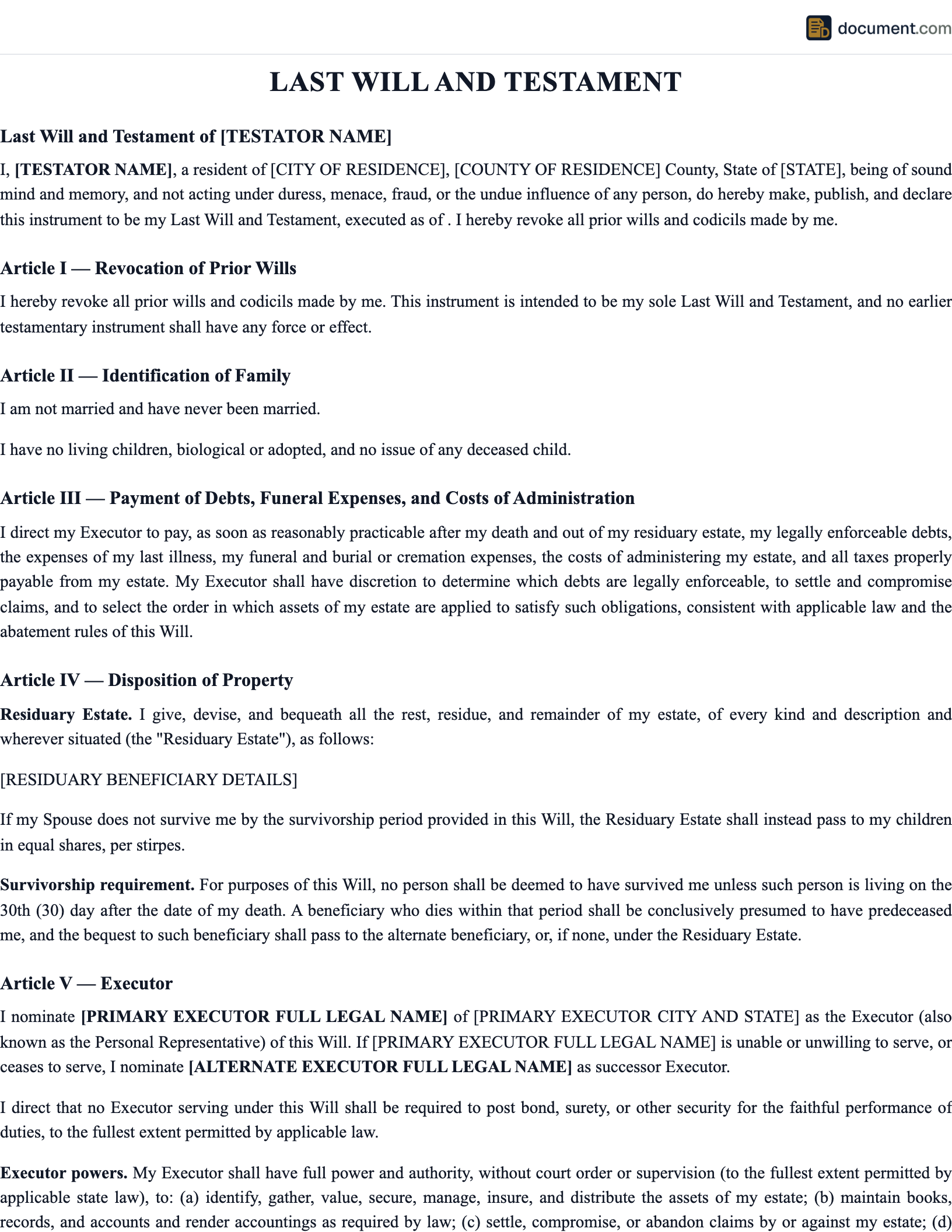
Sample Last Will and Testament
Below is a condensed preview of our last will and testament template. This sample shows the structure, language, and sections included in our attorney-reviewed documents. Your completed will is fully customized for your state, family situation, distribution plan, and executor designations.
LAST WILL AND TESTAMENT
of [Full Legal Name]
ARTICLE I: DECLARATION
I, [Full Legal Name], a resident of [City, County, State], being of sound mind and memory, do hereby declare this to be my Last Will and Testament. I hereby revoke all prior wills and codicils made by me at any time.
ARTICLE II: FAMILY
I am married to [Spouse Name]. I have the following children:[Child Names and DOBs].
ARTICLE III: SPECIFIC BEQUESTS
I give [Description of Item] to[Beneficiary Name]. If the named beneficiary does not survive me, this bequest shall[lapse / pass to alternate]...
ARTICLE IV: RESIDUARY ESTATE
I give the rest, residue, and remainder of my estate, both real and personal, of whatever kind and wherever situated, to [Residuary Beneficiary]. If the above-named beneficiary does not survive me, I direct that the residuary estate be distributed to [Alternate Beneficiaries], in equal shares, per stirpes...
ARTICLE V: EXECUTOR
I appoint [Executor Name] as Executor of this Will. If my named Executor is unable or unwilling to serve, I appoint[Alternate Executor] as alternate Executor. I direct that my Executor serve without bond and with full powers of independent administration to the fullest extent permitted by law...
ARTICLE VI: GUARDIAN FOR MINOR CHILDREN
If my spouse does not survive me, I nominate [Guardian Name] as guardian of the person and property of my minor children. If the named guardian is unable or unwilling to serve, I nominate [Alternate Guardian]...
ARTICLE VII: NO-CONTEST CLAUSE
If any beneficiary under this Will, directly or indirectly, contests or attacks this Will or any of its provisions, any bequest or devise to that beneficiary shall be revoked and shall be disposed of as if that beneficiary had predeceased me without issue...
Frequently Asked Questions
Find answers to common questions about last wills and testaments, probate, executors, beneficiaries, and the legal requirements for creating a valid will.
Official Resources
For additional information on wills, probate, and estate planning, consult these official and reputable resources.
ABA - Estate Planning Resources
American Bar Association resources on wills, trusts, and estate planning
ULC - Uniform Probate Code
Uniform Law Commission information on the UPC and state adoption
AARP - How to Write a Will
Comprehensive guide to creating a will from AARP
Nolo - Wills & Estate Planning
Free legal information on wills, probate, and estate planning
IRS - Estate and Gift Taxes
Federal estate tax thresholds, exemptions, and filing requirements
CFPB - Managing Someone Else's Money
Consumer Financial Protection Bureau fiduciary guides for executors
Create your Last Will Testament in under 10 minutes.
Answer a few questions and download a compliant, attorney-drafted document ready for your state.