
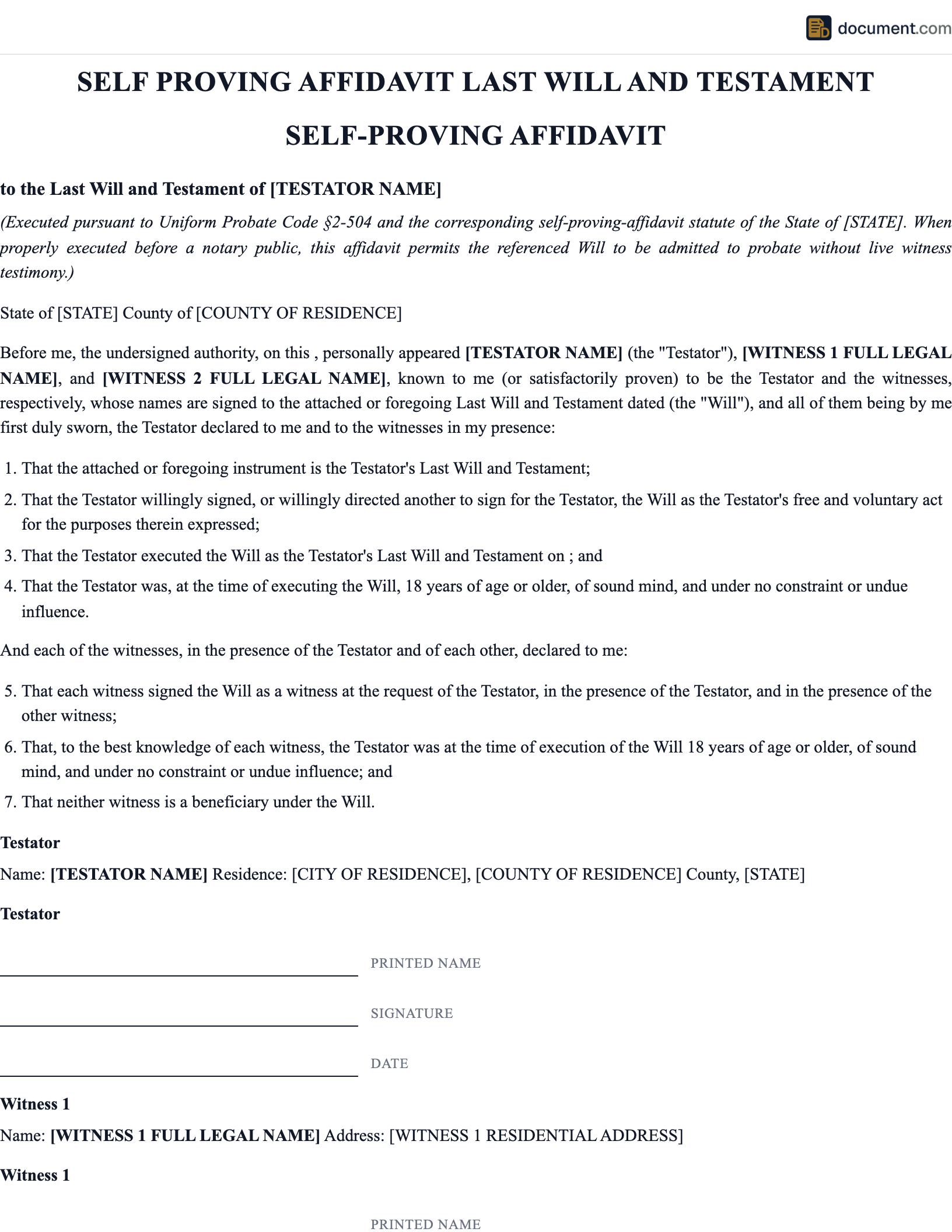



What Is a Self-Proving Affidavit?
A self-proving affidavit is a sworn, notarized statement attached to a last will and testament in which the testator and the attesting witnesses swear under oath that the will was executed with all formalities required by state law. The affidavit functions as preserved witness testimony, capturing the execution ceremony's validity at the moment it occurs so that the will can be admitted to probate years or decades later without the witnesses having to appear in court. UPC § 2-504 governs the modern form, and 47 states have adopted it in some version.
Before the Uniform Probate Code's adoption in 1969, virtually every will admitted to probate required live testimony from the original attesting witnesses. When witnesses had died, moved away, or could not be located, executors faced expensive and sometimes impossible probate challenges. The alternative-proof procedures of the era (handwriting expert testimony, familiar witness depositions, attorney-drafter testimony under prior versions of the Massachusetts and New York probate codes) added 6 to 18 months to most probates and several thousand dollars in litigation costs. UPC § 2-504 solved the problem by authorizing the self-proving affidavit, which captures the witnesses' sworn testimony at the moment of execution and stores it in permanent form attached to the will.
UPC § 2-504 and elimination of live witness testimony at probate
Section 2-504(c) provides that the affidavit conclusively establishes the facts recited at probate. The probate court is bound to accept the affidavit as proof of due execution unless an interested party affirmatively challenges the affidavit's truthfulness. Even then the burden of proof shifts to the challenger; the will's proponent does not need to produce the witnesses. States that have adopted the UPC form (Arizona, Colorado, Hawaii, Idaho, Maine, Michigan, Minnesota, Montana, Nebraska, New Mexico, North Dakota, South Dakota, Utah, and several others) treat the affidavit as substantively equivalent to in-court witness testimony. States with non-UPC forms (California Probate Code § 8220, Texas Estates Code § 251.104, Florida Stat. § 732.503) provide functionally equivalent procedural simplification.
Notarization rules and state variations across CA, TX, NY, FL
The affidavit must be notarized to function as a self-proving instrument. California Probate Code § 8220 requires the notary to administer the oath to all signers (testator and both witnesses) and to complete a jurat clause identifying the notary's commission number, expiration date, and county of notarization. Texas Estates Code § 251.104 prescribes mandatory language and treats deviations strictly; minor wording differences have been held to defeat self-proved status. New York EPTL § 3-2.1(a)(4) permits the affidavit but requires the attesting witnesses to acknowledge their signatures before the notary, and SCPA § 1406 governs supplemental affidavits obtained later. Florida Stat. § 732.503 incorporates the affidavit into the will's signature page rather than as a separate attached document, which simplifies physical attachment but requires precise integration with the witness clauses above. Always copy the state's statutory form verbatim; legal-form templates that generalize across states routinely produce defective affidavits.
The affidavit does not make a will valid; execution under UPC § 2-502 (or the parallel state statute) does that. The affidavit is a purely evidentiary device that shifts the burden of proving authenticity from post-death witness testimony to contemporaneous notarized record. A will without an affidavit is still legally valid; a will with one simply moves through probate faster and with lower administrative cost. The affidavit can be executed at the same time as the will (most common, using the contemporaneous form of UPC § 2-504(a)) or added later as a supplemental affidavit (UPC § 2-504(b)) when the original participants are still available to swear to the earlier ceremony.
UPC § 2-504 Explained
Section 2-504 of the Uniform Probate Code provides two statutory forms: one for contemporaneous execution alongside the will and one for later supplemental attestation. Both require sworn statements covering the same core facts: the testator's age and competence, voluntary execution, witness presence, and the absence of duress or undue influence.
The contemporaneous form is recited and signed in a single execution ceremony. The testator signs the will, the witnesses sign the attestation clause, and all three then appear before the notary to execute the affidavit. The supplemental form is used when a previously executed will lacks an affidavit and the original participants are still available to swear to the earlier ceremony.
States that have adopted the UPC, including Alaska, Arizona, Colorado, Hawaii, Idaho, Maine, Michigan, Minnesota, Montana, Nebraska, New Mexico, North Dakota, South Dakota, and Utah, typically reproduce § 2-504 verbatim. States that have not formally adopted the UPC (California, New York, Texas, Florida, and others) nonetheless have functionally equivalent statutory forms.
Self-Proved vs. Witness Testimony at Probate
The choice between a self-proved will and a standard witnessed will is procedural rather than substantive. The table below summarizes the practical differences that surface at probate.
| Factor | Self-Proved Will | Standard Witnessed Will |
|---|---|---|
| Probate speed | Faster, no witness hearing | Slower, witness testimony required |
| Cost to estate | Lower administrative fees | Higher (subpoena, deposition, travel) |
| Risk if witnesses die | None, affidavit preserved | High, may require handwriting proof |
| Required for validity | No | No |
| Notary required | Yes | No |
| Evidentiary weight | Prima facie valid | Rebuttable with testimony |
| Works for holographic wills | Limited, state-specific | Not applicable |
| Can be added later | Yes (supplemental form) | N/A |
Key Components of a Self-Proving Affidavit
A complete affidavit contains six discrete elements. Missing any one jeopardizes self-proved status and forces probate to revert to live witness testimony.
Jurat
The opening phrase 'sworn to and subscribed before me' identifying the notary as the officer administering the oath.
Witness Statements
Sworn assertion by each witness that the testator signed the will in their presence and appeared competent and free from undue influence.
Testator Statement
Sworn declaration by the testator that the will was signed voluntarily, with full knowledge of contents, and that the testator is at least 18.
Notary Seal and Commission
Official notarial seal, commission number, expiration date, and county of notarization.
Signature Block
Signature lines for testator, both witnesses, and the notary public, dated the same day.
State-Specific Language
Statutory recitals required by individual state probate codes where they diverge from the UPC form.
How to Execute a Self-Proving Affidavit: Six Steps
The execution ceremony is where most affidavits succeed or fail at probate. Procedural defects (missing notary seal, witness signing outside the testator's presence, beneficiary serving as notary) defeat self-proved status. Work the six steps below in a single sitting with the notary and both witnesses physically present.
Complete the will first
The testator and witnesses must first execute the underlying will in accordance with state law. The self-proving affidavit is a supplement to, not a substitute for, valid execution under UPC § 2-502.
Locate a commissioned notary public
Any state-commissioned notary may officiate, provided they are not a witness or beneficiary. Most banks, UPS Stores, and title companies offer notary services at low or no cost.
Present identification
The testator and both witnesses must produce government-issued photo identification satisfying the notary's state of commission. The notary will record the IDs in the journal.
Recite and sign the affidavit
The notary reads the affidavit aloud or presents it for review. Each party signs in the presence of the notary and the other signers.
Notary jurat and seal
The notary completes the jurat, affixes the official seal, and records the transaction in the notarial journal as required by state law.
Physically attach to will
Staple, bind, or clip the executed affidavit to the original will. Never separate the two documents, as detachment can weaken evidentiary value at probate.
Form Preview
Self-Proving Affidavit
STATE OF __________ )
COUNTY OF __________ )
We, [Testator], [Witness 1], and [Witness 2], the testator and the witnesses, respectively, whose names are signed to the attached instrument, being first duly sworn, do hereby declare to the undersigned authority that the testator signed and executed the instrument as his/her last will, that he/she signed willingly, that he/she executed it as his/her free and voluntary act for the purposes therein expressed, that each of the witnesses, in the presence and hearing of the testator, signed the will as witness, and that to the best of his/her knowledge the testator was at that time 18 or more years of age, of sound mind, and under no constraint or undue influence.
_____________________________ Testator
_____________________________ Witness
_____________________________ Witness
Subscribed, sworn to, and acknowledged before me this ______ day of __________, 20___.
_____________________________ Notary Public (SEAL)
Sample Language Variations
Excerpts from two leading state forms. Always conform to the exact statutory language in the testator's domicile state; courts in Texas in particular reject self-proved status when the form deviates from § 251.104.
Texas Estates Code § 251.104 Form
“Before me, the undersigned authority, on this day personally appeared [Testator], [Witness 1], and [Witness 2], known to me to be the testator and witnesses, respectively, whose names are subscribed to the annexed or foregoing instrument in their respective capacities, and all of said persons being by me duly sworn...”
Florida Statutes § 732.503 Form
“I, [Testator], declare to the officer taking my acknowledgment of this instrument, and to the subscribing witnesses, that I signed this instrument as my will...”
Frequently Asked Questions
Common questions about UPC § 2-504, notarization rules, supplemental affidavits, and state-specific forms.
Official Resources
Authoritative federal and state references for self-proving affidavit execution and notarial procedure.
Uniform Probate Code §2-504
Self-proved will and supplemental affidavit forms
Texas Estates Code §251.104
Texas statutory self-proving affidavit form
Florida Statutes §732.503
Florida self-proof of will procedure
National Notary Association
Notarization standards and best practices for wills
ABA Probate Resources
American Bar Association estate planning resources
Cornell LII: Wills
Cornell Legal Information Institute overview of wills law
Create your Self-Proving Affidavit in under 10 minutes.
Answer a few questions and download a notarized affidavit attached to your will, ready for probate in your state.