
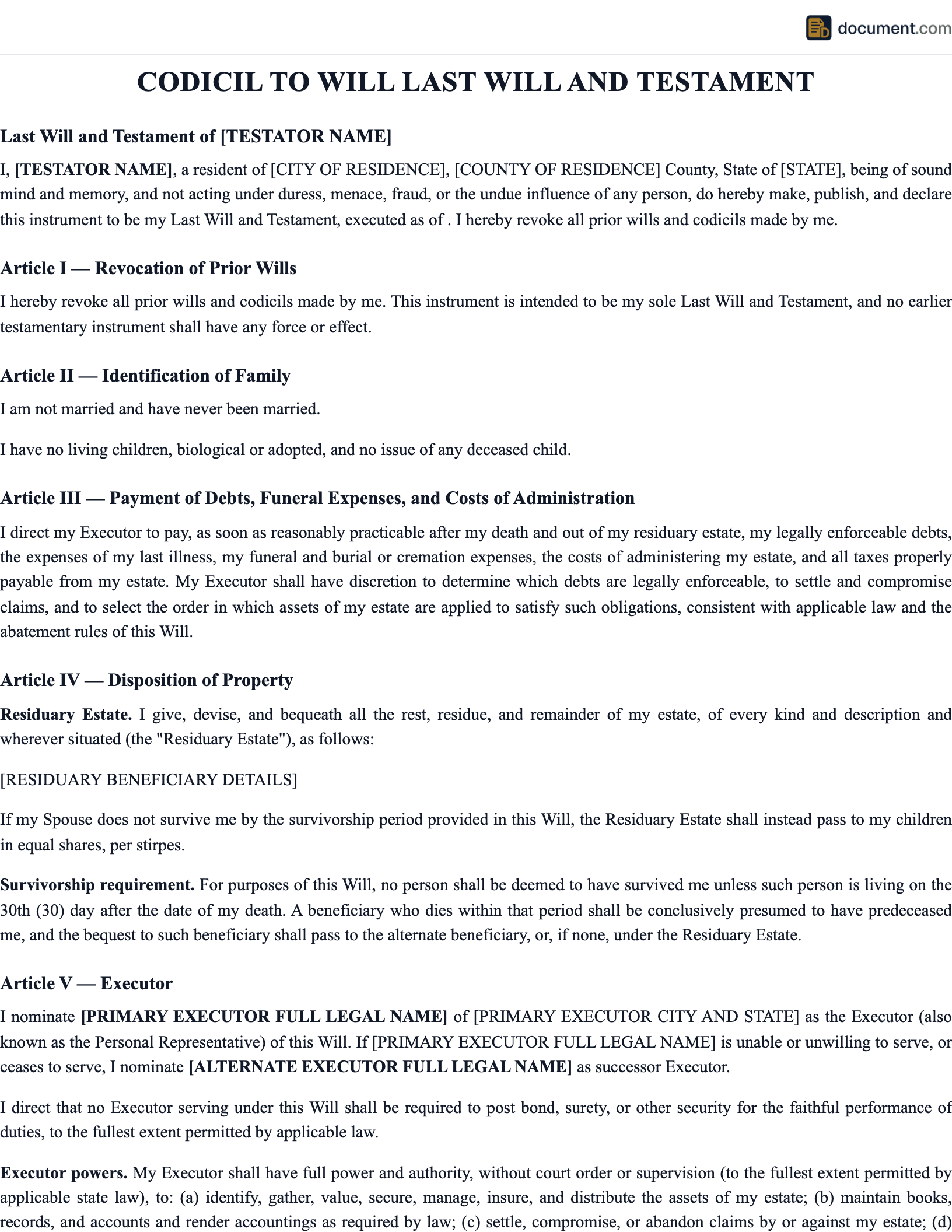



What Is a Codicil to a Will?
A codicil is a formal legal instrument that amends, supplements, or partially revokes an existing last will and testament. Unlike a new will, a codicil preserves the original document intact and surgically modifies specific provisions: an executor change, a new bequest, a revised guardian nomination, the removal of a deceased beneficiary. The codicil operates alongside the underlying will, and the two are read together as a single testamentary plan when admitted to probate. Probate courts in every U.S. jurisdiction recognize codicils provided they satisfy the same execution formalities as the underlying will.
The codicil traces its lineage to English ecclesiastical courts and the Statute of Wills (1540), which the Uniform Probate Code § 2-502 and individual state probate codes have refined over the past century. In every U.S. jurisdiction, a codicil must be executed with the same formalities as the original will: a competent testator (UPC § 2-501 requires age 18 and sound mind), a written document, the testator's signature, and (except in holographic-recognizing states) the attestation of two disinterested adult witnesses signing in the testator's presence. The Restatement (Third) of Property: Wills and Other Donative Transfers § 3.1 codifies the modern doctrinal framework.
Republication doctrine and its consequences
The legal doctrine of republication by codicil gives the codicil unusual power. When properly executed, a codicil treats the original will as re-executed on the codicil date. This carries three significant consequences. First, provisions of the will that would otherwise have lapsed under the state anti-lapse statute (UPC § 2-603 in 18 states; California Probate Code § 21110; New York EPTL § 3-3.3) are revived for analysis as of the codicil date. Second, gifts to beneficiaries who had become disqualified between the original will date and the codicil date (a divorced spouse under UPC § 2-804, an interested witness under § 2-505) may be unintentionally reactivated. Third, the testator's domicile at the codicil date may govern interpretive questions previously controlled by the original will's domicile. Always review the entire underlying will, not just the clause being changed, before executing any codicil.
Execution must match will formalities under UPC § 2-502
The execution requirements run state by state but converge on a common pattern. UPC § 2-502 (adopted in Arizona, Colorado, Hawaii, Idaho, Maine, Michigan, Minnesota, Montana, Nebraska, New Mexico, North Dakota, South Dakota, Utah, and others) requires the testator's signature in the conscious presence of at least two witnesses, who must then sign within a reasonable time. California Probate Code § 6110 imposes substantially the same requirements. Florida Stat. § 732.502 requires the witnesses to sign in the testator's presence and in the presence of each other. Texas Estates Code § 251.051 requires two credible witnesses age 14 or older. Vermont historically required three witnesses; conformed to two in 2005. Louisiana Civil Code Article 1577 imposes a notarial-will format with two witnesses and notary. A codicil executed with formalities below the underlying will's standard is void.
Codicils made sense in an era when wills were laboriously typed on legal-size paper and re-execution was costly. Today, most estate planners recommend restating the entire will whenever changes are substantial. Codicils remain appropriate, however, for narrow updates: adding a single specific bequest, correcting an executor's name, or adjusting a small percentage allocation without disturbing the rest of the dispositive plan. The decision between codicil and restatement is the central drafting choice and is addressed in the next section.
Codicil vs. New Will: Which Should You Use?
Whether to amend with a codicil or replace with a new will depends on three variables: the scope of the change, the age of the original document, and the complexity of the estate. The drafting axiom most probate practitioners follow: more than two codicils on a single will and the next change should be a complete restatement. Stacked codicils accumulate interpretive ambiguity, and probate courts resolve ambiguity unpredictably and expensively. The comparison below summarizes the practical considerations that drive the decision.
| Factor | Codicil | New Will (Restatement) |
|---|---|---|
| Best for | One or two narrow changes | Multiple changes or major life events |
| Cost | Lower (shorter document) | Slightly higher |
| Probate clarity | Two documents read together | Single, self-contained instrument |
| Risk of contradiction | Higher with each added codicil | None, prior will is revoked |
| Execution formalities | Same as original will | Same as original will |
| Republishes prior will | Yes (UPC doctrine) | No, prior will is expressly revoked |
| Recommended after divorce | No | Yes |
| Recommended after relocation to new state | No | Yes, execution rules differ |
Key Components of a Valid Codicil
A legally enforceable codicil must contain six distinct elements. Missing any one of them can render the document void or expose it to probate challenge. The execution ceremony must satisfy state law in every detail; courts strike codicils for procedural defects more often than for substantive flaws.
Identification of Testator and Original Will
Full legal name, county and state of residence, and the precise execution date of the will being amended.
Declaration of Testamentary Intent
Clear language declaring the document to be a codicil to the prior will rather than a separate testamentary instrument.
Specific Amendments
Article and paragraph references identifying which provisions are revoked, modified, or added.
Republication Clause
An express statement republishing and confirming all unaffected provisions of the original will.
Witness Attestation
Signatures of at least two competent adult witnesses (three in some historical Vermont practice) who have no beneficial interest under the will.
Self-Proving Affidavit
Optional but strongly recommended notarized affidavit under UPC §2-504 that allows admission to probate without later witness testimony.
How to Execute a Codicil: Six Steps
The execution ceremony is where most codicils succeed or fail at probate. Procedural defects (witness not signing in testator's presence, witness signing outside a reasonable time, beneficiary serving as witness) doom the document regardless of substantive merit. Work the six steps below in a single sitting with both witnesses physically present.
Locate and review the original will
Retrieve the original signed will and read it in full. Identify every provision that may be affected by the proposed change, not just the obvious target clause, because the doctrine of republication can revive lapsed gifts and reactivate disqualified beneficiaries.
Draft the codicil
Use precise article and paragraph references. State whether each amendment revokes, modifies, or adds language. Include a republication clause confirming all unaffected provisions of the original will remain in full force.
Assemble two disinterested witnesses
Witnesses must be adults (18 or older), mentally competent, and not named as beneficiaries in either the will or the codicil. Avoid family members, household employees, and the executor's spouse.
Sign in the witnesses' presence
The testator must sign or acknowledge the codicil in the conscious presence of both witnesses, who must then sign in the testator's presence. Most state statutes require contemporaneous attestation in a single execution ceremony.
Add the self-proving affidavit
After execution, the testator and witnesses appear before a notary public and sign the affidavit attesting that the formalities were observed. This step is optional but eliminates the need to track down witnesses years later.
Store with the original will
Place the executed codicil in the same secure location as the original will: a fireproof safe, attorney's vault, or county will registry. Do not staple, clip, or attach it in a way that creates marks of physical removal.
Form Preview
First Codicil to the Last Will and Testament of
[Testator Full Legal Name]
I, [Testator], a resident of [County], [State], being of sound mind and memory and not acting under duress or undue influence, do hereby make, publish, and declare this instrument to be the First Codicil to my Last Will and Testament dated [Original Will Date].
Article I. Amendment to Article IV. I hereby revoke Paragraph 2 of Article IV of my said Will in its entirety and substitute the following in its place: [New language].
Article II. Republication. In all other respects, I hereby ratify, confirm, and republish my said Will dated [Original Will Date].
IN WITNESS WHEREOF, I have hereunto set my hand this ______ day of __________, 20___.
_____________________________ (Testator)
Witness #1: _______________________ Address: _______________________
Witness #2: _______________________ Address: _______________________
Sample Codicil Language
The following are tested clause patterns drawn from probate-court-tested templates. They are illustrative only; always conform language to your state's execution statute.
Changing an Executor
“I hereby revoke the appointment of [Original Executor] as Executor of my Will and in his/her place appoint [New Executor], to serve without bond.”
Adding a Specific Bequest
“I give and bequeath my [item description] to [beneficiary name], if he/she survives me. If [beneficiary] does not survive me, this bequest shall lapse and become part of my residuary estate.”
Removing a Beneficiary
“I hereby revoke any and all gifts, bequests, devises, and appointments in favor of [Former Beneficiary] contained in my said Will. It is my intention that [Former Beneficiary] take nothing under my Will or this Codicil.”
Frequently Asked Questions
Common questions about codicil execution, witness requirements, republication, and state-specific rules.
Official Resources
Authoritative federal and state references for codicil execution and probate procedure.
Uniform Probate Code §2-502
Execution requirements for witnessed wills under the UPC
Uniform Probate Code §2-504
Self-proved will and supplemental affidavit forms
ABA Estate Planning Resources
American Bar Association resources on wills and probate
Cornell LII: Wills
Cornell Legal Information Institute overview of wills law
NAEPC
National Association of Estate Planners & Councils
NAELA
National Academy of Elder Law Attorneys
Create your Codicil to Will in under 10 minutes.
Answer a few questions and download a compliant, attorney-drafted codicil ready for your state.