



What Is an Advance Directive?
An advance directive is a written healthcare-planning instrument executed under the state Healthcare Decisions Act that records the patient's treatment preferences in the event of decisional incapacity and appoints an agent authorized to make medical decisions when the patient cannot. In most states the document combines two historically separate components: a living will (treatment preferences in end-of-life or permanent-unconsciousness scenarios under California Probate Code §4670 and Florida Stat. §765.302) and a healthcare power of attorney (agent appointment under California Probate Code §4671 and Texas Health and Safety Code §166.151). The Patient Self-Determination Act, 42 U.S.C. §1395cc(f), requires Medicare and Medicaid providers to ask every adult patient on admission whether they have an advance directive and to honor it consistent with state law.
The instrument's core function is to translate the patient's values into actionable guidance for clinicians during a crisis. Without a directive, treatment decisions for incapacitated patients fall to the state's surrogate hierarchy (typically spouse, then adult children, then parents, then siblings) under statutes like Florida Stat. §765.401 or New York Family Health Care Decisions Act PHL §2994. That hierarchy produces deadlock when adult children disagree on a feeding-tube placement, or family conflict when an estranged spouse retains decision-making authority. A directive forecloses both problems by naming the agent and stating the preferences in writing, with a HIPAA authorization under 45 C.F.R. §164.508 enabling the agent to receive the medical information needed to act.
A well-drafted directive balances specificity and flexibility. Specificity matters for the predictable end-of-life scenarios: the patient's preferences on mechanical ventilation, artificial nutrition and hydration, dialysis, antibiotics in end-stage condition, and palliative sedation should be stated explicitly. Flexibility matters for the unpredictable: the agent must have authority to make decisions the directive does not anticipate, ranging from a time-limited trial of intensive care to a transfer between facilities. Pair the directive with a POLST or MOLST when illness becomes serious so that the patient's preferences translate into actionable EMS-compatible medical orders.
HIPAA authorization for the healthcare agent
The HIPAA Privacy Rule at 45 C.F.R. §164.508 restricts a covered entity's disclosure of protected health information except for treatment, payment, and healthcare operations or with a valid authorization. The healthcare agent has implied authority to receive the PHI needed to make treatment decisions, but hospitals and physician practices routinely demand a written authorization before releasing records, lab results, imaging, or care discussions. Embed a HIPAA authorization within the advance directive that names the agent, the alternate agent, and any other family members who should receive information; specifies that the authorization survives the patient's incapacity and continues until revoked in writing; and identifies covered information categories including general medical records, billing, mental-health records, substance-use treatment records, and HIV status. Without this language the agent's appointment is partially neutralized by Privacy Rule restrictions and providers will refuse to share information at the moment it is most needed.
Patient Self-Determination Act and POLST integration
The Patient Self-Determination Act, 42 U.S.C. §1395cc(f) and 42 U.S.C. §1396a(w), conditions Medicare and Medicaid participation on the provider's offer of advance-directive information at admission, documentation in the medical record of whether the patient has a directive, education of staff and community on advance directives, and honoring of valid directives consistent with state law. The PSDA does not create the directive; it guarantees that patients are reminded of the option at every healthcare encounter. POLST (Physician Orders for Life-Sustaining Treatment, called MOLST in New York and POST in West Virginia) translates the directive's preferences into actionable medical orders signed jointly by the patient and an authorized clinician for patients with serious illness or frailty. National POLST Paradigm forms are recognized in 47 states. Use the directive to establish values and the agent; use POLST to operationalize the values when illness becomes serious.
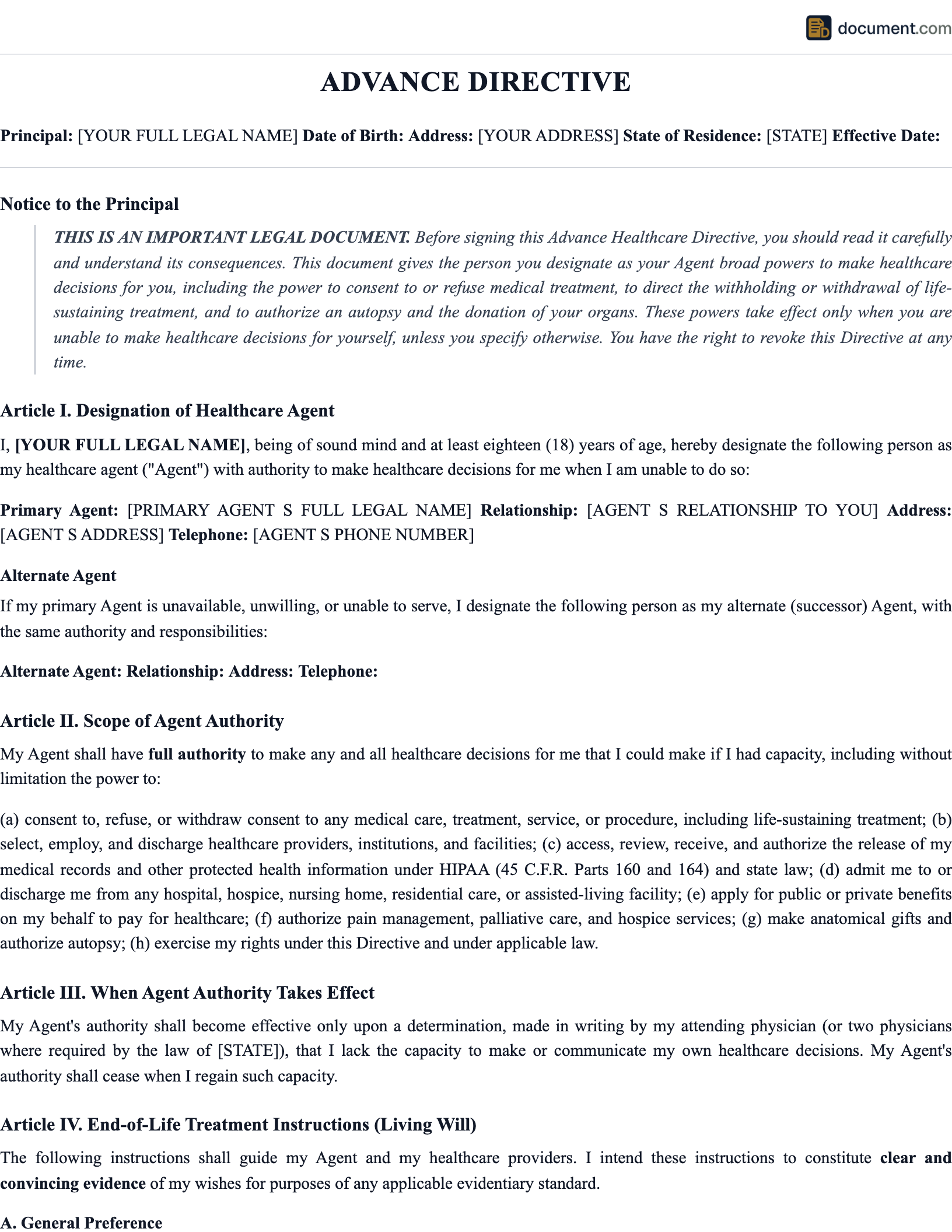
Advance Directive Form Preview
Most advance directives follow a predictable structure: an appointment of agent, written treatment instructions, communication/privacy language, and a signature block that meets the state's formal execution rules.
Advance Directive
Combined healthcare instructions and agent appointment
1. Appointment of Healthcare Agent
Names the person authorized to communicate with doctors and make medical decisions when you cannot.
2. Treatment Instructions
Addresses life support, artificial nutrition, pain relief, comfort measures, and related care preferences.
3. Privacy and Records Access
Allows providers to share health information with the people you trust to carry out your wishes.
4. Signatures
Includes the witness and notary language required for your directive to be respected under state law.
What an Advance Directive Includes
Living Will Instructions
States the treatment you want or refuse if you lose decisional capacity and your condition meets the statutory trigger (terminal condition, permanent unconsciousness, or end-stage condition under most state acts).
Healthcare Agent Appointment
Names the person authorized under the state Healthcare Decisions Act to speak with treating physicians, review treatment options, consent to or refuse care, and make decisions the written instructions do not address.
HIPAA Authorization
Authorizes providers to release protected health information to the named agent under 45 C.F.R. §164.508, an essential addition because the federal HIPAA Privacy Rule otherwise restricts disclosure even to family members.
Advance Directive vs Other Documents
These documents overlap and the terminology varies by state, but each serves a distinct legal function under the state Healthcare Decisions Act. The advance directive is the broadest container; the living will, healthcare power of attorney, POLST, and DNR each address narrower slices of the planning problem. A complete healthcare-planning packet typically includes an advance directive plus a POLST when illness becomes serious. The state-specific terminology matters: New York uses Health Care Proxy under PHL §2981 and a separate Living Will; California consolidates into one Advance Health Care Directive under Probate Code §4701; Florida uses a Designation of Health Care Surrogate under Stat. §765.203 plus a separate Living Will under §765.302.
Advance Directive
Combines treatment instructions and the appointment of a healthcare decision-maker in one document. Authorized under the Patient Self-Determination Act, 42 U.S.C. §1395cc(f), and the state Healthcare Decisions Act.
Living Will
Narrower document focused on treatment preferences in end-of-life or permanent-unconsciousness scenarios. California Probate Code §4670 and Florida Stat. §765.302 set the statutory framework. Does not appoint an agent unless paired with a healthcare power of attorney.
Medical Power of Attorney
Appoints an agent under state Healthcare Decisions Act authority but typically lacks the written treatment detail of a living will. Best paired with a separate living will or merged into a combined advance directive.
How to Create an Advance Directive
Choose the right healthcare agent
Select an agent who is calm under pressure, geographically available, willing to follow your stated wishes even under family pressure to deviate, and not disqualified by state law (most states bar treating physicians, employees of treating facilities, and witnesses to the directive from serving as agent under California Probate Code §4659 and similar provisions).
Clarify your treatment goals across the spectrum
Address mechanical ventilation, artificial nutrition and hydration via feeding tube, cardiopulmonary resuscitation, dialysis, antibiotic use in end-stage condition, palliative sedation, and time-limited trials of intensive treatment. Use the Five Wishes framework or CaringInfo state-specific forms as a checklist.
Match your state's statutory form
California uses the Advance Health Care Directive form under Probate Code §4701; Florida uses a designation under Stat. §765.203; New York uses a Health Care Proxy under PHL §2981 plus a separate Living Will. Out-of-state directives are typically honored under state portability statutes and the Uniform Health Care Decisions Act, but local forms reduce friction in emergency rooms.
Name alternate agents and provide complete contact data
Name a primary agent and at least one alternate. Include cell phone, email, mailing address, and relationship for each. Hospitals routinely cannot reach the primary agent during a crisis, and the directive becomes useful only when the alternate is reachable in 30 minutes.
Sign with the state-specified formalities
California Probate Code §4673 requires either two adult witnesses or a notary; the witnesses cannot include the agent, the patient's healthcare provider, or anyone who would inherit. Florida Stat. §765.202 requires two adult witnesses, one of whom is not a spouse or blood relative. Texas Health and Safety Code §166.032 requires two witnesses or a notary. Misexecution voids the directive in many states.
Distribute, register, and review every five years
Provide signed copies to the primary agent, the alternate, the primary care physician, the local hospital's medical-records department for filing in the EHR, and the family member most likely to be present during a crisis. Register with the state directive registry where available (Arizona, Vermont, North Carolina, and Washington maintain public registries). Review and reaffirm every five years or after any major health change.
Key Components
Identification of the declarant with date of birth and address
Appointment of primary and alternate healthcare agents with full contact data
Specific guidance on life-sustaining treatment by treatment modality
Instructions on pain relief, hospice, and comfort-care preferences
HIPAA authorization under 45 C.F.R. §164.508 for agent access to records
Witness or notarization blocks meeting state Healthcare Decisions Act formalities
Legal Requirements
California Probate Code §4673 requires either two adult witnesses (with statutory disqualifications under §4674) or notarization; one witness must not be related by blood, marriage, or adoption.
Florida Stat. §765.202 requires two adult witnesses, at least one of whom is not the spouse or a blood relative of the principal; notarization is not required.
Texas Health and Safety Code §166.032 requires either two qualified adult witnesses or notarization; the agent and the patient's healthcare provider are disqualified as witnesses under §166.003.
New York Public Health Law §2981 requires the Health Care Proxy to be signed in the presence of two adult witnesses, with the agent and the alternate disqualified.
The Patient Self-Determination Act, 42 U.S.C. §1395cc(f), requires Medicare and Medicaid providers to ask every adult patient on admission whether they have an advance directive and to document the answer.
An advance directive may be revoked at any time by writing, by oral notice to a treating provider, or by physical destruction of the document under most state Healthcare Decisions Acts.
Sample Advance Directive
ADVANCE DIRECTIVE
Appointment of Agent: I appoint the person named below to make healthcare decisions if I become unable to do so.
Treatment Preferences: My wishes regarding life support, nutrition, hydration, and comfort-focused care are as follows.
Access to Information: My agent may receive information needed to carry out these instructions.
Execution: I sign this directive voluntarily in the presence of the required witnesses and/or notary.
Frequently Asked Questions
Official Resources
National Institute on Aging
Advance care planning guidance with practical explanations of directives and healthcare agents.
CaringInfo
National resource center with state-specific advance directive information.
American Bar Association
Legal guidance on healthcare decision-making and document selection.
Prepare for Your Care
Consumer tool for thinking through healthcare values and decision-maker choices.
Ready to Create Your Advance Directive?
Build a directive that documents your treatment wishes and names the person who can speak for you when it matters most.
Create DocumentNo account required. Free to create and preview.