
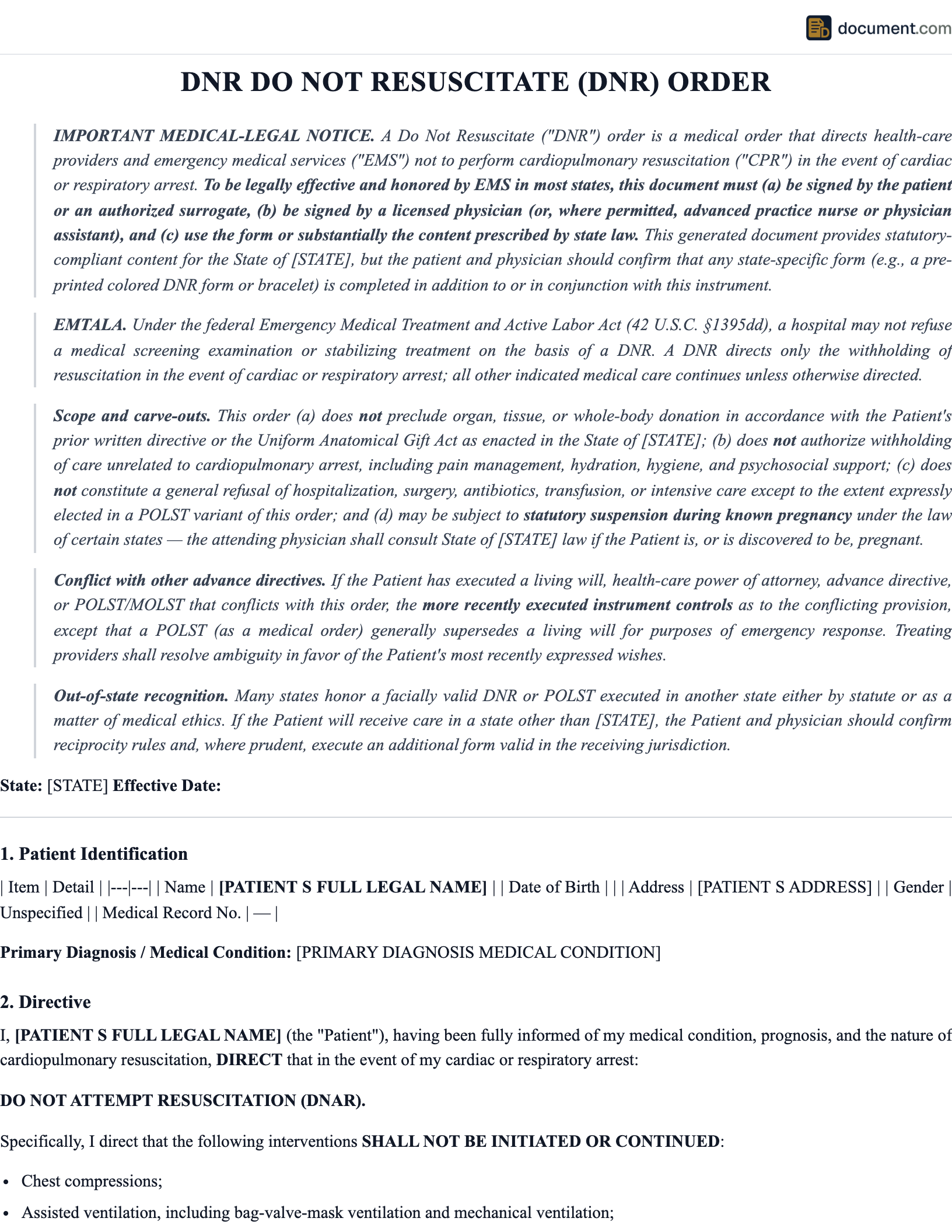



What Is a Do Not Resuscitate (DNR) Order?
A Do Not Resuscitate (DNR) order is a medical directive that instructs healthcare providers not to perform cardiopulmonary resuscitation (CPR) if a patient's heart stops beating (cardiac arrest) or if the patient stops breathing (respiratory arrest). CPR is an umbrella term for a range of emergency interventions including chest compressions, mouth-to-mouth or mechanical ventilation, electrical defibrillation, endotracheal intubation, and the administration of cardiac medications. A DNR order means none of these interventions will be attempted — the patient will be allowed to die naturally if cardiac or respiratory arrest occurs.
A DNR is fundamentally different from other advance planning documents because it is a medical order, not merely a statement of personal preference. While a living will expresses your wishes and a healthcare power of attorney designates someone to speak for you, a DNR is a physician's order that is entered into your medical record and immediately actionable by any medical professional who encounters it. This distinction matters in emergency situations: EMS personnel responding to a 911 call can act on a valid DNR order without needing to contact a physician, whereas they generally cannot act on a living will alone.
The decision to establish a DNR is deeply personal and typically arises in one of several contexts. Patients with terminal illnesses may choose a DNR because CPR is unlikely to restore meaningful life and may cause additional suffering. Elderly patients with multiple serious conditions may decide that the burdens of resuscitation outweigh the potential benefits. Patients in hospice care almost always have DNR orders because the focus of care has shifted from curative treatment to comfort. And some individuals, regardless of current health, simply prefer a natural death over aggressive medical intervention if their heart or breathing stops.
It is critically important to understand what a DNR does notdo. A DNR does not mean "do not treat." Patients with DNR orders continue to receive all other medically appropriate care — including medications, antibiotics, surgery, chemotherapy, dialysis, pain management, oxygen therapy, and nutritional support. The DNR applies only to the specific scenario of cardiac or respiratory arrest. If you wish to limit medical treatments beyond CPR, you need additional documents such as a POLST (Physician Orders for Life-Sustaining Treatment), living will, or advance directive.
Our templates help you prepare the documentation needed to establish a DNR order in your state, including the proper physician signature blocks, patient identification sections, witness or notarization requirements, and out-of-hospital DNR provisions that EMS personnel will recognize and honor. We also provide guidance on coordinating your DNR with other advance planning documents to ensure comprehensive coverage of your end-of-life medical preferences.
Clear Directive
Provides unambiguous instructions to medical personnel about resuscitation preferences
Medical Order
Signed by a physician and immediately actionable by all healthcare providers and EMS
Patient Autonomy
Ensures your resuscitation preferences are respected in emergency situations
DNR Order Form Preview
Below is a visual preview of the sections and fields included in a standard DNR order form. This mockup illustrates the structure of both in-hospital and out-of-hospital DNR documentation. Your completed form will include your state's specific requirements and proper physician certification language.
Out-of-Hospital Do Not Resuscitate Order
Prehospital Medical Directive
Section 1: Patient Information
Section 2: Do Not Resuscitate Directive
DO NOT RESUSCITATE (DNR)
"If the above-named patient is found in cardiac or respiratory arrest, no resuscitation measures shall be initiated. No chest compressions, no defibrillation, no intubation, no artificial ventilation, and no cardiac medications shall be administered for the purpose of resuscitation."
Section 3: Healthcare Agent / Surrogate
Section 4: Physician Certification & Signatures
I have discussed this DNR order with the patient (or the patient's authorized decision-maker). The patient (or decision-maker) understands the implications of this order and has given informed consent.
Attending Physician Signature
Patient / Surrogate Signature
DNR vs POLST/MOLST: Understanding the Difference
The DNR and the POLST are the two most commonly confused end-of-life medical order forms. While they share some overlap, they serve different purposes and cover different treatment decisions.
DNR Order
- - Addresses only CPR (cardiac/respiratory arrest)
- - Binary decision: resuscitate or do not resuscitate
- - Does not address other treatments
- - Available to any adult patient
- - Relatively simple, focused document
- - Recognized in all 50 states
POLST/MOLST
- - Addresses multiple treatment decisions
- - Covers CPR, intubation, antibiotics, feeding tubes
- - Specifies level of intervention desired
- - Intended for seriously ill patients
- - Comprehensive, multi-section medical order
- - Available in most but not all states
When to use which: If you only want to address resuscitation, a DNR is sufficient. If you have a serious illness and want to communicate preferences about multiple treatment categories (including resuscitation, hospitalization, intubation, and artificial nutrition), a POLST is the more comprehensive tool. Many patients with serious illnesses have both a DNR (for immediate EMS recognition) and a POLST (for broader treatment guidance).
DNR vs Other Advance Care Documents
A DNR is one component of a broader advance care planning framework. Understanding how it relates to other documents ensures you have comprehensive coverage of your healthcare preferences.
DNR vs Living Will
DNR Order
- - Is a medical order signed by a physician
- - Immediately actionable by EMS and hospital staff
- - Addresses only resuscitation
- - Applies at any time, not just end-of-life
Living Will
- - Is a legal document signed by the patient
- - Expresses wishes but requires physician interpretation
- - Addresses multiple end-of-life treatments
- - Typically activates only in terminal or vegetative states
Key difference: A living will tells your doctors what you want; a DNR is a doctor's order reflecting what you want. EMS can act directly on a DNR but generally cannot interpret or act on a living will in the field.
DNR vs Advance Directive
DNR Order
- - Narrow scope: CPR only
- - Requires physician involvement
- - Immediately binding on medical staff
- - Does not designate a decision-maker
Advance Directive
- - Broad scope: all medical decisions
- - Created by the patient independently
- - Guides but does not directly order treatment
- - Often includes healthcare proxy designation
Best practice:An advance directive is the foundation of your healthcare planning — it designates your healthcare agent and outlines your treatment preferences broadly. A DNR is a specific medical order that implements one aspect of those preferences. Ideally, your advance directive's resuscitation preferences should align with your DNR status.
DNR vs Healthcare Proxy / Medical POA
DNR Order
- - States a specific treatment decision
- - No agent needed — the order speaks for itself
- - Applies to one scenario (cardiac/respiratory arrest)
Healthcare Proxy / Medical POA
- - Designates a person to make decisions
- - Agent uses judgment for all medical situations
- - Covers all healthcare decisions broadly
Why have both: Your healthcare agent can request a DNR on your behalf if you lose capacity. Having both ensures that your CPR preferences are documented as a standing order and that a trusted person can make other medical decisions as situations arise.
How to Obtain a DNR Order: A 7-Step Guide
Unlike a living will or advance directive that you can create on your own, a DNR order requires a physician's involvement because it is a medical order. Follow these steps to establish a valid DNR in your state.
Discuss Your Wishes with Your Physician
Schedule a dedicated appointment to discuss your end-of-life care preferences with your primary care physician. Be prepared to discuss your understanding of your medical condition and prognosis, why you are considering a DNR, what treatments you do and do not want beyond CPR, and whether you have other advance planning documents in place. Your physician will explain the implications of a DNR, the realistic outcomes of CPR given your specific health status, and help you make an informed decision.
Determine the Type of DNR You Need
Decide whether you need an in-hospital DNR (if you are currently hospitalized or entering a care facility), an out-of-hospital DNR (if you want the order to apply at home, in assisted living, or in public), or both. If you are being discharged from a hospital with a DNR, the hospital social worker or discharge planner can help you obtain the out-of-hospital version. Also consider whether a POLST would be more appropriate for your situation, as it covers additional treatment decisions beyond resuscitation.
Obtain Your State's Official DNR Form
Most states have official DNR forms that must be used for the order to be recognized by EMS and healthcare facilities. These forms are typically available from your state's department of health, your physician's office, hospitals, or through our state-specific templates. Some states require the form to be printed on a specific color paper (often orange or yellow) for easy identification by EMS personnel.
Complete and Sign the Form
Fill in the patient identification information, sign the form (or have your authorized surrogate sign if you lack capacity), and have your attending physician sign and date the form. Some states require additional signatures from witnesses, the patient's healthcare agent, or a second physician. Your physician will enter the DNR order into your medical record and provide you with copies of the signed form.
Obtain a DNR Bracelet or Medical ID (If Available)
Many states offer official DNR identification bracelets or medallions that alert EMS personnel to your DNR status when they encounter you outside a healthcare facility. These are particularly important for patients who spend time outside their home, as EMS may not have access to your paper DNR form in an emergency. Contact your state health department or ask your physician about enrollment in your state's DNR identification program.
Display and Distribute the DNR
Post the out-of-hospital DNR form in a visible location in your home — the refrigerator door, inside the front door, or at your bedside. Provide copies to your healthcare agent, family members, all treating physicians, your pharmacy, and any care facilities you use. If you are in a nursing home or assisted living facility, ensure the DNR is prominently noted in your medical chart at the facility.
Review and Communicate Regularly
Discuss your DNR status with family members and your healthcare agent so they understand and can advocate for your wishes. Review the DNR periodically — especially after changes in health status, hospitalization, or a new diagnosis — to confirm it still reflects your preferences. If you move to a new state, obtain a new DNR on that state's official form, as your out-of-state form may not be recognized by local EMS.
Key Components of a DNR Order
A valid DNR order must contain specific elements to be recognized and honored by healthcare providers and emergency medical services. Missing or incomplete components can result in the DNR being disregarded in an emergency.
| Component | Description |
|---|---|
| Patient Identification | Full name, date of birth, gender, and partial Social Security number for positive identification by EMS |
| DNR Directive | Clear statement that no CPR, defibrillation, intubation, or cardiac medications are to be administered for cardiac or respiratory arrest |
| Comfort Care Instructions | Specification of comfort measures that should still be provided (oxygen, pain management, suctioning, positioning) |
| Physician Signature | Attending physician's signature, printed name, license number, and date — the element that makes it a medical order |
| Patient / Surrogate Signature | Signature of the patient or authorized surrogate decision-maker confirming informed consent |
| Healthcare Agent Contact | Name and contact information for the patient's healthcare agent or next of kin |
| Hospice Information | If applicable, the name and contact information of the patient's hospice provider |
| Revocation Instructions | Statement that the patient may revoke the DNR at any time by verbal or written communication |
| State-Specific Identifiers | Form number, color designation, registry information, and any state-required formatting elements |
Types of DNR Orders
DNR orders come in several forms, each designed for different settings and circumstances. Understanding which type you need ensures your resuscitation preferences are honored wherever you are.
In-Hospital DNR
A medical order within a healthcare facility's chart system. Entered by the attending physician after discussion with the patient or surrogate. Applies only within the facility where it was entered. Must be renewed or transferred if the patient moves to a different facility.
Out-of-Hospital DNR
A portable medical order designed for use outside healthcare facilities — at home, in assisted living, or in public. Must be on the state's official form to be recognized by EMS. Often printed on distinctive colored paper for quick identification by first responders.
DNR Comfort Care
Used in some states as an enhanced DNR that specifies comfort measures to be provided while withholding resuscitation. May include instructions for oxygen administration, pain management, suctioning, and other palliative interventions that do not constitute resuscitation.
DNR Comfort Care - Arrest
Available in certain states, this variation permits all medical treatments up until the point of cardiac or respiratory arrest, at which time comfort measures only are provided. This differs from DNR Comfort Care, which may limit aggressive treatments before arrest occurs.
Legal Requirements for DNR Orders
DNR orders are governed by state law and EMS protocols, which vary significantly across jurisdictions. Understanding your state's specific requirements is essential for ensuring your DNR will be honored in an emergency.
- Physician Signature: All states require a licensed physician's signature on a DNR order. Some states also accept signatures from nurse practitioners (NPs) or physician assistants (PAs) under physician supervision. The physician must document that the DNR was discussed with the patient or their authorized representative and that informed consent was obtained.
- Patient Capacity: If the patient has decision-making capacity, they must personally consent to the DNR. If the patient lacks capacity, the DNR must be requested by an authorized surrogate decision-maker (healthcare agent, guardian, or statutory surrogate) based on the patient's known wishes or best interests.
- Official Forms: Most states require out-of-hospital DNR orders to be on the state's official standardized form. Using an unofficial form may result in EMS not honoring the order. Some states mandate specific paper colors (orange, yellow, pink) for easy recognition by first responders.
- Portability: A DNR executed in one state may not be recognized by EMS in another state. If you travel frequently or split time between states, consider obtaining DNR orders in each state where you spend significant time. Some states have reciprocity agreements, but coverage is inconsistent.
- EMS Protocols: Emergency medical services operate under medical director protocols that vary by jurisdiction. EMS personnel will follow their protocols when encountering a DNR, which is why using the state's official form and any approved identification (bracelet, medallion) is critical for ensuring compliance.
Surgical DNR Considerations
If you have a DNR and are scheduled for surgery, your surgeon and anesthesiologist will discuss whether to temporarily suspend the DNR during the operative and immediate post-operative period. Many anesthesiologists will not proceed with surgery while a DNR is in effect because anesthesia inherently carries a risk of cardiac or respiratory arrest that is directly treatable. The discussion should address which specific interventions you would accept in the operating room versus those you wish to refuse. The decision is documented in your medical record and the DNR is reinstated after the agreed-upon recovery period.
Sample DNR Order
Below is a condensed preview of our out-of-hospital DNR order template. This sample shows the structure, directive language, and signature requirements included in our state-specific documents. Your completed DNR will conform to your state's official form requirements.
OUT-OF-HOSPITAL DO NOT RESUSCITATE ORDER
Prehospital Medical Directive
PATIENT INFORMATION:
Name: [Patient Full Legal Name]
DOB: [Date of Birth]Gender: [Gender]
Address: [Home Address]
DO NOT RESUSCITATE
I, the undersigned physician, certify that the above-named patient has been informed of and consents to this order. If the patient experiences cardiac arrest (no pulse) or respiratory arrest (no breathing), no resuscitative measures shall be initiated including but not limited to: chest compressions, defibrillation, endotracheal intubation, assisted ventilation, or resuscitative medications.
COMFORT MEASURES:
The following comfort measures are authorized and should be provided: suction airway as needed, administer oxygen for comfort, administer medications for pain relief, position for comfort, and other comfort care measures appropriate to the patient's condition.
REVOCATION:
This order may be revoked at any time by the patient or the patient's authorized representative by verbal or written communication, or by destroying this form or removing the DNR identification bracelet.
Frequently Asked Questions
Find answers to common questions about DNR orders, their legal status, how they work in practice, and how they interact with other advance care planning documents.
Official Resources
For additional information on DNR orders, POLST programs, advance care planning, and end-of-life medical decision-making, consult these official and reputable resources.
National POLST
National POLST program information and state-by-state program status
NIA - Advance Care Planning
National Institute on Aging guide to advance care planning and DNR orders
AMA - DNR Ethics Guidelines
American Medical Association ethical guidance on do-not-resuscitate orders
NHPCO - Hospice & Palliative Care
National Hospice and Palliative Care Organization resources
CaringInfo - Advance Care Planning
Free advance directive forms and end-of-life planning resources
Five Wishes
Easy-to-use advance directive and end-of-life planning resource
Create your Dnr in under 10 minutes.
Answer a few questions and download a compliant, attorney-drafted document ready for your state.