



What Is a Medical Power of Attorney?
A medical power of attorney — also called a healthcare power of attorney or, in some states, a healthcare proxy — is a written legal document that names a person you choose to make medical decisions on your behalf when you are unable to make them yourself. The person you appoint is called your healthcare agent, healthcare proxy, or surrogate. Their authority is triggered only when a physician determines that you lack the capacity to understand and communicate decisions about your own care; while you are conscious and oriented, your treating team must follow your direction, not your agent's.
The medical POA is the most flexible advance directive available because it relies on a human being who can talk to physicians, ask questions, weigh options, and respond to unanticipated situations. Unlike a living will, which is a static written declaration of treatment preferences, a medical POA puts a real person in the room with your care team. That person can ask why a particular treatment is being recommended, request a second opinion, change hospitals if necessary, and reverse course if your condition improves or your prognosis changes. For most situations, this flexibility is exactly what is needed.
Healthcare decision-making is governed by a combination of state law (which controls who may serve as agent, the formalities for execution, and the scope of the agent's authority) and federal law (most importantly HIPAA, which controls who may access your protected health information, and the federal Patient Self-Determination Act, which requires hospitals receiving Medicare or Medicaid funding to ask about and respect advance directives). A well-drafted medical POA addresses both bodies of law in a single document, with a HIPAA release built into the form so your agent can actually obtain the records they need to make informed decisions.
A medical POA is different from — and complementary to — a living will. The living will is your written voice on specific end-of-life questions: do you want to be resuscitated, do you want artificial nutrition and hydration, do you want mechanical ventilation in cases of permanent unconsciousness. The medical POA is your spokesperson for everything else, including the many decisions a living will cannot anticipate. Many states now offer a combined "advance directive" that includes both functions in a single document, but the underlying tools remain conceptually distinct.
Without a medical POA, healthcare decisions for an incapacitated patient typically fall to a default surrogate identified by state statute — usually a spouse, then adult children, then parents, then siblings. These default rules cause real problems: they may name someone you would not have chosen, they require everyone within a tier to agree, and they apply a rigid order regardless of who actually knows your values. A medical POA takes that decision out of the hands of statutes and puts it in yours.
Healthcare Authority
Your agent can consent to or refuse treatment, surgeries, and medications.
HIPAA Access
Built-in HIPAA release lets your agent see the medical records they need.
End-of-Life Decisions
Authority to consent to or withdraw life-sustaining treatment per your wishes.
Medical POA Form Preview
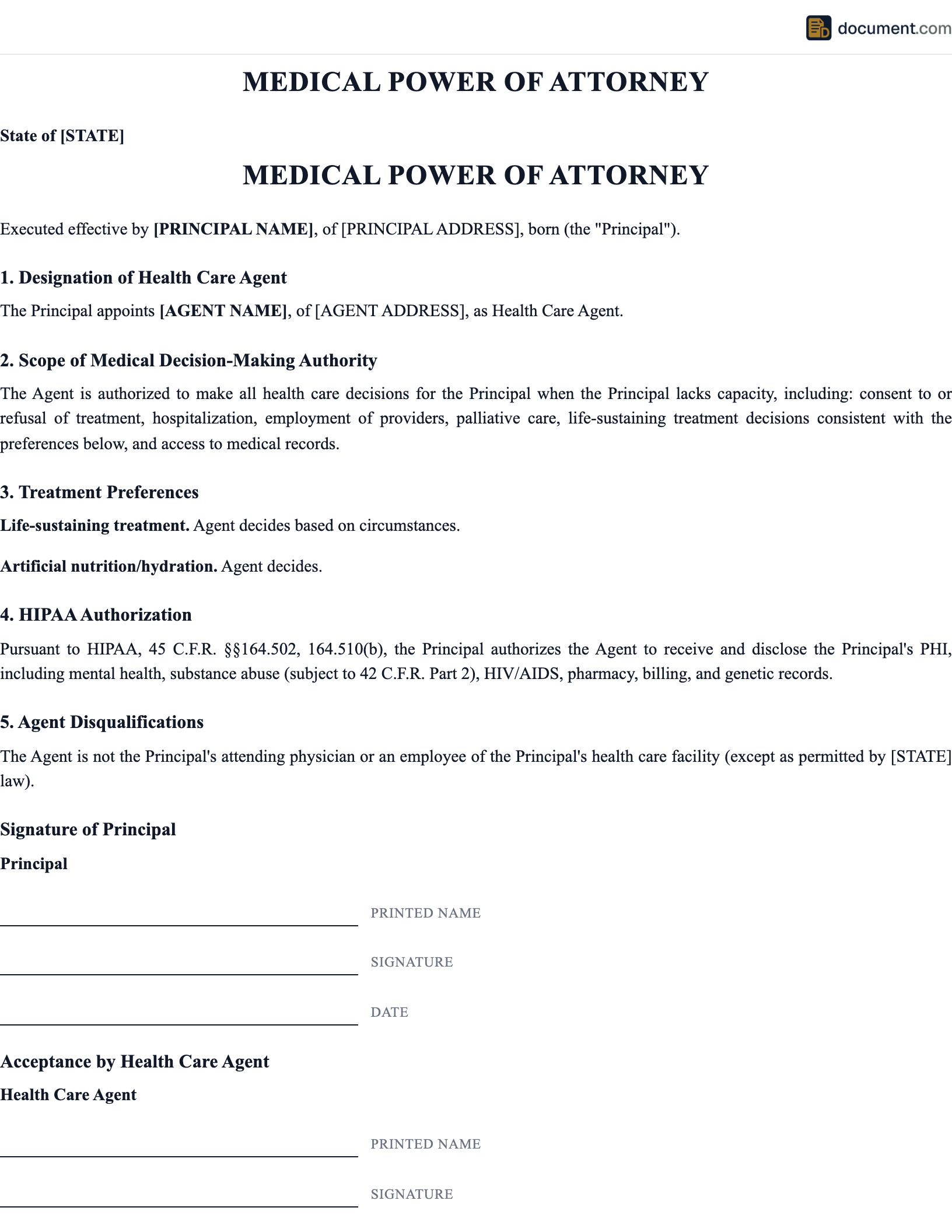
Below is a structural preview of our medical power of attorney template, including the HIPAA release and end-of-life authorization sections that distinguish it from a financial POA.
Medical Power of Attorney
Healthcare Decisions & HIPAA Authorization
1. Principal
2. Healthcare Agent
3. HIPAA Release
4. Powers Granted
- Consent to or refuse medical treatments, surgeries, and medications
- Choose hospitals, physicians, and care facilities
- Access medical records and communicate with providers
- Authorize or withdraw life-sustaining treatment (initialed)
- Consent to pain management, including palliative sedation
- Make organ donation and anatomical gift decisions
5. Personal Wishes & Values
6. Witnesses & Notary
Witness 1 (not the agent)
Witness 2 / Notary
When You Need a Medical POA
A medical POA is appropriate for any adult who wants their healthcare wishes respected if they cannot speak for themselves. It is most urgent for adults with chronic illness, upcoming surgery, or family members who would not naturally agree on care decisions.
Chronic or Serious Illness
Cancer, heart disease, COPD, kidney failure, and progressive neurological conditions all carry the risk of incapacitation during the course of treatment.
Upcoming Surgery
Anesthesia, complications, and post-operative delirium can leave a patient unable to consent to treatment changes for hours or days.
Cognitive Decline
Early-stage dementia or mild cognitive impairment is the right time to put a medical POA in place — while capacity is unquestionable.
Blended or Complicated Families
If a default surrogate statute would name the wrong person — a stepchild, an estranged relative, or a tier of equally entitled siblings — a medical POA is essential.
Medical POA vs Other Healthcare Documents
The medical POA is one of several documents that govern healthcare decision-making. Understanding the differences helps you build a complete advance care plan rather than relying on a single document.
Medical POA vs Living Will
Medical POA
- - Names a real person to decide
- - Flexible — adapts to new situations
- - Covers all medical decisions
- - Requires a willing agent
Living Will
- - States preferences in writing
- - Static — cannot adapt
- - Usually limited to end-of-life
- - Speaks even if no one is available
Medical POA vs DNR Order
Medical POA
- - Authorizes broad healthcare decisions
- - Effective when you cannot decide
- - Created and signed by you
- - Lives in your records and home
Do Not Resuscitate Order
- - A specific medical order against CPR
- - Effective immediately during a code
- - Signed by a physician
- - Often needed in addition to a POA
Medical POA vs HIPAA Authorization
Medical POA
- - Authority to decide
- - Triggered by incapacity
- - Includes a HIPAA release
Standalone HIPAA Authorization
- - Authority only to receive records
- - Effective even when you have capacity
- - Useful for adult children, advisors
How to Create a Medical Power of Attorney
A valid medical POA is straightforward to create but requires careful thought about who will speak for you and what you want them to know about your values and wishes.
Reflect on Your Values and Wishes
Before naming an agent, think about what matters to you in healthcare. Quality of life vs length of life. Comfort vs aggressive intervention. Religious considerations. Tolerance for disability. The clearer you are, the better your agent can advocate for you.
Choose Your Healthcare Agent
Pick someone who knows you, respects your values, can stay calm under pressure, and can stand up to medical staff and family members who disagree. Geographic proximity is helpful but not essential. Most importantly, choose someone willing to follow your wishes even when it is hard.
Name a Backup Agent
If your primary agent is unavailable, hospitalized themselves, or unable to act, a backup ensures continuity. Many people name an adult child as primary and a sibling or close friend as backup.
Have a Conversation
Talk to your chosen agent before signing. Walk them through your values, your specific wishes about end-of-life care, your religious or spiritual considerations, and any treatments you absolutely want or absolutely refuse. This conversation matters more than the document itself.
Add a HIPAA Release
Without HIPAA authorization, your agent may have decision-making authority but no access to records. A built-in release lets your agent talk to physicians, request second opinions, and review test results.
Authorize End-of-Life Decisions Explicitly
Many states require you to expressly authorize your agent to consent to or withdraw life-sustaining treatment, including artificial nutrition and hydration. Initial these provisions only after careful thought.
Consider Mental Health Decisions
If you have or anticipate a mental health condition, ensure the document covers psychiatric admission, medication, and ECT — and consider a separate psychiatric advance directive if your state requires one.
Sign with Witnesses (and Notary if Required)
Most states require two adult witnesses, neither of whom is the agent or related to the principal by blood or marriage. Some states also require notarization. Sign in the presence of all witnesses.
Distribute Copies
Give a copy to your agent, your backup agent, your primary care physician, your hospital, and your closest family members. Carry a wallet card noting that you have an advance directive on file.
Key Components of a Medical POA
A complete medical POA includes the following elements. Missing one — particularly the HIPAA release or witness signatures — can render the document unusable when it matters most.
Principal Identification
Full legal name, date of birth, and address.
Healthcare Agent & Backup
Name, contact information, and relationship of the primary and backup agents.
Scope of Authority
Explicit list of healthcare decisions the agent may make.
End-of-Life Authorization
Express authority to consent to or withdraw life-sustaining treatment.
HIPAA Release
Authorization for the agent to access protected health information.
Personal Wishes Statement
Written values and treatment preferences to guide the agent.
Mental Health Provisions
Authorization for psychiatric care if applicable in your state.
Witnesses & Notary
Two adult witnesses (and notary in some states), neither of whom is the agent.
Legal Requirements: HIPAA & State Law
Medical powers of attorney are governed by a layered framework. Each state has its own healthcare consent statute defining who may serve as agent, what powers can be granted, what witness or notary formalities apply, and how the document interacts with default surrogate statutes. Federal HIPAA rules govern access to protected health information. The federal Patient Self-Determination Act requires hospitals receiving Medicare or Medicaid funding to ask about and document advance directives.
Most states require two adult witnesses, neither of whom is the agent or, in many states, related to the principal by blood, marriage, or adoption, employed by the principal's healthcare provider, or entitled to inherit from the principal. Some states require both witnesses and a notary; others allow either. A handful of states have a statutory short form that, if used, simplifies acceptance.
HIPAA, codified at 45 CFR Part 164, restricts the disclosure of protected health information to anyone other than the patient. A medical POA must include an explicit written authorization that names the agent, identifies the categories of information to be disclosed, and is signed by the patient. Without this language, your agent may have decision-making authority on paper but no way to obtain the records they need.
Some states limit the scope of agent authority over certain decisions: psychiatric hospitalization, ECT, antipsychotic medication, abortion, sterilization, withdrawal of artificial nutrition and hydration, and admission to long-term care can each require additional authorization or different documentation. Our state-specific templates surface these exclusions automatically.
Medical POA Requirements by State
Every state recognizes a medical power of attorney, but the statutory name, witness requirements, and scope of authority vary. The list below shows the 50 states for which our templates apply state-specific rules.
Sample Medical Power of Attorney
Below is a condensed preview of our medical POA template, including the HIPAA release and end-of-life provisions.
MEDICAL POWER OF ATTORNEY
Healthcare Decisions & HIPAA Authorization
I, [Principal], of [Address], appoint the following person as my Healthcare Agent:
HEALTHCARE AGENT: [Name]
BACKUP AGENT: [Name]
1. WHEN AUTHORITY BEGINS
My Agent's authority becomes effective only when my treating physician determines in writing that I am unable to make or communicate my own healthcare decisions. The authority ends when capacity is restored.
2. POWERS GRANTED
My Agent may consent to or refuse any medical treatment, surgery, medication, procedure, or admission; choose physicians, hospitals, and care facilities; access my medical records; and make decisions about pain management and comfort care.
3. END-OF-LIFE AUTHORITY (initial if granted)
___ Authority to consent to or withdraw life-sustaining treatment
___ Authority to consent to or withdraw artificial nutrition and hydration
___ Authority to consent to a Do Not Resuscitate order
___ Authority to consent to organ donation and anatomical gifts
4. HIPAA AUTHORIZATION
I authorize all healthcare providers to release my protected health information to my Agent for the purpose of making healthcare decisions on my behalf. This authorization complies with 45 CFR 164.508 and remains effective until revoked.
5. PERSONAL WISHES
[Statement of values, preferences, and specific wishes]
Frequently Asked Questions
Common questions about medical powers of attorney, healthcare proxies, HIPAA, end-of-life decisions, and physician acceptance.
Official Resources
Authoritative resources on healthcare decision-making, HIPAA, advance care planning, and patient rights.
HHS - HIPAA for Individuals
Federal HIPAA guidance for patients and healthcare agents.
NIA - Advance Care Planning
National Institute on Aging guide to medical POA and advance directives.
ABA - Health Care Decision Making
American Bar Association resources on healthcare directives and surrogate laws.
CaringInfo (NHPCO)
National Hospice and Palliative Care Organization advance directive resources.
CMS - Patient Self-Determination Act
Federal law requiring hospitals to ask about advance directives.
POLST - Portable Medical Orders
National POLST organization on portable medical orders.
Medicare - Advance Care Planning
Medicare coverage for advance care planning conversations.
Compassion & Choices
End-of-life care planning and patient rights advocacy.
Create your Medical Power of Attorney in under 10 minutes.
Answer a few questions and download a compliant, attorney-drafted document ready for your state.