



What Is a Quitclaim Deed?
A quitclaim deed is a legal document used to transfer one person's interest in real property to another person. Unlike a warranty deed, a quitclaim deed makes no promises or guarantees about the quality of the title being transferred. The grantor (the person giving up the interest) simply "quits" whatever claim they have to the property and passes it to the grantee (the person receiving the interest). If the grantor has full, clear ownership, the grantee receives full ownership. If the grantor has no actual interest in the property, the grantee receives nothing — and has no legal recourse against the grantor.
Quitclaim deeds are among the most commonly used real estate documents in the United States, though they serve a very different purpose than warranty deeds used in standard home purchases. Because quitclaim deeds offer no warranty of title, they are most frequently used between parties who know and trust each other — spouses, family members, divorcing couples, or business partners. They are also heavily used for transfers to and from trusts, LLCs, and other entities where the same person controls both sides of the transaction.
The simplicity of a quitclaim deed is both its strength and its limitation. It requires minimal information compared to other deed types — typically just the names of the grantor and grantee, a legal description of the property, the amount of consideration (if any), and the grantor's notarized signature. There is no title search, no title insurance requirement, and no obligation for the grantor to prove they actually own the property. This makes quitclaim deeds fast and inexpensive to execute, but it also means the grantee bears all the risk.
Every state recognizes quitclaim deeds, though the specific requirements for execution, notarization, witnesses, and recording vary. Some states, like California, use grant deeds as the standard conveyance instrument and quitclaim deeds are less common for regular transactions. Other states, like Florida, have specific statutory forms and witness requirements. Regardless of your state, a quitclaim deed must be recorded with the county recorder's office (sometimes called the register of deeds or county clerk) to provide constructive notice of the transfer and protect the grantee's interest.
It is important to understand that a quitclaim deed transfers ownership interest only — it does not transfer or affect any mortgage, lien, or other debt secured by the property. If the property has an existing mortgage, the grantor remains responsible for that debt even after signing over their ownership. Most mortgages include a due-on-sale clause allowing the lender to demand full payment when ownership changes, so transferring property via quitclaim deed without consulting your lender can have serious financial consequences.
Family Transfers
Transfer property between spouses, parents, children, and other family members
Trust & LLC Transfers
Move property into revocable trusts, irrevocable trusts, and LLCs for asset protection
Divorce & Title Corrections
Divide marital property, correct name errors, and clear title clouds
Quitclaim Deed Form Preview
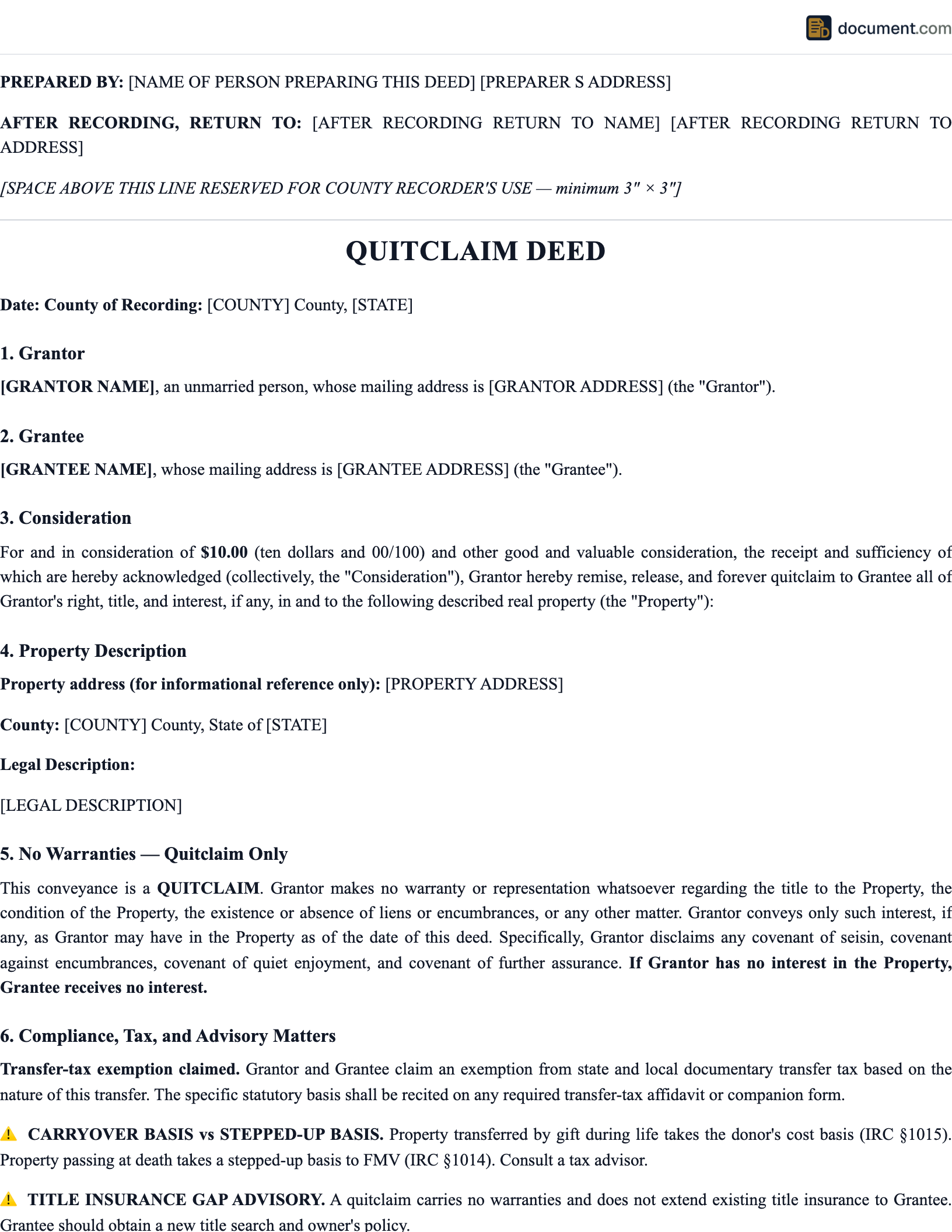
Our quitclaim deed form includes all the fields required for a valid property transfer. Below is a preview of the key sections. Your customized document will be tailored to your state's specific recording and notarization requirements.
QUITCLAIM DEED
Property Transfer Without Warranty
RECORDING INFORMATION
Return to: [Name & Address]
Parcel ID / APN: [Parcel Number]
Prepared by: [Name & Address]
GRANTOR (Transferring Party)
Name: [Full Legal Name]
Address: [Street, City, State, ZIP]
Marital Status: [Single / Married / Divorced]
GRANTEE (Receiving Party)
Name: [Full Legal Name]
Address: [Street, City, State, ZIP]
Vesting: [Individual / Joint Tenants / Tenants in Common]
PROPERTY LEGAL DESCRIPTION
County: [County Name] State: [State]
Legal Description: [Lot, Block, Subdivision or Metes & Bounds]
Property Address: [Street Address]
CONSIDERATION & TRANSFER
Consideration: $[Amount] ([Written Amount] dollars)
The Grantor hereby remises, releases, and quitclaims to the Grantee all right, title, and interest in the above-described property.
NOTARY ACKNOWLEDGMENT
State of [State] County of [County]
On this [Date], before me personally appeared...
Notary Public: [Signature & Seal]
My Commission Expires: [Date]
When to Use a Quitclaim Deed
Quitclaim deeds are the preferred transfer instrument for many situations where the parties know each other and a full title warranty is unnecessary. Below are the most common use cases, each with specific considerations you should understand before proceeding.
Adding or Removing a Spouse From Title
One of the most common uses is adding a new spouse to the property title after marriage or removing an ex-spouse after divorce. When adding a spouse, the current owner signs a quitclaim deed transferring the property from themselves individually to both spouses (typically as joint tenants or tenants by the entirety). This is generally not a taxable event between spouses under IRC Section 1041.
Divorce Property Division
During divorce proceedings, the court typically orders one spouse to transfer their interest in the marital home to the other. A quitclaim deed is the standard instrument for this transfer. The departing spouse signs the deed, but keep in mind this does not remove them from the mortgage. The retaining spouse usually needs to refinance the mortgage in their name alone within a court-specified timeframe.
Transferring Property to a Living Trust
Estate planning frequently involves transferring property from an individual's name into a revocable living trust. Since the trust creator (settlor) typically serves as the trustee, this is effectively a transfer from yourself to yourself in a different capacity. Quitclaim deeds are ideal because no title warranty is needed. Most states exempt these transfers from transfer taxes, and the Garn-St. Germain Act generally prevents lenders from triggering the due-on-sale clause for transfers to revocable trusts.
Transferring Property to an LLC
Real estate investors and rental property owners often transfer property into an LLC for liability protection. A quitclaim deed from the individual to the LLC they own is the typical method. Be aware that mortgage lenders may invoke the due-on-sale clause for LLC transfers (the Garn-St. Germain exemption does not apply to LLCs), and some states charge transfer taxes on these transfers even though the beneficial ownership has not changed.
Clearing Title Defects and Clouds
When a title search reveals a potential claim, a misspelled name, or some other defect that creates a "cloud" on the title, a quitclaim deed can be used to clear it. For example, if a previous owner's heir may have a claim to the property, that heir can sign a quitclaim deed releasing any interest they might hold. Title companies often require these curative quitclaim deeds before issuing title insurance.
Gifting Property to Family Members
Parents frequently use quitclaim deeds to transfer property to their children as a gift or part of estate planning. While straightforward to execute, these transfers carry significant tax implications. The recipient inherits the grantor's cost basis (not stepped-up basis), which can result in substantial capital gains tax when the property is eventually sold. If the property value exceeds the annual gift tax exclusion, the grantor must file IRS Form 709. Additionally, some states will reassess property taxes upon transfer.
Removing a Deceased Owner From Title
When a property owner dies, the surviving co-owners may need to clear the deceased person's name from the title. If the property was held as joint tenants with right of survivorship, an affidavit of survivorship is typically used rather than a quitclaim deed. However, if the estate has been through probate, the executor or personal representative may use a quitclaim deed to transfer the property from the estate to the designated beneficiary.
Correcting Name Errors on Title
If a deed was recorded with a misspelled name, a name change due to marriage, or an incorrect legal name, a corrective quitclaim deed can be used to fix the error. The grantor signs under both the incorrect name and their correct legal name, transferring the interest to themselves under the proper name. This is one of the simplest and most routine uses of a quitclaim deed.
Quitclaim Deed vs Other Deeds
Understanding the differences between deed types is critical for choosing the right instrument for your property transfer. Each type offers a different level of protection for the grantee and is suitable for different situations.
Quitclaim Deed vs Warranty Deed
| Feature | Quitclaim Deed | Warranty Deed |
|---|---|---|
| Title Guarantee | None — transfers only what grantor has | Full — guarantees clear title |
| Grantor's Liability | No liability for title defects | Liable for all title defects, past and present |
| Title Search Required | Not required (but recommended) | Always performed |
| Title Insurance | Often unavailable or limited | Standard practice |
| Common Use | Family transfers, divorce, trusts, LLCs | Standard real estate sales |
| Cost to Prepare | Low — simple document, fewer requirements | Higher — title search, insurance, attorney |
Quitclaim Deed vs Special Warranty Deed
A special warranty deed (sometimes called a limited warranty deed or covenant deed) provides a middle ground between a quitclaim deed and a general warranty deed. The grantor warrants only that they have not done anything to impair the title during their period of ownership — they make no guarantees about what happened before they acquired the property.
| Feature | Quitclaim Deed | Special Warranty Deed |
|---|---|---|
| Warranty Period | None | Only during grantor's ownership |
| Common Use | Family, divorce, trust transfers | Commercial sales, bank-owned properties, foreclosures |
| Grantee Protection | No protection | Moderate — protected against grantor's acts only |
Quitclaim Deed vs Bargain and Sale Deed
A bargain and sale deed implies that the grantor holds title to the property and has the right to convey it, but does not include specific covenants or warranties against liens and encumbrances. It is commonly used in tax sales, foreclosures, and estate transfers, particularly in states like New York and New Jersey.
| Feature | Quitclaim Deed | Bargain and Sale Deed |
|---|---|---|
| Implied Ownership | No — grantor may or may not own property | Yes — implies grantor holds title |
| Lien Protection | None | None (unless covenants added) |
| Common Jurisdictions | All 50 states | Primarily New York, New Jersey |
Quitclaim Deed vs Grant Deed (California)
California and a few other western states use grant deeds as the standard property transfer instrument instead of warranty deeds. A grant deed includes two implied warranties: (1) that the grantor has not previously conveyed the property to someone else, and (2) that the property is free from encumbrances made by the grantor that have not been disclosed. This provides more protection than a quitclaim deed but less than a general warranty deed.
| Feature | Quitclaim Deed | Grant Deed (CA) |
|---|---|---|
| Implied Warranties | None | Two: no prior conveyance, no undisclosed encumbrances |
| Tax Reassessment (CA) | May trigger (same as any transfer) | May trigger (same as any transfer) |
| Documentary Transfer Tax | Applies if consideration paid | Applies — $1.10 per $1,000 |
| Standard Use | Family, trust, divorce transfers | Standard California real estate sales |
How to File a Quitclaim Deed
Filing a quitclaim deed is a multi-step process that varies slightly by state. Follow these eight steps to ensure your property transfer is legally valid, properly recorded, and does not create unexpected tax or insurance problems.
Gather Property Information
Obtain the property's full legal description from the existing deed, tax records, or county assessor's office. You will need the legal description (lot, block, and subdivision name, or metes and bounds description), the property address, the parcel number or APN (assessor's parcel number), and the county where the property is located. Using the wrong legal description is one of the most common — and most costly — mistakes in deed preparation.
Prepare the Quitclaim Deed
Complete the deed form with the grantor's full legal name, the grantee's full legal name and desired vesting (how they will hold title), the legal description, the amount of consideration, and any required recording information. Ensure the deed complies with your state's specific formatting requirements — many states mandate minimum font sizes, margin requirements, and specific return address placement for recorded documents.
Review for Accuracy
Carefully verify every detail on the deed before signing. Check that names match government-issued IDs exactly, the legal description matches the existing deed of record, the county and state are correct, and the vesting type reflects the grantee's intentions. Errors discovered after recording require a corrective deed, which means additional fees and delays. If you are unsure about any aspect, consult a real estate attorney.
Get the Deed Notarized
The grantor must sign the deed in front of a notary public. The notary verifies the grantor's identity (typically through a government-issued photo ID) and confirms they are signing voluntarily and understand the document. Some states require witnesses in addition to notarization — Florida, for example, requires two witnesses. Do not sign the deed before appearing before the notary, as many notaries require witnessing the actual signature.
File With the County Recorder
Take or mail the notarized deed to the county recorder's office (also called the register of deeds, county clerk, or land records office, depending on your state) in the county where the property is located. Recording the deed provides constructive notice to the public that the property has been transferred. An unrecorded deed is still technically valid between the parties, but it does not protect the grantee against third-party claims.
Pay Recording Fees and Transfer Taxes
Pay the required recording fees and any applicable transfer taxes or documentary stamps. Recording fees range from about $10 to $250 depending on the state and county. Transfer taxes vary widely — some states have none, while others charge significant amounts (Florida charges $0.70 per $100, and New York City's combined rate can exceed 2.6%). Some transfers are exempt from transfer taxes, such as gifts, divorce transfers, and transfers to trusts — check your state's exemptions carefully.
Notify Relevant Parties
After recording, notify your mortgage lender (if applicable), title insurance company, homeowners insurance provider, and local tax assessor's office of the ownership change. Failing to notify your mortgage lender could trigger the due-on-sale clause. Your title insurance policy may need to be updated or a new policy obtained. The tax assessor needs to know for property tax billing and potential reassessment purposes.
File Tax Forms if Applicable
If the property transfer is a gift exceeding the annual exclusion amount ($18,000 per recipient in 2024), the grantor must file IRS Form 709 (United States Gift and Generation-Skipping Transfer Tax Return) with their annual tax return. Transfers between spouses are generally unlimited and tax-free under the marital deduction. Transfers pursuant to a divorce decree are also typically not taxable events. Consult a tax professional for transfers with significant value or complex ownership structures.
Key Components of a Quitclaim Deed
A valid quitclaim deed must include specific elements to be legally effective and accepted for recording. While requirements vary by state, the following components are standard across most jurisdictions.
| Component | Description |
|---|---|
| Grantor Name | Full legal name of the person or entity transferring the property interest |
| Grantee Name | Full legal name of the person or entity receiving the property interest |
| Grantor Address | Current mailing address of the grantor |
| Grantee Address | Current mailing address of the grantee |
| Legal Description | Lot, block, subdivision, or metes and bounds description from the recorded plat |
| Property Address | Street address of the property (for reference — legal description controls) |
| Parcel Number / APN | Assessor's parcel number used by the county for tax identification |
| County & State | County and state where the property is physically located |
| Consideration | Amount paid for the transfer ($10 nominal, gift, or actual purchase price) |
| Vesting Type | How grantee holds title: sole ownership, joint tenants, tenants in common, etc. |
| Quitclaim Language | Operative words: "remise, release, and quitclaim" all right, title, and interest |
| Grantor Signature | Original signature of the grantor (grantee signature is not required) |
| Notary Acknowledgment | Notary's signature, seal, and commission details per state requirements |
| Witness Signatures | Required in some states (e.g., FL requires 2, OH requires notary only) |
| Prepared By Statement | Name and address of the person who prepared the deed (required in most states) |
| Return Address | Address where the recorded deed should be returned after processing |
Legal Requirements for Quitclaim Deeds
While quitclaim deeds are relatively simple documents, they must meet specific legal requirements to be valid and recordable. These requirements vary by state, so it is essential to understand your jurisdiction's rules before preparing and filing a deed.
Important: Recording Is Essential
While a properly executed quitclaim deed is valid between the grantor and grantee even without recording, an unrecorded deed does not provide constructive notice to third parties. This means a subsequent purchaser or lien holder who checks the public records would not see the transfer. Always record your quitclaim deed promptly with the county recorder in the county where the property is located.
Recording Requirements
- Document Formatting: Most counties require specific margin sizes (typically 3-inch top margin on first page, 1-inch on subsequent pages), minimum font size (usually 10pt), and black ink on white paper
- Return Address: A return mailing address must appear on the face of the document for the recorder to return the original after processing
- Parcel Number: Most states require the property's tax parcel number or APN to be included on the deed for proper indexing
- Transfer Tax Declaration: Many states require a separate transfer tax form or declaration filed alongside the deed
Notarization Requirements
Every state requires the grantor's signature on a quitclaim deed to be notarized. The notary public verifies the signer's identity and confirms they are signing voluntarily. Remote online notarization (RON) is now legal in many states, allowing the notarization to take place via video conference. However, some county recorders still require traditional in-person notarization for recorded documents.
Witness Requirements
Witness requirements vary significantly by state. Most states do not require witnesses for quitclaim deeds if the deed is properly notarized. However, Florida requires two witnesses in addition to notarization, and several other states have similar requirements. Witnesses must be disinterested parties — they cannot be the grantor, grantee, or notary public.
Transfer Taxes and Documentary Stamps
Many states impose a transfer tax (also called documentary stamps, deed tax, or real estate excise tax) when property changes hands. Rates and exemptions vary enormously. Some states have no transfer tax (Texas, Alaska, Idaho, and others), while others have substantial rates. Common exemptions include transfers between spouses, transfers pursuant to divorce, transfers to trusts where the grantor is the beneficiary, and transfers where no consideration is paid.
Gift Tax Implications (IRS Form 709)
When property is transferred via quitclaim deed without fair market value consideration, the IRS may treat it as a gift. If the value of the gifted property exceeds the annual gift tax exclusion ($18,000 per recipient in 2024, $19,000 in 2025), the grantor must file IRS Form 709. While no actual gift tax is typically owed until the grantor exceeds their lifetime exemption ($13.61 million in 2024), the form must still be filed. Transfers between spouses and transfers pursuant to a divorce decree are generally exempt from gift tax requirements.
Quitclaim Deed by State
Each state has different requirements for quitclaim deeds, including recording fees, transfer tax rates, notarization standards, witness requirements, and specific statutory language. Select your state below for a quitclaim deed form customized to your jurisdiction's requirements.
Sample Quitclaim Deed
Below is a preview of a standard quitclaim deed. Your customized document will include state-specific language, notary acknowledgment format, and any additional declarations required by your jurisdiction.
RECORDING REQUESTED BY AND RETURN TO:
[Name, Address, City, State, ZIP]
QUITCLAIM DEED
APN / Parcel No.: _______________
FOR VALUABLE CONSIDERATION, receipt of which is hereby acknowledged,
[GRANTOR NAME], ("Grantor"), hereby remises, releases, and forever quitclaims to [GRANTEE NAME], ("Grantee"), all right, title, interest, claim, and demand which the Grantor has in and to the following described real property situated in [COUNTY] County, State of [STATE]:
Legal Description:
[Lot, Block, Subdivision per recorded plat, or Metes and Bounds description]
Property Address: [Street Address, City, State, ZIP]
IN WITNESS WHEREOF, the Grantor has executed this Quitclaim Deed on the _____ day of _______________, 20_____.
Grantor Signature
Printed Name: _______________
Witness (if required)
Printed Name: _______________
NOTARY ACKNOWLEDGMENT
State of _______ County of _______
On _______ before me personally appeared _______, proved to me on the basis of satisfactory evidence to be the person(s) whose name(s) is/are subscribed to the within instrument...
Notary Signature: _______________ [SEAL]
Commission Expires: _______________
Frequently Asked Questions
Find answers to common questions about quitclaim deeds, property transfers, recording requirements, tax implications, and the differences between deed types.
Official Resources
Use these trusted resources for additional information about property transfers, gift tax requirements, title insurance, and real estate recording standards.
IRS Gift Tax Information
Gift tax rates, annual exclusions, Form 709 requirements
American Land Title Association (ALTA)
Title insurance standards, find a title company, industry resources
IRS Form 709 — Gift Tax Return
Download Form 709 and instructions for reporting property gifts
HUD — Home Buying & Real Estate
Federal resources on property ownership, title, and closing
CFPB — Housing Resources
Consumer guides on mortgages, closings, and homeownership
National Notary Association
Find a notary, notarization requirements by state
Related Property Documents
Depending on your situation, you may need additional documents to complement your quitclaim deed or to use an alternative transfer instrument instead.
Warranty Deed
Full warranty of title for standard real estate purchases
Grant Deed
Standard California transfer deed with implied warranties
Title Search
Verify property ownership and check for liens before transfer
Property Deed
General property deed forms for all transfer types
Trust Transfer Deed
Transfer property to or from a revocable or irrevocable trust
Power of Attorney
Authorize someone to sign property documents on your behalf
Create your Quitclaim Deed in under 10 minutes.
Answer a few questions and download a compliant, attorney-drafted document ready for your state.