
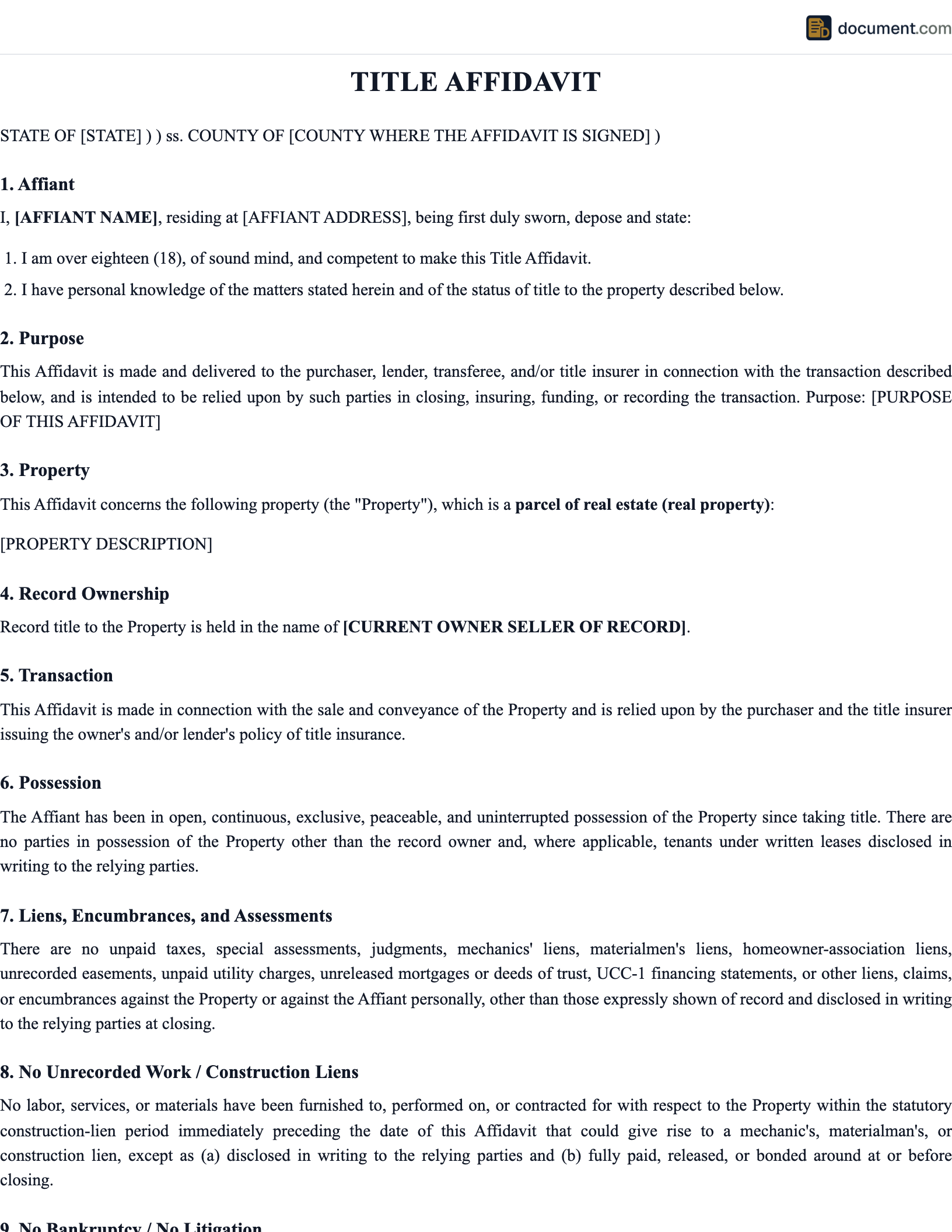



What Is an Affidavit of Title
An affidavit of title is a sworn declaration by the seller of property that the buyer can rely on to confirm clean ownership. The document shows up most often at real estate closings, where it sits beside the deed, the closing disclosure, and the title insurance commitment. It also appears in vehicle transactions when the original certificate of title has been lost, damaged, or never issued.
The affidavit fills the gap between the public record and reality. A title search will catch documents that have been recorded, but it cannot reveal a lawsuit filed yesterday, a contractor who has not yet recorded a mechanics lien, or a recent divorce judgment that affects ownership. By signing under oath, the seller takes personal responsibility for disclosing those off-record problems.
Title insurers use the affidavit to issue coverage. The standard owner's policy excludes claims that the insured knew about and did not disclose, so insurers want a written record of what the seller has revealed. If a hidden problem surfaces after closing, the insurer can pursue the seller under the affidavit while still paying the buyer's claim.
Vehicle affidavits work similarly but focus on a much smaller universe of issues. The owner swears the car is theirs, the VIN matches, and there are no undisclosed lienholders. State motor vehicle agencies use the document when issuing duplicate titles or when ownership history has gaps that prevent a clean retitling.
Real Estate Use
At every residential and commercial closing, the title agent will ask the seller to sign an affidavit of title or a title affidavit. The form usually walks through a checklist of potential problems: undisclosed leases, unrecorded easements, pending litigation, judgment liens, federal tax liens, recent bankruptcies, and improvements completed in the past ninety days that could give a contractor mechanics lien rights.
Many states require both spouses to sign even when only one is named on the deed, because community property and homestead laws can give a non-titled spouse rights that survive the sale. Failing to obtain both signatures is a frequent reason title claims arise after closing.
Lost Vehicle Title Use
When the paper title to a car has been lost, stolen, or damaged, every state offers a duplicate title application. Most states require the owner to attach an affidavit explaining the loss and confirming there is no outstanding lienholder. Some states will issue a salvage or bonded title backed by a surety bond when the chain of ownership cannot be reconstructed.
The vehicle affidavit must include the year, make, model, VIN, and current odometer reading. Submitting it with the wrong VIN or without notarization is the most common reason DMV applications are bounced back to the owner.
How to Complete the Affidavit
Identify the Property
Pull the deed, survey, or title certificate so the description matches the underlying records exactly.
Confirm All Owners
List every person on title, including spouses where state law requires joinder, and trustees or officers for entities.
Search for Liens
Order a title search or run a UCC and judgment search to identify anything that must be disclosed in the affidavit.
Disclose Recent Work
Note any contractors, suppliers, or laborers who performed work in the past ninety days.
Sign Before a Notary
Execute the document in front of a notary at the closing table or vehicle title office.
Deliver to the Title Company or DMV
Hand the original to the title insurer for the closing file or submit it with the duplicate title application.
Key Components
Seller Identification
Full legal name, address, and marital status of every owner conveying the property.
Property Description
Real estate legal description, parcel ID, and street address, or vehicle VIN, year, make, and model.
Ownership Statement
Sworn declaration that the seller is the lawful owner with authority to transfer the property.
Lien and Judgment Disclosure
Affirmation that no undisclosed mortgages, judgment liens, tax liens, or mechanics liens encumber the property.
Possession and Lease Statement
Confirmation that no tenants or third parties are in possession beyond what was disclosed.
Recent Improvement Disclosure
Statement about any work performed in the past ninety days that could trigger a mechanics lien.
Notary Acknowledgment
Official jurat or acknowledgment block signed and stamped by a commissioned notary public.
Sample Affidavit
AFFIDAVIT OF TITLE
STATE OF __________ COUNTY OF __________
The undersigned, being first duly sworn, states:
1. I am the lawful owner of the property described as: _____________________.
2. There are no liens, judgments, mortgages, or other encumbrances against the property except: _____________________.
3. No work, labor, or materials have been furnished in the past 90 days.
4. There are no parties in possession other than the undersigned.
5. I have full authority to convey the property.
__________________________ Affiant / Date
Frequently Asked Questions
Common questions about affidavits of title, real estate closings, lost vehicle titles, and notarization.
Official Resources
CFPB: Closing on Your Home
Federal consumer guidance on the residential closing process
HUD: Buying a Home
Department of Housing and Urban Development homebuyer resources
USA.gov: State Motor Vehicle Services
Directory of state DMV title and registration offices
NHTSA VIN Decoder
Federal VIN decoder for vehicle identification verification
Close with clean title in under 10 minutes.
Answer a few questions and download a notary-ready affidavit of title for your real estate closing or vehicle retitling.