
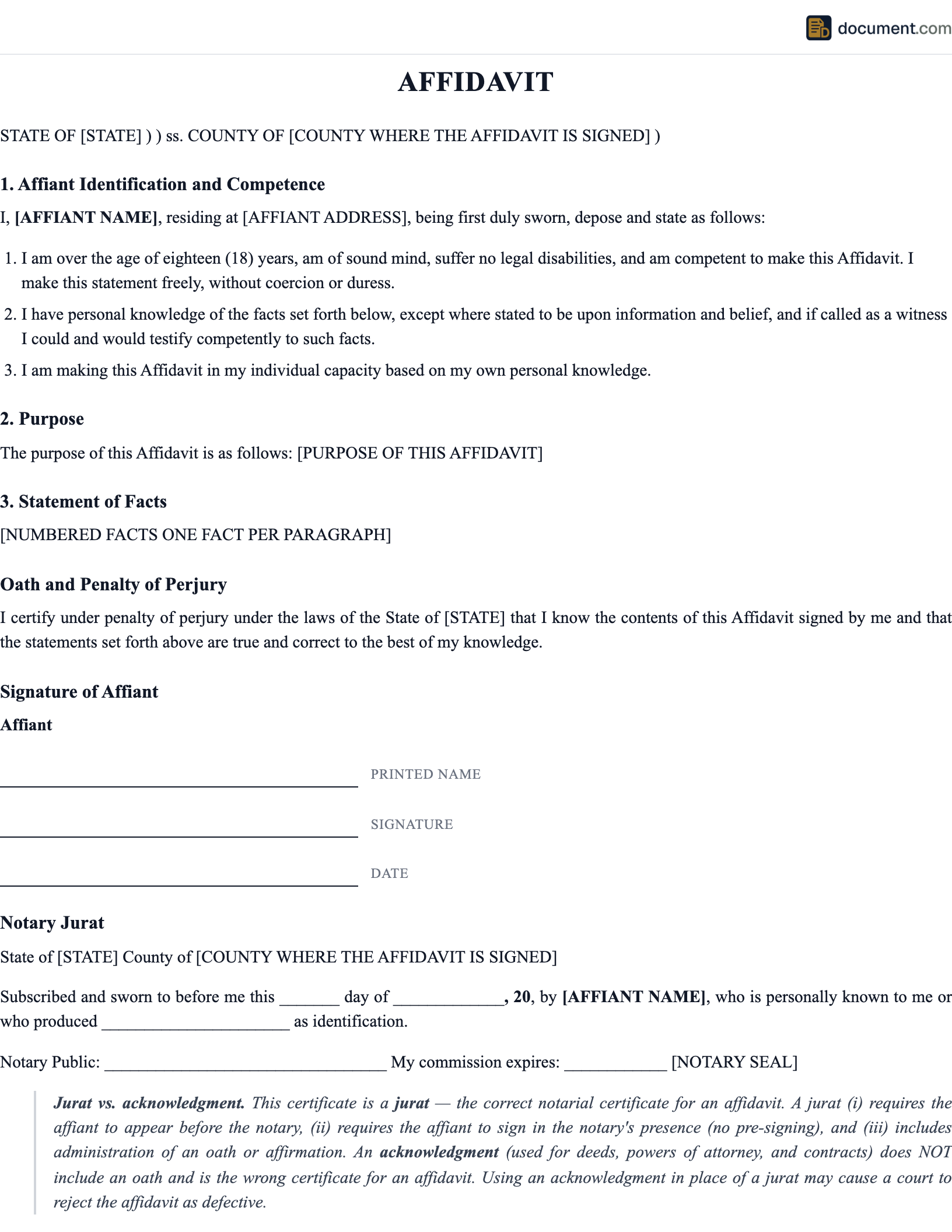



What Is an Affidavit?
An affidavit is a formal, written statement of facts that the person making it — known as the affiant, deponent, or declarant — swears or affirms to be true under oath. The oath is administered by a notary public or other officer authorized by law to administer oaths, and the affiant's signature is notarized to certify that the statement was made voluntarily and under penalty of perjury. Affidavits are one of the oldest and most widely used legal documents in the American legal system, serving as a bridge between informal statements and formal courtroom testimony.
The legal weight of an affidavit comes from the oath. When a person signs an affidavit, they are making a solemn declaration that every fact stated in the document is true to the best of their knowledge and belief. Because the statement is sworn, any materially false statement constitutes perjury — a criminal offense that carries serious penalties including imprisonment in every U.S. jurisdiction. This accountability mechanism is what gives affidavits their evidentiary value and distinguishes them from ordinary written statements, letters, or emails.
Affidavits serve countless purposes across the legal, business, and personal landscape. In litigation, they support motions, preserve testimony, and establish facts without requiring a witness to appear in court. In real estate, they clear title defects, establish ownership chains, and confirm property conditions. In estate administration, they identify heirs, confirm death, establish domicile, and enable small estate transfers without formal probate. In government and regulatory contexts, they verify identity, confirm citizenship, support immigration petitions, and accompany applications for benefits, licenses, and permits.
The structure of an affidavit follows a specific format: a caption identifying the parties and the matter (if for a court proceeding), a body consisting of numbered paragraphs each stating a single fact based on the affiant's personal knowledge, and a jurat — the notarization block where the notary certifies that the oath was administered and the affiant signed in their presence. Each fact must be something the affiant personally knows or observed, not hearsay, speculation, or opinion (unless the affidavit specifically identifies the basis for the information).
Our attorney-reviewed affidavit templates are designed for each specific use case and customized for your state's requirements. Each template includes the proper oath language, jurat format, witness provisions (where required), and numbered fact paragraphs tailored to the type of affidavit you need. Whether you are filing a small estate affidavit, establishing heirship, documenting a gift, or swearing to facts for a court proceeding, our templates ensure your affidavit meets the formal requirements that courts, agencies, and institutions expect.
Sworn Under Oath
Every statement carries the legal weight of testimony given under penalty of perjury
Court-Accepted
Formatted to meet judicial filing requirements and rules of evidence
Notarization-Ready
Includes the proper jurat block and oath language for your state
Affidavit Form Preview
Below is a visual preview of the sections and fields included in a general affidavit form. This mockup illustrates the standard structure. Your completed document will include the proper oath language, jurat, and formatting for your specific affidavit type and state.
General Affidavit
Sworn Statement of Facts
Affiant Information
Sworn Statements of Fact
I, James T. Morrison, being duly sworn, depose and state as follows:
1. I am over the age of eighteen (18) and am competent to make this Affidavit. The facts stated herein are within my personal knowledge and are true and correct.
2. [Statement of fact #2]
3. [Statement of fact #3]
4. [Statement of fact #4]
Jurat (Notarization)
Affiant Signature
Subscribed and sworn to (or affirmed) before me this ____ day of __________, 20___, by , proved to me on the basis of satisfactory evidence to be the person who appeared before me.
Notary Public Signature
Commission Exp:
Types of Affidavits
Affidavits come in many specialized forms, each designed for a specific legal, financial, or administrative purpose. The content, required facts, and supporting documentation vary by type. Select the affidavit that matches your needs for a template with the proper language and structure.
Affidavit of Death
Sworn statement confirming a person's death, used for estate administration and asset transfers
Affidavit of Domicile
Certifies a decedent's legal residence at the time of death for estate and tax purposes
Affidavit of Heirship
Identifies legal heirs and establishes inheritance rights, often used to avoid formal probate
Affidavit of Identity
Verifies a person's identity, commonly used when names differ across official documents
Affidavit of Paternity
Establishes legal fatherhood, affecting custody, child support, and inheritance rights
Affidavit of Service
Proves that legal documents were properly delivered to a party in a court proceeding
Affidavit of Title
Seller's sworn statement about property ownership, liens, and encumbrances in real estate transactions
Financial Affidavit
Discloses income, assets, debts, and expenses, typically required in family law proceedings
Gift Affidavit
Documents that a transfer of property was a gift, not a sale, for tax and title purposes
Affidavit of Marriage
Sworn statement confirming marital status, used for immigration, benefits, and legal proceedings
Small Estate Affidavit
Allows heirs to claim estate assets without full probate when the estate value is below state thresholds
Certificate of Trust Affidavit
Confirms the existence and key terms of a trust without disclosing the full trust document
Affidavit vs Other Documents
Understanding how affidavits differ from similar legal documents is essential for choosing the right document for your situation.
Affidavit vs Declaration
Affidavit
- - Sworn under oath before a notary
- - Requires notarization (jurat)
- - Universally accepted by courts and agencies
- - More formal and carries greater legal weight
- - Must appear before a notary in person or via RON
Declaration Under Penalty of Perjury
- - Unsworn but signed under perjury penalties
- - Does not require a notary
- - Accepted by federal courts (28 U.S.C. Section 1746)
- - More convenient but not accepted everywhere
- - Can be signed anywhere without an officer present
Affidavit vs Deposition
Affidavit
- - Written by the affiant (or their attorney)
- - No opposing party questions present
- - One-sided presentation of facts
- - Less expensive and faster to prepare
Deposition
- - Oral testimony transcribed by a court reporter
- - Both parties' attorneys may ask questions
- - Subject to cross-examination
- - More expensive but more thorough
Affidavit vs Notarized Statement
Affidavit (with Jurat)
- - Signer placed under oath by notary
- - Creates perjury liability for false statements
- - Uses a jurat notarization certificate
- - Required for court filings and sworn evidence
Notarized Statement (with Acknowledgment)
- - Signer not placed under oath
- - No perjury liability for content
- - Uses an acknowledgment notarization certificate
- - Used for deeds, contracts, and other non-sworn docs
How to Write an Affidavit: A 7-Step Guide
Writing an effective affidavit requires precision, specificity, and adherence to legal formatting requirements. Follow these seven steps to create an affidavit that will be accepted by courts, government agencies, and financial institutions.
Identify the Purpose and Recipient
Before writing, determine exactly why you need the affidavit and who will receive it. A court filing has different formatting requirements than an affidavit submitted to a bank, title company, or government agency. If the affidavit is for a court proceeding, identify the court, case number, and parties involved — this information goes in the caption. If it is for an administrative or business purpose, identify the institution and any specific form requirements they may have.
Write the Caption and Introduction
The caption identifies the state and county where the affidavit is signed, and (if for court) the case parties and case number. The introduction identifies the affiant by full legal name, states that they are of legal age and competent to make the affidavit, and that the facts stated are within their personal knowledge and are true and correct. This establishes the foundation for the affiant's credibility and the affidavit's admissibility.
State Facts in Numbered Paragraphs
Each fact should be stated in its own numbered paragraph. Be specific and factual — include dates, names, amounts, locations, and other concrete details. State only what you personally know, observed, or did. Avoid opinions, conclusions, hearsay, and legal arguments. If you must include information from another source, identify the source and state that you believe the information to be true based on that source. Keep each paragraph focused on a single point to make the affidavit clear and easy to reference.
Warning:Never include statements you are not certain about. An affidavit with inaccurate or exaggerated statements can be challenged, discredited, or used as grounds for perjury charges. When in doubt, use qualifying language such as "to the best of my knowledge and belief."
Attach Supporting Documents
If your affidavit references documents, photographs, or other evidence, attach them as numbered exhibits and reference them in the body of the affidavit (e.g., "A true and correct copy of the deed is attached as Exhibit A"). This allows the reader to verify the factual statements and strengthens the evidentiary value of the affidavit. Label each exhibit clearly and reference it by its label in the relevant paragraph.
Include the Attestation Clause
The attestation clause is a concluding statement where the affiant affirms that everything in the affidavit is true and correct. Common language includes: "I declare under penalty of perjury that the foregoing is true and correct to the best of my knowledge and belief" or "Further affiant sayeth naught" (a traditional legal closing meaning the affiant has nothing further to add). This clause precedes the affiant's signature line.
Sign Before a Notary Public
Do not sign the affidavit until you are in the presence of a notary public. The notary will verify your identity (typically by checking a government-issued photo ID), administer the oath or affirmation, watch you sign the document, and then complete the jurat — the notarization certificate that certifies the oath was administered and the signature is genuine. Remote online notarization (RON) is accepted in most states and allows the process to be completed via video conference.
File or Deliver the Affidavit
Deliver the completed, notarized affidavit to the intended recipient — the court clerk, attorney, title company, bank, or government agency. Keep the original or a certified copy for your records. If filing with a court, ensure the affidavit complies with the court's filing requirements (page size, margins, page numbering, certificate of service). Some jurisdictions require the affidavit to be filed electronically through the court's e-filing system.
Key Components of an Affidavit
Every affidavit must contain specific structural elements to be legally valid. Missing any critical component can render the affidavit inadmissible or unacceptable to the receiving party.
| Component | Description |
|---|---|
| Caption / Heading | Title of the document, state, county, and (if for court) the case caption with parties and case number |
| Affiant Identification | Full legal name, age or statement of legal majority, address, and basis for personal knowledge |
| Statement of Oath | Declaration that the affiant is making the statement under oath or affirmation and under penalty of perjury |
| Numbered Fact Paragraphs | Each relevant fact stated in its own numbered paragraph, based on personal knowledge, specific and verifiable |
| Exhibit References | References to attached supporting documents, each labeled and described in the body of the affidavit |
| Attestation Clause | Concluding statement affirming the truth of the foregoing statements under penalty of perjury |
| Affiant Signature | The affiant's handwritten signature, printed name, and date of signing |
| Jurat | Notarization certificate certifying that the oath was administered and the affiant signed in the notary's presence |
| Notary Seal / Stamp | The notary public's official seal or stamp, including their commission number and expiration date |
| Witness Signatures | Where required by state law, signatures of one or two disinterested witnesses who observed the signing |
Notarization & Witness Requirements
The notarization process is the critical step that transforms a written statement into a legally sworn affidavit. Understanding the difference between a jurat and an acknowledgment, and knowing your state's witness requirements, ensures your affidavit will be accepted.
The Jurat Process
Identity Verification
The notary verifies the affiant's identity using a government-issued photo ID (driver's license, passport, or state ID card). Some states also accept personal knowledge of the signer by the notary.
Oath Administration
The notary administers the oath ("Do you solemnly swear that the statements in this document are true?") or affirmation (for those with religious objections to swearing). The affiant must respond affirmatively.
Signing in Presence
The affiant signs the affidavit in the notary's presence. The affidavit must not be pre-signed — signing must occur after the oath is administered and while the notary is watching.
Jurat Completion
The notary completes the jurat certificate, applies their seal or stamp, signs, and records the notarization in their official journal. The jurat certifies that the oath was administered and the affiant signed in the notary's presence.
Remote Online Notarization (RON)
Most states now authorize remote online notarization, which allows the affiant to appear before the notary via audio-video conference rather than in person. The notary verifies the signer's identity through knowledge-based authentication questions and credential analysis, administers the oath verbally, and watches the signer apply an electronic signature. The session is recorded and stored as part of the notary's records. RON makes affidavit notarization accessible regardless of location and has become widely accepted since the COVID-19 pandemic accelerated adoption.
Legal Requirements for Affidavits
While affidavits follow a generally consistent format nationwide, state laws create important variations in notarization procedures, witness requirements, and acceptable alternatives to traditional affidavits.
- Personal Knowledge Requirement: The affiant must have firsthand, personal knowledge of the facts stated. Information learned from others (hearsay) is generally not appropriate for an affidavit unless the source is identified and the basis for reliance is explained. Courts may strike affidavits that contain hearsay, speculation, or conclusory statements.
- Competency: The affiant must be of legal age (18 in most states) and mentally competent — meaning they understand the nature of the oath and the consequences of making a false statement. An affidavit signed by a minor or an incapacitated person may be challenged.
- Voluntariness: The affidavit must be signed voluntarily, without coercion, duress, or undue influence. The notary has a responsibility to assess whether the affiant appears to be signing under pressure, and may refuse to notarize if they suspect the statement is not voluntary.
- Perjury Penalties: Federal perjury (18 U.S.C. Section 1621) carries a maximum of 5 years imprisonment. State penalties vary but typically classify perjury as a felony with prison terms ranging from 1 to 15 years depending on the jurisdiction and the severity of the false statement.
- Unsworn Declarations: Federal law (28 U.S.C. Section 1746) allows unsworn declarations under penalty of perjury as a substitute for affidavits in federal proceedings. Many states have adopted similar provisions based on the Uniform Unsworn Declarations Act. These are useful when a notary is unavailable but are not accepted in all contexts.
Sample General Affidavit
Below is a condensed preview of our general affidavit template. This sample shows the structure, oath language, and jurat format included in our attorney-reviewed documents. Your completed affidavit will be customized for your specific type and state requirements.
GENERAL AFFIDAVIT
State of [State]
County of [County]
Before me, the undersigned authority, personally appeared[Affiant Name], who being duly sworn, deposes and states as follows:
1. My name is [Full Legal Name]. I am over the age of eighteen (18) years, am of sound mind, and am competent to make this Affidavit. The facts stated herein are within my personal knowledge and are true and correct.
2. I reside at [Address], in the County of [County], State of [State].
3. [Statement of fact]
4. [Statement of fact]
I declare under penalty of perjury under the laws of the State of[State] that the foregoing is true and correct.
Further affiant sayeth naught.
JURAT
Subscribed and sworn to (or affirmed) before me this _____ day of __________, 20_____, by [Affiant Name], proved to me on the basis of satisfactory evidence to be the person(s) who appeared before me.
Notary Public Signature
My Commission Expires: __________
[SEAL]
Frequently Asked Questions
Find answers to common questions about affidavits, notarization, perjury, and the legal requirements for sworn statements.
Official Resources
For additional information on affidavit requirements, notarization procedures, and sworn statements, consult these official and reputable resources.
National Notary Association
Comprehensive notarization resources, notary locator, and state-specific requirements
U.S. Courts - Official Forms
Federal court forms including affidavit templates for federal proceedings
28 U.S.C. Section 1746 - Unsworn Declarations
Federal statute authorizing unsworn declarations under penalty of perjury
ULC - Notarial Acts
Revised Uniform Law on Notarial Acts (RULONA) with state adoption information
Nolo - Affidavit Legal Encyclopedia
Free legal information on affidavits, sworn statements, and notarization
ABA - Real Property, Trust & Estate
American Bar Association resources for estate affidavits and title documents
Create your Affidavit in under 10 minutes.
Answer a few questions and download a compliant, attorney-drafted document ready for your state.