



What Is an Affidavit of Identity?
An affidavit of identity is a sworn written statement, signed in front of a notary public, in which a person confirms under penalty of perjury that they are who they claim to be. The affidavit ties the affiant to a specific full legal name, date of birth, residential address, and identifying records (driver's license number, Social Security number, passport number, etc.). It is most commonly used to bridge a gap between two different names appearing on two different documents — for example, a maiden name on an old recorded deed and a married name on a current driver's license — or to support an application for a replacement government ID after a loss or theft.
The affiantis the person whose identity is at issue. They appear in person before a notary, present whatever ID they do have, and sign the affidavit under oath. In a closely related variant — sometimes called an "affidavit of one and the same person" — the affidavit specifically confirms that two or more different names refer to the same individual. Title companies, banks, and recorders use the one-and-the-same affidavit when a chain of title shows the same person under several different name variants over time. The two affidavit types overlap and many states use the labels interchangeably.
The legal effect of the affidavit is to provide the requesting institution with a sworn statement that it can rely on for compliance, underwriting, or record-clearing purposes. Banks use it for customer identification under the USA PATRIOT Act and for releasing funds when account records show a slightly different name. Title companies use it to underwrite owner's and lender's policies when the chain of title shows name variants. The State Department accepts an identifying-witness affidavit (Form DS-71) for passport applications when the applicant lacks the usual primary ID. Courts and county clerks accept identity affidavits to support sworn pleadings and filings. Each setting has its own preferred form and recitals.
Because the affidavit is signed under oath, knowingly false statements expose the affiant to perjury charges, civil liability, and possible identity-fraud prosecution. Notaries are required to verify the affiant's identity (or accept a credible identifying witness) before completing the notarial certificate. The affidavit is not a substitute for an underlying ID — the affiant must still produce whatever documentary evidence the requesting institution requires — but it serves as a sworn bridge between the documents in hand and the documents needed.
Whether you are a recently married homebuyer reconciling your maiden name on the deed with your married name on the closing documents, an applicant seeking a replacement passport without your prior ID, or a bank customer dealing with a payable-to discrepancy on an inherited check, our affidavit of identity templates include the recitals, identity disclosures, and notarization language that financial institutions, title companies, and government agencies routinely accept.
Identity Bridge
Reconcile name variants across deeds, IDs, and account records
KYC Support
Satisfy bank Know Your Customer and anti-money-laundering verification
Sworn Under Oath
Carries perjury weight when an unsworn statement won't suffice
Affidavit of Identity Form Preview
Below is a preview of a complete affidavit of identity. Your final document will include the specific identifying records, name variants, and supporting documents required by the institution requesting the affidavit.
Affidavit of Identity
Sworn Statement of the Affiant
Section 1: Affiant
Section 2: Identification Records
Section 3: Name Variants
Affiant has been known by the following names, all of which refer to the same person:
- Priya Lakshmi Venkatesh (maiden name on 2018 deed)
- Priya L. Venkatesh-Brody (current driver's license)
- Priya Brody (informal variant on bank records)
Section 4: Supporting Documents
- Marriage certificate dated 06/22/2021, attached as Exhibit A
- Massachusetts driver's license, attached as Exhibit B
- U.S. passport biographical page, attached as Exhibit C
Section 5: Sworn Statement
I swear under penalty of perjury that:
1. The information stated above is true and accurate.
2. I am the person identified by the records and name variants above.
3. I have not used any other name to deceive any person or institution.
4. I make this affidavit to establish my identity for the requesting institution.
Section 6: Notarization
Affiant Signature
Notary Public
When to Use an Affidavit of Identity
The affidavit of identity is a flexible tool. It is used in many different settings, but each one has its own preferred form and supporting documents.
Real estate closings with name discrepancies
The seller's current driver's license shows a married name; the recorded deed shows a maiden name. The title company requires an affidavit of identity (or one-and-the-same affidavit) to bridge the two.
Lost or stolen government ID
You need a replacement driver's license, state ID, passport, or birth certificate but cannot produce your original ID. The issuing agency may accept an affidavit of identity from a credible witness (or from you, with supporting documents) as part of the application.
Bank account verification
A bank requires sworn confirmation of your identity to release funds, process a wire transfer, open a new account in a slightly different name, or comply with internal Know Your Customer procedures.
Inherited check made out to a former name
An estate check is made out to your maiden name but you only have ID in your married name. The issuing institution requires an affidavit confirming you are the same person.
Court filings and sworn pleadings
A court requires sworn confirmation of your identity to support a verified pleading, a signature on a settlement agreement, or a declaration in a contested matter.
Background checks and licensing
A licensing board, employer, or government agency conducting a background check requires you to swear that you are the same person identified by your prior records.
Wrong tool when: the issue is fixing an error inside a recorded deed (use a corrective deed), formally changing your name (use a court name change order), or proving identity for federal immigration purposes (use the USCIS form required for the specific benefit).
Identity vs Other Affidavits
The affidavit of identity overlaps with several closely related documents. Understanding the distinctions helps you pick the right form.
Affidavit of Identity vs Affidavit of One and the Same Person
Affidavit of Identity
- - Confirms who the affiant is
- - Used for bank KYC, replacement IDs
- - May reference one or several names
- - Broader, general-purpose document
One and the Same Person
- - Confirms two names refer to one person
- - Used for chain-of-title work
- - Always references multiple names
- - Narrower, title-company favorite
Affidavit of Identity vs Name Change Order
Affidavit of Identity
- - Sworn statement, no court involvement
- - Reconciles existing name variants
- - Does not change your legal name
- - Quick and inexpensive
Court Name Change Order
- - Court petition and hearing
- - Adopts a brand-new legal name
- - Updates Social Security and IDs
- - Takes weeks to months
Affidavit of Identity vs Notary Acknowledgment
Affidavit of Identity
- - Substantive sworn statement
- - Affiant attests to identity facts
- - Carries perjury liability
- - Stand-alone document
Notary Acknowledgment
- - Notarial certificate, not a statement
- - Notary attests to seeing the signature
- - Attached to other documents
- - No sworn substantive statement
How to Create an Affidavit of Identity
Preparing an affidavit of identity is one of the simpler affidavit tasks, but the details matter. Follow these seven steps.
Confirm What the Requesting Institution Needs
Before drafting, contact the bank, title company, government agency, or other entity requesting the affidavit. Ask whether they have their own form, what specific recitals they want included, and whether they require attached supporting documents. Most institutions will tell you exactly what they want.
Gather Your Identifying Records
Collect every government-issued ID and identification record you have: driver's license, state ID, U.S. passport, birth certificate, Social Security card, military ID, naturalization certificate, marriage certificate, divorce decree, prior name change order, or court documents. The more underlying records you can reference, the stronger the affidavit.
List Every Name Variant
Identify every name you have used or appeared under in official records — maiden name, married name, hyphenated forms, anglicized variants, middle initial vs full middle, common nicknames that appear in official records. The affidavit must disclose every variant and swear that they all refer to you.
Draft the Sworn Statement
Use a state-appropriate template with sections for: affiant identification, identifying records, name variants, supporting document references, and the sworn statement itself. Each section should match the requesting institution's expectations.
Attach Supporting Documents as Exhibits
Photocopy your IDs, marriage certificate, divorce decree, and other supporting documents. Label them Exhibit A, Exhibit B, etc., and reference them by exhibit letter inside the affidavit. Original documents are generally not attached to the affidavit.
Sign Before a Notary Public
Take the unsigned affidavit and your government-issued photo ID to a notary public. The notary will verify your identity using the ID, watch you sign, and complete a notarial certificate (acknowledgment or jurat depending on state practice). Many banks, libraries, and shipping stores offer notary services for a small fee.
Deliver to the Requesting Institution
Submit the original signed and notarized affidavit, with attached exhibits, to the institution that requested it. Keep a copy for your records. If the institution uses the affidavit and then returns it, store the original in a safe place — you may need it again.
Key Components
Every complete affidavit of identity contains the same essential elements.
Affiant Identification
Current full legal name, date of birth, and current residential address.
Identification Records
Driver's license, passport, SSN (last 4), and any other government-issued identifiers.
Name Variants
Every name the affiant has used in official records, with the source document for each.
Supporting Document References
Marriage certificate, divorce decree, prior court orders, attached as labeled exhibits.
Sworn Statement
Penalty-of-perjury declaration confirming the truth of every statement.
Purpose Recital
Clear statement of why the affidavit is being made and to whom it is being delivered.
Notary Acknowledgment
Notarial certificate, signature, seal, and commission expiration date.
Affiant Signature
Handwritten signature in front of the notary.
Legal Requirements
Affidavits of identity are governed by general state notary statutes and by the specific compliance rules of the institution requesting the affidavit.
USA PATRIOT Act and Bank KYC
Federal banking regulations under Section 326 of the USA PATRIOT Act require banks to implement a Customer Identification Program (CIP). Banks must verify customer identity using documentary evidence — typically a current government-issued photo ID — before opening any new account. An affidavit of identity is generally a supplement to (not a substitute for) the underlying ID, used when name discrepancies or unusual circumstances require additional verification.
Notarization Required
An affidavit of identity must be acknowledged before a notary public to carry weight with banks, title companies, and government agencies. The notary verifies the affiant's identity using a government-issued photo ID (or, in some states, a credible identifying witness), watches the affiant sign, and completes the notarial certificate. Remote online notarization is now permitted in most states and is particularly useful for affiants who cannot travel to a notary in person.
Identity Theft and Fraud Liability
Knowingly false statements in an affidavit of identity expose the affiant to criminal perjury charges, civil fraud liability, and potential prosecution under federal identity-theft statutes (18 U.S.C. Section 1028). The affiant should review every recital carefully and consult an attorney if there is any uncertainty about the underlying name history or supporting documents.
Federal Forms vs State Affidavits
- U.S. State Department Form DS-71: Affidavit of identifying witness for passport applications. Witness must be a U.S. citizen or permanent resident who has known the applicant for at least 2 years.
- SSA Form SS-5: Application for a Social Security card. Supporting affidavits of identity are accepted in limited circumstances when standard documents are unavailable.
- State DMV affidavits: Most states have their own affidavit of identity form for replacement driver's licenses, often combined with a witness affidavit signed by a person who has known the applicant for years.
- Title company affidavits: Each title insurer has its own one-and-the-same-person form. The affidavit must satisfy the underwriting requirements of the specific insurer that will issue the policy.
Sample Affidavit of Identity
Below is a condensed preview of our affidavit of identity template. Your final document will be tailored to the requesting institution and your specific name history.
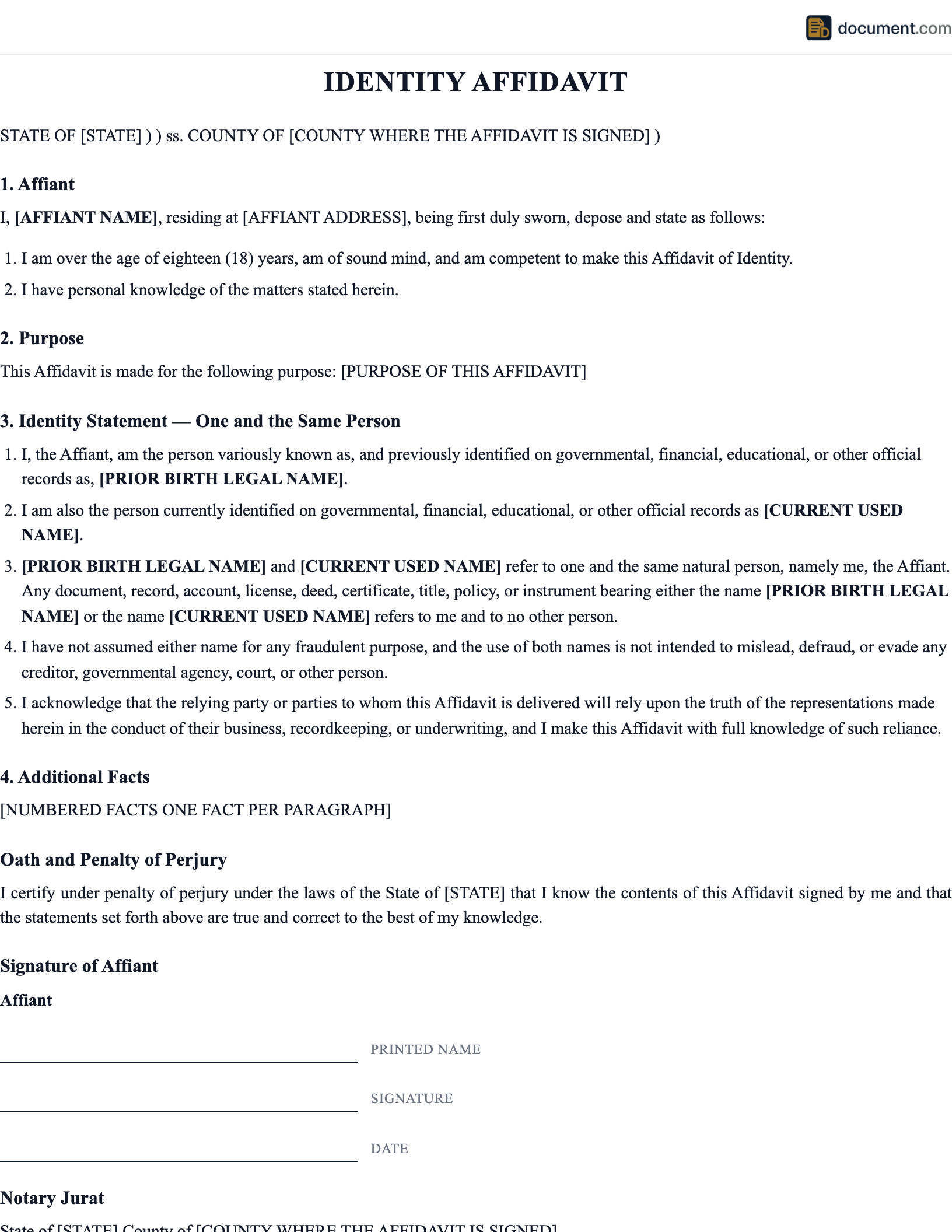
AFFIDAVIT OF IDENTITY
STATE OF [State] COUNTY OF [County]
I, [Affiant Full Legal Name], being first duly sworn under penalty of perjury, hereby depose and state:
1. IDENTITY
My current full legal name is [Name]. I was born on [DOB] in[City, State]. My current residential address is [Address].
2. IDENTIFYING RECORDS
I am identified by the following government-issued records: driver's license number [#] issued by the State of [State]; U.S. passport number [#]; and Social Security number ending in [XXXX].
3. NAME VARIANTS
I have appeared in official records under the following names, all of which refer to the same individual:
- [Variant 1 — source document]
- [Variant 2 — source document]
4. SUPPORTING DOCUMENTS
[List of attached exhibits — marriage certificate, divorce decree, prior court orders, etc.]
5. PURPOSE
I make this affidavit to confirm my identity to [Requesting Institution] for the purpose of [Purpose].
6. TRUTHFULNESS
The statements in this affidavit are true and correct to the best of my knowledge. I understand that knowingly false statements may subject me to criminal penalties for perjury and to civil liability.
Subscribed and sworn to before me on [Date].
Frequently Asked Questions
Common questions about identity verification, name discrepancies, lost IDs, and bank requirements.
Official Resources
Authoritative sources for identity verification, KYC compliance, and federal ID forms.
U.S. State Department - Lost or Stolen Passport
Form DS-71 affidavit of identifying witness for passport replacement
SSA Form SS-5 - Application for SSN Card
Social Security Administration application form for new or replacement SSN cards
FinCEN - USA PATRIOT Act
Federal Customer Identification Program rules for banks
CFPB - Cashing a Check Made Out to a Different Name
Consumer Financial Protection Bureau guidance on name discrepancies
National Notary Association
Authoritative resource on notarization standards in all 50 states
American Land Title Association
Industry organization for title insurers; underwriting bulletins on identity affidavits
FTC IdentityTheft.gov
Federal Trade Commission resource for identity theft victims
DMV.org - State DMV Information
State-by-state guide to DMV identification requirements
Create your Identity Affidavit in under 10 minutes.
Answer a few questions and download a compliant, attorney-drafted document ready for your state.