
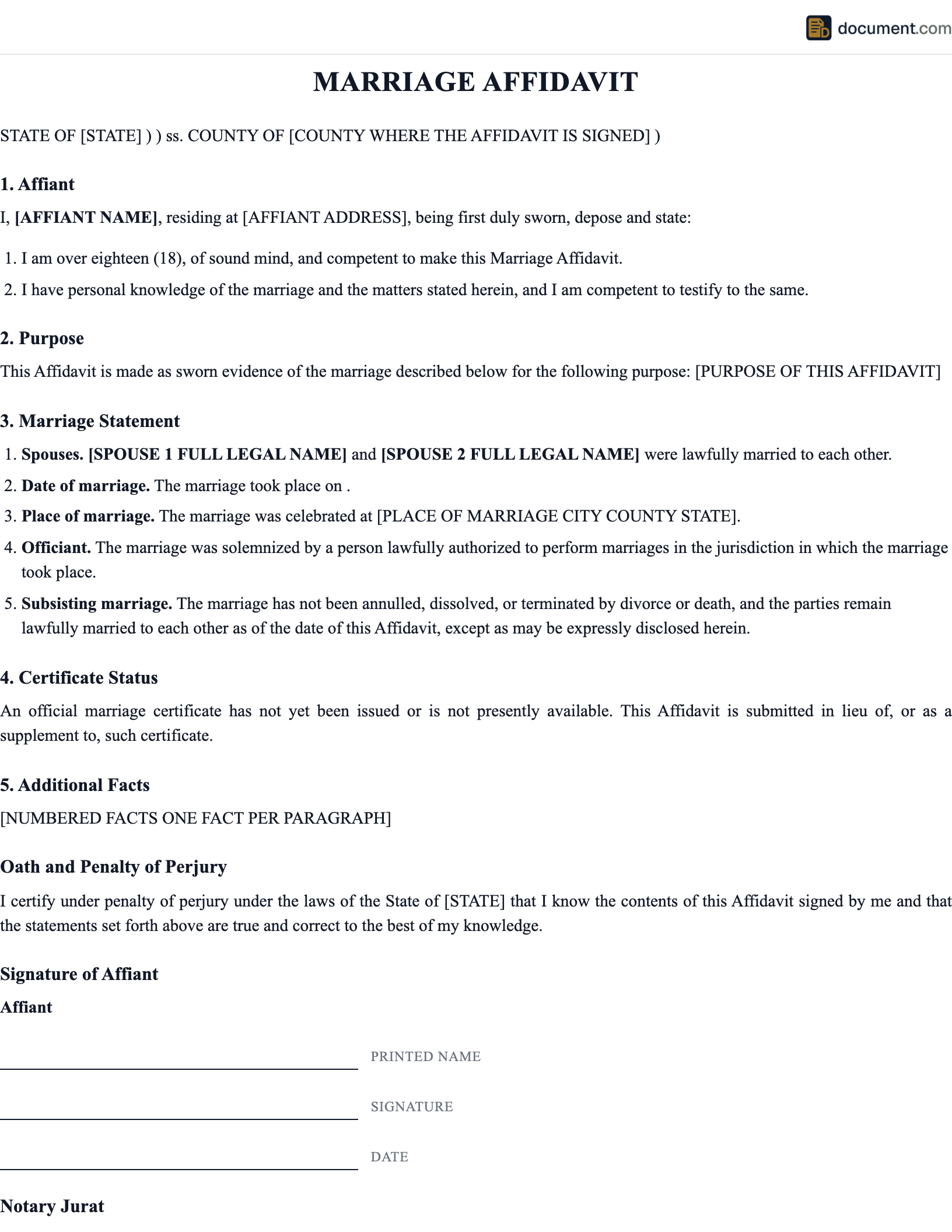



What Is a Marriage Affidavit?
A marriage affidavit is a sworn written statement, made under oath before a notary public or other authorized official, in which an affiant (the person signing the statement) attests to facts about a marriage. It is used to prove or confirm the existence, validity, authenticity, or circumstances of a marriage when a marriage certificate alone is either unavailable or insufficient. Marriage affidavits serve as official supporting evidence for a wide range of legal, administrative, and governmental purposes — from immigration petitions to lost-certificate replacements to establishing common-law marriages in jurisdictions where they are still recognized.
Because an affidavit is a sworn statement, the facts in it are given under penalty of perjury — meaning the affiant legally represents that everything in the document is true to the best of their personal knowledge. This is what gives affidavits their legal weight. A court, government agency, or other decision-maker can treat the statements in a properly executed affidavit as evidence of the facts asserted, whereas an unsworn statement is typically given far less weight or may be inadmissible altogether.
Marriage affidavits come in several varieties depending on the purpose. An affidavit of marriage generally confirms that a marriage took place on a specific date in a specific location. An affidavit of bona fide marriage, commonly required by USCIS in immigration cases, goes further and provides detailed facts supporting the genuine nature of the marital relationship. An affidavit of common-law marriage establishes a marriage that was never formalized with a license and ceremony in states that recognize common-law marriage. An affidavit of single status confirms that a person is free to marry, typically for use abroad. Our template supports each of these variations with tailored language for your specific use case.
Whenever possible, you should first attempt to obtain a certified copy of the marriage certificate from the vital records office in the state and county where the marriage took place. Certificates are the primary form of proof and are accepted without question by most agencies. A marriage affidavit is a secondary form of proof — appropriate when the certificate is lost, when the marriage was performed in a jurisdiction that does not issue certificates, when additional supporting evidence is required (as in USCIS cases), or when establishing a common-law marriage.
Sworn Under Oath
A notarized affidavit carries real legal weight and is accepted by courts and agencies
Multiple Uses
USCIS filings, lost certificates, common-law marriage, benefits applications, and more
Ready to Notarize
Includes jurat block and state-specific notary language for immediate signing
Marriage Affidavit Form Preview
Preview of the sections in our marriage affidavit template.
Affidavit of Marriage
Section 1: Affiant Information
Section 2: Marriage Details
Section 3: Statement of Facts
I hereby swear that I was lawfully married on the date and at the place stated above, and that the marriage remains in full force and effect as of the date of this affidavit.
Section 4: Jurat & Notarization
Affiant Signature
Notary Public
When to Use a Marriage Affidavit
USCIS immigration petitions
U.S. Citizenship and Immigration Services requires bona fide marriage evidence in I-130 petitions, I-485 adjustment of status applications, and removal of conditions filings. Affidavits from the couple and from third parties who know them are standard supporting evidence.
Lost or destroyed marriage certificate
When the original marriage certificate is unavailable and a certified duplicate cannot be obtained from vital records, a sworn affidavit can serve as substitute evidence, often paired with a statement of no record from the vital records office.
Establishing a common-law marriage
In states that still recognize common-law marriage, couples use affidavits to formally document the existence of their marriage for tax filings, inheritance, Social Security, and other purposes.
Social Security spousal benefits
The Social Security Administration may require a marriage affidavit to establish eligibility for spousal, survivor, or divorced-spouse benefits when documentary evidence is incomplete.
Name change after marriage
Courts and government agencies sometimes accept a marriage affidavit as supporting evidence in name change petitions, particularly when the underlying marriage certificate is lost or unavailable.
Probate and inheritance
In probate proceedings, surviving spouses may use affidavits to establish the existence of a marriage for purposes of claiming intestate share, elective share, or spousal homestead rights.
Types of Marriage Affidavits
Affidavit of Marriage
Sworn statement confirming that a marriage took place, used when a certificate is unavailable
Affidavit of Bona Fide Marriage
Statement attesting that a marriage is genuine, commonly used for USCIS immigration petitions
Affidavit of Common Law Marriage
Sworn statement establishing a common-law marriage in states that recognize it
Affidavit of Single Status
Sworn statement confirming a person is unmarried and free to marry, often used abroad
Affidavit of Marriage for SSA
Marriage affidavit used to establish spousal Social Security benefits
Third-Party Marriage Affidavit
Statement from a witness or family member attesting to a marriage they observed
Affidavit of Lost Marriage Certificate
Sworn statement for use when the original marriage certificate has been lost or destroyed
Affidavit of Marriage for Name Change
Supporting affidavit used for legal name changes tied to a marriage
USCIS Bona Fide Marriage Affidavits
For immigration cases involving a U.S. citizen or lawful permanent resident spouse petitioning for a foreign-national spouse, USCIS requires proof that the marriage is "bona fide" — entered into for the genuine purpose of establishing a life together, not primarily to obtain immigration benefits. Bona fide marriage evidence is the heart of every I-130 petition, and affidavits from the couple and from third parties play a critical role.
What to include in a bona fide marriage affidavit.The affidavit should describe: (1) how the couple met, when, and in what circumstances; (2) the development of the relationship over time (dates, trips, introductions to family, engagement); (3) the circumstances of the wedding (location, attendees, ceremony details); (4) shared residence (moving in together, lease or deed in both names, shared utilities); (5) joint financial life (joint bank accounts, shared credit cards, joint tax returns, shared insurance policies); (6) children (biological or otherwise); (7) shared activities, vacations, and social life; (8) relationships with each other's families; (9) any challenges the couple has faced together; and (10) future plans. Specificity and credibility are far more persuasive than generic assertions.
Third-party affidavits.USCIS gives significant weight to sworn statements from people who know the couple — family members, friends, coworkers, neighbors, clergy. Third-party affiants should explain their relationship to the couple, how long they have known the couple, specific interactions they have had with the couple together, and their personal observations of the couple's relationship. Generic letters of support are not as persuasive as detailed sworn statements with personal observations.
Common mistakes.Avoid boilerplate language that could apply to any couple. Avoid contradictions between the couple's affidavits. Ensure every fact is consistent with the supporting documentation (photos, leases, tax returns). Do not sign an affidavit containing any statement you are unsure about — USCIS officers are trained to spot inconsistencies, and discrepancies trigger fraud investigations and interviews.
How to Create a Marriage Affidavit
Determine your purpose
Identify why you need the affidavit (USCIS, lost certificate, common-law marriage, etc.). Different purposes require different content and tailored language.
Check what the requesting agency requires
Contact the agency, court, or institution that will receive the affidavit and confirm their specific requirements — number of affiants, required facts, formatting, and whether a notarized affidavit is sufficient or an additional declaration is needed.
Gather supporting facts and documents
Collect all relevant dates, names, places, and events. Have any supporting documentation (photos, certificates, correspondence) available to reference and to attach if appropriate.
Draft the affidavit
Use our template to draft the affidavit. Include the affiant's identity, relationship to the marriage (spouse, witness, third party), detailed factual statements, and a sworn conclusion.
Review for accuracy
Every statement in the affidavit is made under penalty of perjury. Read the draft carefully and remove or correct anything you are not 100% certain is true based on your personal knowledge.
Find a notary public
Do not sign the affidavit before meeting with the notary. Bring valid government-issued photo ID. Banks, credit unions, UPS stores, libraries, and mobile notaries all provide notarization services.
Sign in the notary's presence
The notary will verify your identity, administer an oath, and watch you sign the affidavit. They will then complete the jurat block with their signature, seal, and commission details.
Make copies and submit
Keep the original and make certified copies as needed. Submit the affidavit to the requesting agency along with any supporting documentation and cover letter explaining its purpose.
Key Components
Caption and title
A clear title identifying the type of affidavit (e.g., 'Affidavit of Marriage,' 'Affidavit of Bona Fide Marriage') and the jurisdiction where it is being executed.
Affiant identification
The affiant's full legal name, date of birth, current address, and relationship to the marriage being attested (spouse, witness, family member, etc.).
Statement of competency
Language confirming the affiant is over 18, of sound mind, and competent to make the sworn statement.
Personal knowledge clause
A statement that all facts in the affidavit are based on the affiant's personal knowledge, not hearsay or belief.
Statement of facts
The detailed facts being attested — names of spouses, date and place of marriage, officiant, and any other relevant details.
Supporting details
For bona fide or common-law marriage affidavits, additional facts about the relationship: shared residence, joint finances, children, and public holding-out.
Sworn declaration
The formal 'I swear under penalty of perjury that the foregoing is true and correct' language that makes the document a sworn statement.
Signature block
The affiant's signature line with printed name and date.
Jurat
The notary's attestation block — 'Subscribed and sworn to before me' — with the notary's signature, seal, and commission expiration date.
Exhibits (if applicable)
Attached supporting documents referenced in the affidavit (photos, certificates, records) labeled as exhibits.
Notarization Requirements
Notarization is what transforms a written statement into an affidavit. Without a notary's acknowledgment and jurat, the document is merely an unsworn declaration and carries significantly less legal weight. Every marriage affidavit must be notarized — or, in some contexts, signed as an unsworn declaration under 28 U.S.C. § 1746 with specific statutory language.
What the notary does.The notary will verify your identity by examining a valid government-issued photo ID (driver's license, passport, or state ID), administer an oath or affirmation, watch you sign the affidavit, and complete the jurat block with their signature, seal, and commission details. You must sign in the notary's physical presence — not before the meeting and not after. Some states now allow remote online notarization (RON), which lets you appear via video and sign electronically.
Fees. Notary fees are regulated by state law and typically range from $2 to $15 per notarized signature. Mobile notaries may charge travel fees on top. Banks and credit unions often provide free notary services to customers. UPS stores, AAA offices, libraries, and public libraries are other common low-cost options.
International use.If the affidavit will be used outside the United States, you may also need an apostille (under the Hague Convention) or authentication by the U.S. State Department and the foreign country's consulate. Apostilles are issued by the Secretary of State in the state where the notary is commissioned and typically cost $10–$30 per document.
Common-Law Marriage Affidavits
A common-law marriage is a legally recognized marriage established without a formal wedding ceremony or marriage license. While the overwhelming majority of U.S. states have abolished common-law marriage, a handful still recognize it: Colorado, Iowa, Kansas, Montana, Oklahoma (limited), Rhode Island, Texas, Utah (limited), New Hampshire (limited to inheritance), and the District of Columbia. States that previously recognized common-law marriage usually grandfather existing common-law marriages.
To establish a common-law marriage, the couple generally must prove: (1) they are both legally eligible to marry (of age, not already married, not closely related); (2) they have agreed to be married and consider themselves spouses; (3) they live together; and (4) they hold themselves out to the public as married. Requirements vary by state — Texas, for example, requires a mutual agreement, cohabitation in Texas, and holding out.
A common-law marriage affidavit typically includes: the couple's agreement to be married and the approximate date that agreement was reached; their shared residence history; evidence that they hold themselves out as married (joint tax returns, insurance listing spouse, introductions to others, use of the same last name, joint bank accounts, joint leases); any children born during the marriage; and attestations from third parties who know the couple as married. Both spouses typically sign, and supporting affidavits from family and friends are common. The affidavit is important for inheritance, Social Security benefits, health insurance, and tax purposes, and can also be used to obtain a divorce or dissolution.
Legal Requirements
- Sworn statement. An affidavit must be sworn before a notary or other authorized officer, or signed as a declaration under penalty of perjury per 28 U.S.C. § 1746.
- Competent affiant. The affiant must be at least 18 years old and mentally competent.
- Personal knowledge. Facts must be within the affiant's personal knowledge, not hearsay or speculation.
- Truthful. All statements must be true. Perjury is a criminal offense with serious penalties including imprisonment and fines.
- Proper identification. The notary must verify the affiant's identity via government-issued photo ID.
- In-person signing. Except where remote online notarization is authorized, the affiant must sign in the notary's physical presence.
- State notary requirements. The notary must be commissioned in the state where the affidavit is signed and must comply with state notary law.
Sample Marriage Affidavit
AFFIDAVIT OF MARRIAGE
STATE OF [State]
COUNTY OF [County]
I, [Affiant Full Name], being first duly sworn upon oath, depose and state as follows:
1. COMPETENCY
I am over the age of eighteen (18) years, of sound mind, and competent to make this affidavit. The statements made herein are based upon my personal knowledge and are true and correct to the best of my belief.
2. MARRIAGE
I was lawfully married to [Spouse Full Name] on [Date of Marriage] in [City, State/Country]. The marriage was officiated by [Officiant Name and Title].
3. CONTINUING VALIDITY
The marriage has not been terminated by divorce, annulment, or death, and the marriage remains in full force and effect as of the date of this affidavit.
4. PURPOSE
I make this affidavit for the purpose of [Purpose].
5. PENALTY OF PERJURY
I declare under penalty of perjury under the laws of the State of [State] that the foregoing is true and correct.
JURAT
Subscribed and sworn to before me on this [Day] day of [Month], [Year].
Frequently Asked Questions
Official Resources
USCIS - Family of U.S. Citizens
Official guidance on spousal immigration petitions and bona fide marriage evidence
USCIS - Form I-130
Petition for Alien Relative, including spousal petitions
CDC - Where to Write for Vital Records
Contact information for vital records offices in every state
SSA - Documents for Spousal Benefits
Documents required to apply for Social Security spousal benefits
State Department - Marriage Abroad
U.S. State Department guidance on marriages performed abroad
NASS - Notary Information by State
National Association of Secretaries of State notary directory
28 U.S.C. § 1746
Federal statute on unsworn declarations under penalty of perjury
State Department - Apostille Information
How to obtain an apostille for documents used abroad
Create your Marriage Affidavit in under 10 minutes.
Answer a few questions and download a compliant, attorney-drafted document ready for your state.