



What Is a Prenuptial Agreement?
A prenuptial agreement — commonly called a prenup — is a legally binding contract entered into by two people before they get married. The agreement establishes how assets, debts, property, and financial responsibilities will be managed during the marriage and divided in the event of divorce, separation, or death. Prenups are governed by state law, and while each state has its own specific requirements for validity and enforceability, the fundamental purpose is the same everywhere: to allow couples to define their own financial terms rather than relying on default state divorce and property laws.
At its core, a prenuptial agreement protects the assets that each person brings into the marriage. These "separate property" assets might include real estate, savings accounts, investment portfolios, retirement funds, business interests, intellectual property, and inherited wealth. Without a prenup, the distinction between separate property and marital property can become blurred over time — particularly when separate assets are commingled with marital funds, when one spouse contributes to the growth of the other's pre-marital business, or when the couple lives in a community property state where most assets acquired during marriage are automatically split 50/50.
Beyond asset protection, prenuptial agreements define how property acquired during the marriage will be treated. The agreement can specify whether income earned during the marriage is shared or kept separate, how jointly purchased property will be divided, who is responsible for household debts, and whether one spouse will receive spousal support (alimony) if the marriage ends. These provisions give couples control over their financial future rather than leaving these critical decisions to a judge who knows nothing about their relationship or individual circumstances.
Prenuptial agreements are not just for the wealthy — and that is one of the most persistent misconceptions about them. While high-net-worth individuals have long used prenups to protect substantial assets, the modern prenup is equally valuable for middle-income couples. Anyone with student loan debt, a small business, savings they want to protect, children from a prior relationship, or simply a desire for financial clarity can benefit from a prenup. The agreement is as much about preventing future conflict as it is about protecting wealth.
The trend toward prenuptial agreements has accelerated dramatically among younger generations. According to a 2023 Harris Poll survey for the American Academy of Matrimonial Lawyers, prenup requests among millennials increased by over 62% in the preceding five years. This shift reflects changing attitudes about marriage and money — couples are marrying later, bringing more individual assets and debts into the relationship, and viewing prenups as practical financial planning tools rather than pessimistic predictions of divorce. Just as you would not buy a house without insurance, many modern couples see a prenup as essential protection for their financial partnership.
Asset Protection
Protect pre-marital property, inheritance, business interests, and investments
Debt Allocation
Define responsibility for student loans, credit cards, and other pre-marital debts
Financial Clarity
Establish clear expectations for property division, spousal support, and finances
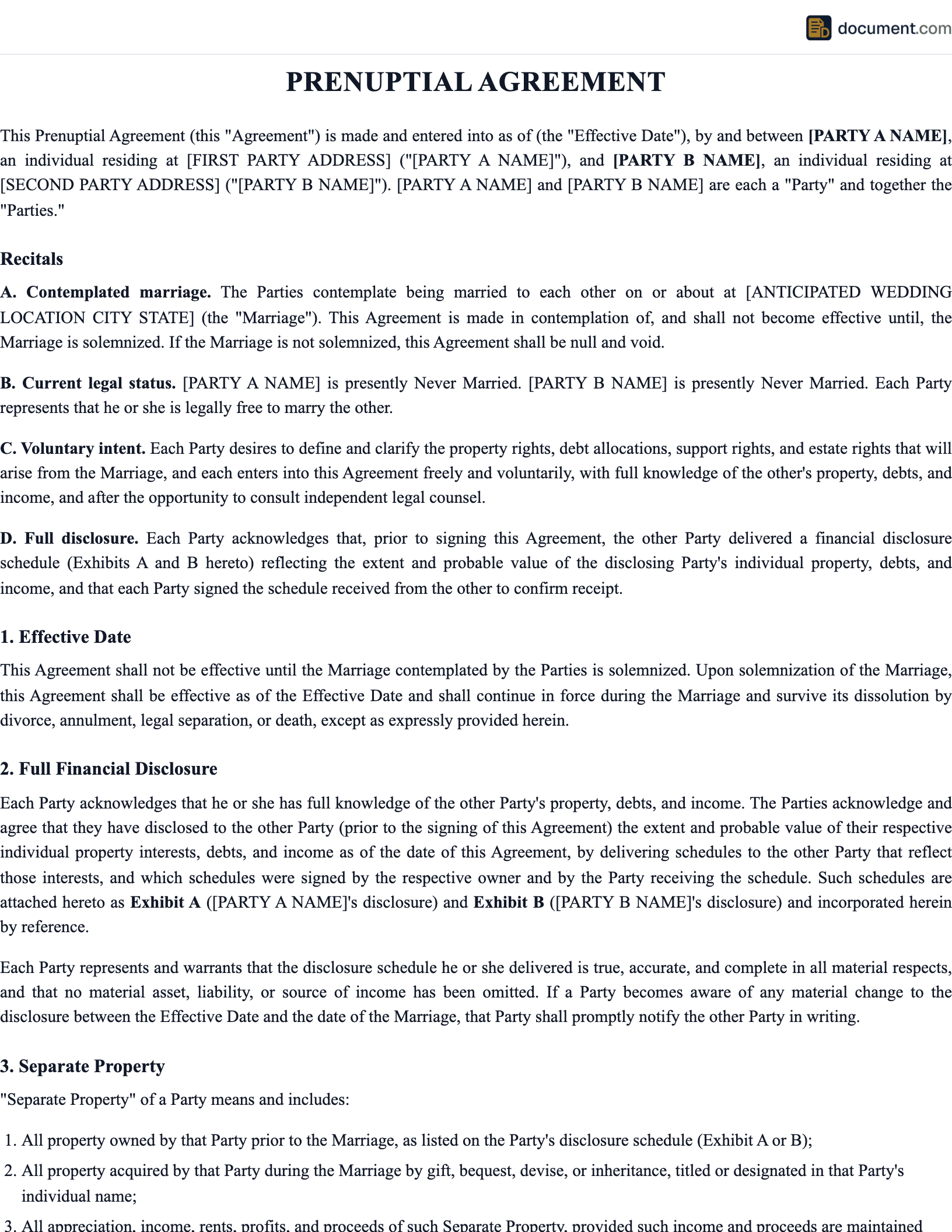
Prenuptial Agreement Form Preview
Our prenuptial agreement template covers all the essential provisions needed for a comprehensive and enforceable prenup. Below is a preview of the key sections included in your customized document, which will be tailored to your state's specific legal requirements.
PRENUPTIAL AGREEMENT
Entered Into Before Marriage
PARTY 1 (Prospective Spouse)
Full Legal Name: [Name]
Date of Birth: [DOB]
Current Address: [Address]
Attorney: [Attorney Name]
PARTY 2 (Prospective Spouse)
Full Legal Name: [Name]
Date of Birth: [DOB]
Current Address: [Address]
Attorney: [Attorney Name]
SEPARATE PROPERTY — PARTY 1
Real Estate: [Description & Value]
Bank Accounts: [Institution & Balance]
Investments: [Description & Value]
Business Interests: [Entity & Ownership %]
MARITAL PROPERTY DIVISION
Income Treatment: [Shared / Separate / Hybrid]
Jointly Acquired Property: [Division Method]
Retirement Accounts: [Treatment]
SPOUSAL SUPPORT / ALIMONY
Spousal Support: [Waived / Terms Specified / Per State Law]
Duration: [Term / Permanent / Based on Marriage Length]
Amount Formula: [Fixed / Percentage / Sliding Scale]
DEBT ALLOCATION
Pre-Marital Debts: [Each Party Responsible for Own]
Marital Debts: [Division Method]
Student Loans: [Individual / Shared]
BUSINESS OWNERSHIP PROTECTION
Business Entity: [Name & Type]
Treatment of Appreciation: [Separate / Shared]
Non-Compete Clause: [Yes / No]
ESTATE & INHERITANCE PROVISIONS
Inheritance Treatment: [Separate Property]
Estate Rights: [Waived / Modified / Per State Law]
Life Insurance: [Requirements]
SUNSET CLAUSE
Expiration: [Date / After X Years / Never]
Phase-Out Terms: [Gradual / Immediate / N/A]
SIGNATURES & NOTARIZATION
Party 1 Signature: [Signature] Date: [Date]
Party 2 Signature: [Signature] Date: [Date]
Notary Public: [Signature & Seal]
Commission Expires: [Date]
When Do You Need a Prenuptial Agreement?
While any couple can benefit from a prenuptial agreement, certain situations make a prenup particularly important. If any of the following scenarios apply to you, a prenup should be considered an essential part of your wedding preparation.
Second or Subsequent Marriage
If either spouse has been married before, a prenup is especially critical. You likely have assets accumulated from your prior life, obligations from a previous divorce settlement, and possibly children whose inheritance you want to protect. A prenup ensures that the financial terms of your new marriage do not inadvertently affect your obligations from the first marriage or the financial legacy you want to leave your existing children.
Business Owners and Entrepreneurs
If you own a business — whether a sole proprietorship, partnership, LLC, or corporation — a prenup can protect your ownership interest from being divided in a divorce. Without a prenup, a spouse may be entitled to a share of the business's value (including appreciation during the marriage), which could force a sale, bring an unwanted partner into the business, or require a large buyout payment. Business partners and co-founders often require their partners to have prenups to protect the company.
Significant Pre-Marital Assets
If either spouse brings significant assets into the marriage — real estate, investments, retirement accounts, or substantial savings — a prenup clearly defines these as separate property. Over a long marriage, the line between separate and marital property can become blurred through commingling (mixing funds), appreciation, or improvements funded by marital income. A prenup prevents disputes about what belongs to whom.
Inheritance Protection
If you have received or expect to receive a significant inheritance, a prenup can ensure that the inheritance remains your separate property. While most states treat inheritance as separate property by default, this protection can be lost if inherited funds are commingled with marital assets — for example, depositing inherited money into a joint bank account or using it to improve jointly owned real estate. A prenup provides an additional layer of protection.
Debt Protection
If either spouse carries significant debt — student loans, credit card debt, business debts, or tax obligations — a prenup can shield the other spouse from responsibility for those obligations. In community property states, debts incurred during marriage are often considered shared debts. A prenup can specify that each party remains solely responsible for their own pre-marital debts and define how new debts incurred during marriage will be allocated.
Children From a Prior Relationship
If you have children from a prior marriage or relationship, a prenup helps protect their inheritance and financial interests. Without a prenup, your new spouse may have a statutory right to a portion of your estate (the "elective share" in many states), which could reduce what your children receive. A prenup can modify or waive these spousal estate rights, ensuring your children are protected while still providing for your new spouse.
Career Sacrifice Protection
If one spouse plans to reduce their work hours, leave their career, or forgo educational opportunities to raise children or support the other spouse's career, a prenup can include provisions that compensate for this sacrifice. The agreement might include specific spousal support terms, a larger share of marital property, educational fund provisions, or other financial protections that acknowledge the career-sacrificing spouse's contribution.
International or Cross-Border Couples
If either spouse holds citizenship in another country, owns property abroad, or plans to live in multiple jurisdictions, a prenup is essential for establishing which country's laws will govern the marriage and any potential divorce. International divorce can involve conflicting legal systems, and a prenup can specify choice of law, jurisdiction for disputes, and how foreign assets will be treated. This is particularly important for couples where one spouse comes from a community property legal tradition and the other from a common law tradition.
What Can and Cannot Be in a Prenuptial Agreement
Prenuptial agreements are powerful tools, but they are not unlimited. Courts will enforce provisions that deal with financial and property matters, but will refuse to enforce provisions that violate public policy, attempt to regulate non-financial aspects of the marriage, or are fundamentally unfair.
What CAN Be Included in a Prenup
Property Division
How separate and marital property will be classified and divided, including real estate, bank accounts, investments, and personal property
Debt Allocation
Responsibility for pre-marital debts, student loans, and debts incurred during the marriage, including credit cards and business liabilities
Spousal Support / Alimony
Whether spousal support will be paid, the amount, duration, and under what circumstances — including waivers of alimony (subject to state law limits)
Business Interests
Protection of business ownership, treatment of business appreciation during marriage, and restrictions on a spouse's claim to business assets
Inheritance and Estate Rights
Waiver or modification of spousal elective share rights, protection of family inheritance, and coordination with estate plans and trusts
Pet Custody
Who keeps pets in the event of divorce, shared custody arrangements, and financial responsibility for pet care and veterinary expenses
What CANNOT Be Included in a Prenup
Child Custody or Child Support
Courts determine child custody and support based on the child's best interests at the time of divorce — these cannot be predetermined in a prenup, as circumstances and the child's needs may change
Illegal Provisions
Any provision that requires either party to do something illegal is unenforceable — this includes provisions that violate federal or state law, tax fraud provisions, or agreements to commit crimes
Unconscionable Terms
Provisions that are extremely one-sided or fundamentally unfair to one party can be struck down — for example, a prenup that leaves one spouse destitute while the other keeps millions may be deemed unconscionable
Provisions Encouraging Divorce
Courts may reject provisions that create a financial incentive for divorce — for example, a clause giving one spouse a massive payout only upon divorce could be seen as promoting marital dissolution rather than protection
Prenup vs Other Agreements
Prenuptial agreements are one of several legal tools couples can use to define their financial relationship. Understanding how a prenup compares to other agreements will help you choose the right instrument for your situation.
Prenuptial Agreement vs Postnuptial Agreement
A postnuptial agreement serves the same purpose as a prenup but is executed after the marriage has already taken place. Couples who did not sign a prenup before the wedding, or who want to update or replace an existing prenup, can use a postnuptial agreement. However, postnups face greater legal scrutiny because the parties are already in a fiduciary relationship as spouses, and courts are more likely to find duress or undue influence.
| Feature | Prenuptial Agreement | Postnuptial Agreement |
|---|---|---|
| Timing | Signed before marriage | Signed after marriage |
| Legal Scrutiny | Standard — well-established framework | Higher — fiduciary duty between spouses |
| Enforceability | Recognized in all 50 states | Not recognized or limited in some states |
| Common Use | Before wedding to set initial terms | After major life changes (inheritance, business, reconciliation) |
Prenuptial Agreement vs Cohabitation Agreement
A cohabitation agreement is designed for unmarried couples who live together but do not plan to marry (or have not yet decided). It addresses many of the same financial issues as a prenup — property ownership, expense sharing, debt allocation — but operates under contract law rather than family law. If the couple later marries, the cohabitation agreement should be replaced with or converted into a prenuptial agreement.
| Feature | Prenuptial Agreement | Cohabitation Agreement |
|---|---|---|
| Relationship Status | Engaged couple planning to marry | Unmarried couple living together |
| Governing Law | Family law / UPAA | General contract law |
| Spousal Support | Can address alimony | No alimony provisions (not married) |
| Triggered By | Divorce or death | Separation or end of cohabitation |
Prenuptial Agreement vs Separation Agreement
A separation agreement is created when a married couple decides to separate or divorce. It addresses the same issues as a prenup — property division, spousal support, debt allocation — but does so at the end of the marriage rather than the beginning. If a prenup exists, the separation agreement typically implements the prenup's terms. If no prenup exists, the separation agreement is negotiated from scratch, which is often more contentious and expensive.
| Feature | Prenuptial Agreement | Separation Agreement |
|---|---|---|
| Timing | Before marriage | During separation / divorce |
| Emotional Climate | Generally cooperative | Often adversarial |
| Cost | $2,500 - $10,000 typical | $5,000 - $50,000+ depending on dispute |
| Purpose | Establish future terms proactively | Resolve existing disputes reactively |
Prenuptial Agreement vs Property Agreement
A property agreement (sometimes called a community property agreement or transmutation agreement) is used to change the character of specific property — for example, converting separate property to community property or vice versa. While a prenup typically covers the couple's entire financial relationship, a property agreement usually focuses on specific assets. In some community property states, married couples can use property agreements to designate certain assets as separate or community property without a full prenup or postnup.
| Feature | Prenuptial Agreement | Property Agreement |
|---|---|---|
| Scope | Comprehensive — all financial matters | Narrow — specific assets or property types |
| Timing | Before marriage | Before or during marriage |
| Spousal Support | Can address | Typically does not address |
| Common Jurisdictions | All 50 states | Primarily community property states |
How to Create a Prenuptial Agreement
Creating a valid and enforceable prenuptial agreement requires careful planning, complete transparency, and adequate time. Rushing the process or cutting corners can lead to an agreement that a court will refuse to enforce. Follow these eight steps to create a prenup that will hold up in court.
Complete Full Financial Disclosure
Both parties must provide complete, honest disclosure of all assets, debts, income, and financial obligations. This is the single most important requirement for enforceability. Include bank statements, investment account summaries, retirement fund balances, real estate appraisals, business valuations, tax returns, and a list of all debts. Failing to disclose even one significant asset can be grounds for invalidating the entire agreement.
Hire Independent Attorneys
Each party should retain their own independent attorney who specializes in family law. One lawyer cannot represent both sides — that would be a conflict of interest. While not legally required in most states (California is a notable exception), having separate counsel dramatically increases the likelihood that the prenup will be enforced. Each attorney will review the terms, explain the legal implications, and ensure their client understands what they are agreeing to.
Negotiate the Terms
Work with your respective attorneys to negotiate the specific terms of the agreement. This includes property classification (separate vs. marital), property division percentages or methods, spousal support terms, debt allocation, business protection provisions, estate and inheritance provisions, and any sunset clauses. Both parties should feel that the agreement is fair, even if it is not perfectly equal — unconscionable agreements can be invalidated.
Draft the Agreement
One attorney (typically the attorney for the party who initiated the prenup) drafts the agreement based on the negotiated terms. The draft should include all required legal provisions, financial schedules listing each party's assets and debts, clear definitions of separate and marital property, and compliance with your state's specific statutory requirements. The other attorney then reviews and proposes revisions.
Allow Adequate Review Time
Both parties must have sufficient time to review the final agreement, consult with their attorneys, and ask questions before signing. Rushing the review process can support a claim of duress. While there is no universal minimum review period, best practice is to allow at least 7 to 30 days between receiving the final draft and signing. California requires at least 7 days. Presenting a prenup the night before the wedding is a recipe for invalidation.
Sign Before the Wedding (Not Day-Of)
Sign the prenuptial agreement well before the wedding date. Signing on the wedding day, or even a few days before, creates a strong argument that one party signed under duress — the implicit threat of canceling the wedding puts pressure on the reluctant party. Ideally, the agreement should be signed at least 30 days before the ceremony. Both parties should sign voluntarily, without any threats, coercion, or undue pressure from the other party or their families.
Notarize the Agreement
While not required in all states, having the prenuptial agreement notarized is strongly recommended and is required in some jurisdictions. Notarization verifies the identity of both signers and confirms that they signed voluntarily. The notary public cannot be related to either party or have a financial interest in the agreement. Some states also require witnesses in addition to notarization.
Store the Agreement Safely
Keep the original signed and notarized agreement in a secure location such as a safe deposit box, fireproof safe, or with your attorney. Each party should have their own copy, and each attorney should retain a copy in their files. Unlike deeds and some other legal documents, prenuptial agreements are not filed with a court or government agency at the time of execution — they are private contracts that are only presented to a court if needed during divorce proceedings.
Key Components of a Prenuptial Agreement
A comprehensive prenuptial agreement addresses all aspects of the couple's financial relationship. While the specific provisions will vary based on each couple's circumstances, the following components are standard in most well-drafted prenups.
| Component | Description |
|---|---|
| Party Identification | Full legal names, dates of birth, addresses, and attorney information for both parties |
| Recitals / Preamble | Statement of intent to marry, purpose of the agreement, and confirmation of voluntary execution |
| Financial Disclosure | Schedules listing each party's assets, debts, income, and financial obligations with current values |
| Separate Property Definition | Identification and classification of each party's pre-marital assets that will remain separate property |
| Marital Property Rules | How property acquired during the marriage will be classified, managed, and divided |
| Income Treatment | Whether income earned during marriage is separate, marital, or a hybrid arrangement |
| Spousal Support Terms | Alimony waiver, fixed amount, duration, formula, or deferral to state law |
| Debt Allocation | Responsibility for pre-marital and marital debts, including student loans, credit cards, and mortgages |
| Business Protection | Treatment of business interests, appreciation, and restrictions on spousal claims to business assets |
| Real Estate Provisions | Treatment of the marital home, investment properties, and real estate acquired during marriage |
| Retirement Accounts | Treatment of 401(k)s, IRAs, pensions, and other retirement accounts including marital-period contributions |
| Estate and Inheritance | Waiver or modification of spousal elective share, inheritance protection, and life insurance requirements |
| Sunset Clause | Expiration date or trigger event after which the prenup (or specific provisions) no longer applies |
| Governing Law | Which state's law governs the agreement and dispute resolution provisions |
| Severability Clause | If one provision is found invalid, the rest of the agreement remains enforceable |
| Modification Provisions | How the agreement can be amended or revoked — requires written consent of both parties |
| Signatures and Notarization | Both parties' signatures, date of execution, notary acknowledgment, and witness signatures if required |
Enforceability Requirements
A prenuptial agreement is only as good as its enforceability. Courts across the country apply specific tests to determine whether a prenup should be upheld, and failing to meet these requirements can result in the agreement being partially or entirely invalidated. The two primary legal frameworks are the Uniform Premarital Agreement Act (UPAA) and the newer Uniform Premarital and Marital Agreements Act (UPMAA).
Important: UPAA vs. UPMAA
The Uniform Premarital Agreement Act (UPAA), adopted in 1983, has been enacted in some form by 28 states and the District of Columbia. The newer Uniform Premarital and Marital Agreements Act (UPMAA), approved in 2012, has been adopted by a smaller but growing number of states (including Colorado, Connecticut, and North Dakota). The UPMAA provides stronger protections for the less powerful party and requires a higher standard for enforceability. States that have not adopted either act apply their own common law standards, which can vary significantly.
Core Enforceability Requirements
Voluntary Execution
Both parties must sign the prenup voluntarily, without coercion, duress, or undue influence. Evidence of involuntary execution includes presenting the agreement for the first time on the wedding day, threatening to cancel the wedding unless the other party signs, one party being intoxicated or emotionally distressed when signing, or extreme pressure from family members. Courts look at the totality of circumstances to determine voluntariness.
Full Financial Disclosure
Both parties must provide a complete and accurate disclosure of their assets, debts, income, and financial obligations. This is typically done through attached financial schedules that list each asset and debt with its current value. If one party conceals assets or significantly understates their wealth, the prenup can be invalidated for fraud or lack of disclosure. Some states allow parties to waive the right to disclosure, but this must be done explicitly and knowingly.
Independent Legal Counsel
While not required in most states, both parties having independent legal counsel is the strongest indicator of a valid prenup. California's Family Code Section 1615 requires that the party against whom enforcement is sought either had independent counsel or waived the right to counsel in a specific written manner. Even in states where independent counsel is not mandatory, courts give significantly more weight to agreements where both parties were represented.
Not Unconscionable
The agreement must not be unconscionable — meaning it cannot be so one-sided that it shocks the conscience of the court. Unconscionability is evaluated either at the time of execution (in UPAA states) or at the time of enforcement (in some non-UPAA states). An agreement where one spouse gets everything and the other gets nothing is likely unconscionable. However, an agreement does not have to be perfectly equal — it just cannot be fundamentally unfair.
Adequate Time Before Wedding
Both parties must have had adequate time to review the agreement, consult with attorneys, and make an informed decision. There is no universal minimum timeframe, but courts are skeptical of agreements presented days before the wedding. California requires at least 7 days between presenting the final agreement and signing. Best practice is to have the agreement finalized at least 30 days before the ceremony, with the initial conversation beginning months earlier.
Legal Requirements by State Framework
Prenuptial agreement laws vary significantly from state to state. The most important distinction is whether your state follows the Uniform Premarital Agreement Act (UPAA), the Uniform Premarital and Marital Agreements Act (UPMAA), or its own independent common law framework. Additionally, the distinction between community property states and equitable distribution states fundamentally affects how a prenup functions.
Community Property vs. Equitable Distribution
The United States has two primary systems for dividing marital property, and which system your state uses has a profound impact on why you need a prenup and what it should contain.
Community Property States (9)
Arizona, California, Idaho, Louisiana, Nevada, New Mexico, Texas, Washington, and Wisconsin
All income earned and property acquired during the marriage is owned equally (50/50) by both spouses. Upon divorce, community property is split evenly. A prenup is critical in these states to keep certain assets separate.
Equitable Distribution States (41)
All other states, including New York, Florida, Illinois, Pennsylvania, and Ohio
Marital property is divided "equitably" (fairly, but not necessarily equally) by a judge based on factors like marriage length, earning capacity, and contributions. A prenup removes the uncertainty of judicial discretion.
Uniform Premarital Agreement Act (UPAA) Adoption
The UPAA provides a standardized framework for prenuptial agreements across adopting states. States that have adopted the UPAA include Arizona, Arkansas, California (with significant modifications), Connecticut, Delaware, Hawaii, Idaho, Illinois, Indiana, Iowa, Kansas, Maine, Montana, Nebraska, Nevada, New Jersey, New Mexico, North Carolina, North Dakota, Oregon, Rhode Island, South Dakota, Texas, Utah, Virginia, and Wisconsin. Each state may have made modifications to the uniform act, so it is important to consult your specific state's version.
States that have not adopted the UPAA — including Florida, Georgia, Massachusetts, Michigan, New York, Ohio, Pennsylvania, and Washington — apply their own statutory or common law standards. These states may have different requirements for disclosure, voluntariness, and unconscionability. Regardless of which framework your state follows, the fundamental principles of fairness, disclosure, and voluntary execution apply everywhere.
Prenuptial Agreement by State
Each state has different requirements for prenuptial agreements, including enforceability standards, disclosure requirements, independent counsel rules, notarization requirements, and treatment of spousal support waivers. Select your state below for a prenup form customized to your jurisdiction.
Sample Prenuptial Agreement
Below is a preview of a standard prenuptial agreement. Your customized document will include state-specific language, enforceability provisions, financial schedules, and all required execution formalities for your jurisdiction.
PRENUPTIAL AGREEMENT
State of _______________
This Prenuptial Agreement ("Agreement") is entered into on [Date] by and between [PARTY 1 NAME]("Party 1") and [PARTY 2 NAME]("Party 2"), collectively referred to as the "Parties."
WHEREAS, the Parties intend to marry on or about [Wedding Date], and desire to establish their respective rights and obligations regarding property, finances, and support in the event of dissolution of the marriage or death;
WHEREAS, both Parties have made full, fair, and complete disclosure of their respective financial circumstances, as set forth in the attached Schedules A and B;
WHEREAS, both Parties have had the opportunity to consult with independent legal counsel of their own choosing;
NOW, THEREFORE, in consideration of the mutual promises contained herein and the upcoming marriage, the Parties agree as follows:
ARTICLE I — SEPARATE PROPERTY
All property listed in Schedule A (Party 1) and Schedule B (Party 2) shall remain the separate property of the respective Party...
ARTICLE II — MARITAL PROPERTY
Property acquired jointly during the marriage shall be divided as follows: _______________
ARTICLE III — SPOUSAL SUPPORT
The Parties agree to the following terms regarding spousal support: _______________
Party 1 Signature
Printed Name: _______________
Date: _______________
Party 2 Signature
Printed Name: _______________
Date: _______________
NOTARY ACKNOWLEDGMENT
State of _______ County of _______
On _______ before me personally appeared _______, proved to me on the basis of satisfactory evidence to be the person(s) whose name(s) is/are subscribed to the within instrument...
Notary Signature: _______________ [SEAL]
Commission Expires: _______________
Frequently Asked Questions
Find answers to common questions about prenuptial agreements, including enforceability, costs, legal requirements, and what provisions can be included.
Official Resources
Use these trusted resources for additional information about prenuptial agreements, family law, marriage requirements, and financial planning.
Uniform Law Commission — UPAA
Official text and adoption status of the Uniform Premarital Agreement Act
American Bar Association — Family Law
Family law resources, find an attorney, and legal guides
IRS — Marriage Tax Information
Tax filing status changes, deductions, and credits for married couples
American Academy of Matrimonial Lawyers
Find a certified family law specialist for prenup drafting and review
FindLaw — Prenuptial Agreement Guide
Comprehensive legal guide to prenups, state laws, and enforceability
National Notary Association
Find a notary, notarization requirements by state
Related Family Law Documents
Depending on your situation, you may need additional documents to complement your prenuptial agreement or address related legal matters.
Postnuptial Agreement
Financial agreement created after marriage for existing couples
Cohabitation Agreement
Property and financial agreement for unmarried couples living together
Separation Agreement
Divide assets, debts, and custody during legal separation or divorce
Divorce Forms
State-specific divorce petition, settlement, and filing documents
Estate Planning Documents
Wills, trusts, and estate planning tools to coordinate with your prenup
Power of Attorney
Authorize your spouse or another person to act on your behalf
Create your Prenuptial Agreement in under 10 minutes.
Answer a few questions and download a compliant, attorney-drafted document ready for your state.