
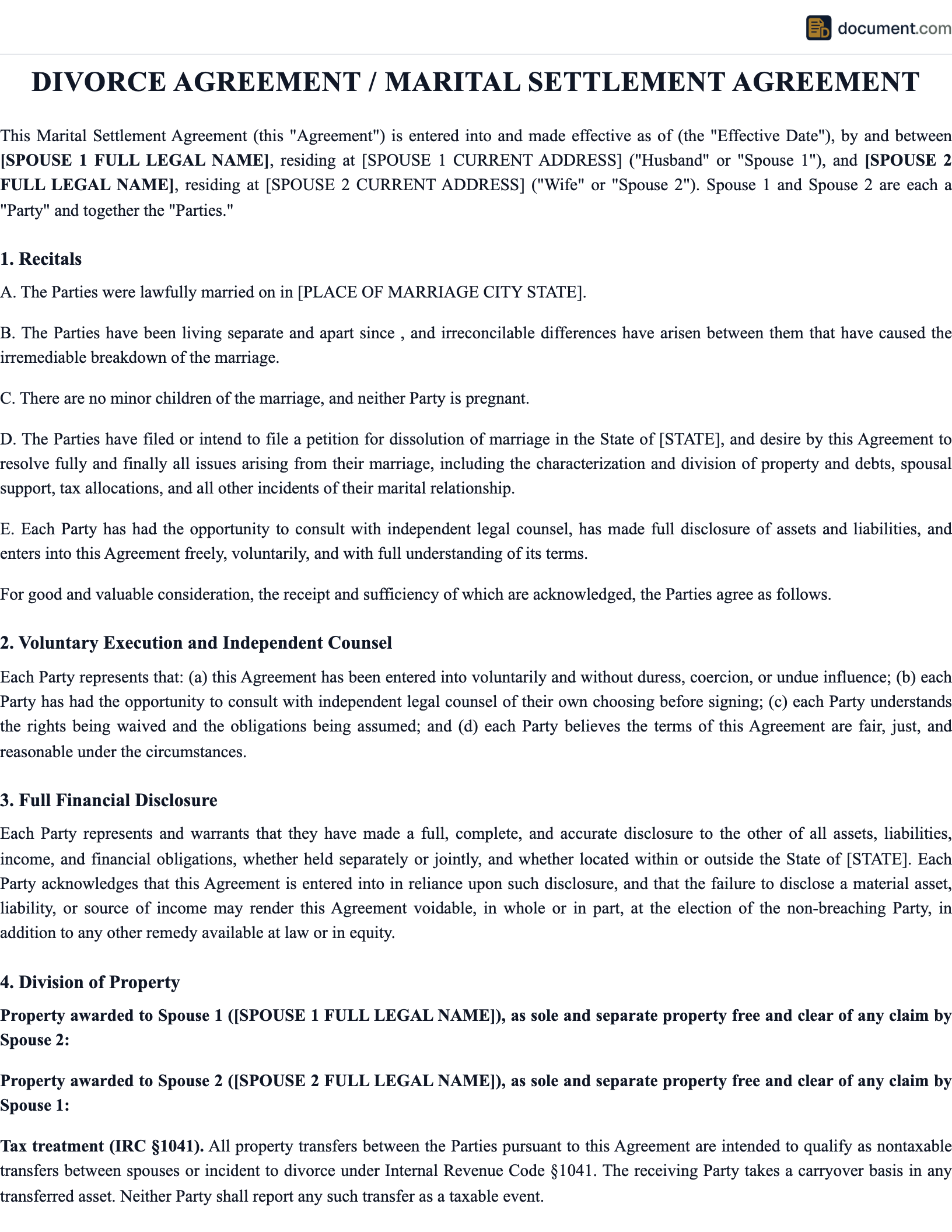



What Is a Divorce Settlement Agreement?
A divorce settlement agreement — also called a marital settlement agreement (MSA), property settlement agreement, or separation and settlement agreement depending on the jurisdiction — is a legally binding contract between divorcing spouses that resolves all issues arising from the dissolution of their marriage. This document replaces adversarial litigation with a negotiated resolution, giving both parties control over the outcome rather than leaving decisions to a judge who has limited time and information about the family's unique circumstances.
The settlement agreement typically covers five major categories: the division of marital assets (real estate, bank accounts, investments, retirement funds, vehicles, personal property), the allocation of marital debts (mortgages, credit cards, student loans, tax liabilities), child custody and visitation schedules (legal custody, physical custody, holiday and vacation arrangements), child support (amount, duration, and method of payment), and spousal support or alimony (type, amount, duration, and conditions for termination). Additionally, it may address life insurance requirements, health insurance continuation, tax filing status, name changes, and provisions for dispute resolution.
Once both spouses sign the agreement, it is submitted to the family court for approval. The judge reviews the agreement to ensure it is fair, voluntary, and — in cases involving children — consistent with the best interests of the child standard. If approved, the settlement terms are incorporated into the final divorce decree, making them enforceable as a court order. Violation of incorporated terms can result in contempt of court proceedings, which carry penalties including fines, attorney fee awards, and even incarceration in extreme cases.
The enforceability and interpretation of a divorce settlement agreement are governed by state law, and significant variations exist across jurisdictions. Community property states (Arizona, California, Idaho, Louisiana, Nevada, New Mexico, Texas, Washington, Wisconsin) presume a 50/50 split of marital assets and debts, while equitable distribution states divide property based on what the court considers fair given the totality of circumstances. Understanding your state's framework is essential because it sets the baseline from which negotiations begin and determines how a court would divide property if the spouses cannot agree.
Our attorney-reviewed templates guide you through each section of the settlement agreement with explanatory notes, optional clauses, and state-specific provisions. Whether you are pursuing an uncontested divorce with full agreement or resolving the remaining issues in a partially contested case, our templates provide the legal framework to document your agreement comprehensively and submit it to the court with confidence.
Fair Division
Divide assets, debts, and responsibilities equitably with structured negotiation frameworks
Child Protection
Establish custody, visitation, and support arrangements that prioritize children's well-being
Cost Savings
Avoid $15,000-$50,000+ in litigation costs by settling outside of court
Divorce Settlement Agreement Form Preview
Below is a visual preview of the sections and fields included in a comprehensive divorce settlement agreement. This mockup shows the structure our templates follow. Your completed document will be tailored to your specific situation, family structure, and state requirements.
Marital Settlement Agreement
Divorce Settlement and Property Division
Section 1: Identifying Information
Section 2: Division of Marital Property
Section 3: Child Custody & Visitation
Section 4: Child Support & Spousal Maintenance
Section 5: Execution & Acknowledgment
Petitioner Signature
Respondent Signature
Petitioner's Attorney
Respondent's Attorney
Notary Public / Commission Expiration
Types of Divorce Settlement Agreements
Not all divorces follow the same path. The type of settlement agreement you need depends on whether you and your spouse can agree on terms, whether attorneys or mediators are involved, and the complexity of your marital estate. Understanding these distinctions helps you choose the most efficient and cost-effective approach for your situation.
Uncontested Divorce Agreement
Both spouses agree on all terms including property, custody, and support
Contested Divorce Settlement
Court-facilitated resolution when spouses cannot reach voluntary agreement
Collaborative Divorce Agreement
Negotiated with collaborative attorneys where both sides commit to settlement
Mediated Divorce Agreement
Terms reached through neutral third-party mediation sessions
Default Divorce Agreement
Entered when one spouse does not respond to the divorce petition
Summary Dissolution Agreement
Simplified agreement for short marriages with minimal assets and no children
Divorce Agreement vs Other Documents
A divorce settlement agreement is often confused with other family law documents. Understanding the distinctions is important for choosing the right document for your situation and ensuring that all necessary legal issues are properly addressed.
Divorce Settlement vs Separation Agreement
Divorce Settlement Agreement
- - Filed as part of divorce proceedings
- - Legally terminates the marriage
- - Incorporated into the final divorce decree
- - Both parties are free to remarry after finalization
- - Permanent resolution of all marital issues
Separation Agreement
- - Can exist without filing for divorce
- - Marriage remains legally intact
- - Governs rights and obligations during separation
- - Neither party can remarry
- - May convert to divorce settlement later
Key takeaway: A separation agreement is often used as a precursor to divorce, particularly in states that require a period of separation before granting a divorce. Many separation agreements are later incorporated into the divorce settlement with minimal changes.
Divorce Settlement vs Prenuptial Agreement
Divorce Settlement Agreement
- - Created during or after marriage breakdown
- - Reflects actual assets, debts, and circumstances at time of divorce
- - Subject to court review and approval
- - Must comply with child support guidelines
Prenuptial Agreement
- - Created before marriage in anticipation of potential divorce
- - Predetermines property division and support terms
- - May be challenged if circumstances changed substantially
- - Cannot predetermine child custody or child support
How they interact: If a valid prenuptial agreement exists, it typically controls the division of property and may influence spousal support in the divorce settlement. However, the court can set aside prenuptial provisions that are unconscionable or that were entered into without full financial disclosure.
Divorce Settlement vs Parenting Plan
Divorce Settlement Agreement
- - Covers all divorce issues comprehensively
- - Includes property, support, custody, and debts
- - May contain custody provisions at a high level
- - Single document covering the entire divorce
Parenting Plan
- - Focuses exclusively on children
- - Detailed custody, visitation, and decision-making provisions
- - Includes holiday schedules, transportation, communication protocols
- - Often required as a separate filing in many states
Best practice: Many states require a separate parenting plan in addition to the settlement agreement. Even when not required, a detailed parenting plan attached to the settlement agreement reduces future conflicts by addressing day-to-day logistics that a settlement agreement typically does not cover in sufficient detail.
How to Create a Divorce Settlement Agreement: An 8-Step Guide
Creating a thorough divorce settlement agreement requires careful financial analysis, honest disclosure, and thoughtful consideration of each family member's needs. Follow these eight steps to build an agreement that will withstand court scrutiny and serve your family's interests for years to come.
Compile a Complete Financial Inventory
Before negotiating any terms, both spouses must compile a comprehensive list of all marital assets and debts. This includes real estate (with current appraisals), bank accounts, investment and brokerage accounts, retirement accounts (401(k)s, IRAs, pensions), vehicles, business interests, personal property of significant value (jewelry, art, collectibles), and all debts (mortgages, car loans, credit cards, student loans, tax obligations). Many states require a formal financial disclosure affidavit, and failure to disclose assets can invalidate the agreement.
Classify Assets as Marital or Separate Property
Determine which assets are marital property (subject to division) and which are separate property (belonging to one spouse alone). Generally, assets acquired during the marriage are marital property, while assets owned before marriage, inherited individually, or received as gifts are separate property. Be aware of commingling — when separate property is mixed with marital property (e.g., depositing an inheritance into a joint account), it may lose its separate character and become subject to division. Asset tracing may be required to establish separate property claims.
Determine Custody and Parenting Arrangements
If you have minor children, develop a custody and visitation plan that serves the children's best interests. Decide on legal custody (who makes major decisions about education, healthcare, and religion) and physical custody (where the children live). Create a detailed visitation schedule including regular weekly/biweekly arrangements, holiday rotations, summer vacation time, and provisions for birthdays, school breaks, and special occasions. Consider each parent's work schedule, the children's school and activity schedules, and geographic proximity between the parents' residences.
Calculate Child Support
Every state has child support guidelines that use a formula based on both parents' income, the number of children, the custody arrangement, and other factors such as healthcare costs and childcare expenses. While parents can agree to deviate from the guidelines, the court must approve any deviation and ensure it does not disadvantage the children. Include provisions for extraordinary expenses (medical, educational, extracurricular), cost-of-living adjustments, and the method of payment (direct payment, income withholding order, or through the state disbursement unit).
Address Spousal Support
Determine whether spousal support (alimony or maintenance) is appropriate given the income disparity between the spouses, the length of the marriage, and each spouse's ability to become self-supporting. Specify the type (rehabilitative, transitional, permanent, or lump-sum), amount, duration, method of payment, and conditions for modification or termination. Consider tax implications — since the Tax Cuts and Jobs Act of 2017, alimony is no longer deductible by the payor or taxable to the recipient for agreements executed after December 31, 2018.
Negotiate Property Division
Divide marital property according to your state's framework. Create a detailed schedule of assets listing each item, its current value, and which spouse will receive it. For items that cannot be divided (like a house), determine whether one spouse will buy out the other's share or whether the asset will be sold and proceeds split. Address retirement accounts with a QDRO, business interests with a professional valuation, and personal property with an agreed-upon list. Do not overlook digital assets, frequent flyer miles, timeshares, country club memberships, and deferred compensation.
Allocate Debts and Liabilities
Assign responsibility for each marital debt — mortgage, car loans, credit cards, student loans, medical bills, and taxes. Include indemnification clauses so that if one spouse fails to pay an assigned debt, the other spouse has a contractual right to reimbursement plus attorney fees. Close joint credit accounts, refinance joint loans into individual names where possible, and document the payment plan for any debts that cannot be immediately resolved. Remember that creditors are not bound by the divorce settlement and can pursue either spouse on a joint debt.
Review, Sign, and File with the Court
Have each spouse's attorney review the final agreement. Both spouses sign before a notary public (most states require notarization). File the agreement with the family court along with the divorce petition and any other required documents (financial affidavits, parenting plan, child support worksheets). The court will schedule a hearing — in uncontested cases, this may be brief or waived entirely — and the judge will issue the final divorce decree incorporating the settlement terms.
Tip: Keep copies of the signed agreement, the final decree, and all financial documentation in a safe place. You will need these records for tax filings, property transfers, QDRO processing, and any future modification proceedings.
Key Components of a Divorce Settlement Agreement
A comprehensive divorce settlement must address every financial, custodial, and practical issue to prevent future disputes. Below are the essential components that every thorough settlement agreement should include.
| Component | Description |
|---|---|
| Party Identification | Full legal names, addresses, dates of birth, marriage date, separation date, and minor children |
| Real Property Division | Marital home disposition, other real estate, equity buyout terms, deed transfer deadlines, and refinancing obligations |
| Personal Property | Vehicles, furniture, jewelry, collectibles, household items, and personal effects with assigned values |
| Financial Accounts | Bank accounts, investment accounts, cryptocurrency, stock options, and other financial instruments |
| Retirement Accounts | 401(k), IRA, pension, and other retirement plan division with QDRO provisions and coverture fractions |
| Debt Allocation | Assignment of each marital debt with indemnification clauses and account closure requirements |
| Child Custody | Legal and physical custody arrangements, decision-making authority, and dispute resolution for parenting issues |
| Visitation Schedule | Regular parenting time, holidays, vacations, transportation responsibilities, and right of first refusal |
| Child Support | Monthly amount, duration, payment method, cost-of-living adjustments, and extraordinary expense sharing |
| Spousal Support | Type, amount, duration, payment schedule, and conditions for modification or termination |
| Insurance Provisions | Health insurance continuation (COBRA), life insurance requirements to secure support obligations, and auto insurance |
| Tax Provisions | Filing status for current year, dependency exemptions, tax liability allocation, and refund/liability indemnification |
| Dispute Resolution | Mediation or arbitration clauses for future disagreements before returning to court |
| Modification Provisions | Which terms are modifiable, the standard for modification, and non-modifiable terms |
Understanding Property Division in Divorce
Property division is often the most complex and contentious aspect of a divorce settlement. The approach depends on your state's legal framework and the unique circumstances of your marriage. Understanding the rules that apply in your jurisdiction is essential for negotiating a fair settlement.
Equitable Distribution
Used in 41 states and D.C. Property is divided fairly but not necessarily equally.
- - Length of marriage considered
- - Income and earning capacity of each spouse
- - Contributions to marital property (including homemaking)
- - Age, health, and future needs
- - Standard of living during marriage
- - Tax consequences of proposed division
- - Custody arrangements may influence property awards
Community Property
Used in 9 states (AZ, CA, ID, LA, NV, NM, TX, WA, WI). Marital assets split 50/50.
- - All earnings during marriage are community property
- - Assets acquired during marriage presumed community
- - Debts during marriage are community obligations
- - Separate property remains with the owning spouse
- - Commingling can convert separate to community
- - Equal division is the default starting point
- - Some states allow deviation for good cause
Hidden Assets Warning
Each spouse has a legal obligation to fully disclose all assets, debts, income, and expenses during the divorce process. Hiding assets — whether by transferring property to third parties, underreporting income, overstating debts, or concealing accounts — constitutes fraud and can result in the court setting aside the settlement agreement, awarding a larger share of the marital estate to the defrauded spouse, imposing sanctions, and in severe cases, criminal prosecution. If you suspect your spouse is hiding assets, consult a forensic accountant and inform your attorney immediately.
Legal Requirements for Divorce Settlement Agreements
Divorce law is governed by state statutes, and the requirements for a valid, enforceable settlement agreement vary across jurisdictions. Understanding your state's specific requirements is essential for creating an agreement that the court will approve and that will withstand future challenges.
Residency Requirements
Every state requires at least one spouse to be a resident for a specified period before filing for divorce. Residency requirements range from 6 weeks (Nevada) to 12 months (New York for some grounds, Connecticut, New Jersey). Some states require residency in the specific county where you file. You must meet the residency requirement at the time of filing, not at the time of separation. Military personnel may file in their state of legal residence or the state where they are stationed.
Grounds for Divorce
All 50 states now offer no-fault divorce, allowing couples to dissolve their marriage without proving wrongdoing by either spouse. The grounds are typically stated as "irreconcilable differences," "irretrievable breakdown," or "incompatibility." Some states still offer fault-based grounds (adultery, cruelty, abandonment, imprisonment) which may affect property division or alimony in some jurisdictions. Several states require a mandatory separation period before granting a no-fault divorce — ranging from 30 days (Montana) to 2 years (Pennsylvania without consent).
Waiting Periods
Many states impose a mandatory waiting period between filing for divorce and the issuance of the final decree. California requires a 6-month waiting period, Colorado requires 91 days, Texas requires 60 days, and Kansas requires 60 days. The purpose is to allow time for reconciliation and to prevent hasty decisions. During the waiting period, the settlement agreement can be negotiated and finalized so that the divorce can be granted as soon as the waiting period expires.
Court Approval Standards
- Voluntary Consent: The court must find that both spouses entered into the agreement voluntarily, without coercion, duress, or undue influence. Evidence of independent legal counsel strengthens this finding.
- Full Financial Disclosure: Both parties must have made complete and accurate disclosure of all assets, debts, income, and expenses. Concealment of material information can invalidate the agreement.
- Fairness and Equity: While courts generally approve agreements reached by competent adults, they may reject terms that are grossly unconscionable or that appear to be the result of overreaching by one party.
- Best Interests of the Child: For agreements involving minor children, the court independently evaluates whether custody, visitation, and support provisions serve the children's best interests, regardless of what the parents agreed to.
- Child Support Compliance: Child support provisions must comply with the state's child support guidelines. Deviations may be approved if adequately justified, but the court will scrutinize any arrangement that falls below guideline amounts.
State Law Considerations for Divorce Settlements
Divorce settlements are heavily shaped by state law, but this page does not yet have direct state-level routes. Instead of showing dead state links, we summarize the biggest legal differences you need to account for before finalizing an agreement.
Property Division Framework
States either follow equitable distribution or community property rules, which changes how marital homes, retirement accounts, business interests, and debt are split.
Residency and Waiting Periods
Filing eligibility and finalization timelines vary widely. Some states allow quick uncontested resolutions, while others impose cooling-off periods or parenting-class requirements before entry of judgment.
Support Calculations
Child support guidelines, alimony formulas, duration standards, and modification rules are all state-specific, especially when income is irregular or one spouse owns a business.
Court Approval Standards
Judges review divorce settlements for voluntariness, financial disclosure, and fairness to children. Some courts require additional schedules, parenting plans, or notarized exhibits.
Sample Divorce Settlement Agreement
Below is a condensed preview showing the structure and legal language of our divorce settlement agreement template. Your completed document will be fully customized for your family, financial situation, and state requirements.
MARITAL SETTLEMENT AGREEMENT
State of [State]
This Marital Settlement Agreement ("Agreement") is entered into by and between[Petitioner Name]("Petitioner") and[Respondent Name]("Respondent"), collectively the "Parties," who were married on[Date]and separated on[Date].
1. PROPERTY DIVISION
The Parties agree to divide all marital property as set forth in Exhibit A, attached hereto and incorporated by reference. Each Party shall execute all documents necessary to effectuate the transfers described herein within [30/60/90] days of the entry of the Final Decree of Dissolution...
2. SPOUSAL SUPPORT
[Payor] shall pay to[Payee]the sum of $[Amount] per month as [rehabilitative/permanent/transitional] spousal support, commencing on the first day of the month following entry of the Final Decree and continuing for a period of [Duration]...
3. CHILD CUSTODY AND PARENTING TIME
The Parties shall share joint legal custody of the minor child(ren). Primary physical custody shall reside with [Parent]. The parenting time schedule shall be as set forth in the Parenting Plan attached as Exhibit B...
4. CHILD SUPPORT
In accordance with the state child support guidelines, [Payor] shall pay child support in the amount of $[Amount] per month, payable through [method], until each child reaches the age of majority or is otherwise emancipated...
5. DEBT ALLOCATION
The Parties agree to assume responsibility for debts as set forth in Exhibit C. Each Party shall indemnify and hold harmless the other from any liability for debts assigned to them under this Agreement...
6. MUTUAL RELEASE
Except as specifically provided in this Agreement, each Party releases and forever discharges the other from any and all claims, demands, and obligations arising out of the marital relationship...
Frequently Asked Questions
Find answers to common questions about divorce settlement agreements, property division, child custody, spousal support, and the divorce process.
Official Resources
For additional information on divorce law, property division, custody, and family law resources in your state, consult these official and reputable sources.
ABA Family Law Section
American Bar Association resources on family law and divorce
WomensLaw.org - Divorce Guide
State-by-state divorce information and legal resources
IRS - Divorce Tax Information
Tax filing guidance for divorced and separated individuals
OCSE - Child Support Enforcement
Federal Office of Child Support Enforcement resources and state contacts
Nolo - Divorce & Property
Free legal information on divorce property division and settlement
Mediate.com - Family Mediation
Find divorce mediators and learn about the mediation process
Create your Divorce Agreement in under 10 minutes.
Answer a few questions and download a compliant, attorney-drafted document ready for your state.