
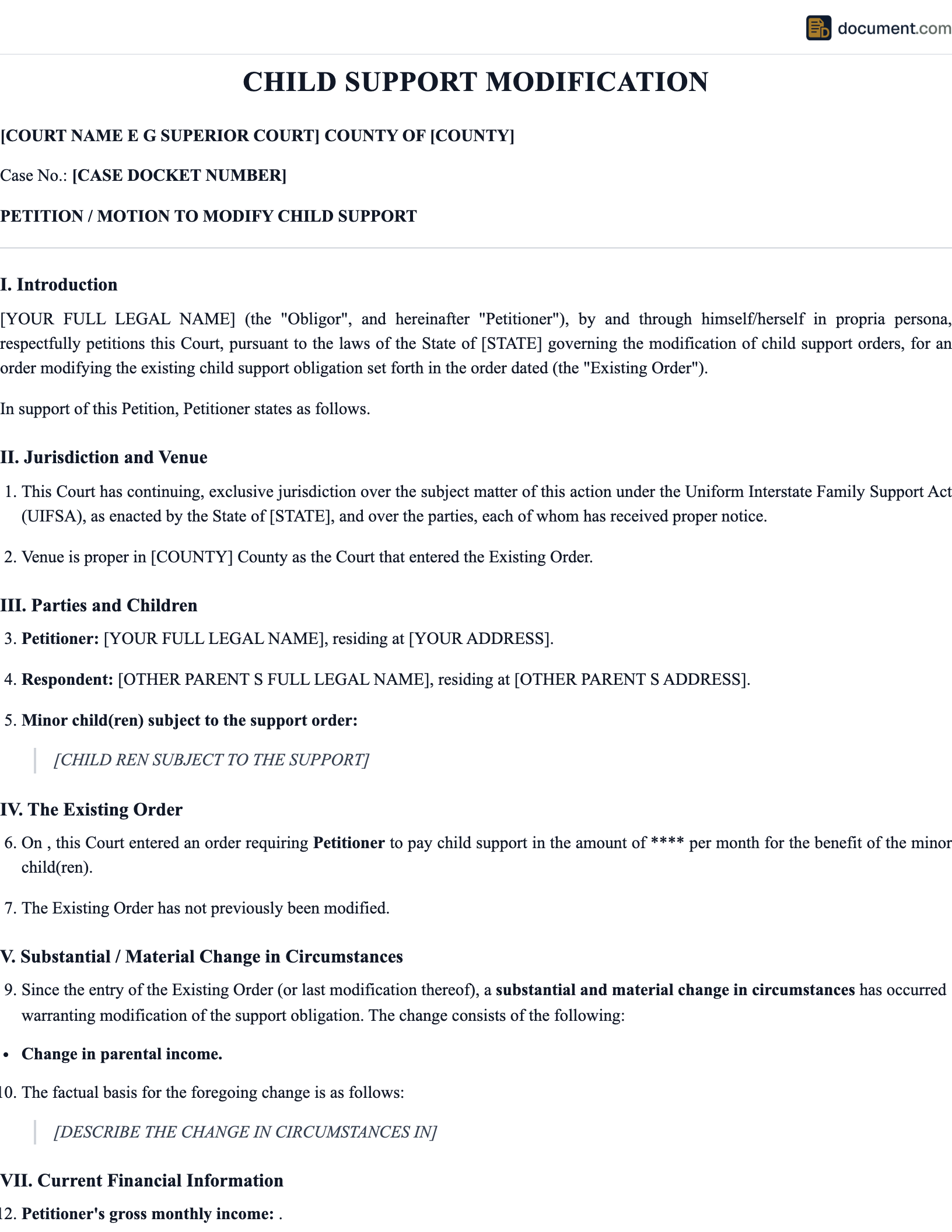



What Is a Child Support Modification?
A child support modification is a legal proceeding in which either parent petitions the court to change the amount of child support established in an existing court order. Child support orders are not permanent fixtures — they are designed to reflect the financial circumstances of both parents and the needs of the child at a given point in time. When those circumstances change materially, the law provides a mechanism to adjust the support amount so it remains fair, adequate, and aligned with current realities.
The fundamental legal standard for modifying child support in virtually every state is a "substantial change in circumstances" since the original order was entered or the last modification was granted. This threshold prevents the courts from being inundated with frivolous modification requests based on minor or temporary changes, while ensuring that genuinely significant changes — such as job loss, disability, a major increase in income, or a change in custody — can be addressed through the legal system. What constitutes "substantial" varies by state, but most jurisdictions use either a percentage threshold (e.g., a 15-25% change in income) or a dollar threshold (e.g., a $50-$100 difference in the monthly guideline amount) as a benchmark.
Either parent can petition for modification — the paying parent (obligor) if circumstances warrant a reduction, or the receiving parent (obligee) if circumstances support an increase. Additionally, state child support enforcement agencies can initiate periodic reviews (typically every three years) to determine whether the current order should be adjusted based on updated income information. In some states, either party can request an agency review as an alternative to filing a court petition directly.
It is critical to understand that child support modifications are not retroactivein most states. The modification typically takes effect from the date the petition is filed, not from the date the change in circumstances occurred. This means that if you experience a qualifying change — such as involuntary job loss — you should file your modification petition immediately rather than waiting. The support obligation at the old rate continues to accrue until the court enters the new order, and in most states, accrued arrearages cannot be reduced or forgiven retroactively.
Our attorney-reviewed modification templates guide you through the entire process: documenting the changed circumstances, completing income worksheets and financial affidavits, calculating the proposed new support amount under your state's guidelines, and preparing the petition and supporting documents required by your local family court. Each template is customized for your state's specific guidelines, thresholds, and procedural requirements.
Income Decrease
Adjust support when involuntary job loss, disability, or reduced income changes your financial reality
Income Increase
Request an increase when the paying parent's income has substantially risen
Custody Changes
Recalculate support when parenting time or custody arrangements shift substantially
Modification Petition Form Preview
Below is a visual preview of the sections and fields included in a child support modification petition. This mockup illustrates the information required by family courts to evaluate your request. Your completed petition will include your state's specific forms and guideline worksheets.
Petition to Modify Child Support
Family Court Filing
Section 1: Petitioner (Party Requesting Modification)
Section 2: Current Child Support Order
Section 3: Substantial Change in Circumstances
Section 4: Income Comparison
Section 5: Verification & Signature
I declare under penalty of perjury that the foregoing statements are true and correct to the best of my knowledge and belief.
Petitioner Signature
Notary Public (if required)
Grounds for Child Support Modification
Courts require a legitimate reason — a "substantial change in circumstances" — before modifying an existing child support order. The following are the most commonly accepted grounds.
Involuntary Income Loss
Layoff, termination, company closure, or industry downturn resulting in a significant, involuntary reduction in the paying parent's income. The loss must be through no fault of the parent and the parent must demonstrate active efforts to obtain comparable employment.
Substantial Income Increase
A significant increase in either parent's income — through promotion, new employment, business growth, or receipt of substantial assets — that makes the current support amount inconsistent with what the guidelines would now produce.
Medical or Disability Changes
A parent's new disability or serious medical condition that affects earning capacity, or a child developing special needs requiring additional medical care, therapy, or educational support that substantially increases the cost of raising the child.
Custody or Parenting Time Change
A substantial change in the custody arrangement or parenting time schedule — such as moving from standard visitation to shared 50/50 custody, or a child beginning to live primarily with the other parent — that affects the guideline calculation.
Child Aging Out or Emancipation
When one of the supported children reaches the age of majority (typically 18 or 19), graduates from high school, or becomes emancipated through marriage, military service, or court order, the support obligation should be recalculated for the remaining children.
Changed Living Expenses
Significant changes in the cost of childcare, health insurance, educational expenses, or housing that materially affect the financial needs of the child or the ability of either parent to meet their financial obligations under the current order.
Modification vs Other Family Court Actions
A child support modification is one of several actions available in family court. Understanding the differences helps you pursue the right legal remedy for your situation.
Modification vs Enforcement
Modification
- - Changes the support amount going forward
- - Requires substantial change in circumstances
- - Filed when the amount needs to be adjusted
- - Results in a new court order with a different amount
Enforcement
- - Enforces the existing support order
- - Filed when a parent is not paying as ordered
- - Can result in wage garnishment, contempt, jail
- - Does not change the amount, only compels compliance
Key distinction: If the current amount is correct but not being paid, you need enforcement. If the amount itself needs to change, you need a modification.
Court Modification vs Agency Review
Court Modification
- - Filed directly with the family court
- - Parent controls the process and timing
- - May require a court hearing
- - Can address complex issues and deviations
Agency Review
- - Requested through child support enforcement agency
- - Agency handles paperwork and calculations
- - Available every 3 years or upon changed circumstances
- - Typically limited to guideline calculations
When to use which: An agency review is a good option for straightforward income-based recalculations, especially if you qualify for agency services. A court modification is necessary for complex situations involving disputed income, deviation requests, or custody changes.
How to File for Child Support Modification: A 9-Step Guide
Filing a child support modification requires documenting the changed circumstances, calculating the proposed new amount under your state's guidelines, and presenting a clear petition to the family court. Follow these steps for a thorough, well-prepared filing.
Verify You Meet the Threshold
Before filing, confirm that your situation meets your state's threshold for modification. Calculate the difference between the current support amount and what the guidelines would produce under current circumstances. If the difference meets the percentage or dollar threshold (typically 15-25% or $50-$100), you have grounds to file. If you are unsure, many state child support enforcement agencies offer free guideline calculation tools.
Gather Financial Documentation
Collect comprehensive financial records including recent pay stubs (at least 3 months), federal and state tax returns (2-3 years), W-2s and 1099s, bank statements, evidence of other income (investments, rental income, bonuses), documentation of health insurance costs for the child, childcare expenses, and any extraordinary expenses. If you experienced a job loss, gather your termination letter, unemployment benefits documentation, and evidence of job search efforts.
Complete the Income Worksheet
Every state has a child support guidelines worksheet that calculates the presumptive support amount based on both parents' incomes, the number of children, the custody arrangement, healthcare costs, childcare expenses, and other relevant factors. Complete this worksheet using current income figures. The difference between the current order and the worksheet result is the basis for your modification request.
Prepare the Modification Petition
Draft the petition (also called a motion to modify) using your state's required form or format. The petition must identify the parties and children, reference the existing court order by case number and date, describe the substantial change in circumstances, state the proposed new support amount with the guideline calculation supporting it, and request that the court enter a modified order.
Complete the Financial Affidavit
Most states require both parties to file a sworn financial affidavit (also called a financial declaration or disclosure) detailing their income, expenses, assets, and debts. This is a sworn document — providing false information constitutes perjury. Be thorough and honest in your disclosures, as the opposing party and the court will scrutinize the numbers.
File with the Court
File the petition, income worksheet, financial affidavit, and supporting documentation with the clerk of the family court that issued the original order. Pay the filing fee (typically $50-$300, with fee waiver available for low-income filers). Obtain a stamped copy of the filed petition for your records and for service on the other party.
Serve the Other Parent
The other parent must be formally served with copies of all filed documents according to your state's service of process rules. This may be done by a process server, sheriff's deputy, certified mail (in some states), or by the other parent signing a waiver of service. The other parent then has a specified period (typically 20-30 days) to file a response.
Attend the Hearing
If the modification is contested, the court will schedule a hearing where both parties present evidence. Bring all financial documentation, the completed guidelines worksheet, and any evidence supporting the changed circumstances. Some courts require mediation before the hearing. If the modification is agreed upon by both parties, many courts will approve it without a formal hearing based on a stipulated agreement.
Obtain and Implement the Modified Order
Once the court grants the modification, obtain certified copies of the new order. Provide copies to your employer (if support is withheld from wages), the state child support enforcement agency, and any other relevant parties. The new support amount typically takes effect from the date the petition was filed, and any difference between the old and new amounts since the filing date may be credited or owed.
Key Components of a Modification Petition
A complete child support modification filing typically includes multiple documents that work together to present your case to the court. Each component serves a specific purpose in the modification process.
| Component | Description |
|---|---|
| Modification Petition | The formal request to the court identifying parties, referencing the existing order, and describing the changed circumstances |
| Income Worksheet | State-specific guideline calculation showing current incomes and the resulting presumptive support amount |
| Financial Affidavit | Sworn statement of income, expenses, assets, and debts providing the court with a complete financial picture |
| Income Documentation | Pay stubs, tax returns, W-2s, 1099s, profit and loss statements, and other evidence of current and prior income |
| Evidence of Changed Circumstances | Layoff letters, medical records, custody orders, job search logs, or other documentation supporting the claimed change |
| Proposed Order | Draft of the modified child support order for the judge's consideration, specifying the proposed new amount and effective date |
| Certificate of Service | Proof that the other party was properly served with all filed documents |
| Fee Waiver (if applicable) | Request for waiver of filing fees based on financial hardship, available to low-income filers |
Income Changes & Support Calculations
Child support calculations are primarily driven by parental income, and understanding how income is defined and measured under your state's guidelines is critical to a successful modification. States use different income models that produce different support amounts.
State Guideline Models
Income Shares Model
Used by ~41 states. Combines both parents' incomes to determine the total child support obligation, then apportions it based on each parent's share of combined income and the custody arrangement.
Percentage of Income Model
Used by a few states (e.g., Texas, Wisconsin). Calculates support as a flat percentage of the non-custodial parent's income based on the number of children (e.g., 20% for one child, 25% for two).
Melson Formula
Used by Delaware, Hawaii, and Montana. A variation of the income shares model that first accounts for each parent's basic self-support needs before allocating remaining income to child support.
Imputed Income Warning:If the court finds that a parent is voluntarily unemployed or underemployed, it will impute income — calculating support based on what the parent could earn given their education, work history, skills, and the job market, rather than their actual current income. Courts look at factors such as whether the parent has a history of similar employment, whether they have made good-faith efforts to find comparable work, and whether the income reduction appears designed to reduce the support obligation.
Legal Requirements for Child Support Modification
Child support modification proceedings are governed by state family law and, in interstate cases, by the Uniform Interstate Family Support Act (UIFSA). Understanding these requirements ensures your petition is properly prepared and filed.
- Jurisdiction: The modification petition must generally be filed in the court that issued the original order, unless neither parent nor the child resides in that jurisdiction. Under UIFSA, the issuing state retains continuing exclusive jurisdiction as long as at least one party or the child still lives there.
- Burden of Proof: The party requesting modification bears the burden of proving that a substantial change in circumstances has occurred since the last order. This requires presenting evidence — not merely making allegations — of the changed circumstances and their impact on the guideline calculation.
- Financial Disclosure: Both parties are required to provide full and honest financial disclosure, including income from all sources, assets, debts, and expenses. Failure to disclose or providing false information can result in sanctions, adverse inferences, and even criminal perjury charges.
- Three-Year Review: Federal law requires states to offer periodic review and adjustment of child support orders (typically every 3 years) upon request of either party. This provides an alternative to court-based modification for parents who want a guideline recalculation based on updated income.
- Deviation Factors: Courts may deviate from the guideline amount based on factors such as the child's special needs, extraordinary educational expenses, travel costs for visitation, high income of either parent, shared custody arrangements, and other circumstances that make strict guideline application unjust.
Sample Modification Petition
Below is a condensed preview of our child support modification petition template.
PETITION TO MODIFY CHILD SUPPORT
In the Family Court of [County], [State]
Case No: [Case Number]
Petitioner: [Your Name]
Respondent: [Other Parent Name]
Child(ren): [Child Names & DOBs]
1. CURRENT ORDER
The current child support order was entered on [Date], requiring [Obligor Name] to pay $[Amount] per month in child support.
2. SUBSTANTIAL CHANGE IN CIRCUMSTANCES
Since the date of the current order, the following substantial change in circumstances has occurred: [Detailed description of the change...]
3. GUIDELINE CALCULATION
Based on current incomes and the applicable child support guidelines, the presumptive support amount is $[New Amount]per month, representing a difference of $[Difference]([%]%) from the current order.
4. PRAYER FOR RELIEF
Petitioner respectfully requests that this Court modify the existing child support order to $[Proposed Amount]per month, effective the date of filing of this petition...
Frequently Asked Questions
Find answers to common questions about child support modification, changed circumstances, income calculations, and the court filing process.
Official Resources
For additional information on child support modification procedures, guideline calculations, and enforcement, consult these official resources.
OCSE - Child Support
Office of Child Support Enforcement federal program information
NCSEA - Child Support Professionals
National Child Support Enforcement Association resources
ULC - UIFSA
Uniform Interstate Family Support Act information and resources
NCSL - Guideline Models
National Conference of State Legislatures child support guideline comparison
Nolo - Child Support Modification
Free legal information on modifying child support orders
LSC - Find Legal Aid
Legal Services Corporation directory to find free legal help in your area
Create your Child Support Modification in under 10 minutes.
Answer a few questions and download a compliant, attorney-drafted document ready for your state.