



What Is a Child Travel Consent?
A child travel consent — also called a parental travel consent letter, child travel authorization, or minor travel permission letter — is a notarized written statement in which one or both parents authorize a specific trip for a minor. The letter identifies the child, the accompanying adult, the destination, and the dates, and it gives border officers, airline staff, cruise personnel, and emergency medical providers a single document that proves the trip is consensual rather than a possible parental abduction. It is not required by US federal statute, but in practice it is requested at borders worldwide and routinely required by foreign immigration officers, cruise lines, and international tour operators.
The letter exists primarily because of the Hague Convention on the Civil Aspects of International Child Abduction, which more than 100 countries have signed. The Convention creates a fast legal mechanism to return a child who has been wrongfully removed by one parent across an international border. Border agents in Hague-member countries are trained to look for evidence that an international trip is authorized by every parent with custody rights, and a notarized consent letter is the cleanest and fastest evidence to provide. Without one, families often face secondary inspection, lengthy verification calls, missed connecting flights, or — in serious cases — outright denial of entry.
The letter is also used outside the international context. Airlines may require it for unaccompanied minors and for children traveling with an adult who is not their parent. Cruise lines almost always ask for it when a minor boards without both parents. Schools and youth organizations require it for international field trips and competitive sports travel. Emergency rooms in foreign countries — and sometimes in the United States — use it as the basis for treating a child whose parents are not present. In each case, a carefully drafted consent letter answers the question that any official is going to ask first: who is responsible for this child, and is everyone with parental rights aware of this trip?
A travel consent does not transfer any parental rights. It is a temporary, narrow authorization tied to a specific trip. The non-traveling parent retains all custody and decision-making authority and can revoke the consent at any time before the trip begins. Travel consents are routinely paired with a child medical consent so that the accompanying adult can authorize emergency care, and with a copy of the relevant custody order if the parents are divorced or separated. Together these documents form a travel-ready packet that can be carried in the same folder as the child's passport.
Whether you are taking your child on a cruise, sending them to a grandparent overseas, flying to Canada with one parent, or chaperoning a school trip to Europe, our attorney-reviewed templates produce a notarized letter that border officials around the world will recognize. Every template includes the elements CBP and CBSA explicitly recommend, plus emergency medical authorization, passport identification, contact information for the non-traveling parent, and a notary acknowledgment block compatible with all 50 states.
Border-Ready
Accepted by CBP, CBSA, and foreign immigration officers worldwide
Airline-Compatible
Meets carrier and cruise-line documentation policies for minor passengers
Emergency Coverage
Authorizes the accompanying adult to obtain emergency medical care abroad
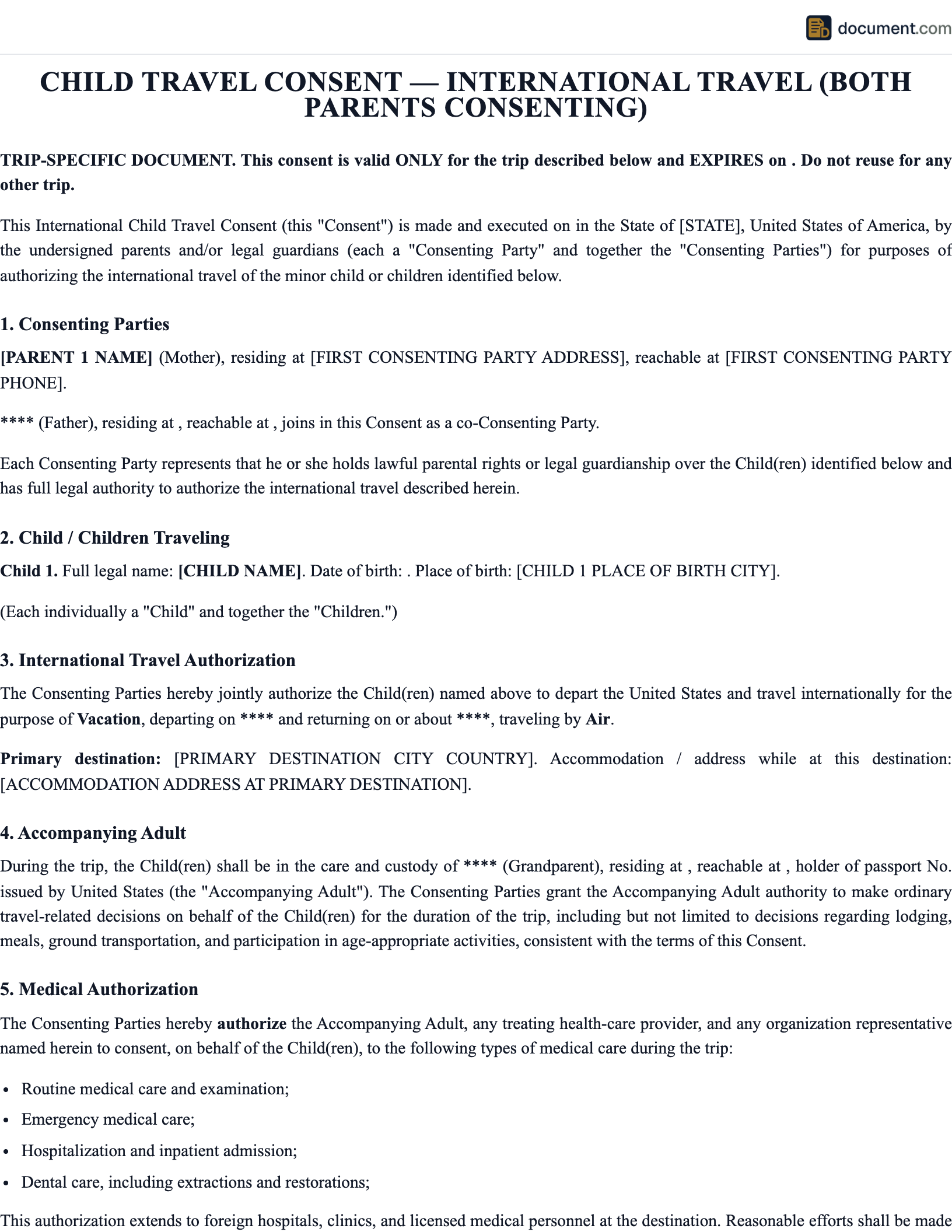
Travel Consent Form Preview
Below is a visual preview of the sections and fields in a complete child travel consent letter. Your finished document will be fully formatted, professionally styled, and customized for the trip details, the parent or parents signing, and your state's notary requirements.
Child Travel Consent Letter
Notarized Authorization for Travel of a Minor
Section 1: Parents
Section 2: Minor Child
Section 3: Accompanying Adult
Section 4: Trip Details
Section 5: Authorizations
Section 6: Signatures & Notary
Parent 1 Signature
Parent 2 Signature
Notary Public — Seal & Commission Expiration
When You Need a Travel Consent
Almost any trip in which a child travels without both legal parents calls for a travel consent. The most common scenarios are below — pick the one closest to your situation to start with the right template.
International Travel with One Parent
Required at most foreign borders when only one parent travels with the child
Travel with Grandparents or Relatives
Authorize a relative to take the child across state or international borders
Travel with Friends or Chaperones
Permit a non-relative chaperone to travel with your child for school or sports
Cruise Ship Travel
Cruise lines and CBP officers routinely require notarized consent from absent parents
School or Sports Trip Abroad
Schools, leagues, and tour operators require parental consent for international group trips
Travel After Divorce or Separation
Helps comply with custody orders and prevents accusations of parental abduction
Domestic Travel (Minor Alone or with Others)
Airlines and rail carriers may require parental authorization for unaccompanied minors
Cross-Border Day Trips
CBSA and CBP officers often request consent for routine US-Canada and US-Mexico trips
Travel Consent vs Other Documents
A travel consent is one of several documents families can use to authorize travel or delegate authority over a minor. Understanding the differences helps you bring the right paperwork — and avoid carrying things you do not need.
Travel Consent vs Medical Consent
Travel Consent
- - Authorizes a specific trip
- - Used at borders, airlines, cruises
- - Tied to dates and destinations
- - Often includes emergency medical clause
Medical Consent
- - Authorizes medical decisions
- - Used at clinics, hospitals, urgent care
- - Tied to a designated caregiver
- - Includes HIPAA release language
Best practice: Carry both. The travel consent gets the child across the border; the medical consent gets the child treated if something happens at the destination.
Travel Consent vs Minor Child POA
Travel Consent
- - Single trip, narrow scope
- - One or two pages
- - Notarized but not court-filed
- - Best for vacations and short trips
Minor Child POA
- - Ongoing delegation of authority
- - Multiple pages, broad powers
- - Often required for school enrollment
- - Best for long absences or deployment
Choose by duration: A travel consent is right for a two-week trip with grandparents; a minor child POA is right for a six-month deployment.
Travel Consent vs Custody Order
Travel Consent
- - Voluntary authorization for one trip
- - Created by the parents
- - Confirms permission, not custody
Custody Order
- - Court-ordered legal custody
- - May restrict or allow travel
- - Used to prove parental rights
Carry both: If you have a custody order, bring a certified copy with the travel consent letter. Border officers may want to see both, especially when only one parent is traveling.
How to Create a Travel Consent: Step-by-Step
A travel consent is short, but every detail matters. The steps below will produce a letter that border officers, airlines, and cruise lines will accept on the first try.
Confirm the trip details before drafting
Pin down the exact dates of departure and return, every destination country and city, the airline or cruise line, and the booking confirmation numbers. The letter should match your itinerary precisely. If you do not yet have flight numbers, list at least the carrier name and the departure airport. Border officers compare the letter against the passports and tickets, and even small mismatches — a different return date, a different airport — can lead to follow-up questions.
Identify both parents (or document sole custody)
List both legal parents with full legal names, current addresses, daytime phone numbers, and email addresses. If only one parent has legal custody, omit the other parent's signature line and attach a certified copy of the custody order, the child's birth certificate (if it lists only one parent), or the death certificate of a deceased parent. Border officers want a clear answer to the question 'who else has parental rights and where are they?' — so leave nothing ambiguous.
Identify the child and the accompanying adult
Include the child's full legal name, date of birth, passport number, and country of issuance, exactly as they appear on the passport. Include the same information for the accompanying adult, plus their relationship to the child and a working phone number. If the child is traveling alone (an unaccompanied minor), name the airline's UM program and the adult who will receive the child at the destination.
Specify destinations and authorizations
List every country and major city the child will visit. Include connecting countries even if the child will not leave the airport, since some immigration authorities check transit passengers. Add explicit authorization statements: that the named adult may travel internationally with the child, may cross any international border for the duration of the trip, may authorize emergency medical care, and may interact with consular officers. The clearer the language, the less interpretation a border officer has to do.
Add emergency medical authorization
Include a clause authorizing the accompanying adult to consent to emergency medical, dental, and surgical treatment for the child. List the child's allergies, current medications, blood type if known, and health insurance information (carrier, member ID, group number, customer service phone). For international travel, also note whether the family has travel medical insurance and how to reach the carrier.
Sign in front of a notary
Notarization is the single most important formal step. Both parents (where applicable) must sign the letter in front of a notary public, present photo identification, and have their signatures acknowledged. If the parents live in different states or countries, each can have their signature notarized separately on a duplicate copy and the originals can be combined into a single packet. Mobile notaries, banks, credit unions, shipping centers, and public libraries are all common notarization options.
Translate and apostille if needed
If you are traveling to a country whose primary language is not English, get a certified translation of the letter into the destination language. For Hague Apostille countries, an apostille from the Secretary of State of the issuing state may be required to make the notarization recognizable abroad. Mexico typically wants Spanish; Brazil and many Latin American countries want Portuguese or Spanish; most EU countries accept English but prefer the local language.
Pack the document with the passport
Print at least two original notarized copies. Carry the primary original in the same folder as the child's passport so it is at hand at every check-in and border crossing. Keep a backup in your luggage, and email yourself a scanned PDF in case the originals are lost. If a custody order or birth certificate is part of the packet, store all of the related documents together so you can present them as a single bundle.
Notify the non-traveling parent before departure
Make sure the non-traveling parent has the trip itinerary, emergency contact information, and a copy of the consent letter. Border officers sometimes call the non-traveling parent to verify consent in real time, and a parent who is unaware of the trip can derail the entire entry process. A short text message with flight numbers and hotel addresses on departure day takes one minute and prevents most problems.
Verify destination-specific requirements
Check the destination country's official immigration website (or the US State Department's country information page) for any specific minor entry requirements. South Africa, Brazil, and several other countries have strict notarized-letter requirements. Cruise lines often have their own rules on top of the destinations. A two-minute web search the week before the trip can prevent a sixty-minute problem at check-in.
Key Components of a Travel Consent
Every effective travel consent letter contains the same core components. Knowing what each section does helps you confirm your letter is complete before you head to the airport.
Parent Identification
Full legal names, addresses, and contact information for both parents (or for the parent with sole custody plus supporting documents).
Child Identification
Full legal name, date of birth, passport number, and issuing country, exactly as they appear on the passport.
Accompanying Adult
Full name, relationship to the child, passport details if traveling internationally, and contact information.
Destinations
Every country and city the child will visit, including transit stops where applicable.
Travel Dates
Exact departure and return dates, plus the carrier and itinerary information.
Emergency Medical Clause
Authorization for the accompanying adult to consent to emergency medical, dental, and surgical care.
Emergency Contact
A working phone number and email for the non-traveling parent, available 24/7 during the trip.
Authorization Statement
Clear language that both parents authorize the trip, in compliance with the Hague Convention.
Notary Acknowledgment
A notary block, seal, and commission expiration date to verify both parents' signatures.
Supporting Documents
References to attached items: birth certificate, custody order, passport copies, insurance card.
US Customs & International Border Rules
Border requirements vary by country, but the practical reality is that almost every international destination expects a notarized consent letter for a minor traveling without both parents. A summary of the most common rules is below.
United States (CBP)
CBP recommends a notarized letter from the absent parent for any minor entering or leaving the United States with one parent or another adult. Letters should include the destination, dates, and contact information for both parents. CBP officers have wide discretion and may pull the family into secondary inspection if the letter is missing or incomplete.
Canada (CBSA)
CBSA strongly recommends a notarized consent letter for any minor entering Canada without both parents. The Government of Canada publishes a sample letter on its travel website, and CBSA officers are trained to ask for it. Travel by land, sea, or air is treated the same.
Mexico (INM)
Mexico requires a notarized letter for minors traveling without both parents, and a Spanish translation is strongly recommended. Mexican-citizen minors have additional SAM program requirements administered by INM. Trips longer than the standard tourist period may require apostilled documents.
European Union
EU member states do not have a uniform rule, but most border officers expect a notarized letter from the absent parent. Some countries (notably France and Germany) have refused entry to families traveling without one. English-language letters are generally accepted, though local-language translations help.
South Africa & Brazil
South Africa requires both an unabridged birth certificate and a notarized consent letter for minors traveling without both parents. Brazil requires an authorization that may need to be apostilled or processed through a Brazilian consulate. These are two of the strictest enforcement environments in the world for minor travel.
Cruise Lines
Major cruise lines (Royal Caribbean, Carnival, Norwegian, Disney) require a notarized parental consent letter for any minor boarding without both legal parents, regardless of destination. The letter is checked at the cruise terminal during embarkation; without it, the family is denied boarding and the cruise fare is generally non-refundable.
Legal Requirements
No federal US statute specifies the format of a child travel consent, but a number of practical requirements have emerged from CBP guidance, foreign government rules, and airline policies. Following these requirements ensures the document will be accepted by every official who looks at it.
- Both Parents. Both legal parents (or the sole custodial parent with documentation) must sign whenever possible.
- Notarization. Universally recommended; required by CBSA, INM, and most foreign immigration authorities.
- Specific Trip. Letters should reference the exact dates, destinations, and accompanying adult; open-ended letters are discouraged.
- Emergency Medical Clause. Recommended in every letter to authorize treatment abroad.
- Translation. Required or recommended for non-English-speaking destinations.
- Apostille. Required by some Hague Apostille countries for the notarization to be recognized.
- Custody Compliance. The letter must be consistent with any existing custody order.
Sample Travel Consent Letter
Below is a condensed preview of our travel consent template. Your finished letter will be fully customized for the trip details, the parents signing, and your state's notary acknowledgment.
CHILD TRAVEL CONSENT LETTER
Notarized Authorization for Travel of a Minor
We, [Parent 1 Name]and [Parent 2 Name], being the legal parents of[Child Full Name](born [DOB], passport number [Passport]), do hereby authorize our child to travel as described below.
ACCOMPANYING ADULT
Name: [Adult Name]
Relationship: [Relationship]
Passport: [Passport]
Phone: [Phone]
1. TRIP DETAILS
Destination(s): [Destinations]. Departure: [Date]. Return: [Date]. Carrier: [Carrier & Flight].
2. CONSENT TO TRAVEL
We jointly and individually authorize the above-named adult to travel with our child to the destinations listed above for the dates listed above, and to cross any international borders necessary to complete that travel. This authorization is consistent with our shared parental rights and any applicable custody order.
3. EMERGENCY MEDICAL CARE
We further authorize the accompanying adult to consent on our behalf to any emergency medical, dental, or surgical treatment a licensed provider deems necessary for our child during the trip.
4. CONTACT INFORMATION
In an emergency, contact [Parent Phone]or [Parent Email].
5. EXECUTION
Signed this [Day]day of [Month],[Year], before the undersigned notary public.
Frequently Asked Questions
Answers to the most common questions about international travel with a minor, border requirements, notarization, and the Hague Convention.
Official Resources
Verify country-specific requirements and the latest border guidance using these authoritative sources.
US CBP - Minors Traveling Abroad
Customs and Border Protection guidance on traveling with children
US State Department - Children & Family Travel
International travel resources for families with minors
Government of Canada - Consent Letter
CBSA recommended consent letter and downloadable sample
Mexico INM - Migration Authority
Mexican immigration rules for minors entering and leaving Mexico
HCCH - Hague Child Abduction Convention
Full text of the 1980 Hague Convention on child abduction
US State Department - Child Passports
Passport requirements and DS-3053 consent form for minors under 16
IATA - Travel Information
International Air Transport Association guidance for families flying internationally
TSA - Traveling with Children
Transportation Security Administration screening rules for minors
Create your Child Travel Consent in under 10 minutes.
Answer a few questions and download a compliant, attorney-drafted document ready for your state.