



What Is a Child Medical Consent?
A child medical consent form — sometimes called a medical authorization for a minor, caregiver authorization affidavit, or temporary medical consent — is a legal document in which a parent or legal guardian grants a designated adult the authority to obtain medical treatment for the parent's minor child. Without this written authorization, doctors, urgent care centers, and emergency rooms may delay non-emergency treatment or refuse to act, even when the caregiver has the parent's clear verbal permission. The form bridges the gap between full legal guardianship and informal verbal arrangements, giving caregivers the documentation they need and giving providers the legal cover they require.
The parent or legal guardian who creates the document is the only person who can grant this authority. Both biological and adoptive parents with legal custody qualify, as do court-appointed guardians. The designated caregiver can be almost any responsible adult: a grandparent, aunt or uncle, adult sibling, family friend, babysitter, nanny, school official, camp director, or coach. The consent should clearly identify the caregiver by full legal name, relationship to the child, and contact information so that healthcare providers can verify identity at the point of care.
The scope of the consent is whatever the parent specifies. A narrow consent might cover only routine doctor visits during a two-week summer trip with grandparents. A broader consent might cover all routine, urgent, and emergency care for an entire school year while a child lives with an aunt during a parent's military deployment. The document should also state whether the caregiver may consent to surgery, anesthesia, hospital admission, prescription medications, mental health treatment, dental and orthodontic care, and the release of medical records under HIPAA. The clearer the scope, the less friction the caregiver will encounter at any provider's office.
A child medical consent terminates on the date specified in the document, when the parent revokes it in writing, when the child reaches the age of majority, or when state law imposes a maximum duration. Several states limit caregiver authorization affidavits to six months or one year unless renewed, and a few require court approval for any delegation longer than that. Because the document does not transfer legal custody or parental rights, it can coexist with school enrollment forms, the child's primary health insurance, and any existing custody orders. It is a flexible, low-cost tool — not a substitute for guardianship.
Whether you are sending your child to summer camp, leaving them with grandparents for a vacation, deploying overseas, or arranging long-term care with a relative, our attorney-reviewed templates give you a document that hospitals, pediatricians, urgent care centers, school nurses, and pharmacies will recognize and accept. Each template includes the witness language, notary acknowledgment, HIPAA authorization, and state-specific provisions required for your jurisdiction.
Faster Treatment
Eliminate delays at the ER, urgent care, and pediatrician's office
Caregiver Confidence
Give grandparents and sitters the legal authority to act in an emergency
HIPAA Compliant
Includes the disclosure language providers need to share records
Child Medical Consent Form Preview
Below is a visual preview of the sections and fields included in a complete child medical consent. Your finished document will be fully formatted, professionally styled, and customized for your state, the duration you select, and the scope of authority you grant.
Child Medical Consent
Authorization for Treatment of a Minor
Section 1: Parent / Legal Guardian
Section 2: Minor Child
Section 3: Designated Caregiver
Section 4: Authority Granted
Section 5: Health Insurance
Section 6: Effective Period
Section 7: Signatures & Notarization
Parent / Guardian Signature
Notary Public
Witness 1
Witness 2
When You Need a Child Medical Consent
A child medical consent is appropriate any time your child will be in another adult's care without you being immediately reachable. The most common scenarios are below — pick the one closest to your situation to start with the right template.
Routine Pediatric Care
Authorize a caregiver to consent to checkups, vaccinations, and well-child visits
Emergency Medical Treatment
Allow emergency rooms and urgent care providers to treat your child without delay
School & Daycare Authorization
Permit school nurses and daycare staff to obtain medical care during the day
Summer Camp Consent
Authorize camp medical staff to treat injuries, illnesses, and dispense medications
Travel & Trip Consent
Cover medical care while your child is traveling without you, domestically or abroad
Grandparent Caregiver Consent
Empower grandparents or relatives caring for your child to authorize medical treatment
Prescription Medication Authorization
Allow caregivers to administer prescribed medications and authorize new prescriptions
Specialist & Surgical Consent
Permit a designated adult to consent to specialist visits or non-emergency procedures
Medical Consent vs Other Documents
Parents often confuse a child medical consent with formal guardianship, a minor child power of attorney, or a HIPAA authorization. Each document serves a different purpose and grants a different scope of authority. The comparisons below will help you choose the right tool for your situation.
Medical Consent vs Legal Guardianship
Child Medical Consent
- - Created privately by the parent
- - Limited to medical decisions only
- - Parent retains all other rights
- - No court involvement required
- - Easily revocable at any time
- - Free or very low cost
Legal Guardianship
- - Granted by a court order
- - Transfers nearly all parental rights
- - Includes custody, education, finances
- - Requires petition and hearing
- - Cannot be revoked without court approval
- - Often $1,500-$5,000 in legal fees
Key takeaway: Medical consent is for short-term, voluntary delegations where the parent stays in control. Guardianship is for long-term or permanent caregiving where the court must oversee the arrangement.
Medical Consent vs Minor Child Power of Attorney
Medical Consent
- - Limited to medical and dental care
- - Best for short stays, camps, trips
- - Simple, single-page format
- - Easy for ER staff to read quickly
Minor Child POA
- - Covers medical, school, daily care
- - Best for deployment, hospitalization
- - Multi-page document with broader powers
- - Often required by school districts
Best practice: For arrangements longer than 30-60 days, pair the medical consent with a minor child POA to give the caregiver authority over schools, activities, and daily decisions in addition to healthcare.
Medical Consent vs HIPAA Authorization
Medical Consent
- - Authorizes treatment decisions
- - Caregiver can say yes to procedures
- - Covers active medical care
HIPAA Authorization
- - Authorizes record disclosure
- - Caregiver can request and receive records
- - Covers information sharing only
Use both: A complete child medical consent should include HIPAA release language so the caregiver can also receive medical records, lab results, and provider communications. Our templates combine both into a single document.
How to Create a Child Medical Consent: Step-by-Step
Creating a valid, hospital-ready child medical consent is straightforward but requires attention to a few critical details. Follow the steps below to produce a document any pediatrician, urgent care, or emergency room will accept on the first try.
Identify the child and gather complete medical information
Start by collecting everything a clinician would want to know in the first sixty seconds of an exam: the child's full legal name, date of birth, weight, blood type if known, allergies (especially drug allergies), current medications and dosages, immunization status, chronic conditions, recent surgeries, and the name of the primary care provider. Also write down the health insurance carrier, member ID, group number, and the customer service phone number on the back of the card. Attach a photocopy of the insurance card if you can. The more comprehensive this section is, the less time the caregiver and ER staff will spend trying to track you down.
Choose the designated caregiver — and a backup
Pick an adult who is available, responsible, and physically able to bring your child to a medical appointment if needed. For longer-term arrangements, name a backup caregiver in case the primary caregiver is unreachable in an emergency. Provide the caregiver's full legal name, current address, daytime and evening phone numbers, and relationship to the child. If the caregiver is a non-relative, attach a brief note explaining the relationship — for example, 'long-time family friend who has known the child since birth.' This little detail reduces friction at the front desk.
Define the scope of authority
Decide exactly what the caregiver may consent to. Routine doctor visits and emergency care are nearly always included. Decide whether you also want to authorize surgery, anesthesia, hospital admission, prescription medications, dental and orthodontic care, mental health counseling, and the release of records under HIPAA. If you want to exclude something specific — for example, blood transfusions on religious grounds — say so explicitly. Vague consents create confusion at the point of care and cause hospitals to call you anyway, defeating the purpose.
Set the effective period
Always include a start date and end date. For a vacation, summer camp, or short trip, the dates should match the duration of the trip plus a small buffer. For a school year or multi-month arrangement, use a fixed period rather than 'until further notice' — open-ended consents make providers uncomfortable. If your state caps the duration of caregiver authorization affidavits (six months in California, for example), do not exceed the cap. Calendar a reminder to renew the form before it expires.
Add insurance and provider information
List the child's primary insurance carrier, member ID, group number, and customer service phone number, plus any secondary coverage. Include the name, address, and phone number of the child's pediatrician, dentist, specialists, and preferred hospital. If your child has a complex condition, include the contact information for the relevant specialist (pulmonologist, cardiologist, neurologist, etc.). The caregiver should be able to walk into any urgent care and hand over a single sheet that answers the front desk's questions.
Include HIPAA release language
Federal law restricts how providers share protected health information, even with a temporary caregiver. Include a HIPAA authorization clause that names the caregiver and any backups, identifies the providers covered, and describes the records that may be released. Without this language, the caregiver may not be able to receive lab results, see imaging reports, or coordinate follow-up care. Our templates include the standard HIPAA release block that satisfies 45 CFR 164.508.
Sign in front of witnesses and a notary
Even where state law does not strictly require it, sign the document in front of two adult witnesses who are not named in the form and not related to the child, plus a notary public. Notarization is inexpensive (often $5-$25), takes a few minutes, and dramatically increases the document's credibility at any hospital or clinic. Many banks notarize for free for customers, and pharmacies, shipping centers, and credit unions also commonly offer notary services.
Distribute copies and store the original safely
Give the caregiver multiple originals, not photocopies. Provide a copy to the child's pediatrician, the school, and any camp or program the child will attend. Keep a copy in the diaper bag, backpack, or glove box for emergencies. Store the original with your other important documents. If the child travels internationally, also pack a copy with the passport. Email yourself a scanned copy so you can forward it from anywhere if a hospital asks for it.
Brief the caregiver
Walk the caregiver through the document in advance. Explain the child's allergies, medications, routine, and any quirks (fear of needles, sensory sensitivities, language preferences). Make sure the caregiver knows how to reach you, your spouse, the pediatrician, and the insurance carrier. Provide a printed cheat sheet with phone numbers. The form is a legal authorization, but a five-minute conversation prevents most of the practical problems that can come up in a stressful moment.
Renew or revoke when needed
If your situation changes, replace the form. Revoke an outdated consent in writing, retrieve all copies you can, and notify any provider that has one on file. For ongoing arrangements, refresh the form annually and update any changed medications, allergies, insurance, or contact information. A current document is far more useful — and far more credible — than one that is several years old.
Key Components of a Child Medical Consent
Every effective child medical consent contains the same essential components. Understanding what each section does will help you customize your form for any situation, from a one-night sleepover to a year-long deployment.
Parent / Guardian Identification
Full legal name, address, contact information, and a clear statement of legal custody status. If only one parent has custody, attach a copy of the relevant court order.
Child Identification
Full legal name, date of birth, weight, blood type, and any identifying medical information that would help in an emergency, such as a chronic condition or implanted device.
Medical History
Allergies, current medications, chronic conditions, immunizations, recent procedures, and any preferences or restrictions on care.
Caregiver Information
Full legal name, relationship to the child, address, phone numbers, and information for a backup caregiver if applicable.
Scope of Authority
A specific list of what the caregiver may consent to: routine care, urgent care, emergency treatment, surgery, anesthesia, prescriptions, mental health, and dental care.
HIPAA Release
Language authorizing covered providers to share protected health information with the designated caregiver, satisfying 45 CFR 164.508.
Effective Period
Clear start and end dates, plus any conditions that would terminate the consent earlier (such as the parent's return).
Insurance Information
Primary and secondary health insurance details, including carrier, member ID, group number, and customer service contact.
Preferred Providers
Pediatrician, dentist, specialists, and preferred hospital so the caregiver knows where to go first.
Signature & Notarization
Parent's signature, witness signatures, and notary acknowledgment block compliant with state requirements.
Legal Requirements
Child medical consent laws vary considerably by state. While no state requires a specific font, format, or filing process, several states have enacted statutes governing caregiver authorization affidavits, the duration of consent, and the providers obligated to honor them. The general rules below apply nearly everywhere; your finished template will include any state-specific provisions automatically.
- Parental Capacity. Only a parent or legal guardian with custody may sign. The signer must be a competent adult.
- Notarization. Required for caregiver authorization affidavits in roughly half of all states; recommended in every state.
- Witnesses. Required in some states; best practice everywhere is two disinterested adult witnesses.
- Maximum Duration. Many states cap caregiver authorization affidavits at 6 to 12 months; renewals are permitted.
- HIPAA Compliance. Federal law (45 CFR 164.508) governs the release of protected health information.
- Provider Acceptance. EMTALA requires emergency stabilization regardless of consent, but follow-up care still requires authorization.
- Revocation. The parent may revoke at any time in writing; verbal revocation is risky.
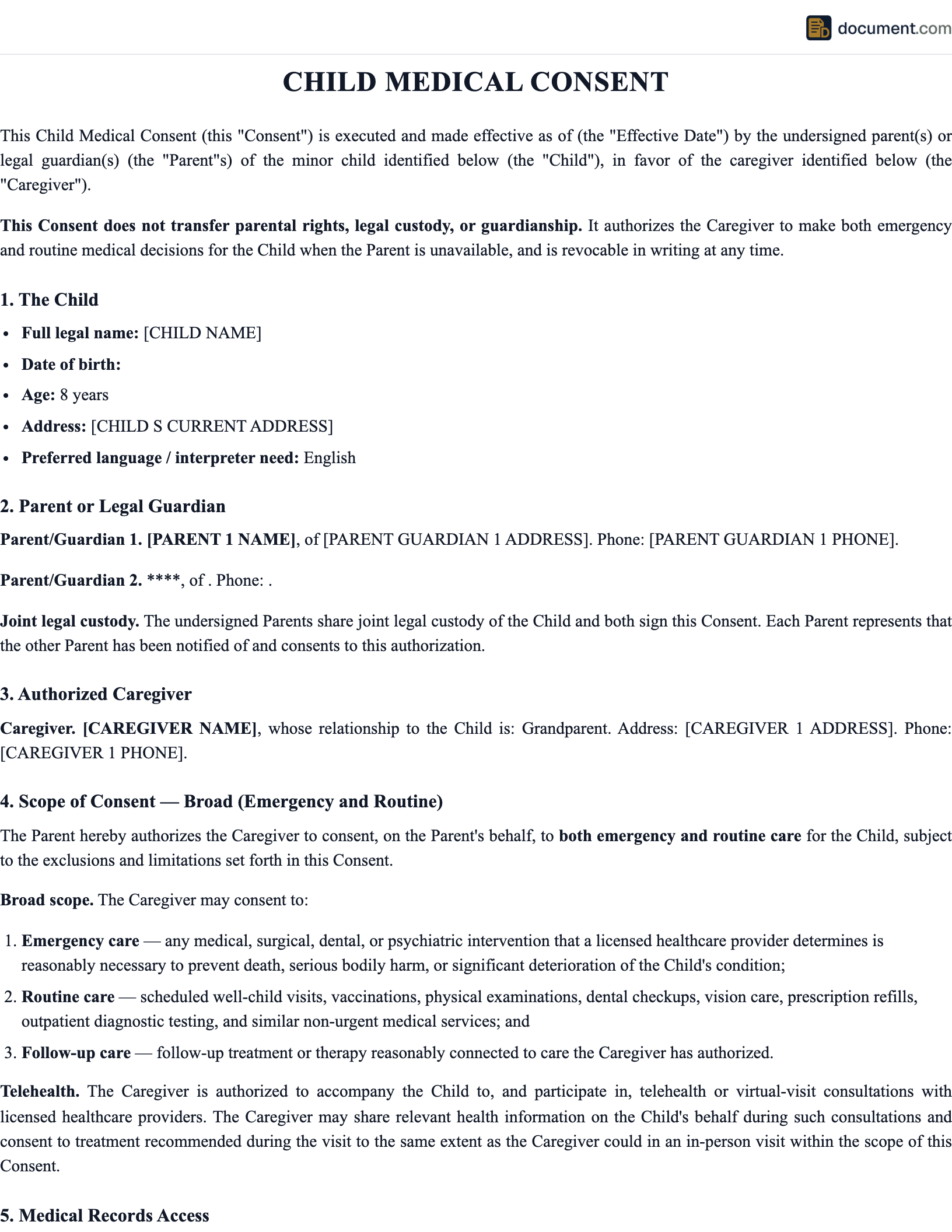
Sample Child Medical Consent
Below is a condensed preview of our child medical consent template. Your finished document will be fully customized for your state, the duration you select, and the scope of authority you grant.
CHILD MEDICAL CONSENT
Authorization for Treatment of a Minor
I, [Parent Full Legal Name], being the [parent / guardian]with legal custody of [Child Full Legal Name](born [DOB]), do hereby authorize the caregiver named below to consent to medical treatment for my child during the period stated in this document.
DESIGNATED CAREGIVER
Name: [Caregiver Name]
Relationship: [Relationship]
Address: [Address]
Phone: [Phone]
1. SCOPE OF AUTHORITY
The caregiver is authorized to consent on my behalf to all medical, dental, surgical, diagnostic, hospital, and emergency care that a licensed provider determines is necessary or advisable for my child, including the administration of anesthesia and prescription medication. The caregiver may release and receive my child's medical records pursuant to 45 CFR 164.508.
2. EFFECTIVE PERIOD
This authorization takes effect on[Start Date]and remains in effect through[End Date], unless revoked earlier in writing by me.
3. MEDICAL INFORMATION
Allergies: [Allergies]. Current medications: [Medications]. Chronic conditions: [Conditions]. Blood type: [Type].
4. INSURANCE
Carrier: [Carrier]. Member ID: [ID]. Group: [Group].
5. EMERGENCY CONTACT
In an emergency, providers should attempt to reach me at[Phone]and proceed with treatment if I cannot be reached.
6. REVOCATION
I reserve the right to revoke this authorization at any time by delivering a written revocation to the caregiver and to any provider holding a copy of this form.
Frequently Asked Questions
Answers to the most common questions parents have about child medical consent forms, caregiver authority, notarization, and how providers handle them in practice.
Official Resources
For additional information on consent for minors, HIPAA, and the rights and duties of temporary caregivers, consult the official resources below.
HHS - HIPAA for Individuals
Federal guidance on health information privacy and authorization for minors
AAP - HealthyChildren.org
American Academy of Pediatrics resources for parents and caregivers
CMS - EMTALA Overview
Federal Emergency Medical Treatment and Labor Act guidance
ACF - Children's Bureau
Administration for Children and Families resources on child welfare
Guttmacher - Minor Consent Laws
State-by-state survey of minor consent and confidentiality laws
ABA - Center on Children and the Law
American Bar Association resources on family and child law
Child Welfare Information Gateway
Federal child welfare information and state statute summaries
CDC - Parent Information
Centers for Disease Control resources on child health and safety
Create your Child Medical Consent in under 10 minutes.
Answer a few questions and download a compliant, attorney-drafted document ready for your state.