
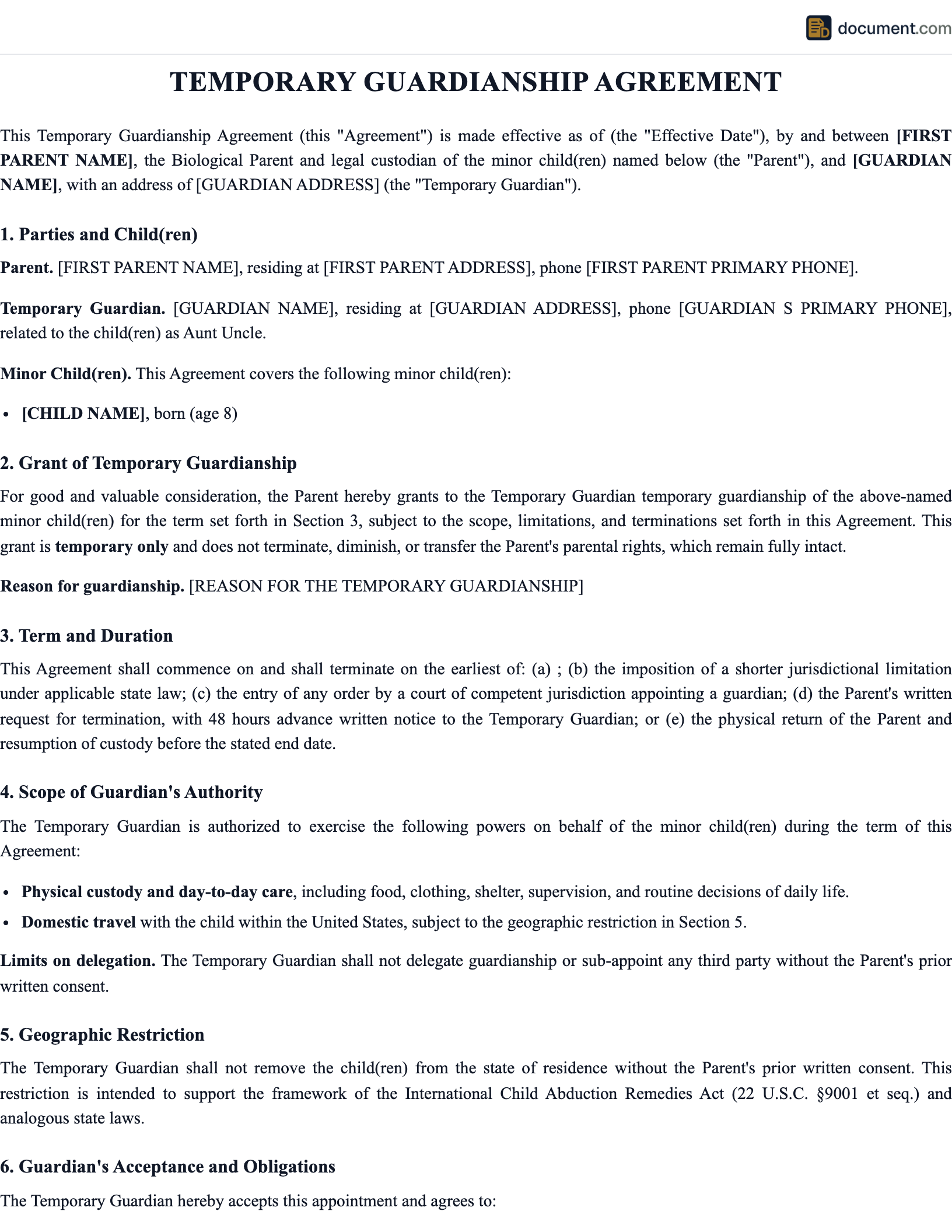



What Is a Temporary Guardianship Agreement?
A temporary guardianship agreement is a legal document that allows a parent or legal guardian to delegate their caregiving authority over a minor child to another trusted adult for a limited period. Unlike permanent guardianship, which requires a court order and typically involves a significant change in the child's living situation, a temporary guardianship agreement is a private arrangement between the parent and the designated caregiver that does not require court approval in most states. The agreement gives the temporary guardian the legal authority to make day-to-day decisions for the child, including those related to medical care, education, and general welfare.
Parents turn to temporary guardianship for a wide range of reasons. A single parent undergoing surgery may need someone to care for their child during recovery. Military service members receive deployment orders and need a reliable arrangement for their children while they serve overseas. Parents who travel frequently for work may want a caregiver who can handle school pickups, doctor visits, and emergency situations without having to track the parent down for authorization every time. Families dealing with a parent's substance abuse treatment, incarceration, or mental health crisis may need a stable arrangement for the children while the parent addresses their situation. Whatever the circumstance, the goal is the same: ensuring that the child receives consistent, authorized care when the parent is temporarily unable to provide it.
Without a temporary guardianship agreement, a caregiver looking after someone else's child has no legal standing to make important decisions. A school may refuse to enroll the child or release them to the caregiver. A hospital may refuse to treat the child (beyond emergency stabilization) without parental consent. An insurance company may deny coverage because the person presenting the child is not the policyholder or an authorized representative. These are not hypothetical problems. They happen regularly to grandparents, aunts and uncles, family friends, and other informal caregivers who assume responsibility for a child without the proper documentation.
Our attorney-reviewed temporary guardianship agreement templates address all of these concerns. Each template is customized for your state's specific requirements regarding parental delegation of authority, notarization, witness requirements, and maximum duration. The forms include comprehensive medical authorization language, educational authority provisions, and clear terms about the scope and duration of the guardianship arrangement.
Medical Authority
Authorize the guardian to consent to medical treatment and access health records
Education Decisions
Grant authority for school enrollment, conferences, and academic choices
Defined Duration
Clear start and end dates with automatic termination and renewal options
Temporary Guardianship Agreement Form Preview
Below is a visual preview of the sections and fields in a comprehensive temporary guardianship agreement. Your completed document will be customized for your specific situation and state requirements.
Temporary Guardianship Agreement
Authorization for Care of Minor Child
Section 1: Parent/Guardian Information
Section 2: Minor Child Information
Section 3: Temporary Guardian Information
Section 4: Duration and Authority
Section 5: Execution
Parent/Guardian Signature / Date
Temporary Guardian Signature / Date
Witness Signature
Notary Public
Types of Temporary Guardianship Agreements
The right temporary guardianship agreement depends on why you need it, how long the arrangement will last, and what specific authority the guardian needs. Each type below addresses a different caregiving scenario.
Standard Temporary Guardianship
General-purpose agreement granting a caregiver authority over a minor child for a defined period
Travel Guardianship Authorization
Specifically designed for parents traveling without their child, covering medical consent and emergency decisions
Military Deployment Guardianship
Extended temporary guardianship for service members deploying overseas or to training assignments
Medical Emergency Guardianship
Focused on authorizing medical decisions, treatment consent, and healthcare access for a minor
Educational Guardianship
Grants authority to enroll a child in school, attend conferences, and make education-related decisions
Temporary vs Permanent Guardianship
Understanding the difference between temporary and permanent guardianship is important because each serves a different purpose and carries different legal weight. The right option depends on your circumstances.
Temporary Guardianship vs Permanent Guardianship
Temporary Guardianship
- - Private agreement between parents and guardian
- - No court approval required in most states
- - Limited duration (typically 6-12 months max)
- - Revocable by the parent at any time
- - Parent retains all underlying legal rights
- - Lower cost and faster to establish
Permanent Guardianship
- - Requires a court petition and hearing
- - Court must find guardianship in child's best interest
- - Indefinite duration until child turns 18
- - Can only be terminated by court order
- - Parent's rights may be significantly limited
- - Higher cost and longer process
Key takeaway: If you expect to resume full-time care of your child within a year, a temporary guardianship agreement is almost always the right choice. It preserves your parental rights while giving the caregiver the legal authority they need. If the situation is likely to be long-term or permanent, consult a family law attorney about petitioning for court-ordered guardianship.
Temporary Guardianship vs Caregiver Authorization Affidavit
Temporary Guardianship
- - Broader authority over child's welfare
- - Covers medical, educational, and daily decisions
- - Typically requires both parents' signatures
- - More comprehensive legal protection
Caregiver Authorization
- - More limited in scope
- - Often specific to school enrollment or medical care
- - May only require one parent's signature
- - Available in some states but not all
Best approach: A temporary guardianship agreement provides more comprehensive coverage than a caregiver authorization affidavit. If your state offers both options, the guardianship agreement is the safer choice because it covers a wider range of situations and is more broadly recognized by institutions.
How to Create a Temporary Guardianship Agreement: A 7-Step Guide
Creating a temporary guardianship agreement requires careful thought about your child's needs and clear communication with the person you are trusting to care for them. Follow these seven steps to build an agreement that protects your child and empowers the guardian.
Choose the Right Temporary Guardian
Select someone you trust completely with your child's safety and well-being. Consider the person's relationship with your child (does the child know and feel comfortable with them?), their physical ability to care for a child, their proximity to the child's school and regular activities, whether they have experience caring for children, and whether they are willing and able to follow your instructions about the child's routine, diet, and medical needs. Family members are a common choice, but close family friends, godparents, or trusted neighbors can also serve effectively. Avoid choosing someone solely out of obligation if you have concerns about their ability to provide attentive care.
Gather the Child's Essential Information
Compile all information the guardian will need to care for your child. This includes the child's full legal name, date of birth, and Social Security number; health insurance information (policy number, group number, and customer service phone number); the child's primary care physician, dentist, and any specialists; a list of current medications, dosages, and schedules; known allergies (food, medication, environmental); the child's school name, address, teacher names, and schedule; any custody orders or parenting plans in place; and emergency contacts beyond the guardian and parents. Attach this information as a schedule to the agreement so the guardian has everything in one place.
Define the Scope of Authority
Be specific about what the guardian can and cannot do. At minimum, address whether the guardian can consent to routine medical care, consent to emergency medical treatment, make educational decisions, travel with the child (and if so, where), discipline the child (and what methods are acceptable), allow the child to participate in extracurricular activities, and authorize the child to stay overnight with friends or relatives. If there are things you explicitly do not want the guardian to do (such as making changes to the child's medication, taking the child out of state, or allowing contact with certain individuals), state those restrictions clearly in the agreement.
Set Clear Start and End Dates
Every temporary guardianship agreement must have a defined duration. Specify the exact start date and end date. If the duration is tied to a specific event (such as a military deployment), include both a specific date and an event-based trigger (e.g., 'This agreement terminates on December 31, 2026, or upon the parent's return from deployment, whichever occurs first'). Check your state's maximum duration limit, since many states cap temporary guardianship at six months to one year. If you need longer, you may need to renew the agreement or seek court-ordered guardianship.
Obtain Consent from the Other Parent
If both parents have legal custody, both must sign the agreement. Contact the other parent well in advance and explain the situation. If the other parent refuses to sign, you generally cannot create a valid temporary guardianship agreement on your own (unless you have sole legal custody). If the other parent is deceased, include a copy of the death certificate with the agreement. If the other parent's location is unknown, consult a family law attorney about your state's requirements for proceeding without their consent, which typically involves an affidavit documenting your efforts to locate them.
Include Medical Authorization and Records
Medical authorization is one of the most critical components of the agreement. Without it, a hospital may refuse to treat your child beyond emergency stabilization. Include explicit consent for the guardian to authorize routine medical care, dental treatment, emergency medical treatment, and prescription medications. Attach the child's medical records or at minimum a medical summary including current medications, allergies, immunization records, and any ongoing conditions. Provide the health insurance card (or a copy) and the pediatrician's contact information. If your child has a specific medical condition that requires specialized knowledge (such as diabetes, severe allergies, or seizures), include detailed instructions for the guardian.
Sign, Notarize, and Distribute Copies
Both parents (if both have custody) and the temporary guardian should sign the agreement. Have the signatures notarized if your state requires it, and even if it does not, because notarization significantly increases the document's acceptance by third parties. Distribute copies of the signed agreement to the temporary guardian, the child's school, the child's pediatrician and dentist, any other regular caregivers (babysitters, after-school programs), and keep the original in a safe place. If the child will be traveling with the guardian, provide the guardian with a notarized copy to carry with them at all times.
Key Components of a Temporary Guardianship Agreement
A thorough temporary guardianship agreement addresses every situation the guardian may encounter while caring for your child. Below are the essential components.
| Component | Description |
|---|---|
| Parent/Guardian Identification | Full legal names, addresses, and contact information for both parents or legal guardians |
| Minor Child Details | Child's full name, date of birth, Social Security number, and physical description |
| Temporary Guardian Identification | Guardian's full name, address, relationship to child, and contact information |
| Duration and Termination | Specific start date, end date, and events that trigger automatic termination |
| Reason for Guardianship | Clear statement of why temporary guardianship is needed (travel, deployment, illness, etc.) |
| Medical Authorization | Explicit consent for the guardian to authorize medical treatment, dental care, and emergency care |
| Health Information | Child's allergies, medications, medical conditions, immunization records, and insurance details |
| Educational Authority | Permission to enroll in school, attend conferences, access records, and make academic decisions |
| Daily Care Authority | Authority for routine decisions about meals, bedtime, transportation, and activities |
| Travel Restrictions | Whether the guardian may travel with the child and any geographic limitations |
| Contact with Other Parent | Arrangements for the non-delegating parent's continued contact with the child |
| Financial Provisions | Who pays for the child's expenses during the guardianship period |
| Revocation Provisions | Statement that either parent can revoke the agreement at any time with written notice |
| Alternate Guardian | Backup person if the primary temporary guardian becomes unable to serve |
| Notarization and Witnesses | Signature blocks for parents, guardian, witnesses, and notary public |
When to Use a Temporary Guardianship Agreement
Temporary guardianship agreements are versatile documents that serve families in many different situations. Below are the most common scenarios where having a formal guardianship agreement protects both your child and the caregiver.
Travel Without Your Child
Whether you are taking a vacation, attending a work conference, or visiting family overseas, leaving your child with a caregiver requires proper authorization. A temporary guardianship agreement ensures the caregiver can handle any situation that arises while you are away, from a minor scrape that needs medical attention to a school emergency that requires a parent or guardian's presence.
Military Deployment
Service members facing deployment need a reliable plan for their children. A military deployment guardianship agreement provides the caregiver with full authority for the duration of the deployment, which can last several months or longer. Many states have specific statutes addressing custody during deployment, and military legal assistance offices can help prepare these documents at no cost.
Parent Illness or Surgery
If you are facing surgery, a hospital stay, or a period of recovery where you cannot physically care for your child, a temporary guardianship agreement gives your designated caregiver the authority they need. This is especially important for single parents who do not have a co-parent to step in automatically. The agreement should cover the expected recovery period with a built-in extension option.
Educational Placement
Sometimes a child needs to attend school in a different district, perhaps to access a specialized program, live closer to a relative during a family transition, or attend a school with better resources for their needs. A temporary guardianship agreement allows the caregiver in the new district to enroll the child, attend parent-teacher conferences, and make educational decisions on the parent's behalf.
When Temporary Guardianship Is Not Enough
Temporary guardianship agreements are designed for situations where the parent intends to resume care of the child. If you are unable to care for your child indefinitely due to incarceration, severe disability, substance abuse, or other long-term circumstances, a court-ordered permanent guardianship or, in some cases, voluntary relinquishment of parental rights may be more appropriate. Consult a family law attorney if the arrangement is likely to extend beyond your state's maximum temporary guardianship period.
Legal Requirements for Temporary Guardianship Agreements
Temporary guardianship requirements vary significantly from state to state. Some states have detailed statutes governing parental delegation of authority, while others rely on general contract and family law principles. Regardless of your state, certain elements are consistently important for creating an enforceable agreement.
State-by-State Variation
The legal framework for temporary guardianship varies considerably across states. California allows parents to execute a Caregiver's Authorization Affidavit under Family Code Section 6550 for relatives, while requiring a more formal process for non-relatives. Ohio has a specific "Power of Attorney for Care of a Minor Child" statute (ORC 3109.52). Texas allows an Authorization Agreement for Nonparent Relative under Chapter 34 of the Family Code. Florida permits a temporary guardianship of up to one year under its guardianship statutes. Each state sets its own rules about duration limits, notarization requirements, consent from both parents, and the scope of authority that can be delegated without court involvement.
Essential Elements for Validity
- Parental Consent: Both parents with legal custody must sign the agreement. If one parent has sole custody, only that parent's signature is required. The agreement should reference the custody arrangement and, if applicable, attach a copy of the custody order.
- Identification of All Parties: The agreement must clearly identify the parent(s), the minor child (including date of birth), and the temporary guardian. Vague references are insufficient.
- Defined Duration: The agreement must specify a start date and end date. Open-ended temporary guardianship agreements may be treated as invalid in states that impose maximum duration limits.
- Scope of Authority: Clearly state what the guardian can and cannot do. Broad, undefined grants of authority are more likely to be challenged by third parties.
- Notarization: Many states require notarization for the agreement to be valid. Even where not required, notarization is strongly recommended because it provides proof of identity and date, and institutions are more likely to accept a notarized document.
- Revocation Language: The agreement must state that the parent can revoke it at any time. Any agreement that purports to permanently limit parental rights without court involvement is unenforceable.
Sample Temporary Guardianship Agreement
Below is a condensed preview showing the structure and language of our temporary guardianship agreement template. Your completed document will be fully customized for your specific situation and state requirements.
TEMPORARY GUARDIANSHIP AGREEMENT
State of [State]
This Temporary Guardianship Agreement ("Agreement") is entered into on[Date] by[Parent Name]("Parent") and[Guardian Name]("Temporary Guardian"), regarding the care of the minor child[Child Name](date of birth: [DOB]).
1. GRANT OF TEMPORARY GUARDIANSHIP
The Parent hereby grants to the Temporary Guardian the authority to act as temporary guardian of the above-named minor child, effective[Start Date] through[End Date], unless earlier revoked by the Parent in writing...
2. MEDICAL AUTHORIZATION
The Parent authorizes the Temporary Guardian to consent to routine medical care, dental treatment, emergency medical treatment, and the administration of prescribed medications for the minor child. The Temporary Guardian shall make reasonable efforts to contact the Parent before consenting to non-emergency surgical procedures...
3. EDUCATIONAL AUTHORITY
The Parent authorizes the Temporary Guardian to enroll the minor child in school, attend parent-teacher conferences, access educational records, consent to field trips, and make day-to-day educational decisions on behalf of the minor child...
4. LIMITATIONS
The Temporary Guardian shall NOT: change the minor child's legal name, consent to the minor child's marriage, consent to adoption, relocate the minor child outside of [State/Region]without the Parent's written consent, or make any decision that permanently alters the minor child's legal status...
5. REVOCATION
This Agreement may be revoked at any time by the Parent upon written notice to the Temporary Guardian. Upon revocation, the Temporary Guardian shall promptly return the minor child to the Parent's care and surrender all documents and property belonging to the minor child...
Frequently Asked Questions
Find answers to common questions about temporary guardianship agreements, parental delegation of authority, medical consent for minors, and state-specific requirements.
Official Resources
For additional information on temporary guardianship, parental rights, and child welfare laws, consult these official and reputable sources.
Child Welfare Information Gateway
Federal resource on guardianship laws and child welfare statutes by state
ABA Family Law Section
American Bar Association resources on guardianship and family law
Military OneSource
Resources for military families including deployment guardianship guidance
Nolo - Child Guardianship
Free legal information on guardianship of minor children
LawHelp.org
Free legal aid resources by state for low-income families
Grandfamilies.org
Resources for grandparents and relatives raising children
Create your Temporary Guardianship Agreement in under 10 minutes.
Answer a few questions and download a compliant, attorney-drafted document ready for your state.