



What Is a Parenting Plan?
A parenting plan is a detailed legal document that establishes how separated, divorced, or unmarried parents will share the responsibilities of raising their children. It goes far beyond a simple custody agreement — a comprehensive parenting plan addresses every aspect of the child's life that requires coordination between two households, from the weekly schedule and holiday rotations to decision-making authority for education, healthcare, religion, and extracurricular activities. Courts in every state require or strongly encourage parents to file a parenting plan as part of any custody proceeding, and judges evaluate every plan through the lens of the "best interest of the child" standard.
The parenting plan serves three critical functions. First, it provides a predictable structure for the children — they know where they will sleep each night, which parent they will be with for holidays and birthdays, and what to expect from week to week. Research in child psychology consistently demonstrates that children of divorce adjust better when they have consistent routines and clear expectations. Second, it reduces conflict between parents by pre-deciding issues that would otherwise become points of contention — who picks up from soccer practice on Tuesdays, whether both parents must agree before the child gets braces, and how vacation weeks are divided. Third, it creates an enforceable court order that can be used if one parent fails to follow the agreed-upon terms.
The level of detail in a parenting plan should match the level of conflict between the parents. Cooperative co-parents who communicate well may need only a broad framework with built-in flexibility. High-conflict parents, however, benefit from highly specific provisions that leave little room for interpretation or disagreement — specifying exact transition times, locations, communication methods, and decision-making protocols. Family courts increasingly recognize that the most effective parenting plans are those tailored to the family's specific dynamics rather than generic templates applied uniformly.
A parenting plan must also evolve as children grow. The schedule that works for a toddler — frequent, shorter visits to maintain attachment with both parents — is very different from the schedule that works for a teenager who has their own social life, activities, and preferences. The best plans include provisions for periodic review and modification as children reach developmental milestones. Many plans explicitly address transitions such as starting school, entering middle school, beginning to drive, and approaching the age of majority.
Our attorney-reviewed parenting plan templates are built on the best interest of the child framework used by courts in all 50 states. Each template includes age-appropriate scheduling options, comprehensive holiday and vacation provisions, detailed decision-making protocols, communication guidelines, and dispute resolution mechanisms — all customizable to your family's unique needs and your state's specific statutory requirements.
Child-Centered
Every provision structured around your children's developmental needs and stability
Detailed Scheduling
Complete weekly, holiday, vacation, and special occasion schedules with exact times
Court-Ready
Meets your state's filing requirements and the best interest of the child standard
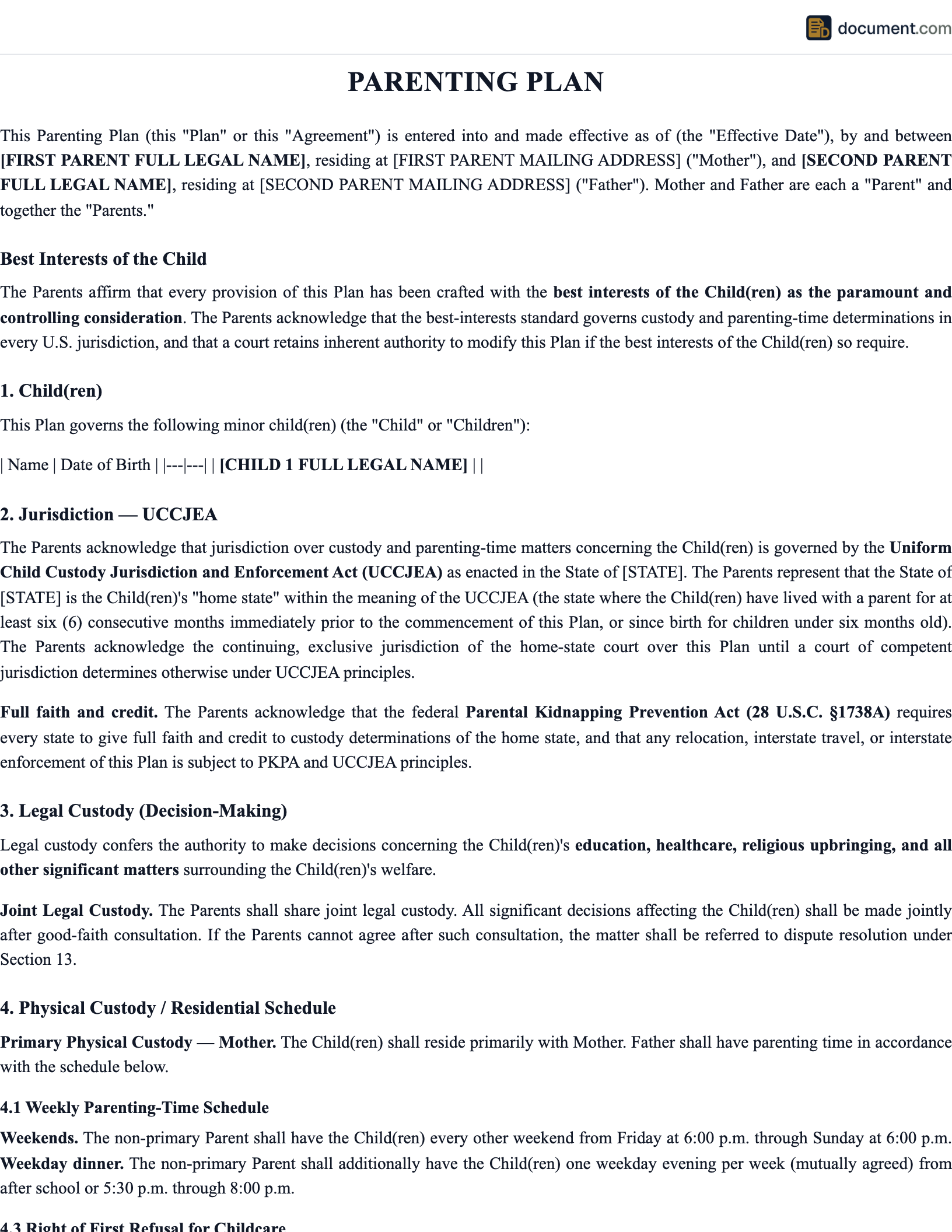
Parenting Plan Form Preview
Below is a visual preview of the sections and fields in a comprehensive parenting plan. Your completed document will be customized for your children's ages, your scheduling needs, and your state's custody requirements.
Parenting Plan
Custody, Visitation, and Decision-Making Agreement
Section 1: Parents and Children
Section 2: Custody Designation
Section 3: Regular Parenting Schedule
Section 4: Holiday & Vacation Schedule
Section 5: Signatures
Parent A Signature / Date
Parent B Signature / Date
Types of Parenting Plans
The right parenting plan depends on your family's specific circumstances — the ages of your children, the distance between parents' homes, the level of cooperation between parents, and whether circumstances have changed since the last plan was created.
Joint Custody Parenting Plan
Shared legal and physical custody with roughly equal parenting time between both parents
Primary Custody Parenting Plan
One parent has primary physical custody; other parent has regular visitation and parenting time
Long-Distance Parenting Plan
Structured plan for parents living far apart, with extended summer and holiday visitation blocks
Infant/Toddler Parenting Plan
Age-appropriate plan for very young children emphasizing frequent, shorter contact with both parents
High-Conflict Parenting Plan
Detailed, low-ambiguity plan minimizing direct parent contact with parallel parenting provisions
Modification Parenting Plan
Updated plan reflecting changed circumstances such as relocation, new schedule, or child aging
Parenting Plan vs Other Custody Documents
Understanding the differences between a parenting plan and other custody-related documents helps you ensure all necessary arrangements are properly documented and enforceable.
Parenting Plan vs Custody Order
Parenting Plan
- - Created by the parents through negotiation or mediation
- - Comprehensive and detailed (schedules, decision-making, communication)
- - Reflects the family's specific needs and preferences
- - Submitted to the court for approval
- - Becomes enforceable upon judicial approval
Court-Imposed Custody Order
- - Imposed by the judge after a contested hearing or trial
- - May be less detailed and flexible
- - Based on the judge's assessment of best interests
- - Immediately enforceable as a court order
- - Parents have less control over the outcome
Key advantage of parenting plans:Parents who create their own plan retain control over the specific terms. A judge deciding custody after a trial has limited information and time, and the resulting order may not reflect the family's actual needs as well as a parent-created plan would.
Parenting Plan vs Divorce Settlement Agreement
Parenting Plan
- - Focuses exclusively on children
- - Includes granular scheduling detail
- - Addresses day-to-day logistics and communication
- - Can be used by unmarried parents
- - Required as a separate filing in many states
Divorce Settlement Agreement
- - Covers all divorce issues (property, support, custody)
- - Custody provisions may be high-level only
- - Focuses on financial and property terms
- - Only applicable in divorce proceedings
- - Parenting plan often attached as an exhibit
How to Create a Parenting Plan: A 9-Step Guide
Creating an effective parenting plan requires putting your children's needs at the center of every decision. Follow these nine steps to build a plan that courts will approve and that your family can actually live with day to day.
Assess Each Child's Developmental Needs
Consider each child's age, temperament, school schedule, activity commitments, special needs, and relationship with each parent. An infant's need for frequent contact with their primary attachment figure differs dramatically from a teenager's desire for independence and continuity with their peer group. If you have children of different ages, the plan may need to include age-specific provisions that evolve as the younger children grow.
Choose a Custody Structure
Decide between joint legal custody (shared decision-making), sole legal custody (one parent decides), joint physical custody (roughly equal time), or primary physical custody (one parent has most residential time). Joint legal custody is the most common arrangement because courts prefer that both parents remain involved in major decisions. Physical custody depends on practical factors — work schedules, geographic proximity, and each parent's ability to provide daily care.
Design the Regular Weekly Schedule
Create a week-to-week schedule that works with both parents' work schedules, the children's school and activity commitments, and the children's need for stability and routine. Common patterns include: alternating weeks (week-on/week-off), 2-2-3 rotation (two days with each parent, then three days alternating), 3-4-4-3 schedule, or a 5-2 arrangement (weekdays with one parent, weekends with the other). Test the schedule against real-life logistics before committing.
Build the Holiday and Vacation Schedule
Create a comprehensive holiday calendar covering every major holiday, school break, summer vacation, and special occasion. Use an alternating annual rotation for most holidays. Specify exact start and end times, pickup locations, and which schedule takes priority when holidays conflict with the regular rotation. Address each child's birthday, Mother's Day, Father's Day, and any culturally significant observances. Summer vacation blocks should be claimed by a specific date each year to allow travel planning.
Establish Decision-Making Protocols
Define how major decisions about education, healthcare, religion, and extracurricular activities will be made. For joint legal custody, specify whether both parents must agree (with a dispute resolution mechanism if they cannot) or whether certain categories of decisions are assigned to one parent. Include provisions for emergency decisions that cannot wait for mutual agreement, routine medical and dental care, and school-related communications.
Set Communication Guidelines
Establish rules for parent-to-parent communication (method, frequency, response times) and parent-to-child communication during the other parent's time (phone calls, video chats, texting). For high-conflict situations, require all communication through a co-parenting app that creates a documented record. Include provisions about social media, sharing of photos and updates, and maintaining children's contact with extended family on both sides.
Address Transportation and Exchanges
Specify who provides transportation for custody exchanges, where exchanges take place (receiving parent's home, school, neutral location), what to do if a parent is late, and how transportation costs are shared for long-distance arrangements. For high-conflict situations, consider neutral exchange locations such as a police station, public library, or a supervised exchange center to minimize direct contact between parents.
Include Relocation and Modification Provisions
Define the notification requirements if either parent intends to relocate (typically 60-90 days written notice for moves beyond 50-100 miles), the dispute resolution process for contested relocations, and the criteria for modifying the plan. Include a provision for periodic review — many plans specify a review when the youngest child starts school, reaches adolescence, or when any child's needs significantly change.
Review, Sign, and File with the Court
Have each parent's attorney review the completed plan. Both parents sign the plan, and it is filed with the family court for judicial approval. The judge will review the plan against the best interest of the child standard and may request modifications if any provision appears to disadvantage the children. Once approved, the parenting plan becomes a court order enforceable through contempt proceedings.
Key Components of a Parenting Plan
A court-ready parenting plan must address every area where two-household parenting requires coordination. Below are the essential components that make a plan comprehensive and enforceable.
| Component | Description |
|---|---|
| Custody Designation | Legal and physical custody type — joint, sole, or split — for each child |
| Regular Schedule | Week-to-week residential schedule with specific days, times, and rotation pattern |
| Holiday Schedule | Alternating annual rotation for every major holiday with exact start/end times |
| Summer/Break Schedule | Vacation blocks, spring break rotation, and school break arrangements |
| Transportation | Exchange logistics — location, time, who drives, late pickup protocols |
| Decision-Making | Authority for education, healthcare, religious, and extracurricular decisions |
| Communication | Parent-to-parent and parent-to-child communication rules and methods |
| Right of First Refusal | Threshold time and notification process for offering care to other parent first |
| Relocation Notice | Required notice period and process if either parent intends to move |
| New Partner Provisions | Introduction timeline and overnight rules regarding new romantic partners |
| Extracurricular Activities | Enrollment authority, cost sharing, and participation during both parents' time |
| Travel & Passport | Consent requirements, itinerary sharing, and passport custody |
| Dispute Resolution | Mediation, parenting coordinator, or other mechanism before court action |
| Modification Triggers | Circumstances that warrant revisiting the plan (age milestones, schedule changes) |
Common Custody Schedules
The custody schedule is the heart of the parenting plan. The right schedule depends on your children's ages, both parents' work schedules, geographic distance, and the level of cooperation between parents. Below are the most commonly used schedule patterns.
Alternating Weeks
Best for: School-age children, 50/50 custody
- - One week with Parent A, next week with Parent B
- - Exchange on Sunday evening or Monday morning
- - Optional midweek dinner with non-custodial parent
- - Simple and easy to track
- - Longer stretches away from each parent
2-2-3 Rotation
Best for: Younger children, frequent contact needed
- - 2 days Parent A, 2 days Parent B, 3 days Parent A
- - Reverses the following week
- - Child never goes more than 3 days without seeing each parent
- - More transitions per week
- - Results in equal 50/50 time over two weeks
3-4-4-3 Schedule
Best for: Preschool and early elementary children
- - 3 days Parent A, 4 days Parent B (week 1)
- - 4 days Parent A, 3 days Parent B (week 2)
- - Each parent has the same days each week (consistency)
- - Equal 50/50 time over two-week cycle
- - Works well with parents' fixed work schedules
Every Other Weekend + Midweek
Best for: Primary custody arrangements (70/30 or 80/20)
- - Child lives primarily with one parent
- - Every other weekend (Fri-Sun) with non-custodial parent
- - One midweek overnight or dinner visit
- - Results in approximately 70/30 or 80/20 time split
- - Common when parents live further apart
Legal Requirements for Parenting Plans
Every state has specific statutory requirements for parenting plans, and courts evaluate all plans using the best interest of the child standard. Understanding your state's requirements ensures that your plan will be accepted by the court and effectively enforced.
The Best Interest of the Child Standard
Every state uses the "best interest of the child" as the primary standard for evaluating custody and parenting plans. While specific factors vary by state, they generally include: the emotional bonds between child and each parent, each parent's ability to meet the child's needs, stability and continuity of the current arrangement, the child's adjustment to home and school, any history of domestic violence or substance abuse, each parent's willingness to facilitate the child's relationship with the other parent, and (in many states) the child's own preferences if they are of sufficient age and maturity.
State-Specific Requirements
- Mandatory Filing: Many states (including Washington, Florida, Arizona, and Oregon) require a parenting plan to be filed as part of any custody proceeding. Some states provide statutory forms that must be used.
- Parenting Education: Approximately 30 states require one or both parents to complete a parenting education class (typically 4-6 hours) before the court will approve a parenting plan or finalize a divorce involving minor children.
- Mediation: Many states require parents to attempt mediation before litigating custody disputes. Courts view a mediated parenting plan more favorably than one imposed through adversarial proceedings.
- Child's Preference: Most states allow a child's custodial preference to be considered starting at age 12-14 (Georgia allows it at 14, Texas at 12, many states use judicial discretion). Some states require the judge to interview the child in chambers.
- Domestic Violence Provisions: If there is a history of domestic violence, most states create a rebuttable presumption against awarding custody to the abusive parent. The parenting plan must include safety provisions such as supervised visitation, protected exchange locations, and no-contact orders.
UCCJEA Jurisdiction Rules
The Uniform Child Custody Jurisdiction and Enforcement Act (UCCJEA), adopted by all 50 states, determines which state has jurisdiction over custody matters. The child's "home state" — where the child lived for the six months before the proceeding — has priority jurisdiction. This prevents parents from forum shopping by filing in different states to gain a tactical advantage. If you and the other parent live in different states, the UCCJEA rules determine where you must file your parenting plan and any future modifications.
Sample Parenting Plan
Below is a condensed preview of our parenting plan template. Your completed plan will include full holiday schedules, detailed decision-making provisions, and state-specific language tailored to your family's needs.
PARENTING PLAN
State of [State]
This Parenting Plan is entered into by[Parent A] and[Parent B], parents of[Child(ren) Name(s) and DOB(s)].
1. CUSTODY DESIGNATION
The parents shall share joint legal custody. Both parents shall cooperate in making major decisions regarding the child(ren)'s education, healthcare, religious upbringing, and extracurricular activities. Neither parent shall make a unilateral major decision without first consulting the other parent in good faith...
2. RESIDENTIAL SCHEDULE
The child(ren) shall reside with each parent on an alternating weekly basis, transitioning on [Day] at[Time]. The receiving parent shall provide transportation. During each parent's off-week, that parent shall have a midweek visit on [Day] from[Time] to[Time]...
3. HOLIDAY SCHEDULE
Holidays shall take priority over the regular residential schedule. The parents shall alternate holidays annually as set forth in Exhibit A. Mother's Day shall always be spent with the mother; Father's Day shall always be spent with the father. Each child's birthday shall be shared equally or alternated as agreed...
4. COMMUNICATION
Each parent shall have the right to communicate with the child(ren) by telephone or video call during the other parent's residential time at reasonable hours (between[Time] and[Time]). Parent-to-parent communication regarding the children shall be conducted through[method]...
5. RELOCATION
Neither parent shall relocate with the child(ren) more than[miles] from the current residence without providing [60/90] days written notice to the other parent. If the non-relocating parent objects, the matter shall be submitted to mediation before either party may seek court intervention...
Frequently Asked Questions
Find answers to common questions about parenting plans, custody arrangements, visitation schedules, and co-parenting strategies.
Official Resources
For additional information on parenting plans, child custody law, and co-parenting resources, consult these official and reputable sources.
Child Welfare Information Gateway
Federal resource for state child welfare and custody laws
AFCC - Family Court Resources
Association of Family and Conciliation Courts — research and best practices
OurFamilyWizard
Co-parenting communication platform recommended by courts nationwide
ABA Family Law Section
American Bar Association resources on custody and family law
UpToParents.org
Free co-parenting course accepted by courts in many states
Nolo - Child Custody
Free legal information on custody law and parenting plans
Create your Parenting Plan in under 10 minutes.
Answer a few questions and download a compliant, attorney-drafted document ready for your state.