



What Is a Minor Child Power of Attorney?
A minor child power of attorney — sometimes called a parental delegation of authority, caregiver authorization, or temporary custody POA depending on the state — is a written document that allows a parent to delegate certain parental rights and responsibilities to a trusted adult caregiver. It does not transfer legal custody and it does not terminate parental rights. It simply gives the caregiver the legal authority to act in the parent's place for the everyday business of raising a child: enrolling the child in school, consenting to medical treatment, signing field-trip permission slips, and making the dozens of small decisions that come up in the life of a kid.
The minor child POA exists because the law requires a parent (or someone with formal legal authority) to consent to most decisions affecting a child. Without a POA, a grandparent who flies in to care for grandchildren during a family emergency may be unable to authorize a doctor's visit, sign a school registration, or pick the child up from a hospital. The POA fills that gap quickly and inexpensively, without the cost, delay, or formality of court-ordered guardianship.
Most states limit how long a minor child POA can remain in effect — typically six months to one year — and require renewal if the delegation needs to continue. The cap exists for a reason: a parental delegation that lasts indefinitely starts to look like a custody transfer, which is supposed to go through court. Military families are often exempt from the cap because deployments can last longer, and a few states allow longer durations with a court filing.
The most common situations calling for a minor child POA are entirely ordinary: grandparents caring for grandchildren during a parent's hospital stay, a child spending the summer with relatives in another state, a single parent traveling for work, a deployed servicemember leaving children with a spouse or family member, or a family using respite care for a child with special needs. In each case, the POA is the cheapest, fastest, and least intrusive way to give the caregiver the legal authority they need.
Because parental delegation touches some of the most important areas of family law, state requirements vary widely. Some states have a statutory short form (California has the Caregiver's Authorization Affidavit; Texas has the Authorization Agreement for Nonparent Relative). Others rely on a general POA framework. Our templates select the right form and language for your state automatically.
Medical Decisions
Caregiver can consent to routine and emergency healthcare for the child.
School Authority
Enroll the child in school, sign permission slips, attend conferences.
Time-Limited
Most states cap the duration at 6 to 12 months and require renewal.
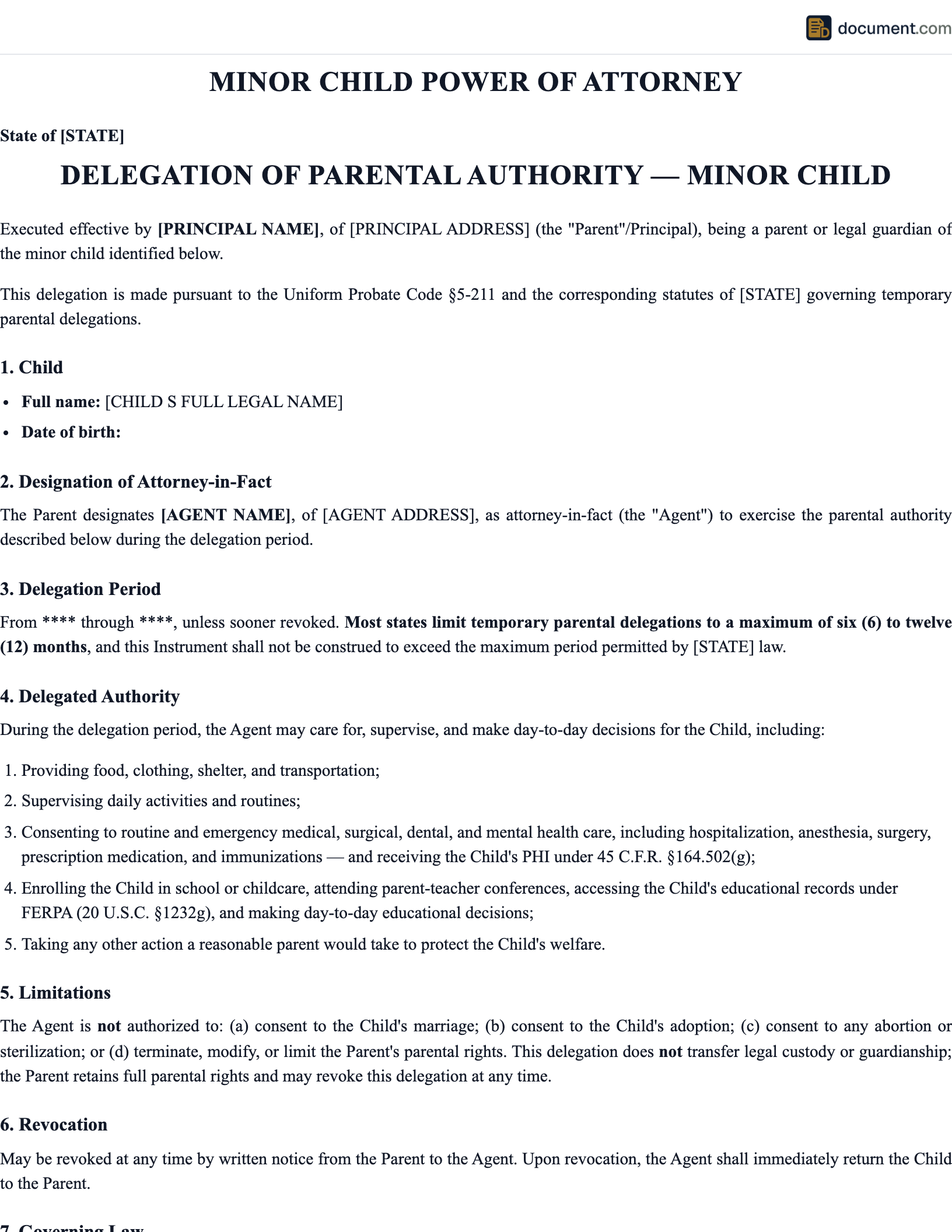
Minor Child POA Form Preview
Below is a structural preview of our minor child POA template, including the medical authorization, school authority, and duration sections.
Minor Child Power of Attorney
Parental Delegation of Authority
1. Parent(s)
2. Child(ren)
3. Designated Caregiver
4. Authority Granted
- Consent to routine and emergency medical, dental, and mental health care
- Enroll in school and sign academic/extracurricular paperwork
- Apply for and use government benefits on the child's behalf
- Authorize travel within and outside the United States
- Make daily care decisions about food, clothing, supervision, and discipline
5. Duration
Effective: May 1, 2026
Expires: May 1, 2027 (deployment)
6. Execution
Parent Signature(s)
Notary Public & Seal
Common Situations
Minor child POAs are a routine tool for families managing temporary caregiving needs. These are the situations that show up most often in our user data.
Military Deployment
A deploying servicemember designates a spouse or family member to care for the child for the duration of the deployment, often through a JAG-prepared family care plan.
Summer with Relatives
A child spends summer with grandparents in another state. The POA covers medical, camp registration, and travel decisions during the visit.
Parental Hospitalization
A single parent or both parents face an extended hospital stay. A relative steps in with full caregiving authority until the parent returns home.
School District Living
A teenager lives with a relative during the school year to attend a particular school district while parents remain elsewhere for work.
Work Relocation
A parent relocating for work leaves a child with relatives until the move is complete and the family can be reunited in a new home.
Substance Recovery or Treatment
A parent entering inpatient treatment delegates care to a trusted relative for the duration of the program, retaining the right to revoke at any time.
Minor Child POA vs Guardianship
The most important comparison is between a minor child POA and a court-ordered guardianship. They look similar from a distance but they are different tools for different problems.
POA vs Guardianship
Minor Child POA
- - Parent-signed, no court
- - Temporary (typically 6-12 months)
- - Parent retains full custody
- - Revocable at any time
- - Inexpensive and immediate
- - Cannot transfer legal custody
Court Guardianship
- - Court-ordered, formal proceeding
- - Long-term or permanent
- - Transfers custody to guardian
- - Can only be terminated by court
- - Expensive ($1,500-$5,000+)
- - Required for long-term placements
Bottom line: use a POA for temporary delegation while the parent remains the parent; use guardianship when the parent cannot or will not parent for an extended period.
POA vs Standalone Medical Consent
Minor Child POA
- - Comprehensive caregiver authority
- - Includes medical, school, daily care
- - Best for extended caregiving
Child Medical Consent
- - Medical decisions only
- - Best for short trips, sleepovers
- - Often paired with travel consent
How to Create a Minor Child POA
Creating a minor child POA is straightforward, but the document needs to be precise enough that schools, hospitals, and government agencies will rely on it.
Identify the Child(ren)
List each child by full legal name and date of birth. If multiple children are covered, list them all on the same document or use separate POAs for each — schools sometimes prefer the latter.
Both Parents Should Sign When Possible
When both parents share legal custody, both should sign. A single-parent POA from a shared-custody arrangement can be challenged. If only one parent has sole legal custody, attach proof of sole custody.
Choose a Caregiver You Trust Fully
The caregiver should be someone the child already knows, who lives in a stable home, who can handle medical and educational paperwork, and who is willing to act in your absence. Discuss the role with them before signing.
List Specific Powers Granted
Spell out medical, dental, mental health, school enrollment, extracurricular permissions, travel, and any specific authority needed for your situation. Vague language causes problems at school and at the doctor's office.
Include a HIPAA Release for Medical Records
Without HIPAA authorization, the caregiver may have authority to consent to treatment but no access to the child's medical records. The release should name the caregiver explicitly.
Set Effective and Expiration Dates
Most states cap the duration at 6 to 12 months. Set the start date to match when the caregiving begins and the end date to match the planned return date plus a small buffer.
Sign Before a Notary
Notarization is required or strongly recommended in every state. Some states also require two adult witnesses. Sign in the presence of the notary, never beforehand.
Distribute Copies
Give the caregiver several originals or certified copies. Provide additional copies to the child's school, pediatrician, and any extended family who may need to act in an emergency.
Renew or Revoke as Circumstances Change
If the caregiving period extends beyond the original duration, sign a new POA. If the caregiving ends early, sign a written revocation and distribute it to everyone who has a copy.
Key Components of a Minor Child POA
Every effective minor child POA includes the following building blocks.
Parent Identification
Full legal names, addresses, and signatures of both parents (when applicable).
Child Identification
Full legal name and date of birth of each child covered.
Caregiver Identification
Full legal name, address, and relationship of the designated caregiver.
Medical Authorization
Express authority for routine and emergency medical care.
School Authorization
Authority to enroll the child and sign school-related documents.
Travel Authorization
Permission to travel with the child within or outside the U.S.
HIPAA Release
Caregiver access to the child's medical records during the term.
Effective & Expiration Dates
Start and end of the caregiving period.
Legal Requirements
Minor child POAs are governed by state family law statutes and vary more across states than financial POAs. Most states have a specific statute or court rule allowing parental delegation, and several states have a statutory short form: California's Caregiver's Authorization Affidavit, Texas's Authorization Agreement for Nonparent Relative, Ohio's Grandparent Power of Attorney, and similar forms in other states.
Most states cap the duration at six months to one year. After the cap expires, the parent must either sign a new POA or pursue court-ordered guardianship if continued delegation is needed. Several states make exceptions for military deployment, allowing the POA to remain in effect for the duration of the deployment plus a buffer.
Notarization is required or strongly recommended in nearly every state. Some states also require two adult witnesses, neither of whom is the designated caregiver. A few states require the document to be filed with a court or a school district to be fully effective.
Certain decisions are typically excluded from delegation regardless of what the POA says: consenting to the child's marriage, consenting to adoption, terminating parental rights, agreeing to abortion or sterilization, and committing the child to a psychiatric facility. These decisions require either the parent personally or a court order.
Minor Child POA Requirements by State
Every state recognizes some form of parental delegation, but the form name, duration cap, and witness requirements vary. The list below shows the 50 states for which our templates apply state-specific rules.
Sample Minor Child POA
Below is a condensed preview of our minor child POA template.
MINOR CHILD POWER OF ATTORNEY
Parental Delegation of Authority
We, [Parent 1] and[Parent 2], the legal parents of [Child Name], do hereby delegate the following authority to:
CAREGIVER: [Caregiver Name]
RELATIONSHIP: [Relationship]
1. AUTHORITY GRANTED
The Caregiver is authorized to make decisions about and consent to: routine and emergency medical, dental, and mental health care; school enrollment and academic activities; travel with the child within and outside the United States; and all other day-to-day care decisions ordinarily made by a parent.
2. HIPAA AUTHORIZATION
We authorize all healthcare providers to release the child's protected health information to the Caregiver for the purpose of providing care.
3. DURATION
This Power of Attorney is effective from [Start Date]through [End Date], unless revoked earlier in writing.
4. NO TRANSFER OF CUSTODY
This Power of Attorney does not transfer legal custody of the child. We retain all parental rights and may revoke this authority at any time.
Frequently Asked Questions
Common questions about minor child powers of attorney, temporary guardianship, school enrollment, military deployment, and state limits.
Official Resources
Authoritative resources on parental delegation, caregiver authorization, military family care plans, and child welfare.
Child Welfare Information Gateway
Federal resource on parental rights and delegation laws by state.
Military OneSource - Family Care Plans
Department of Defense resource for deploying servicemembers.
AAP - Medical Decision Making for Minors
American Academy of Pediatrics policy on consent for minors.
ABA Family Law Section
American Bar Association resources on family law and parental delegation.
Grandfamilies State Law Database
Comprehensive database of grandparent caregiver laws by state.
ACF - Children's Bureau
Federal agency overseeing child welfare programs.
Create your Minor Child Power of Attorney in under 10 minutes.
Answer a few questions and download a compliant, attorney-drafted document ready for your state.