



What Is a Pet Custody Agreement?
A pet custody agreement — sometimes called a companion animal agreement, pet co-ownership agreement, or pet visitation contract — is a written contract between two people that allocates ownership, custody, decision-making, and financial responsibility for a pet. It is most commonly used by divorcing or separating couples, but it is also valuable for unmarried partners ending a cohabitation, roommates who share a pet, family members who jointly purchased an animal, and anyone who wants to set clear expectations before a dispute arises. The agreement converts an emotional negotiation into a clear, enforceable contract that both parties can rely on.
In most US states, pets are still legally classified as personal property — the same category as a sofa or a vehicle. That means a divorce court will, by default, simply award the pet to one spouse and refuse to order any visitation or shared schedule. A pet custody agreement allows the parties to override that default by agreement: they can create a shared schedule, allocate veterinary expenses, name a primary decision-maker for medical care, and even build in a relocation clause. Because the agreement is a voluntary contract, it is enforceable in any state — even those that do not have pet-specific custody statutes.
A small but growing number of states have changed the default rule. Alaska, Illinois, California, New York, Maine, New Hampshire, Rhode Island, and the District of Columbia have all enacted statutes that allow courts to consider the well-being of a companion animal when allocating ownership in divorce. These laws do not transform pets into children, but they do permit judges to look at who feeds, walks, trains, and pays for the animal, and to award sole or joint custody accordingly. A written pet custody agreement complements these laws by giving the court a clear, agreed-upon framework to enter as part of the final decree.
The agreement is not just for divorces. Unmarried couples who buy a pet together, roommates who share a cat, family members who co-parent a service dog, and even close friends who want to set up a backup care plan can all benefit from a written contract. When a relationship changes — whether it is a breakup, a move, a new job, or a death — the agreement provides a roadmap for what happens to the pet, who pays for what, and how disputes will be resolved. Without it, the party whose name appears on the adoption paperwork or microchip registration usually wins by default, regardless of who actually did the caretaking.
Whether you are negotiating a divorce, ending a cohabitation, sharing a pet with a roommate, or planning ahead for incapacity, our attorney-reviewed templates produce a binding, enforceable agreement tailored to your situation and your state. Each template includes shared-schedule provisions, expense allocation clauses, relocation rules, veterinary decision-making, dispute resolution language, and the optional well-being recital required by Alaska, Illinois, California, and other states with pet custody statutes.
Clear Ownership
Establish who legally owns the pet and who has visitation rights
Expense Sharing
Allocate routine vet bills, food, grooming, and emergency care
Pet Well-Being
Put your pet's comfort and health at the center of the agreement
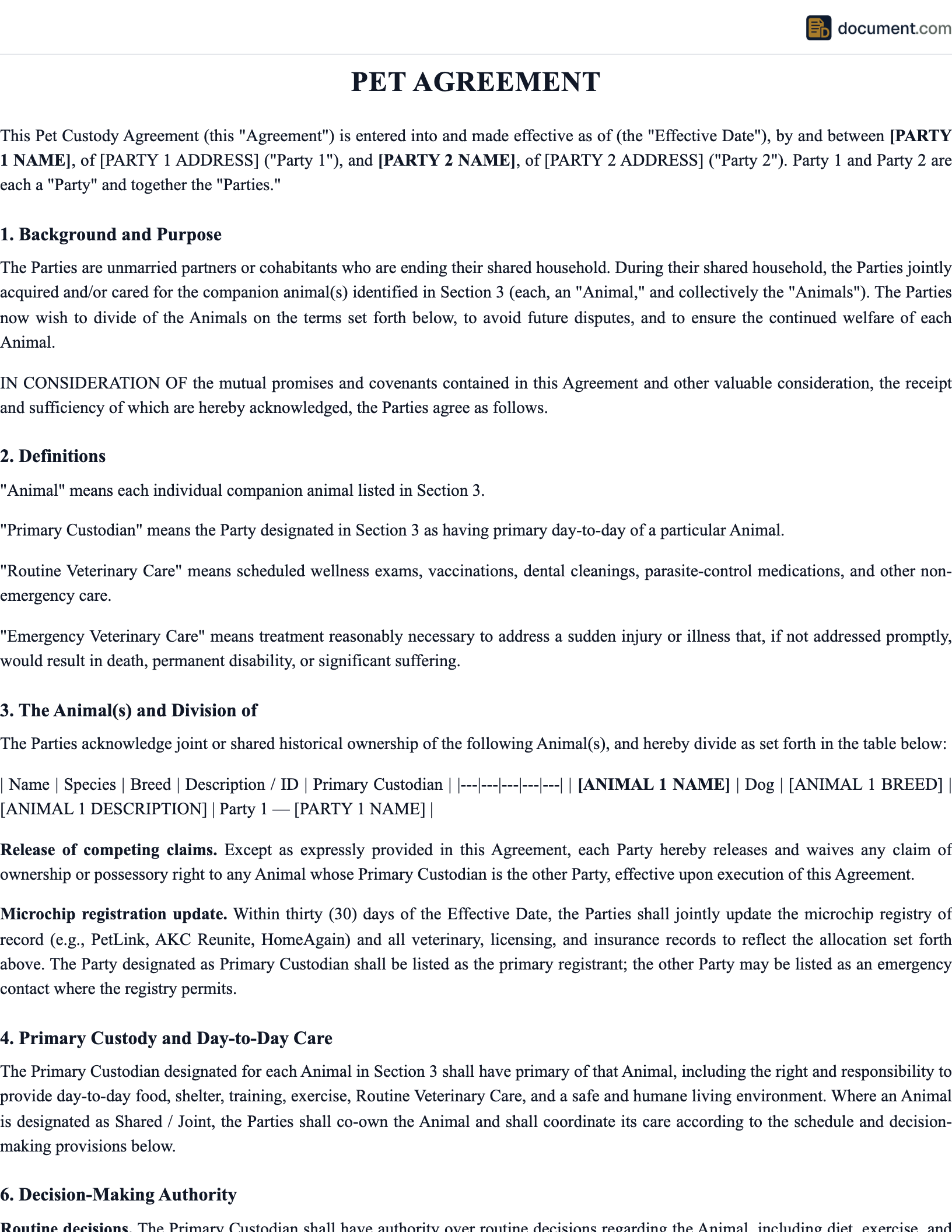
Pet Custody Agreement Preview
Below is a visual preview of the sections in a complete pet custody agreement. Your finished document will be fully formatted, professionally styled, and customized for your situation, your pet, and your state.
Pet Custody Agreement
Allocation of Companion Animal Ownership and Care
Section 1: Parties
Section 2: The Pet
Section 3: Custody Schedule
Section 4: Expense Allocation
Section 5: Signatures
Party A Signature
Party B Signature
Notary Public — Seal & Commission Expiration
When You Need a Pet Custody Agreement
Pet custody agreements are not just for divorce. Anytime two or more people share responsibility for an animal — or want to plan for what happens if their relationship changes — a written agreement protects both parties and the pet itself.
Divorce or Separation
Allocate ownership, custody, and expenses for pets when a marriage or partnership ends
Cohabitation Without Marriage
Define what happens to a shared pet if unmarried partners separate
Shared Custody Schedule
Establish a regular visitation rotation between two homes
Sole Ownership With Visitation
Confirm one party as the legal owner with scheduled visits for the other
Co-Parenting Agreement
Treat the pet as a shared family member with joint decision-making
Roommate Pet Agreement
Set responsibilities and ownership when roommates share a pet
Estate Planning for Pets
Designate a long-term caretaker if the owner becomes incapacitated or passes away
Foster & Rehoming Arrangement
Document an interim placement before permanent adoption
Pet Custody vs Other Documents
A pet custody agreement is one of several documents that can address ownership and care of an animal. The comparisons below help you choose the right tool — or combination of tools — for your situation.
Pet Custody vs Divorce Settlement
Pet Custody Agreement
- - Detailed pet-specific provisions
- - Includes schedule, expenses, vet decisions
- - Stand-alone or attached to divorce decree
- - Easier to update over time
Divorce Settlement Agreement
- - Covers all marital property and debt
- - Pet usually mentioned in a single line
- - Becomes part of the final court decree
- - Harder to modify post-divorce
Best practice: Draft a detailed pet custody agreement and incorporate it by reference into the divorce decree. This gives you both the enforcement power of a court order and the flexibility of a private contract.
Pet Custody vs Cohabitation Agreement
Pet Custody Agreement
- - Focused exclusively on the pet
- - Can be signed at any time
- - Resolves a single, narrow issue
Cohabitation Agreement
- - Covers property, debts, and shared expenses
- - Signed at the start of cohabitation
- - Resolves all financial questions
Use both: A cohabitation agreement should include a pet provision, and the pet custody agreement should be referenced as an attachment for any pet-specific details that go beyond ownership.
Pet Custody vs Pet Trust
Pet Custody Agreement
- - Addresses care during life
- - Contract between two parties
- - Can be modified by mutual consent
Pet Trust
- - Addresses care after the owner's death
- - Funded with money to pay for care
- - Authorized by statute in 40+ states
Layered planning: Use a pet custody agreement for the relationship phase and a pet trust for end-of-life planning. Both documents should be consistent with each other.
How to Create a Pet Custody Agreement: Step-by-Step
A pet custody agreement is a contract — clear, specific, and signed by both parties. The steps below will produce an enforceable agreement in any state.
Identify the parties and the pet
Begin by identifying both parties by full legal name and current address. Then identify the pet with as much specificity as possible: name, species, breed, color, sex, date of birth or estimated age, microchip number, registration or licensing number, and AKC or other registry number if applicable. The clearer the identification, the easier it is to enforce the agreement and to prevent disputes about which animal is covered.
Decide the ownership structure
Choose between sole ownership with visitation rights, joint ownership with a shared schedule, or sole ownership transferring from one party to the other on a specified date. The structure should reflect the practical realities of where the pet will live, who has the resources to care for it, and which arrangement is best for the animal's well-being. Many couples start with shared custody and transition to sole custody after a defined trial period.
Build the custody schedule
If you choose a shared schedule, define it precisely. Specify the cycle (week-on/week-off, two-weeks/two-weeks, or other), the start and end times of each transition, the location of the handoff, and who provides transportation. Address holidays, birthdays, vacations, and special events explicitly. Include a procedure for swapping or rescheduling time if one party has a conflict, and a default rule if the parties cannot agree on a swap.
Allocate financial responsibilities
Decide how the parties will split routine expenses (food, treats, grooming, flea and tick prevention, routine vet visits) and how they will handle major expenses (emergency surgery, chronic illness treatment, end-of-life care). Common approaches include a 50/50 split, a percentage based on income, or one party paying routine costs while the other contributes to major medical bills. For pets with significant veterinary needs, consider a joint pet expense account that both parties fund monthly.
Designate a primary decision-maker for medical care
When the pet needs non-emergency medical care, who decides? The agreement should name a primary decision-maker and require advance consultation with the other party for any procedure costing more than a stated dollar threshold. For emergency care, both parties should be empowered to authorize immediate treatment. List the primary veterinarian, the emergency clinic, and any specialists by name, address, and phone number.
Add a relocation clause
Address what happens if one party wants to move. Require written notice within a specified period (30-60 days) before the move, and give the non-relocating party the right to object, propose a modified schedule, or take primary custody. For long-distance moves, specify how transportation costs and visitation will be handled, including extended visits during holidays and summer breaks. Without a relocation clause, the moving party has full discretion to relocate the pet.
Plan for incapacity and death
Designate a successor caregiver if the primary owner dies, becomes incapacitated, or is unable to continue caring for the pet. For shared custody arrangements, the surviving party usually takes full ownership, but the agreement can also direct the pet to a third party (a sibling, friend, or rescue organization) if neither original party can care for the animal. Consider establishing a pet trust under state law if you want to set aside funds specifically for the care of the animal.
Include a dispute resolution clause
Even the best-drafted agreement can produce disputes. Include a dispute resolution clause that requires the parties to attempt mediation before filing any lawsuit, designates a specific mediator or mediation service, and allocates the cost of mediation between the parties. Mediation is faster, cheaper, and less stressful than litigation, and most disputes settle in a single session.
Sign in front of a notary
Notarization is not legally required for a private contract, but it is strongly recommended. Both parties should sign the agreement in front of a notary public, present photo identification, and have their signatures acknowledged. If the agreement will be incorporated into a divorce decree or court order, the court will require notarization.
Distribute and update
Each party should keep an original signed copy, and a copy should be provided to the primary veterinarian, the boarding facility, and any pet sitter who regularly cares for the animal. Review the agreement annually and update it whenever circumstances change — a new home, a new job, a new partner, the addition of another pet, or a significant change in the animal's health. A current agreement is far more useful than a stale one.
Key Components of a Pet Custody Agreement
A well-drafted pet custody agreement contains the following components. Each one addresses a specific issue that experience has shown to be a common source of dispute.
Parties
Full legal names and addresses of both parties, plus their relationship (spouses, partners, roommates, family).
Pet Identification
Name, species, breed, sex, date of birth, microchip number, registration, and AKC or registry numbers.
Custody Schedule
The day-to-day, weekly, and holiday schedule for which party has the pet.
Handoff Logistics
Where, when, and how the pet is transferred between households.
Expense Allocation
How routine and emergency expenses are split, including a joint account if applicable.
Veterinary Decisions
Primary veterinarian, decision-maker for non-emergency care, and the dollar threshold for prior consent.
Relocation Clause
Notice requirements and rights of the non-relocating party if one party wants to move.
Well-Being Recital
An optional statement that the parties prioritize the well-being of the animal, useful in pet-custody-statute states.
Dispute Resolution
A mediation-first clause and an allocation of mediator fees.
Successor Caregiver
Who takes over if one or both parties become unable to care for the pet.
State Pet Custody Laws
Most US states still treat pets as personal property, but a growing number have enacted specific pet custody statutes that allow courts to consider the well-being of the animal. The summary below covers the leading states.
Alaska (2017)
The first state to enact a pet custody law. Alaska Statute 25.24.160 directs courts to consider the well-being of the animal when allocating ownership in divorce, and authorizes joint ownership arrangements.
Illinois (2018)
750 ILCS 5/503(n) authorizes Illinois courts to allocate sole or joint ownership of, and responsibility for, a companion animal owned by the parties, taking into account the well-being of the animal.
California (2019)
Family Code Section 2605 allows California courts to consider the care of the pet — including who feeds, walks, and takes the pet to the vet — when allocating ownership, and authorizes courts to enter orders providing for the joint care and ownership of the animal.
New York (2021)
Domestic Relations Law Section 236(B)(5)(d)(15) added companion animal well-being to the list of factors courts must consider in equitable distribution.
Other States
Maine, New Hampshire, Rhode Island, and the District of Columbia have all enacted similar laws. In every other state, pets remain legally classified as personal property and courts will award them based on the standard rules of property division — making a written agreement essential.
Legal Requirements
A pet custody agreement is a private contract, so the formal legal requirements are minimal. Following the best practices below ensures the agreement will be enforceable in any state.
- Capacity. Both parties must be competent adults.
- Mutual Consent. Both parties must voluntarily agree to the terms.
- Consideration. Each party must give something of value (typically the mutual exchange of promises).
- Written Form. Verbal pet custody agreements are extremely difficult to enforce.
- Notarization. Recommended in every state; often required if incorporated into a divorce decree.
- Specific Terms. Vague terms produce vague enforcement; spell everything out.
- Compliance with Custody Orders. Must not conflict with any existing court orders.
Sample Pet Custody Agreement
Below is a condensed preview of our pet custody template. Your finished agreement will be fully customized for your situation, the specific pet, and your state.
PET CUSTODY AGREEMENT
Companion Animal Ownership and Care
This Pet Custody Agreement is made on[Date]between [Party A]and [Party B]with respect to the care of the companion animal described below.
THE PET
Name: [Pet Name]
Species / Breed: [Species/Breed]
DOB: [DOB], Microchip: [Chip]
1. WELL-BEING RECITAL
The parties acknowledge that the pet is a sentient being and that all decisions made under this Agreement shall prioritize the well-being and welfare of the pet.
2. CUSTODY SCHEDULE
The parties shall share custody of the pet on the following schedule:[Schedule]. Handoffs shall occur at [Location]at [Time].
3. EXPENSES
Routine expenses shall be split [%/%]. Emergency expenses shall be split [%/%]. Non-emergency procedures exceeding $[Amount]require advance written consent from both parties.
4. VETERINARY CARE
The primary veterinarian shall be [Vet Name].[Party]shall serve as the primary decision-maker for non-emergency care.
5. RELOCATION
Either party intending to relocate more than[Distance]from their current address must provide[Days]days written notice to the other party.
6. DISPUTE RESOLUTION
Any dispute arising under this Agreement shall first be submitted to mediation before either party may file suit. Mediator fees shall be split equally.
Frequently Asked Questions
Answers to the most common questions about pet custody, divorce, state laws, and shared schedules.
Official Resources
For additional information on pet custody, animal welfare, and the laws of states with pet custody statutes, consult the resources below.
AVMA - American Veterinary Medical Association
Authoritative veterinary resources for pet owners and caregivers
ABA - Animal Law Resources
American Bar Association materials on companion animal law
Animal Legal Defense Fund - Pet Custody
Overview of pet custody disputes and state law developments
ASPCA - American Society for the Prevention of Cruelty to Animals
Pet welfare resources and advocacy materials
AKC - American Kennel Club
Dog ownership, registration, and breed-specific resources
Illinois - Companion Animal Law
Text of the Illinois pet custody statute (750 ILCS 5/503)
California - Family Code 2605
Text of the California pet custody statute
Animal & Society Institute
Research on the human-animal bond and policy implications
Create your Pet Custody Agreement in under 10 minutes.
Answer a few questions and download a compliant, attorney-drafted document ready for your state.