



What Is a Postnuptial Agreement?
A postnuptial agreement — often called a postnup — is a legally binding contract between two people who are already married. The agreement defines how assets, debts, property, and financial responsibilities will be divided if the couple divorces, separates, or one spouse dies. Unlike a prenuptial agreement, which is signed before the wedding, a postnup is executed during the marriage. This distinction is not merely procedural — it has significant legal implications because married spouses owe each other fiduciary duties that do not exist between unmarried people planning a wedding.
The core purpose of a postnuptial agreement is to give married couples control over their financial future rather than leaving critical decisions to state default laws or a family court judge. A postnup can define which assets are considered separate property belonging to one spouse alone, how marital property acquired during the marriage will be divided, whether spousal support will be paid and on what terms, how debts will be allocated, and how business interests and retirement accounts will be treated. These are the same issues addressed in a prenup — the only difference is that the couple is already married when they negotiate and sign the agreement.
Postnuptial agreements have grown dramatically in popularity over the past two decades. According to surveys by the American Academy of Matrimonial Lawyers, more than half of family law attorneys reported an increase in postnup requests in recent years. This growth reflects a broader cultural shift: couples increasingly view financial planning during marriage as a practical step rather than a sign of marital trouble. Many couples who did not think about a prenup before their wedding later realize the value of having clear financial terms in place, particularly after experiencing a major life event such as an inheritance, business venture, or career change.
One of the most compelling reasons to consider a postnup is that it can actually strengthen a marriage by addressing the financial tensions that often drive couples apart. Money is consistently cited as one of the top causes of marital conflict and divorce. A postnuptial agreement forces couples to have an honest conversation about their finances, set clear expectations, and resolve disagreements about money in a structured and thoughtful way. Rather than being a sign that a marriage is in trouble, a postnup can be a tool for building financial trust and transparency.
Postnuptial agreements are legally enforceable in most states, but they face stricter judicial scrutiny than prenuptial agreements. Because spouses already owe each other a fiduciary duty of good faith and fair dealing, courts examine postnups more carefully for signs of duress, undue influence, overreach, or inadequate disclosure. Some states that readily enforce prenups are more skeptical of postnups, and a few have historically refused to recognize them at all (though this is increasingly rare). The heightened scrutiny makes it particularly important that postnups be drafted carefully, with full financial transparency and ideally with independent counsel for both spouses.
Asset Protection
Protect separate property, inheritance, business interests, and retirement accounts during marriage
Debt Allocation
Define responsibility for student loans, credit cards, business debts, and marital obligations
Marital Stability
Address financial conflicts transparently and strengthen the marriage through clarity and trust
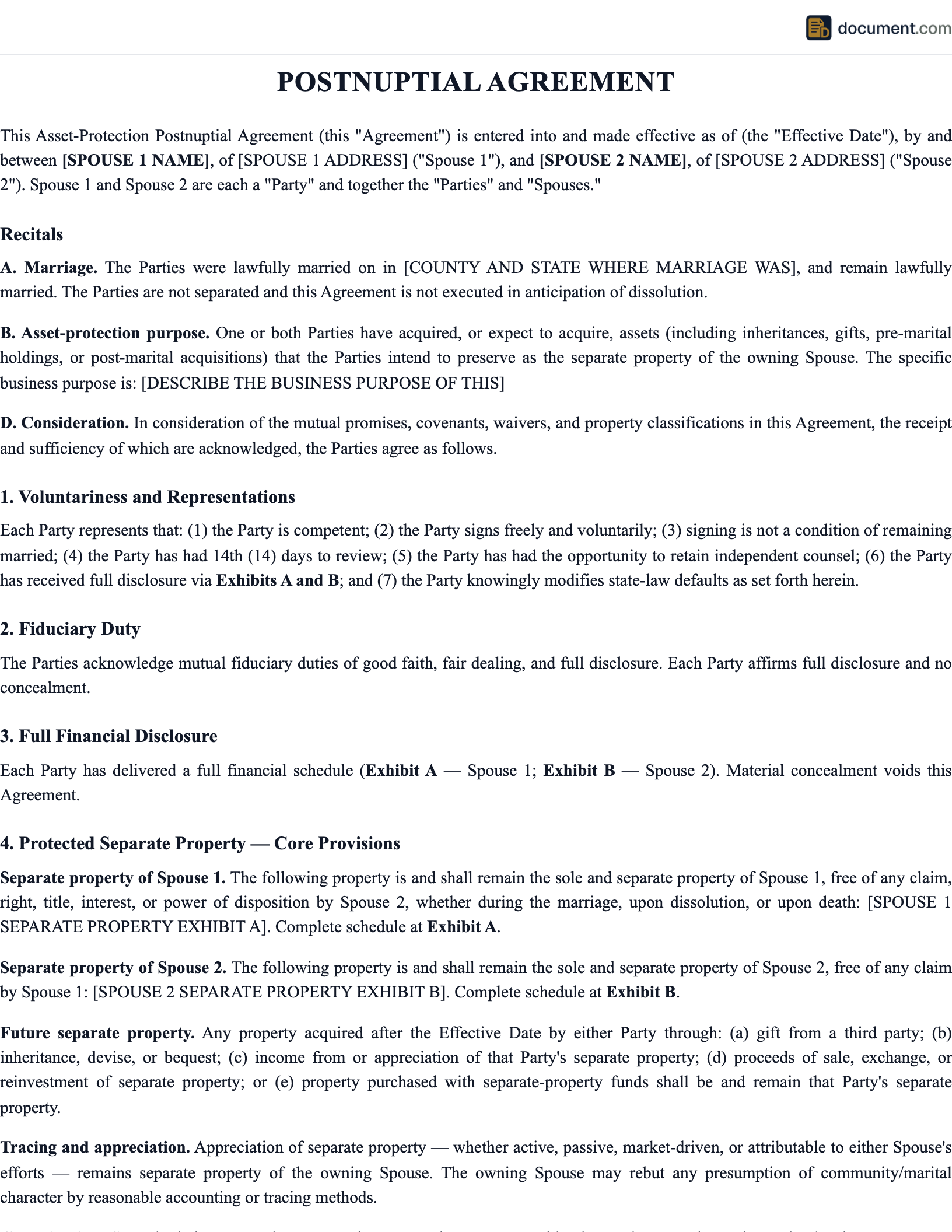
Postnuptial Agreement Form Preview
Our postnuptial agreement template covers all the essential provisions needed for a comprehensive and enforceable postnup. Below is a preview of the key sections included in your customized document, which will be tailored to your state's specific legal requirements for postnuptial agreements.
POSTNUPTIAL AGREEMENT
Entered Into During Marriage
SPOUSE 1
Full Legal Name: [Name]
Date of Birth: [DOB]
Current Address: [Address]
Attorney: [Attorney Name]
SPOUSE 2
Full Legal Name: [Name]
Date of Birth: [DOB]
Current Address: [Address]
Attorney: [Attorney Name]
MARRIAGE INFORMATION
Date of Marriage: [Date]
Location of Marriage: [City, State]
Existing Prenuptial Agreement: [Yes / No]
SEPARATE PROPERTY — SPOUSE 1
Real Estate: [Description & Value]
Bank Accounts: [Institution & Balance]
Investments: [Description & Value]
Business Interests: [Entity & Ownership %]
SEPARATE PROPERTY — SPOUSE 2
Real Estate: [Description & Value]
Bank Accounts: [Institution & Balance]
Investments: [Description & Value]
Business Interests: [Entity & Ownership %]
MARITAL PROPERTY DIVISION
Income Treatment: [Shared / Separate / Hybrid]
Jointly Acquired Property: [Division Method]
Real Estate (Marital Home): [Treatment]
SPOUSAL SUPPORT / ALIMONY
Spousal Support: [Waived / Terms Specified / Per State Law]
Duration: [Term / Permanent / Based on Marriage Length]
Amount Formula: [Fixed / Percentage / Sliding Scale]
DEBT ALLOCATION
Pre-Marital Debts: [Each Spouse Responsible for Own]
Marital Debts: [Division Method]
Student Loans: [Individual / Shared]
Credit Card Debt: [Individual Account Holder / Split]
BUSINESS INTERESTS
Business Entity: [Name & Type]
Treatment of Appreciation: [Separate / Shared]
Spousal Role in Business: [Active / Passive / None]
REAL ESTATE
Marital Home: [Address & Treatment]
Investment Properties: [Description & Division]
Future Acquisitions: [Joint / Separate Based on Funding]
RETIREMENT ACCOUNTS
401(k) / 403(b): [Treatment & Division Method]
IRA Accounts: [Treatment & Division Method]
Pension Plans: [Treatment & QDRO Provisions]
LIFE INSURANCE BENEFICIARIES
Policy 1: [Carrier, Amount, Beneficiary]
Policy 2: [Carrier, Amount, Beneficiary]
Obligation to Maintain: [Yes / No / Duration]
SIGNATURES & NOTARIZATION
Spouse 1 Signature: [Signature] Date: [Date]
Spouse 2 Signature: [Signature] Date: [Date]
Notary Public: [Signature & Seal]
Commission Expires: [Date]
When Do You Need a Postnuptial Agreement?
Postnuptial agreements are valuable in a wide range of situations. While any married couple can benefit from defining their financial terms, certain life events and circumstances make a postnup particularly important. If any of the following scenarios apply to you, a postnup should be a priority.
Reconciliation After Infidelity
One of the most common triggers for a postnuptial agreement is reconciliation after a marital crisis such as infidelity. The spouse who was wronged may agree to stay in the marriage on the condition that certain financial protections are put in place. The postnup might include provisions that adjust property division or spousal support in the event of future infidelity, giving the wronged spouse security and the unfaithful spouse accountability. This structured approach can help rebuild trust by creating tangible consequences and commitments.
Significant Financial Change
A major change in financial circumstances during the marriage — such as receiving a large inheritance, a sudden increase in income, winning a lawsuit settlement, or a significant investment gain — is a prime reason to create a postnup. The agreement can clarify whether the new wealth is separate or marital property and how it will be treated if the marriage ends. Without a postnup, these assets may be subject to your state's default property division rules, which may not reflect the intent of the spouse who brought the wealth into the marriage.
Career Change — One Spouse Stays Home
When one spouse decides to leave their career to raise children, care for a family member, or support the other spouse's professional ambitions, a postnup can protect the stay-at-home spouse. The agreement might include enhanced spousal support provisions, a larger share of marital property, educational fund provisions to help the stay-at-home spouse re-enter the workforce, or other financial protections that acknowledge the sacrifice of career advancement and earning potential. This prevents the stay-at-home spouse from being financially vulnerable if the marriage ends.
Real Estate Purchase
Buying a home or investment property during the marriage raises important questions about ownership, equity, and what happens to the property if the couple divorces. A postnup can specify each spouse's ownership share, who stays in the marital home, how the equity will be divided, and who is responsible for the mortgage and upkeep. This is especially important when one spouse makes a larger down payment or when the property is purchased using funds that one spouse considers separate property.
Starting or Growing a Business
If one spouse starts a business during the marriage or an existing business experiences significant growth, a postnup can protect the business interest. Without a postnup, the non-owning spouse may be entitled to a share of the business's value (including appreciation during the marriage) in a divorce. The postnup can define the business as separate property, limit the non-owning spouse's claim to business assets, and establish a valuation method to avoid costly disputes later. Business partners and investors may also require a postnup to protect the company.
Protecting an Inheritance
When one spouse receives or expects to receive a significant inheritance, a postnup can ensure it remains separate property. While most states treat inheritance as separate property by default, this protection can be lost if the inherited funds are commingled with marital assets — for example, depositing inherited money into a joint bank account, using it to pay marital expenses, or investing it in jointly owned property. A postnup creates a clear written record that both spouses intend the inheritance to remain separate.
Addressing Spending or Debt Issues
Financial irresponsibility by one spouse — excessive spending, gambling, accumulating credit card debt, or making risky investments — is a common source of marital conflict. A postnup can protect the financially responsible spouse by allocating debts to the spouse who incurred them, setting spending limits or financial guardrails, and ensuring that the responsible spouse's assets are shielded from the other's liabilities. This creates accountability and can prevent one spouse's financial behavior from devastating the family's finances.
Preparing for a Blended Family
If one or both spouses have children from a prior relationship, a postnup can protect those children's financial interests. The agreement can specify that certain assets are reserved for the children, modify or waive the surviving spouse's elective share rights, and coordinate with estate plans, trusts, and life insurance policies to ensure that the children are provided for regardless of what happens in the current marriage. This is especially important as blended families have unique financial dynamics.
What Can and Cannot Be in a Postnuptial Agreement
Postnuptial agreements are flexible instruments that can address a wide range of financial and property matters. However, they have important limitations. Courts will refuse to enforce provisions that violate public policy, attempt to regulate non-financial aspects of the marriage, or are fundamentally unfair — and postnups are scrutinized more strictly than prenups.
What CAN Be Included in a Postnup
Property Division
Classification of separate vs. marital property, division of real estate, investments, bank accounts, vehicles, and personal property
Spousal Support / Alimony
Amount, duration, and conditions for spousal support payments, including waivers (subject to state law restrictions and unconscionability review)
Debt Allocation
Assignment of responsibility for pre-marital and marital debts, including student loans, credit cards, mortgages, and business liabilities
Business Interests
Protection of business ownership, treatment of business appreciation during marriage, valuation methods, and buyout provisions
Inheritance and Estate Rights
Waiver or modification of spousal elective share rights, protection of family inheritance, and coordination with estate plans and trusts
Retirement Accounts
Division of 401(k), IRA, pension, and other retirement benefits, including QDRO provisions for qualified plans
Life Insurance Requirements
Obligations to maintain life insurance policies, designation of beneficiaries, and minimum coverage amounts
What CANNOT Be Included in a Postnup
Child Custody or Child Support
Courts determine custody and support based on the child's best interests at the time of divorce — these matters cannot be predetermined in any agreement between spouses
Illegal Provisions
Any provision requiring illegal conduct is unenforceable, including provisions that facilitate tax evasion, fraud, or violation of federal or state law
Unconscionable Terms
Provisions that are grossly unfair to one spouse — particularly concerning given the fiduciary duty between married partners — can be struck down by a court
Personal Lifestyle Clauses (in most states)
Provisions regulating weight, appearance, household chores, frequency of intimacy, or other personal behaviors are generally unenforceable, though some states may enforce limited lifestyle provisions
Provisions Encouraging Divorce
Courts may reject provisions that create a financial incentive to divorce — for example, a clause giving one spouse an outsized payout only upon dissolution could be viewed as promoting marital breakdown
Postnup vs Other Agreements
Postnuptial agreements are one of several legal instruments couples can use to define their financial relationship. Understanding how a postnup compares to other agreements helps you determine which document is appropriate for your specific situation.
Postnuptial Agreement vs Prenuptial Agreement
The most fundamental difference is timing: a prenup is signed before the wedding while a postnup is signed after. This timing distinction has significant legal consequences. Because married spouses owe each other a fiduciary duty that engaged couples do not, postnups face heightened scrutiny for fairness, voluntariness, and full disclosure. Prenups are governed by the Uniform Premarital Agreement Act (UPAA) in most states, while postnups are often evaluated under general contract law principles combined with family law protections.
| Feature | Postnuptial Agreement | Prenuptial Agreement |
|---|---|---|
| Timing | Signed after marriage | Signed before marriage |
| Legal Scrutiny | Higher — fiduciary duty between spouses | Standard — well-established framework |
| Enforceability | Not recognized or limited in some states | Recognized in all 50 states |
| Common Trigger | Life changes, reconciliation, new business | Wedding planning, asset protection |
Postnuptial Agreement vs Separation Agreement
The critical distinction is intent. A postnuptial agreement is created by spouses who intend to remain married — the goal is to establish financial clarity while the marriage continues. A separation agreement is created when the spouses have decided to separate or divorce — its purpose is to settle financial matters as the marriage ends. Some states treat the two documents very differently, and an agreement created during a period of separation may be classified differently than one created during a stable marriage.
| Feature | Postnuptial Agreement | Separation Agreement |
|---|---|---|
| Intent | Stay married — proactive planning | Separate / divorce — resolve disputes |
| Emotional Climate | Generally cooperative | Often adversarial |
| When Triggered | Upon divorce, separation, or death | Immediately upon signing |
| Cost | $3,000 - $10,000 typical | $5,000 - $50,000+ depending on dispute |
Postnuptial Agreement vs Divorce Settlement
A divorce settlement (or marital settlement agreement) is negotiated and finalized as part of the divorce process. It is approved by the court and becomes a binding court order. A postnup, by contrast, is a private contract between spouses who are not divorcing. If a couple with a postnup later divorces, the postnup's terms typically inform or control the divorce settlement, but the court retains the power to reject postnup provisions that are unconscionable or that affect child custody and support.
| Feature | Postnuptial Agreement | Divorce Settlement |
|---|---|---|
| Context | During intact marriage | During active divorce proceedings |
| Court Involvement | Private contract — no court approval needed | Must be approved by divorce court |
| Binding Nature | Contract between spouses | Court order — enforceable by contempt |
| Modification | By mutual written agreement | Requires court petition to modify |
Postnuptial Agreement vs Property Agreement
A property agreement (sometimes called a transmutation agreement or community property agreement) is a narrower instrument used to change the character of specific property — for example, converting separate property to community/marital property or vice versa. A postnup is comprehensive, covering all financial aspects of the marriage. In some community property states, married couples can use property agreements for specific assets without needing a full postnup.
| Feature | Postnuptial Agreement | Property Agreement |
|---|---|---|
| Scope | Comprehensive — all financial matters | Narrow — specific assets or property types |
| Spousal Support | Can address alimony terms | Typically does not address support |
| Debt Provisions | Can allocate all debts | Usually limited to property-related debt |
| Common Use | Full financial planning between spouses | Reclassifying specific assets (e.g., house) |
How to Create a Postnuptial Agreement
Creating an enforceable postnuptial agreement requires careful attention to legal requirements and best practices. Because postnups face stricter scrutiny than prenups, following each step thoroughly is critical to ensuring your agreement holds up if challenged.
Provide Full Financial Disclosure
Both spouses must provide complete and honest disclosure of all assets, debts, income, and financial obligations. This is the most critical step for enforceability. Attach detailed financial schedules listing every bank account, investment, retirement account, real estate holding, business interest, and liability. Failure to disclose even a single significant asset can invalidate the entire agreement.
Retain Independent Attorneys
Each spouse should hire their own family law attorney. This is arguably more important for a postnup than a prenup because of the fiduciary duty between spouses. Having independent counsel demonstrates that both parties understood the agreement, received legal advice, and signed voluntarily. A single attorney cannot represent both spouses due to the inherent conflict of interest.
Negotiate Terms Openly
Both spouses should have genuine input into the terms of the agreement. A postnup that appears to have been dictated by one spouse and accepted without negotiation by the other is vulnerable to challenge. Document the negotiation process, including any back-and-forth exchanges, drafts, and compromises. The goal is to demonstrate that the final agreement reflects the informed choices of both parties.
Ensure No Coercion or Duress
The agreement must be entered into freely and voluntarily by both spouses. Any evidence of coercion, threats, intimidation, or ultimatums (such as threatening divorce if the other spouse does not sign) can invalidate the postnup. Allow adequate time for review — do not pressure your spouse to sign quickly. Courts pay close attention to the circumstances surrounding the signing of postnups.
Draft Fair and Reasonable Terms
The postnup must be substantively fair. Because spouses owe each other a fiduciary duty, courts will not enforce agreements that are unconscionable or grossly one-sided. Each spouse should receive meaningful consideration from the agreement. An arrangement where one spouse gives up everything and the other retains everything is almost certain to be invalidated. Fairness does not require equality, but it requires reasonableness.
Include Proper Legal Language
The agreement should include recitals explaining the purpose and context, representations that both parties have made full disclosure, acknowledgments that both parties had the opportunity to consult independent counsel, a statement that the agreement is voluntary, and severability clauses allowing individual provisions to be struck without invalidating the entire agreement.
Sign and Notarize
Both spouses must sign the agreement. Even in states where notarization is not strictly required, having the postnup notarized adds a layer of authentication and can help prove that both parties signed voluntarily. Some states also require witnesses. Follow your state's specific execution requirements carefully — technical defects in execution can be used to challenge the agreement.
Store Safely and Review Periodically
Store the original signed agreement in a secure location, such as a safe deposit box or fireproof safe. Each spouse and their attorney should retain copies. Review the postnup periodically — especially after major life events such as the birth of a child, a job change, a significant asset acquisition, or a move to a different state — and amend it as needed to reflect changed circumstances.
Key Components of a Postnuptial Agreement
A comprehensive postnuptial agreement should address all significant financial aspects of the marriage. The following table outlines the essential components that should be included in your postnup.
| Component | Description |
|---|---|
| Identification of Parties | Full legal names, dates of birth, addresses, and date of marriage for both spouses |
| Recitals and Purpose | Statement of intent, acknowledgment that the agreement is voluntary, and context for why the postnup is being created |
| Financial Disclosure | Attached schedules listing all assets, debts, income, and financial obligations of both spouses |
| Separate Property | Identification and protection of each spouse's individual assets, including pre-marital property and inheritance |
| Marital Property Division | Rules for how jointly acquired property will be classified and divided upon divorce or death |
| Spousal Support Terms | Amount, duration, conditions, and any waivers of alimony or spousal maintenance |
| Debt Allocation | Responsibility for existing and future debts, including student loans, credit cards, mortgages, and business debts |
| Business Interests | Protection of business ownership, valuation methods, treatment of appreciation, and buyout provisions |
| Real Estate | Ownership, equity division, right of occupancy, and treatment of the marital home and investment properties |
| Retirement Accounts | Division of 401(k), IRA, pension, and other retirement benefits, including QDRO provisions |
| Life Insurance | Obligations to maintain policies, beneficiary designations, and minimum coverage amounts |
| Estate and Inheritance | Coordination with wills, trusts, and estate plans; waiver or modification of elective share rights |
| Tax Provisions | Tax filing status, allocation of tax liabilities and refunds, and indemnification for tax obligations |
| Modification and Termination | Procedures for amending or revoking the agreement, including any sunset clause or expiration provisions |
| Governing Law and Severability | Choice of state law, dispute resolution procedures, and severability clause protecting the agreement if one provision is struck |
| Signatures and Notarization | Signatures of both spouses, notary acknowledgment, and witness attestations as required by state law |
Enforceability Challenges for Postnuptial Agreements
Postnuptial agreements face greater enforceability challenges than prenuptial agreements. The central reason is that married spouses owe each other a fiduciary duty — a legal obligation of good faith, fair dealing, and full transparency. This duty does not exist between unmarried people negotiating a prenup, which is why courts treat postnups with heightened skepticism and examine them more carefully for fairness and voluntariness.
The fiduciary standard means that a spouse who benefits from a postnup may bear the burden of proving that the agreement was fair and that the other spouse was fully informed. In contrast, for a prenup, the burden typically falls on the party challenging the agreement. This reversal of burden can make postnups significantly harder to enforce, especially when one spouse receives a disproportionate benefit.
Full financial disclosure is even more critical for postnups than prenups. Because spouses are in a position to know (or be expected to know) about each other's finances, a court will look very unfavorably on any attempt to hide assets. Even inadvertent omissions can be grounds for invalidation. Some states have historically been hostile to postnuptial agreements altogether, though this attitude has softened considerably in recent years as more states have recognized their practical value.
Fiduciary Duty Between Spouses
Unlike unmarried couples, spouses owe each other duties of loyalty, good faith, and full disclosure. This means postnups are held to a higher standard of fairness. Courts may refuse to enforce a postnup that would be perfectly valid as a prenup because of these heightened obligations.
Duress and Undue Influence
The power dynamics within a marriage make duress and undue influence more likely than in a prenup context. A spouse may feel compelled to sign because of threats (explicit or implied) related to the marriage itself. Courts carefully examine whether both spouses signed freely and without pressure.
Consideration Requirements
Some states require that a postnup be supported by independent consideration — something of value beyond simply continuing the marriage. This requirement does not exist for prenups (where the marriage itself serves as consideration). States differ on what constitutes adequate consideration for a postnup.
State-by-State Hostility
While most states now recognize postnuptial agreements, the degree of acceptance varies. Some states have robust statutory frameworks, others rely on case law, and a few have limited or unclear precedent. Ohio, for instance, was historically hostile to postnups but has become more accepting through recent court decisions.
Postnuptial Agreement Legal Requirements
While specific requirements vary by state, the following general principles apply to postnuptial agreements in most jurisdictions. Always consult the laws of your specific state and work with a qualified family law attorney.
Important: State Recognition Varies
Most states recognize postnuptial agreements, but enforcement standards differ significantly. Unlike prenuptial agreements (governed by the UPAA in most states), postnups lack a uniform national framework. Some states apply contract law principles, others have developed specific case law, and a few have statutes directly addressing postnuptial agreements. Check your state's specific page below for detailed requirements.
General Requirements
- Written Agreement: Postnups must be in writing — oral agreements between spouses are not enforceable
- Signed by Both Spouses: Both parties must sign the agreement voluntarily and without duress
- Full Financial Disclosure: Complete and accurate disclosure of all assets, debts, income, and obligations is essential
- Notarization: Required in some states and strongly recommended in all — verifies identity and adds evidentiary weight
- Witnesses: Some states require one or two witnesses to the signing ceremony
- Consideration: Some states require independent consideration beyond simply remaining married
- Not Unconscionable: The agreement must be substantively fair and not grossly one-sided
- Independent Counsel: Not always legally required, but having both spouses represented is the strongest protection against challenge
Postnuptial Agreement by State
Postnuptial agreement laws vary significantly by state. Select your state below for detailed information about enforceability, legal requirements, fiduciary duty standards, and state-specific forms.
Sample Postnuptial Agreement
Below is a preview of our postnuptial agreement template. Your customized document will include all provisions required for enforceability in your state, financial disclosure schedules, and appropriate signature and notarization blocks.
POSTNUPTIAL AGREEMENT
Between Married Spouses
SPOUSE 1:
Name: [Full Legal Name]
Address: [Address]
Attorney: [Attorney Name]
SPOUSE 2:
Name: [Full Legal Name]
Address: [Address]
Attorney: [Attorney Name]
AGREEMENT TERMS
Date of Marriage: [Date]
Separate Property Schedules: [Attached as Exhibits A & B]
Marital Property Division: [As Defined in Article II]
Spousal Support Terms: [As Defined in Article III]
Debt Allocation: [As Defined in Article IV]
Governing Law: [State]
Frequently Asked Questions
Answers to common questions about postnuptial agreements, including enforceability, legal requirements, and how they compare to prenuptial agreements.
Official Resources
Use these trusted resources for additional information about postnuptial agreements, family law, and finding qualified legal counsel.
ABA Section of Family Law
American Bar Association family law resources and publications
American Academy of Matrimonial Lawyers
Find a certified family law specialist in your state
Uniform Law Commission — UPAA/UPMAA
Official text of the Uniform Premarital and Marital Agreements Act
FindLaw — Postnuptial Agreement Guide
Legal overview and state-by-state information
Related Documents
Depending on your situation, you may need additional family law documents to complement your postnuptial agreement.
Prenuptial Agreement
Financial agreement signed before marriage
Separation Agreement
Divide assets and debts during legal separation
Divorce Forms
State-specific divorce petition and filing documents
Property Agreement
Reclassify specific assets as separate or marital property
Estate Planning
Wills, trusts, and estate documents to coordinate with your postnup
Create your Postnuptial Agreement in under 10 minutes.
Answer a few questions and download a compliant, attorney-drafted document ready for your state.