



Connecticut Postnuptial Agreement Overview
Connecticut recognizes postnuptial agreements under the landmark Connecticut Supreme Court decision in Bedrick v. Bedrick (2007), which established that postnuptial agreements are enforceable in the state subject to heightened scrutiny. This decision was groundbreaking because Connecticut previously had an uncertain legal landscape for postnups, and the court established a clear framework balancing freedom of contract with the need to protect the fiduciary relationship between spouses.
As an equitable distribution state, Connecticut courts divide marital property based on a broad range of factors under Connecticut General Statutes Section 46b-81. Without a postnup, judges have wide discretion to determine property division, alimony, and other financial terms. A postnuptial agreement allows Connecticut couples to define these terms themselves, providing certainty and reducing the potential for contentious litigation.
Connecticut's Bedrick standard requires that postnuptial agreements be evaluated with heightened scrutiny because of the fiduciary relationship between spouses. Courts examine whether the agreement was fair and equitable at the time of execution, whether there was full financial disclosure, whether each spouse had independent counsel or the opportunity to consult one, and whether the agreement was voluntary and free from duress or undue influence.
Yes
Postnup recognized
Recommended
Independent counsel
Recommended
Notarization required
Yes
Full disclosure required
Connecticut Postnuptial Agreement Legal Requirements
Connecticut postnuptial agreements must meet the heightened scrutiny standard established by the Connecticut Supreme Court in Bedrick v. Bedrick (2007).
Important: Connecticut Execution Requirements
Connecticut applies the Bedrick v. Bedrick heightened scrutiny standard to postnuptial agreements. Courts examine whether the agreement was fair at execution, whether there was full disclosure, whether each spouse had access to independent counsel, and whether signing was voluntary. Connecticut courts may also review fairness at the time of enforcement.
Formal Requirements
- Written Agreement: Connecticut requires the postnuptial agreement to be in writing — oral agreements between spouses are not enforceable
- Both Spouses Must Sign: The agreement must be signed by both spouses to be valid under Connecticut law
- Voluntary Execution: Both spouses must sign voluntarily without duress, coercion, or undue influence
- Full Financial Disclosure: Both spouses must provide complete and accurate disclosure of all assets, debts, income, and financial obligations
- Not Unconscionable: The agreement must not be so one-sided as to be unconscionable under Connecticut law
What Can Be Addressed
- Rights and obligations in property owned by either or both spouses
- Disposition of property upon separation, divorce, or death
- Spousal support (alimony) terms, modifications, or waivers
- Life insurance, estate planning, and inheritance provisions
- Debt allocation and responsibility for financial obligations
- Any other matter not in violation of Connecticut public policy or criminal law
Connecticut Postnup Enforceability Rules
Under the Bedrick v. Bedrick framework, Connecticut courts apply a heightened standard of scrutiny to postnuptial agreements. The court examines whether the agreement was voluntary, whether there was full and fair disclosure, whether each party had the opportunity to consult independent counsel, and whether the agreement was fair and equitable at the time of execution. Connecticut courts may also consider fairness at the time of enforcement.
Spousal Support Waiver
Subject to judicial review — Connecticut courts may refuse to enforce spousal support waivers in postnuptial agreements if enforcement would be unconscionable or would leave one spouse eligible for public assistance at the time of divorce
Consideration Requirement
Connecticut courts do not require separate consideration for postnuptial agreements — the mutual promises and the preservation of the marriage are typically sufficient
Unconscionability Standard
Connecticut applies a dual-time analysis — courts examine whether the agreement was fair at execution and may also consider whether enforcement would be unconscionable based on circumstances at the time of divorce
Connecticut Postnuptial Agreement Costs
The cost of creating a postnuptial agreement in Connecticut depends on the complexity of your financial situation and whether you hire attorneys. Here is a breakdown of typical costs:
| Fee / Cost | Amount |
|---|---|
| Attorney Fees (per spouse) | $2,500 - $8,000 |
| Notarization Fee | $5 - $15 |
| Court Filing Fee | N/A (not filed with court) |
| Online Template Service | $0 - $500 |
| Financial Advisor Consultation | $200 - $500 per hour |
| Business Valuation (if needed) | $3,000 - $15,000+ |
Sample Connecticut Postnuptial Agreement
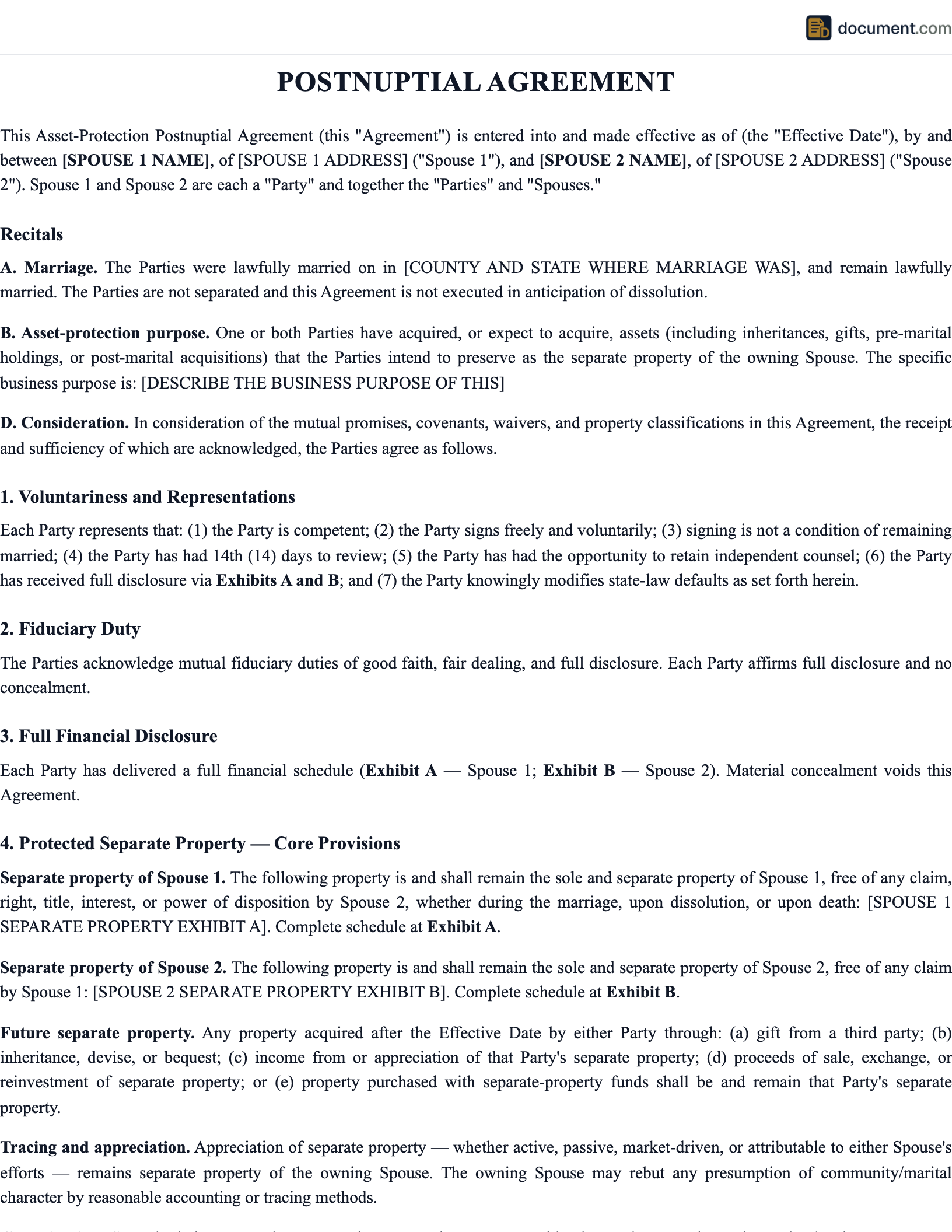
Below is a preview of our Connecticut-specific postnuptial agreement template. Your customized document will include all provisions required for enforceability under Connecticut law.
STATE OF CONNECTICUT
POSTNUPTIAL AGREEMENT
Marital Agreement Under Connecticut Law
SPOUSE 1:
Name: [Full Legal Name]
Address: [Connecticut Address]
Attorney: [Attorney Name]
SPOUSE 2:
Name: [Full Legal Name]
Address: [Connecticut Address]
Attorney: [Attorney Name]
AGREEMENT TERMS
Date of Marriage: [Date]
Separate Property Schedules: [Attached as Exhibits A & B]
Spousal Support Terms: [As Defined in Article III]
Governing Law: State of Connecticut
Connecticut Postnuptial Agreement FAQ
Answers to common questions about postnuptial agreements in Connecticut, including enforceability, legal requirements, and state-specific rules.
Official Connecticut Resources
Use these official resources for additional information about Connecticut family law, postnuptial agreement requirements, and finding a qualified attorney.
Connecticut Bar Association
Find a family law attorney and legal resources
Connecticut General Statutes Title 46b — Family Law
Official state statutes governing family law
American Academy of Matrimonial Lawyers
Find a certified family law specialist in Connecticut
ABA Section of Family Law
American Bar Association family law resources
Related Connecticut Documents
Depending on your situation, you may need additional family law documents to complement your Connecticut postnuptial agreement.
Connecticut Prenuptial Agreement
Financial agreement for couples planning to marry
Connecticut Separation Agreement
Divide assets and debts during legal separation
Connecticut Divorce Forms
State-specific divorce petition and filing documents
Connecticut Estate Planning
Wills, trusts, and estate documents to coordinate with your postnup
Create your Connecticut Postnuptial Agreement in under 5 minutes.
Answer a few questions and download a Connecticut-compliant document, ready for the state agency.