



Pennsylvania Prenuptial Agreement Overview
Pennsylvania has not adopted the UPAA or UPMAA but recognizes prenuptial agreements under its own statutory and common law framework. Pennsylvania courts evaluate prenuptial agreements based on traditional contract law principles combined with family law considerations. The agreement must be in writing, signed by both parties, supported by full financial disclosure, and free from fraud, duress, or undue influence.
Pennsylvania is an equitable distribution state, meaning that without a prenup, marital property is divided by the court in a manner it considers fair and equitable — but not necessarily equal. Pennsylvania courts consider various factors including the length of the marriage, each spouse's contributions and earning capacity, and the economic circumstances of each party. A prenup removes this uncertainty by allowing couples to define their own terms for property division.
Prenuptial agreements are an increasingly common financial planning tool for Pennsylvania couples at all income levels. Whether you are protecting a family business, safeguarding an inheritance, clarifying responsibility for student loan debt, or simply establishing clear financial expectations, a properly drafted Pennsylvania prenup provides certainty that state default laws cannot. Working with a Pennsylvania family law attorney who is experienced in prenuptial agreements is the best way to ensure your agreement meets all state requirements.
No (common law)
Uniform Act adopted
No (equitable distribution)
Community property
No (but recommended)
Independent counsel
No (but recommended)
Notarization required
Pennsylvania Prenuptial Agreement Legal Requirements
To create a valid and enforceable prenuptial agreement in Pennsylvania, you must meet the following legal requirements established by state law:
Important: Pennsylvania Execution Requirements
Pennsylvania requires that prenuptial agreements be in writing and signed by both parties. The agreement becomes effective upon marriage. Both parties should provide complete financial disclosure and have adequate time to review the agreement before signing. Working with independent Pennsylvania family law attorneys is strongly recommended for both parties.
Formal Requirements
- Written Agreement: Pennsylvania requires the prenuptial agreement to be in writing — oral prenuptial agreements are not enforceable
- Both Parties Must Sign: The agreement must be signed by both prospective spouses to be valid
- Voluntary Execution: Both parties must sign voluntarily without duress, coercion, or undue influence
- Full Financial Disclosure: Both parties must provide complete and accurate disclosure of all assets, debts, income, and financial obligations
- Not Unconscionable: The agreement must not be so one-sided as to be unconscionable under Pennsylvania law
What Can Be Addressed
- Rights and obligations in property owned by either or both parties
- Disposition of property upon separation, divorce, or death
- Spousal support (alimony) terms, modifications, or waivers
- Life insurance, estate planning, and inheritance provisions
- Any other matter not in violation of Pennsylvania public policy or criminal law
Pennsylvania Prenup Enforceability Rules
Pennsylvania applies its own statutory and common law standards for prenup enforcement. Courts typically require that the agreement was executed voluntarily, that both parties made full financial disclosure, and that the terms are not unconscionable. Pennsylvania courts evaluate these factors based on the totality of circumstances, including whether both parties had legal counsel, the time available for review, and the relative bargaining positions of the parties.
Spousal Support Waiver
Permitted — Pennsylvania courts allow spousal support waivers in prenuptial agreements, subject to unconscionability review
Sunset Clause Recognition
Recognized — Pennsylvania courts will enforce clearly written sunset clauses that were voluntarily agreed upon by both parties
Unconscionability Standard
Evaluated at the time of execution — Pennsylvania courts examine whether the agreement was fundamentally unfair when signed, considering the adequacy of disclosure and the bargaining positions of the parties
Pennsylvania Prenuptial Agreement Costs
The cost of creating a prenuptial agreement in Pennsylvania depends on the complexity of your financial situation and whether you hire attorneys. Here is a breakdown of typical costs:
| Fee / Cost | Amount |
|---|---|
| Attorney Fees (per party) | $2,500 - $10,000 |
| Notarization Fee | $5 - $10 |
| Court Filing Fee | N/A (not filed with court) |
| Online Template Service | $0 - $500 |
| Financial Advisor Consultation | $200 - $500 per hour |
| Business Valuation (if needed) | $3,000 - $15,000+ |
Sample Pennsylvania Prenuptial Agreement
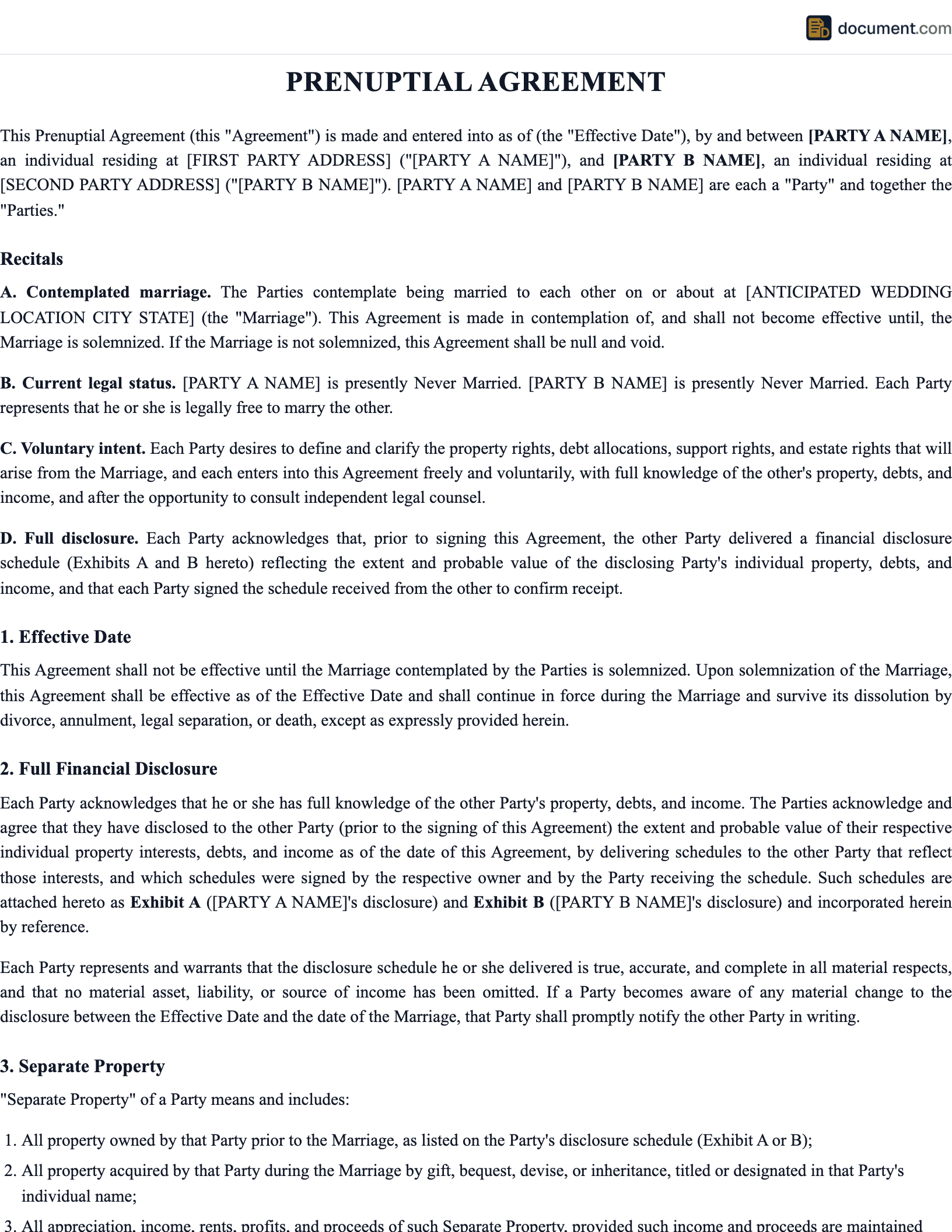
Below is a preview of our Pennsylvania-specific prenuptial agreement template. Your customized document will include all provisions required for enforceability under Pennsylvania law.
STATE OF PENNSYLVANIA
PRENUPTIAL AGREEMENT
Premarital Agreement Under Pennsylvania Law
PARTY 1:
Name: [Full Legal Name]
Address: [Pennsylvania Address]
Attorney: [Attorney Name]
PARTY 2:
Name: [Full Legal Name]
Address: [Pennsylvania Address]
Attorney: [Attorney Name]
AGREEMENT TERMS
Planned Wedding Date: [Date]
Separate Property Schedules: [Attached as Exhibits A & B]
Spousal Support Terms: [As Defined in Article III]
Governing Law: State of Pennsylvania
Pennsylvania Prenuptial Agreement FAQ
Answers to common questions about prenuptial agreements in Pennsylvania, including enforceability, legal requirements, and state-specific rules.
Official Pennsylvania Resources
Use these official resources for additional information about Pennsylvania family law, prenuptial agreement requirements, and finding a qualified attorney.
Pennsylvania Bar Association
Find a family law attorney, legal resources
Pennsylvania Consolidated Statutes Title 23 Chapter 36 — Prenuptial Agreements
Official state statutes governing prenuptial agreements
Uniform Law Commission — UPAA/UPMAA
Official text of the Uniform Premarital Agreement Act
American Academy of Matrimonial Lawyers
Find a certified family law specialist in Pennsylvania
Related Pennsylvania Documents
Depending on your situation, you may need additional family law documents to complement your Pennsylvania prenuptial agreement.
Pennsylvania Postnuptial Agreement
Financial agreement for couples already married
Pennsylvania Divorce Forms
State-specific divorce petition and filing documents
Pennsylvania Separation Agreement
Divide assets and debts during legal separation
Pennsylvania Estate Planning
Wills, trusts, and estate documents to coordinate with your prenup
Create your Pennsylvania Prenuptial Agreement in under 5 minutes.
Answer a few questions and download a Pennsylvania-compliant document, ready for the state agency.