



What Is a Notary Acknowledgment?
A notary acknowledgment is a formal certificate completed by a notary public confirming that a signer personally appeared before the notary, was positively identified through government-issued identification or personal knowledge, and acknowledged that they signed the document voluntarily and for the purposes stated therein. The acknowledgment certificate is attached to or placed on the document being notarized and includes the notary's signature, official seal or stamp, and commission details. It is the most common type of notarial act performed in the United States, used millions of times daily across real estate transactions, legal proceedings, financial instruments, and business formations.
It is critically important to understand what a notary acknowledgment does not do. The notary does not verify, certify, or attest to the accuracy or truthfulness of the content of the document. The notary does not provide legal advice, determine the legality of the transaction, or guarantee that the document will be accepted for recording or filing. The notary's sole function in an acknowledgment is to confirm the identity of the signer and that the signature was made willingly. This limited but essential role serves as a critical safeguard against fraud, forgery, and coercion in important legal and financial transactions.
A notary acknowledgment is not the same as a jurat or verification on oath. With an acknowledgment, the signer does not need to sign the document in the notary's presence — they may sign beforehand and then appear before the notary to acknowledge that the signature is theirs and was made voluntarily. With a jurat, by contrast, the signer must sign the document in front of the notary and must swear or affirm under oath that the contents of the document are true. This distinction is legally significant, and using the wrong type of notarial certificate can render a document invalid or unrecordable.
Notary acknowledgments are required for a wide range of important documents, including real estate deeds (quitclaim deeds, warranty deeds, grant deeds, trust deeds), powers of attorney (durable, financial, healthcare, springing), trust instruments (revocable living trusts, irrevocable trusts, trust amendments), mortgage documents, contracts for the sale of real property, business formation documents (articles of incorporation, operating agreements), and many others. Recording offices, courts, and financial institutions routinely reject documents that lack proper notarial acknowledgment.
Each state prescribes its own statutory wording for the notary acknowledgment certificate. While many states have adopted similar language — particularly those that have enacted the Revised Uniform Law on Notarial Acts (RULONA) — there are meaningful differences in required phrases, formatting, and specific elements. Using the correct state-specific acknowledgment wording is essential, especially for documents that will be recorded with a county recorder or clerk. A document with an acknowledgment form from the wrong state or with non-compliant wording may be rejected for recording, requiring the signer to appear before a notary again.
Identity Verification
Notary confirms the signer is who they claim to be through valid government-issued ID
Voluntary Signing
Signer acknowledges the signature was made willingly and without duress or coercion
Official Certification
Notary affixes official seal and signature as an impartial government-commissioned witness
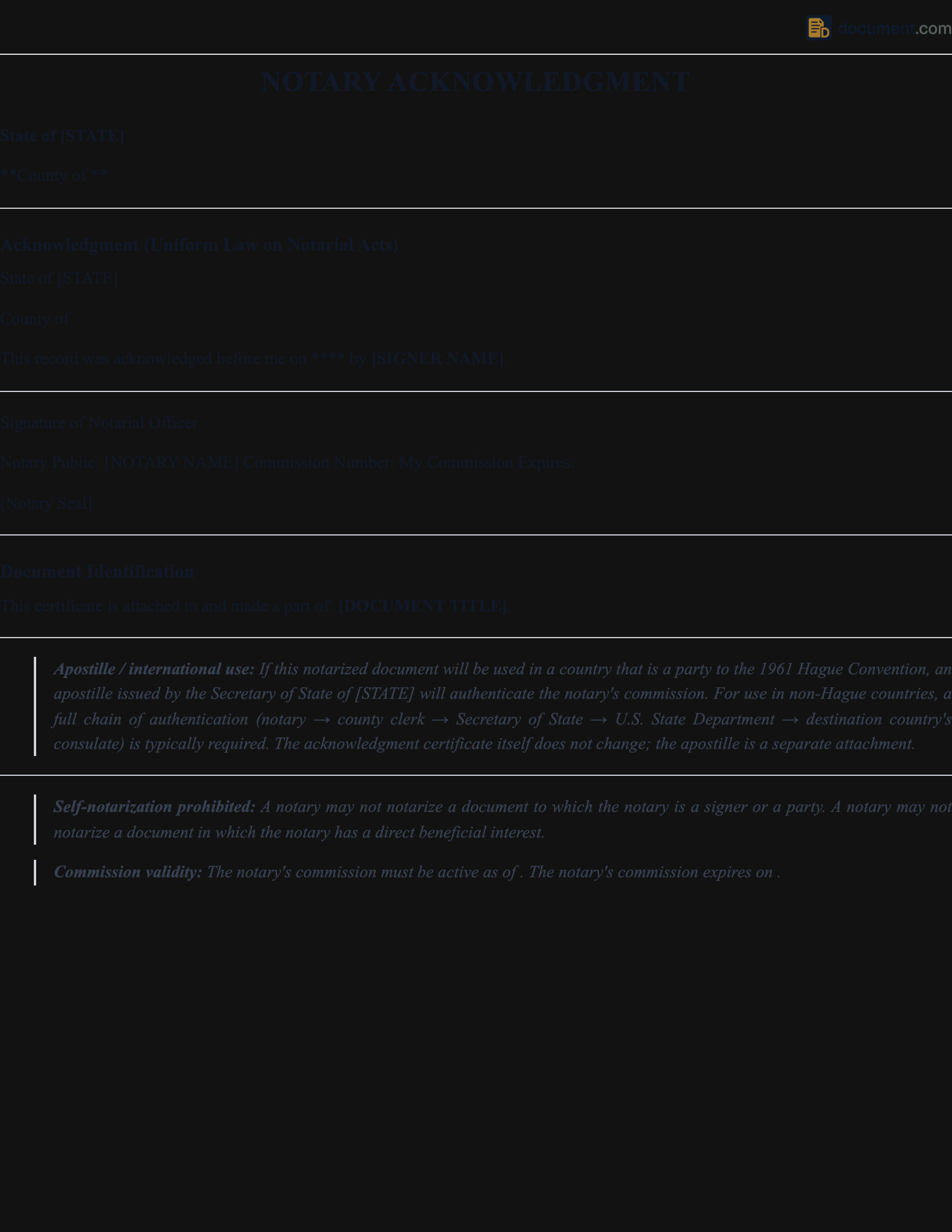
Notary Acknowledgment Form Preview
Below is a visual preview of a standard notary acknowledgment certificate. Your customized form will include your state's exact statutory wording, proper venue formatting, and all required notarial elements.
NOTARY ACKNOWLEDGMENT CERTIFICATE
Individual Acknowledgment
VENUE
State of [State]
County of [County]
ACKNOWLEDGMENT
On this [Date] day of [Month], [Year], before me, [Notary Name], a Notary Public, personally appeared [Signer Name], proved to me on the basis of satisfactory evidence to be the person(s) whose name(s) is/are subscribed to the within instrument and acknowledged to me that he/she/they executed the same in his/her/their authorized capacity(ies), and that by his/her/their signature(s) on the instrument the person(s), or the entity upon behalf of which the person(s) acted, executed the instrument.
NOTARY INFORMATION
Notary Public: [Printed Name]
Commission Number: [Number]
My Commission Expires: [Date]
SEAL / STAMP & SIGNATURE
Signature:
SEAL
When Is a Notary Acknowledgment Required?
Notary acknowledgments are required whenever a document must be authenticated by a neutral third party to verify the signer's identity and willingness. Below are the most common scenarios where a notary acknowledgment is legally required or strongly recommended.
Real Estate Deeds
All types of real estate deeds — quitclaim deeds, warranty deeds, grant deeds, special warranty deeds, and trust deeds — must include a notary acknowledgment before they can be recorded with the county recorder. The acknowledgment confirms that the grantor (person transferring the property) appeared before the notary and signed the deed voluntarily. Without proper notarization, a deed will be rejected for recording and the property transfer is not complete for purposes of public notice.
Powers of Attorney
Most states require powers of attorney to be notarized with an acknowledgment, particularly durable powers of attorney, financial powers of attorney, and healthcare powers of attorney. Because a power of attorney grants significant authority to another person, the notary acknowledgment provides an important safeguard that the principal (person granting power) is acting voluntarily and was properly identified. Many financial institutions will refuse to honor a power of attorney that lacks proper notarization.
Trust Documents
Revocable living trusts, irrevocable trusts, trust amendments, and trust restatements typically require notarized acknowledgments. While some states do not strictly require trust documents to be notarized, it is strongly recommended as a best practice. Trust certifications and abstracts of trust that are presented to financial institutions and title companies almost always must be notarized. Property transfers into or out of a trust also require notarized deeds.
Mortgage Documents
Mortgage documents, deeds of trust, mortgage modifications, mortgage satisfactions, and reconveyance deeds all require notary acknowledgments. Lenders require notarized acknowledgments on mortgage documents to ensure the borrower was properly identified and signed voluntarily. The mortgage or deed of trust must be recorded with the county recorder, which requires proper notarization. Mortgage closings often involve a notary who oversees the signing of the entire loan package.
Vehicle Title Transfers
Some states require notary acknowledgments for vehicle title transfers, particularly when the title is being assigned from one owner to another. States like Pennsylvania, Louisiana, and West Virginia require notarized title transfers. Even in states where it is not strictly required, a notarized title provides stronger legal protection against fraud and disputes about the transfer. The DMV or motor vehicle agency may reject an improperly notarized title.
Business Formation Documents
Articles of incorporation, articles of organization, operating agreements, partnership agreements, and other business formation documents may require notarized acknowledgments depending on the state. Some states require notarization for filing business documents with the Secretary of State. Even when not required, notarization is recommended for important business documents to provide evidence of authenticity and voluntary execution.
Affidavits and Sworn Statements
While affidavits technically require a jurat (not an acknowledgment), they are often loosely grouped under "notarized documents." Affidavits of heirship, affidavits of identity, affidavits of survivorship, and other sworn statements require the signer to sign in the notary's presence and take an oath or affirmation. Some documents that appear to require an acknowledgment may actually need a jurat if they contain a statement of facts sworn to be true — always check the document's notarial certificate requirements.
International Documents (Apostille)
Documents intended for use in foreign countries that are members of the Hague Apostille Convention must typically be notarized with an acknowledgment before they can receive an apostille certification. The apostille, issued by the state's Secretary of State, authenticates the notary's signature and seal for international recognition. Common documents requiring apostilles include powers of attorney for foreign property, international adoption documents, and business documents for overseas use.
Notary Acknowledgment vs Jurat
Understanding the difference between an acknowledgment and a jurat is one of the most important aspects of notarization. Using the wrong type of notarial certificate can invalidate a document or cause it to be rejected for recording or filing.
Key Differences
| Feature | Acknowledgment | Jurat (Verification) |
|---|---|---|
| Signing Location | Signer may sign before appearing before the notary | Signer must sign in the notary's presence |
| Oath Required | No oath or affirmation required | Signer must swear or affirm contents are true |
| Content Verification | Notary does NOT verify document content | Signer swears to truthfulness of content |
| Identity Check | Yes — notary verifies signer's identity | Yes — notary verifies signer's identity |
| Typical Certificate Language | "...acknowledged to me that he/she executed the same..." | "...subscribed and sworn to before me..." |
| Common Documents | Deeds, powers of attorney, trusts, mortgages, contracts | Affidavits, depositions, sworn declarations, interrogatories |
When to Use an Acknowledgment
- Real estate deeds and conveyances
- Powers of attorney (all types)
- Trust documents and amendments
- Mortgages and deeds of trust
- Business formation documents
- Contracts and agreements
When to Use a Jurat
- Affidavits of any kind
- Depositions and interrogatories
- Sworn declarations and statements
- Financial disclosure statements
- Verified pleadings
- Insurance claim statements
Notary Acknowledgment vs Other Notarial Acts
Notaries public perform several different types of notarial acts, each serving a distinct purpose. Understanding the differences helps ensure you request the correct type of notarization for your document.
Acknowledgment vs Jurat (Verification on Oath or Affirmation)
As detailed above, the primary differences are that a jurat requires the signer to sign in the notary's presence and to swear or affirm that the document's contents are true. An acknowledgment requires neither. Jurats are used for affidavits and sworn statements. Acknowledgments are used for deeds, powers of attorney, and other instruments where identity verification (not truth of content) is the goal.
Acknowledgment vs Copy Certification
A copy certification is a notarial act where the notary certifies that a photocopy of an original document is a true, complete, and accurate reproduction. The notary compares the copy to the original and certifies their match. This is commonly used for diplomas, passports (where permitted), and business records. Unlike an acknowledgment, no signer appears before the notary — the notary is certifying the accuracy of a copy, not a person's identity or signature. Note that many states prohibit notaries from certifying copies of certain public records like birth certificates, which must be obtained from the issuing authority.
Acknowledgment vs Oath / Affirmation
An oath or affirmation is a stand-alone notarial act where a person swears or affirms to the truthfulness of a verbal statement, not a written document. This is commonly administered for witnesses in court proceedings, elected officials taking office, or individuals making verbal promises under penalty of perjury. An acknowledgment, by contrast, always involves a written document and never involves an oath regarding the truth of the document's content.
Acknowledgment vs Signature Witnessing
A signature witnessing is a notarial act where the notary watches a person sign a document and verifies the signer's identity. Unlike an acknowledgment, the signer does not acknowledge any particular intent or purpose — the notary simply confirms they witnessed the signature being made by the identified individual. Signature witnessing is less common than acknowledgments and jurats but may be used for certain commercial and legal documents where the primary need is proof that a specific person signed at a specific time and place.
How to Get a Document Notarized
Getting a document notarized with a proper acknowledgment is a straightforward process, but there are specific steps to follow to ensure the notarization is valid and accepted. Follow these eight steps for a smooth notarization experience.
Find a Notary Public
Locate a commissioned notary public in your area. Common places to find notaries include banks and credit unions (many offer free notary services to account holders), UPS stores, FedEx offices, law firms, real estate offices, insurance agencies, and AAA offices. You can also search the National Notary Association's directory or your state's Secretary of State website. If you cannot visit a notary in person, check if your state allows remote online notarization (RON).
Bring Valid Government-Issued Identification
The notary must verify your identity, so bring a current (non-expired) government-issued photo ID. Accepted IDs in most states include a state driver's license, state-issued ID card, U.S. passport or passport card, or U.S. military ID. Some states also accept foreign passports and permanent resident cards. It is best to contact the notary in advance to confirm which IDs they accept, as requirements vary by state. If your ID is expired, damaged, or the photo no longer resembles you, bring an alternative form of identification.
Appear in Person Before the Notary
You must personally appear before the notary public. For a traditional in-person notarization, this means physically being present in the same room as the notary. For remote online notarization (RON), this means appearing via a secure audio-video connection on an approved RON platform. The notary cannot notarize a document based on a phone call, email, or text message. Each signer whose signature is being notarized must appear separately.
Present the Document to the Notary
Give the complete document to the notary for review. The notary will check that the document is complete (not blank), that it contains a notarial certificate (acknowledgment form), and that the name on the document matches the name on your identification. If the document does not already have an acknowledgment certificate, the notary can typically attach a separate acknowledgment form (called a "loose certificate") using the correct form for your state.
Acknowledge Your Signature
For an acknowledgment, you need to verbally acknowledge to the notary that you signed the document voluntarily and for the purposes stated. If you have already signed the document, you confirm that the signature is yours and was made willingly. If you have not yet signed, you may sign at this time in the notary's presence (though this is not required for an acknowledgment). The notary may ask you: "Do you acknowledge that you signed this document voluntarily?"
Notary Completes the Certificate
The notary will complete the acknowledgment certificate by filling in the date, venue (state and county), the signer's name, and whether identification was based on personal knowledge or satisfactory evidence (ID). The notary will also enter their own name, commission number, and commission expiration date on the certificate. The notary should carefully verify that all information is correct before completing the certificate.
Notary Affixes Official Seal or Stamp
The notary will affix their official seal or stamp to the acknowledgment certificate. Most states require the seal to include the notary's name, the words "Notary Public," the state of commission, the commission number, and the commission expiration date. The seal may be an ink stamp (most common and recommended because it is photographically reproducible) or an embossed seal. Some states require both an ink stamp and an embossed seal. The notary will also sign the certificate.
Notary Records the Act in Their Journal
In many states, the notary is required to record the notarial act in their official journal or log. Journal entries typically include the date and time, type of notarial act, type of document, signer's name and address, identification method used, and the fee charged. States that mandate journals include California, Arizona, Colorado, Hawaii, Maryland, Mississippi, Missouri, Montana, Nevada, Oregon, Texas, and Washington. Even in states where journals are not mandatory, many notaries keep them as a best practice and for liability protection.
Key Components of a Notary Acknowledgment
A valid notary acknowledgment certificate must include specific elements to be legally effective and accepted by recording offices, courts, and financial institutions. While requirements vary by state, the following components are standard.
| Component | Description |
|---|---|
| State (Venue) | The state where the notarization takes place — not necessarily where the document will be used |
| County (Venue) | The county where the notarization takes place, forming the complete "venue" with the state |
| Date of Notarization | The exact date the signer appeared before the notary — must be the actual date of appearance |
| Signer's Name | Full legal name of the person who appeared before the notary, matching their identification |
| Identification Type | How the notary verified identity: satisfactory evidence (government ID) or personal knowledge |
| Personally Known vs ID Verified | Some states require noting whether the signer was personally known to the notary or identified via ID |
| Acknowledgment Statement | State-specific statutory language confirming the signer acknowledged signing voluntarily |
| Notary's Name | Full legal name of the notary public as it appears on their commission |
| Commission Number | The notary's unique commission number assigned by the state commissioning authority |
| Commission Expiration | Date the notary's commission expires — must be after the date of notarization |
| Notary Seal / Stamp | Official ink stamp or embossed seal containing notary's name, state, commission info |
| Notary Signature | The notary's official signature exactly as it appears on their commission |
Remote Online Notarization (RON)
Remote online notarization (RON) allows signers to appear before a notary public via secure audio-video technology rather than in person. The notary verifies the signer's identity through knowledge-based authentication (KBA) questions, credential analysis of a government-issued ID, and live video interaction. The document is signed electronically, and the notary applies a digital notary seal. The entire session is recorded and stored for compliance purposes.
RON gained significant traction during the COVID-19 pandemic when many states issued emergency executive orders allowing remote notarization to enable real estate closings, legal transactions, and business operations to continue during lockdowns and social distancing requirements. The vast majority of states that adopted emergency RON provisions have since enacted permanent RON legislation. As of 2025, approximately 45 states have enacted permanent RON laws, with the remaining states actively considering legislation.
RON platforms must meet specific state requirements for technology, security, and record-keeping. Most states require RON platforms to use multi-factor identity verification including knowledge-based authentication (where the signer answers questions based on their credit and public records), credential analysis (where the signer's ID is examined for authenticity), and live video confirmation (where the notary visually compares the signer to their ID). The audio-video session must be recorded and the recording stored for a state-specified period, typically 5-10 years.
Notary fees for RON are typically higher than in-person notarization. Many states set separate fee schedules for remote notarization, often in the $25 range per notarial act compared to $2-$15 for in-person. Some RON platforms also charge technology fees. Despite the higher cost, RON offers significant convenience for signers who cannot easily travel to a notary, are located in different states from the notary, or need notarization outside of business hours.
States with Permanent RON Laws (as of 2025)
Alabama, Alaska, Arizona, Arkansas, Colorado, Connecticut, Delaware, Florida, Georgia, Hawaii, Idaho, Illinois, Indiana, Iowa, Kansas, Kentucky, Louisiana, Maine, Maryland, Michigan, Minnesota, Mississippi, Missouri, Montana, Nebraska, Nevada, New Hampshire, New Jersey, New Mexico, New York, North Carolina, North Dakota, Ohio, Oklahoma, Oregon, Pennsylvania, Rhode Island, South Dakota, Tennessee, Texas, Utah, Vermont, Virginia, Washington, West Virginia, Wisconsin, and Wyoming. States without permanent RON laws may still allow it under emergency orders or temporary provisions. Check your state's current status with the Secretary of State.
Legal Requirements for Notary Acknowledgments
Notary acknowledgments must meet specific legal requirements to be valid and accepted. These requirements are established by state law, and failure to comply can result in a defective notarization that renders the document unrecordable or legally challenged.
Revised Uniform Law on Notarial Acts (RULONA)
The Revised Uniform Law on Notarial Acts (RULONA), drafted by the Uniform Law Commission, provides a standardized framework for notarial acts across states. Many states have adopted RULONA in whole or in part, which has helped standardize acknowledgment requirements. However, each state retains the authority to set its own specific requirements, and variations remain significant. Always use the acknowledgment form prescribed by the state where the document will be recorded.
Notary Commission Requirements
To perform an acknowledgment, a notary must hold a valid, active commission in their state. Commission requirements vary but typically include being at least 18 years old (some states require 21), being a legal resident of the commissioning state, passing a background check, completing a notary education course (required in about 14 states including California, Colorado, Connecticut, and New York), passing an exam (required in some states), obtaining a notary bond (required in most states, typically $5,000-$25,000), and filing an oath of office with the state.
Notary Bond Requirements
Most states require notaries to obtain a surety bond as a condition of their commission. The bond protects the public from financial harm caused by a notary's errors or misconduct. Bond amounts range from $5,000 to $25,000 depending on the state. The bond is not insurance for the notary — it is a financial guarantee for the public. If a claim is paid on a notary's bond, the bonding company will seek reimbursement from the notary. Some states also require or recommend errors and omissions (E&O) insurance, which does protect the notary.
Journal Requirements
Several states mandate that notaries maintain a journal of all notarial acts performed. Mandatory journal states include California, Arizona, Colorado, Hawaii, Maryland, Mississippi, Missouri, Montana, Nevada, Oregon, Texas, and Washington. The journal serves as an independent record that can verify the notarization took place and the signer's identity was verified. Even in states without mandatory journal requirements, maintaining a journal is strongly recommended by the National Notary Association as a best practice.
Exam Requirements
Some states require notary applicants to pass an exam before receiving their commission. States that require notary exams include California, Colorado, Connecticut, the District of Columbia, Hawaii, Louisiana, Maine, Montana, North Carolina, New York, Ohio, Oregon, Pennsylvania, and Utah. The exam typically covers notary laws and procedures, types of notarial acts, identification requirements, certificate completion, and recordkeeping. Exam formats vary from written tests to online assessments.
Notary Acknowledgment by State
Each state has different statutory wording for notary acknowledgment certificates, along with different notary fees, commission terms, bond requirements, and journal mandates. Select your state below for the exact acknowledgment wording and notary requirements specific to your jurisdiction.
Sample Notary Acknowledgment Certificate
Below is a preview of a standard notary acknowledgment certificate. Your customized certificate will include your state's exact statutory wording, proper formatting, and all required notarial elements.
CERTIFICATE OF ACKNOWLEDGMENT
Individual Acknowledgment — Standard Form
State of ______________
County of ______________
On this _____ day of _______________, 20_____, before me, _______________________________, a Notary Public in and for said state, personally appeared _______________________________, proved to me on the basis of satisfactory evidence to be the person(s) whose name(s) is/are subscribed to the within instrument and acknowledged to me that he/she/they executed the same in his/her/their authorized capacity(ies), and that by his/her/their signature(s) on the instrument the person(s), or the entity upon behalf of which the person(s) acted, executed the instrument.
WITNESS my hand and official seal.
Signature: _________________________________
Printed Name: ______________________________
Commission No.: ____________________________
My Commission Expires: _____________________
NOTARY
SEAL
Frequently Asked Questions
Find answers to common questions about notary acknowledgments, the notarization process, state-specific requirements, and the differences between types of notarial acts.
Official Resources
Use these trusted resources for additional information about notary acknowledgments, notary commissions, and notarization requirements by state.
National Notary Association (NNA)
Find a notary, notarization requirements by state, notary education
American Society of Notaries
Notary resources, supplies, education, and legislative updates
RULONA — Uniform Law Commission
Revised Uniform Law on Notarial Acts — model legislation
State Secretary of State Notary Divisions
Notary commission information, laws, and forms by state
CFPB — Consumer Financial Resources
Mortgage closing, real estate, and consumer protection guides
Hague Apostille Convention
International document authentication and apostille information
Related Legal Documents
Documents that commonly require notary acknowledgments or are used alongside acknowledgment certificates.
Jurat / Verification on Oath
Notarial certificate for sworn statements and affidavits
Affidavit
Sworn written statement requiring notarized jurat
Power of Attorney
Legal authorization requiring notarized acknowledgment
Quitclaim Deed
Property transfer deed requiring notarized acknowledgment
Living Trust
Estate planning document often requiring notarized acknowledgment
Warranty Deed
Full warranty property deed requiring notarized acknowledgment
Create your Notary Acknowledgment in under 10 minutes.
Answer a few questions and download a compliant, attorney-drafted document ready for your state.