



Georgia Notary Acknowledgment Overview
The Georgia Superior Court Clerks’ Cooperative Authority publishes separate examples for individual acknowledgments, representative acknowledgments and jurats. An acknowledgment records the signer’s acknowledgment in the notary’s presence; a jurat requires signing and an oath or affirmation. The examples identify the actual signer and actual representative capacity. They do not establish that the underlying document satisfies every execution or recording requirement.
Use the actual date and location of the notarial act. The notary completes and signs the certificate during the act. Whether a deed, power of attorney, trust or other instrument also needs witnesses or additional formalities depends on its governing law.
$2 / act
Notarial maximum
4 years
Commission term
In person
Remote process
Self-filer acts
Mandatory journal category
*See the requirements and fees below for exceptions and applicable categories.
Georgia Acknowledgment and Jurat Wording
GSCCCA certificate examples provides the source rules for these in-person examples. Use the appropriate certificate for the actual capacity, record the actual capacity and represented party, and confirm the document’s execution requirements. The published examples use personal knowledge or government-issued photo identification under O.C.G.A. 45-17-8(e). Complete only the identification alternative actually used. A credible-witness oath alone is not the ordinary Georgia identification procedure.
Individual Acknowledgment
State of Georgia
County of ____________________
Acknowledged in my presence on ____________________ [date] by ____________________ [signer]. The signer was ____________________ [personally known or identified by government-issued photo identification under O.C.G.A. 45-17-8(e)].
Signature of notarial officer: ____________________
Printed name: ____________________
Notary Public
My commission expires: ____________________
[Official Georgia notary seal, including county of appointment]
Representative Acknowledgment
State of Georgia
County of ____________________
Acknowledged in my presence on ____________________ [date] by ____________________ [signer], as ____________________ [actual capacity] on behalf of ____________________ [represented party]. The signer was ____________________ [actual permitted identification method].
Signature of notarial officer: ____________________
Printed name: ____________________
Notary Public
My commission expires: ____________________
[Official Georgia notary seal, including county of appointment]
Attorney-in-Fact Acknowledgment
State of Georgia
County of ____________________
Acknowledged in my presence on ____________________ [date] by ____________________ [agent], as attorney-in-fact on behalf of ____________________ [principal]. The signer was ____________________ [actual permitted identification method].
Signature of notarial officer: ____________________
Printed name: ____________________
Notary Public
My commission expires: ____________________
[Official Georgia notary seal, including county of appointment]
Verification on Oath or Affirmation (Jurat)
State of Georgia
County of ____________________
Signed and sworn to (or affirmed) in my presence on ____________________ [date] by ____________________ [signer]. The signer was ____________________ [actual permitted identification method].
Signature of notarial officer: ____________________
Printed name: ____________________
Notary Public
My commission expires: ____________________
[Official Georgia notary seal, including county of appointment]
Identify each person who actually appears. A jurat requires signing and an oath or affirmation; an acknowledgment serves a different purpose. Confirm the required act with the document recipient or a legal adviser.
Georgia Notary Requirements
Commission: The Clerk of Superior Court commissions Georgia notaries for four years. Apply in the county of residence. A resident of a neighboring state who carries on a business or is regularly employed in Georgia may use the applicable county-of-business or employment exception. A Georgia commission authorizes acts throughout Georgia.
Education: Since January 1, 2025, all new and renewal applicants must complete the approved educational course. Complete it before the initial appointment and within 30 days before a renewal appointment. Use the GSCCCA course and give the completion certificate to the commissioning clerk.
Bond: Georgia does not require a notary surety bond. The absence of a bond requirement does not remove the notary’s responsibility for proper identification and performance of the act.
Journal: Since January 1, 2025, a written or electronic journal is mandatory for each notarial act requested by a self-filer under O.C.G.A. 45-17-8(g). Record the information required by that provision, including the self-filer’s identifying and contact information, signature, the document type and the actual date, time and location. The statutory self-filer rule is not a claim that every ordinary notarization has the same mandatory journal requirement. Keep records securely and follow the applicable access requirements.
Each act requires the official seal containing the notary’s name, “Notary Public,” county of appointment and state. An ink stamp or embossed seal is permitted. Sign in ink in the exact commissioned name. The county of appointment on the seal can differ from the venue of the act. Georgia does not issue notary commission numbers.
Remote Notarization in Georgia
Georgia has no currently operative remote online notary program for its commissioned notaries in the sources reviewed on November 1, 2026. Arrange an in-person act. A proposed bill, electronic document or old emergency procedure does not by itself authorize remote appearance.
The 2025–2026 HB 289 history shows committee action, not enactment. The 2026 Governor’s signed-legislation list does not include that bill or SB 8. Check GSCCCA for any later implementation. For an out-of-state notary, the actual notarial jurisdiction and the document recipient’s requirements still apply.
Georgia Notary Fees
Disclose any notarial fee before performing the act. The permitted fee is a maximum, not a mandatory charge. Appointment fees differ by county.
| Service or requirement | Fee rule |
|---|---|
| Ordinary notarial act | $2 maximum per act |
| Clerk’s certificate of effective commission | Additional $2 when requested |
| New or renewal appointment | $40–$55; confirm the exact county fee |
Georgia Identification and Recordkeeping
For an ordinary act, identify the person through personal knowledge or government-issued photo identification under O.C.G.A. 45-17-8(e). The GSCCCA examples provide those alternatives. Do not certify that an identification method was used when it was not, and do not substitute an unsupported credible-witness or remote KBA procedure. A notary may refuse where identity, willingness or understanding is in doubt.
Since January 1, 2025, a written or electronic journal is mandatory for each notarial act requested by a self-filer under O.C.G.A. 45-17-8(g). Record the information required by that provision, including the self-filer’s identifying and contact information, signature, the document type and the actual date, time and location. The statutory self-filer rule is not a claim that every ordinary notarization has the same mandatory journal requirement. Keep records securely and follow the applicable access requirements.
Sample Georgia Acknowledgment Certificate
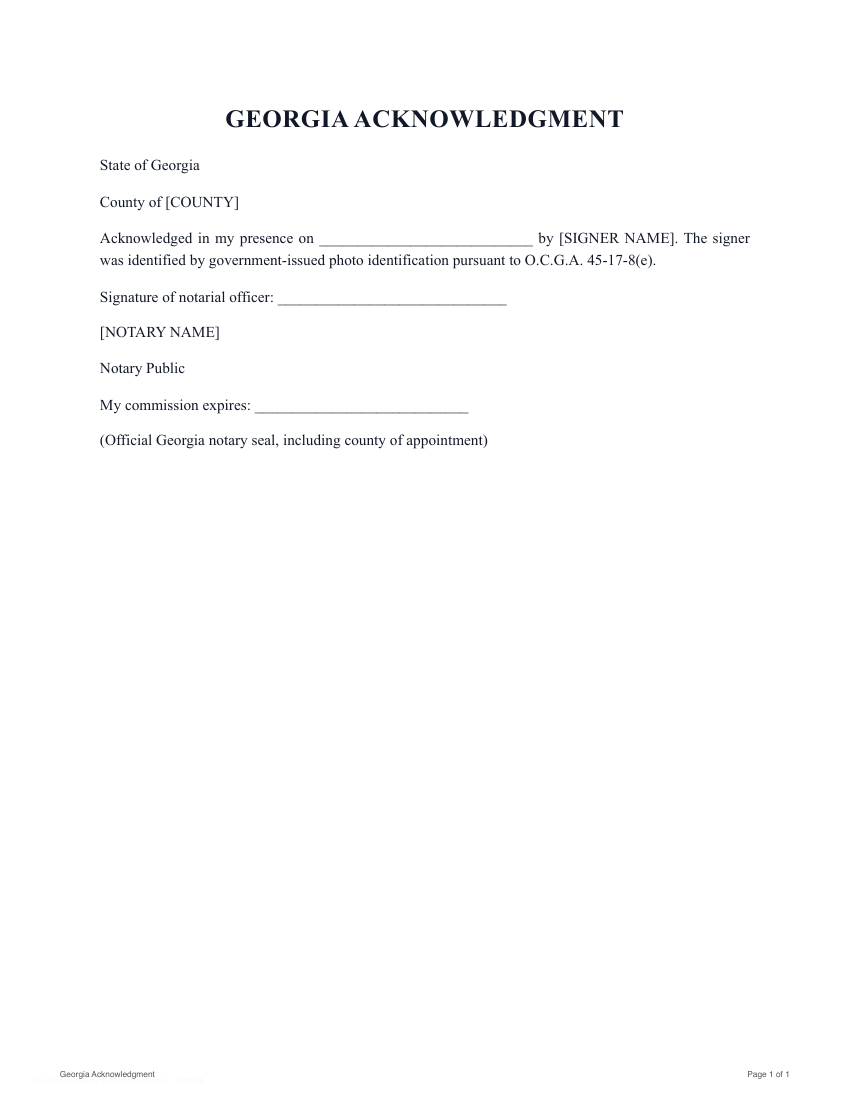
The in-person individual example below includes the acknowledgment recital. Leave the notary’s certification, signature and seal for the notary to complete during the act.
State of Georgia
County of ____________________
Acknowledged in my presence on ____________________ [date] by ____________________ [signer]. The signer was ____________________ [personally known or identified by government-issued photo identification under O.C.G.A. 45-17-8(e)].
Signature of notarial officer: ____________________
Printed name: ____________________
Notary Public
My commission expires: ____________________
[Official Georgia notary seal, including county of appointment]
Georgia Notary Acknowledgment FAQ
Answers to common questions about notary acknowledgments in Georgia, including wording requirements, fees, and notarization procedures.
Official Georgia Resources
Use these official resources to verify Georgia notary requirements, find a notary, and access state notary forms and information.
Related Georgia Documents
Documents commonly used alongside notary acknowledgments in Georgia, or that require GA notarization.
Georgia Jurat / Verification
Notarial certificate for sworn statements and affidavits
Georgia Affidavit
Sworn statement requiring notarized jurat
Georgia Power of Attorney
Execution requirements depend on the type of power of attorney
Georgia Quitclaim Deed
Property transfer deed requiring notarized acknowledgment
Create your Georgia Notary Acknowledgment in under 5 minutes.
Prepare a certificate for the notary to review and complete when performing the act.