


Colorado Notary Acknowledgment Overview
A Colorado acknowledgment confirms that the identified signer appeared and acknowledged signing the record for its stated purpose. Someone signing for another party also acknowledges proper authority and that the signature is the represented party’s act. C.R.S. 24-21-515 and 24-21-516 provide certificate requirements and sufficient short forms, without making those forms the only acceptable wording.
Choose the notarial act based on the underlying document and recipient’s requirements. An acknowledgment does not supply the oath or affirmation needed for a sworn verification and does not replace separate witnesses. Colorado does not require a notary bond. The notary verifies identity and willingness, performs the act and keeps the required record; the notary does not approve the document’s legal contents.
$15
Paper document limit
4 years
Commission term
Yes
RON allowed
Required
Journal
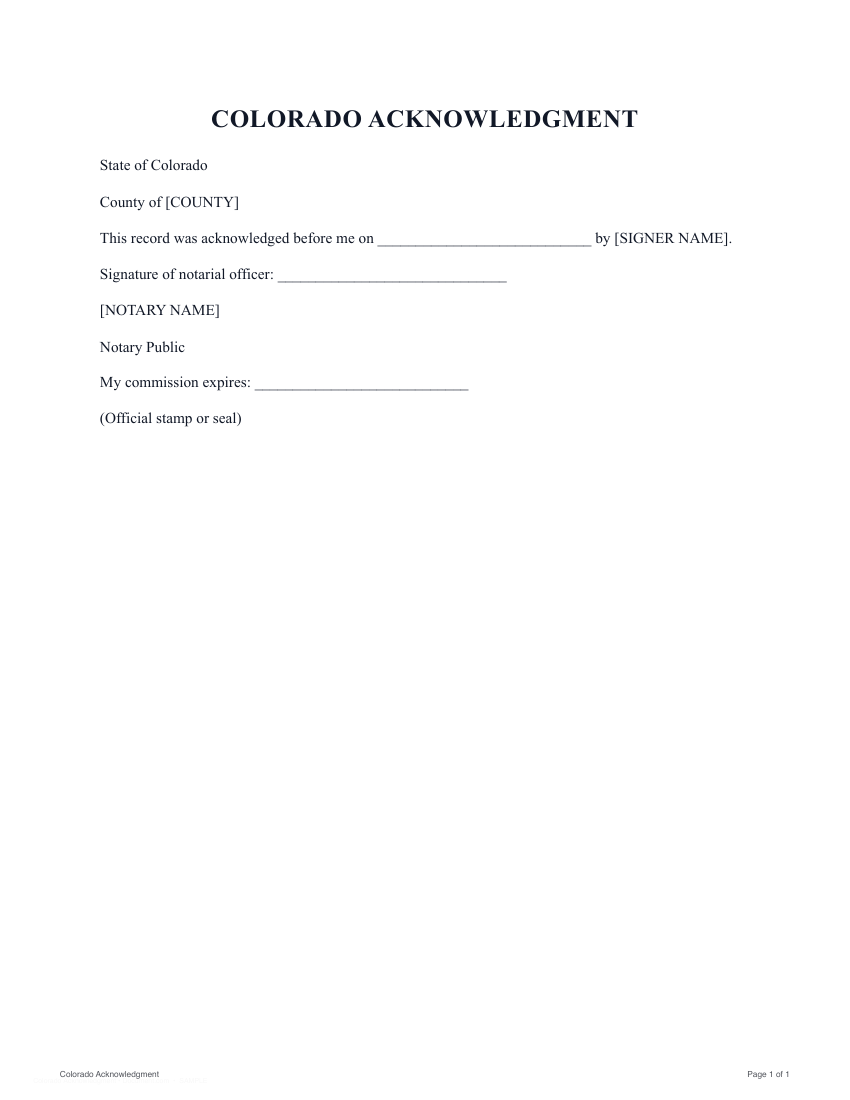
Colorado Acknowledgment Wording
These examples follow the individual and representative acknowledgments in C.R.S. 24-21-516. Complete the actual county and state, date, signer, officer’s signature and title, and official paper stamp. The stamp contains the commission expiration and notary identification number. Other sufficient wording is permitted under section 24-21-515.
Colorado Specific Note
Use the notary’s actual county and state. A paper certificate must be part of or securely attached to the record, and the notary cannot sign it before performing the act. Colorado prohibits a seal embosser. Electronic and remote notarizations have separate signature, technology and certificate requirements.
Individual Acknowledgment
County of _______________
This record was acknowledged before me on __________ [date] by __________ [name of individual].
___________________________
Signature of notarial officer
Title of office: Notary Public
My commission expires: _______________
[Official Colorado ink stamp]
Corporate / Representative Acknowledgment
County of _______________
This record was acknowledged before me on __________ [date] by __________ [name of individual] as __________ [type of authority] of __________ [party on whose behalf the record was executed].
___________________________
Signature of notarial officer
Title of office: Notary Public
My commission expires: _______________
[Official Colorado ink stamp]
Multiple Signers Acknowledgment
County of _______________
This record was acknowledged before me on __________ [date] by __________ and __________ [names of individuals].
___________________________
Signature of notarial officer
Title of office: Notary Public
My commission expires: _______________
[Official Colorado ink stamp]
Colorado Notary Requirements
Colorado requires a current commission and compliance with RULONA and the Notary Program Rules. The required stamp, journal format and technology approvals depend on how the act is performed.
- Commission Term: Colorado notary commissions are valid for 4 years from the date of issuance
- Bond: Colorado does not require a surety bond; a bond or insurance may be obtained voluntarily
- Exam: New applicants and renewals must complete approved training and pass the examination; remote notarization requires additional training and approval
- Journal: Record all acts contemporaneously and retain the journal ten years after its last entry. Remote acts require an electronic journal. Section 24-21-519(10)(c) has a limited employer-record alternative
- Seal/Stamp: A paper certificate requires a rectangular ink stamp with the commissioned name, notary ID, expiration, Notary Public and State of Colorado. Seal embossers are prohibited. Electronic certificates follow separate rules
- Fee limit: $15 per paper document attested by a person; alternatively up to $25 for the notary’s electronic signature
Remote Online Notarization in Colorado
Colorado remote notarization is limited to electronic records and requires an approved remote notary and approved provider. The notary must stay physically in Colorado, use the actual local venue and complete the act in a single real-time session while all participants view the same record. Identity may rest on personal knowledge or a sworn credible witness who knows the signer, is known to the notary and is physically with either the signer or notary. The documentary route requires remote presentation and credential analysis of government ID containing both signature and photograph, plus a permitted additional verification method under section 24-21-514.5(6).
Before recording, disclose the recording and where and how long it will be stored, and obtain the signer’s express consent to both recording and storage. Keep the required recording for ten years and the electronic journal for ten years after its last entry, subject to the narrow statutory employer-record alternative. Restart the entire process after a participant exits or the feed is interrupted. The certificate states that audio-video technology was used. A qualifying interpreter must be properly identified and free of a disqualifying interest; a remote certificate also names the interpreter and any credential or certification number.
A signer abroad must confirm the statutory U.S. connection, and the notary must have no actual knowledge of a foreign prohibition. Electoral records cannot use this process. Wills, codicils and related acknowledgments require the Colorado Uniform Electronic Wills Act exception. Official remote-notary guidance explains approval and recordkeeping. Prepare a Colorado remote acknowledgment certificate; the builder does not provide notarization.
Colorado Notary Fees
C.R.S. 24-21-529 allows up to $15 for each paper document attested by a person before the notary, including all functions needed to complete the act. The alternative electronic-signature limit is $25. Rule 2.4 requires disclosure of all charges before the act and written itemization before, at signing or immediately afterward, including a zero notarial fee when appropriate. A specific exception applies to covered title-company services. Separate services cannot be used to disguise fees for the required notarial work.
| Service | Fee |
|---|---|
| Paper acknowledgment (per document) | Up to $15 |
| Paper sworn verification (per document) | Up to $15 |
| Paper document attestation | Up to $15 |
| Mobile Notary Travel Fee | Separate services: disclose charges and provide written itemization |
| Remote Online Notarization | Up to $25 for the notary’s electronic signature |
Colorado Identification Requirements
Colorado’s ordinary credential rule allows documents that are current or expired not more than one year. Other government ID must have a signature or photograph and be satisfactory to the officer. Personal knowledge and a qualifying sworn credible witness are separate options. Remote documentary identification instead requires signature and photograph plus the additional verification described above.
Sample Colorado Acknowledgment Certificate
This in-person paper example illustrates the acknowledgment recital and notary information. The actual act must occur before the notary completes the certificate and applies the official ink stamp. An electronic or remote act needs its separate procedure and certificate information.
CERTIFICATE OF ACKNOWLEDGMENT
STATE OF COLORADO
Individual Acknowledgment
VENUE:
State of Colorado
County of [County]
ACKNOWLEDGMENT:
This record was acknowledged before me on [Date] by [Signer name].
NOTARY CERTIFICATION:
Notary Name: [Printed Name]
Commission #: [Number]
Commission Expires: [Date]
Signature:
Title of office: Notary Public
[Official Colorado stamp]
Colorado Notary Acknowledgment FAQ
Answers to common questions about notary acknowledgments in Colorado, including wording requirements, fees, and notarization procedures.
Official Colorado Resources
Use these official resources to verify Colorado notary requirements, find a notary, and access state notary forms and information.
Related Colorado Documents
Documents commonly used alongside notary acknowledgments in Colorado, or that require CO notarization.
Colorado Jurat / Verification
Notarial certificate for sworn statements and affidavits
Colorado Affidavit
Sworn statement requiring notarized jurat
Colorado Power of Attorney
Delegation of authority; check the document’s execution requirements
Colorado Quitclaim Deed
Property transfer deed requiring notarized acknowledgment
Create your Colorado Notary Acknowledgment in under 5 minutes.
Prepare a Colorado certificate for a notary to complete. Check the document’s execution requirements and the receiving office’s filing rules.