


Utah Notary Acknowledgment Overview
Utah Code § 46-1-6.5 supplies acknowledgment and jurat forms that identify the officiating notary in the recital. The acknowledgment confirms execution; a jurat also requires the signer to swear or affirm the truth of the document and sign before the notary. These examples are for traditional in-person acts in Utah. The notary must complete and sign the certificate and apply the official seal in purple ink.
Use the actual date and location of the notarial act. The notary completes and signs the certificate during the act. Whether a deed, power of attorney, trust or other instrument also needs witnesses or additional formalities depends on its governing law.
$10*
Ordinary acknowledgment / signature
4 years
Commission term
Authorized
Remote acts with conditions
Required*
Journal / records
*See the requirements and fees below for exceptions and applicable categories.
Utah Acknowledgment and Jurat Wording
Utah Code § 46-1-6.5 — official source provides these certificate forms. The representative example adds capacity and the represented party; Utah Code §§ 57-2a-2 and 57-2a-6 govern authority and recognition. Use personal-knowledge wording when that is the lawful identification method actually used. These examples cover in-person acts. Remote acts need additional certificate wording and procedures.
Individual Acknowledgment
State of Utah
County of ____________________
On ____________________ [date], before me, ____________________ [notary name], a notary public, personally appeared ____________________ [signer name], proved on the basis of satisfactory evidence to be the person whose name is subscribed to this document, and acknowledged that they executed the same.
Signature of notarial officer: ____________________
Printed name: ____________________
Notary Public
My commission expires: ____________________
[Official Utah notary seal in purple ink]
Representative Acknowledgment
State of Utah
County of ____________________
On ____________________ [date], before me, ____________________ [notary name], a notary public, personally appeared ____________________ [signer name], proved on the basis of satisfactory evidence to be the person whose name is subscribed to this document, and acknowledged that they executed the same by proper authority as ____________________ [capacity] on behalf of ____________________ [represented party] for the purposes stated in the document.
Signature of notarial officer: ____________________
Printed name: ____________________
Notary Public
My commission expires: ____________________
[Official Utah notary seal in purple ink]
Verification on Oath or Affirmation (Jurat)
State of Utah
County of ____________________
Subscribed and sworn to (or affirmed) before me, ____________________ [notary name], on ____________________ [date], by ____________________ [signer name].
Signature of notarial officer: ____________________
Printed name: ____________________
Notary Public
My commission expires: ____________________
[Official Utah notary seal in purple ink]
Identify each person who actually appears. A jurat requires signing and an oath or affirmation; an acknowledgment serves a different purpose. Confirm the required act with the document recipient or a legal adviser.
Utah Notary Requirements
Commission: A Utah commission lasts four years. The applicant must meet the qualifications, pass the examination and complete the criminal background check under § 46-1-3. Once a commission expires, the notary must obtain a new commission before acting again; reapplication is required rather than an automatic renewal.
Education: Each applicant must pass the approved notary examination. Study the current Notaries Public Reform Act and the Lieutenant Governor’s guidance, including the May 6, 2026 changes. A returning applicant must meet the new-commission requirements and pass the examination again.
Bond: Before the commission is effective, the notary must take the constitutional oath and file an approved $5,000 surety bond for the four-year term. A remote-notary certification requires an additional $5,000 of bond coverage, ending with the ordinary commission. These are coverage amounts, not a promise of the premium charged by a surety.
Journal: Under § 46-1-13, a notary commissioned or recommissioned on or after May 6, 2026 must keep a physical journal for nonremote acts and a secure electronic journal for remote acts. Earlier commissions may keep a paper journal voluntarily until reapplication; remote journaling remains mandatory. Acts within employment by an attorney, law firm or title agency have the specific exceptions in subsection (4). Retain journals for ten years after the last recorded act, then destroy them as the statute directs. Remote journals and recordings, including backups, have the corresponding retention and destruction duties. New-commission entries under § 46-1-14.1 include required identity details, fees, signatures and refusals; § 46-1-15 governs inspection, security and protected information.
For ordinary paper certificates, § 46-1-16 requires a legible official seal in purple ink near the notary’s signature. It includes the commissioned name, commission number, expiration date, state wording and prescribed seal design. An embossed impression alone does not replace it. The separate electronic-document and map/plat exceptions require their own statutory conditions.
The notary must have current authority, avoid disqualifying interests, identify the signer, perform the required act, and complete the certificate and official seal or stamp.
Remote Notarization in Utah
The notary needs an active remote-notary certification, the additional bond coverage and compliant technology. The notary must be physically in Utah during the act. Section 46-1-3.6 governs audiovisual communication and identity verification; remote satisfactory-evidence procedures also require secondary authentication under § 46-1-2. Follow the current rules for the approved process.
The certificate must state that the notarization was performed remotely. Use the required electronic signature and black electronic seal, and keep the secure electronic journal and audiovisual recording. Section 46-1-13 ties the ten-year retention period to the last notarial act recorded in the journal and requires secure destruction afterward. These in-person sample certificates do not by themselves complete a remote notarization. Prepare a Utah remote electronic acknowledgment certificate using personal knowledge or the direct credential-and-secondary-authentication procedure. Paper and credible-witness remote procedures are not supplied by this builder. Current remote rules and the approved provider directory govern the actual session.
Utah Notary Fees
Section 46-1-12 sets the fee ceilings. Copy certification is limited to $10 per page, an oath or affirmation without a signature to $10 per person, and signature witnessing to $10. Special immigration-form fee limits also apply. The $25 remote ceiling replaces the ordinary ceiling for the remote act; it is not a blanket extra $25 charge on top of the ordinary fee.
| Service or requirement | Fee rule |
|---|---|
| Acknowledgment or jurat | Up to $10 per signature for an ordinary in-person act |
| Remote notarial act | Up to $25 for each item listed in § 46-1-12(1)(a) performed remotely |
| Travel | Separately explained and agreed in advance; no more than the approved federal mileage rate |
| Fee schedule | Display the English-language schedule of notarial fees |
Utah Identification and Recordkeeping
Section 46-1-2 permits personal knowledge or satisfactory evidence of identity. Since May 6, 2026, documentary ID must be unexpired. Qualifying government ID must contain the person’s photograph, signature and physical description; an unexpired passport from any nation is also allowed. A credible witness must personally know the signer and give an oath or affirmation. If the notary does not personally know that witness, the witness must provide the qualifying ID. A Utah driving privilege card is excluded. Remote acts have additional authentication requirements. For a representative acknowledgment, § 57-2a-2 also requires satisfactory evidence or the signer’s sworn statement or affirmation of proper authority to execute the document.
Under § 46-1-13, a notary commissioned or recommissioned on or after May 6, 2026 must keep a physical journal for nonremote acts and a secure electronic journal for remote acts. Earlier commissions may keep a paper journal voluntarily until reapplication; remote journaling remains mandatory. Acts within employment by an attorney, law firm or title agency have the specific exceptions in subsection (4). Retain journals for ten years after the last recorded act, then destroy them as the statute directs. Remote journals and recordings, including backups, have the corresponding retention and destruction duties. New-commission entries under § 46-1-14.1 include required identity details, fees, signatures and refusals; § 46-1-15 governs inspection, security and protected information.
Current Utah notary statute · May 2026 changes · Recognition of Acknowledgments Act
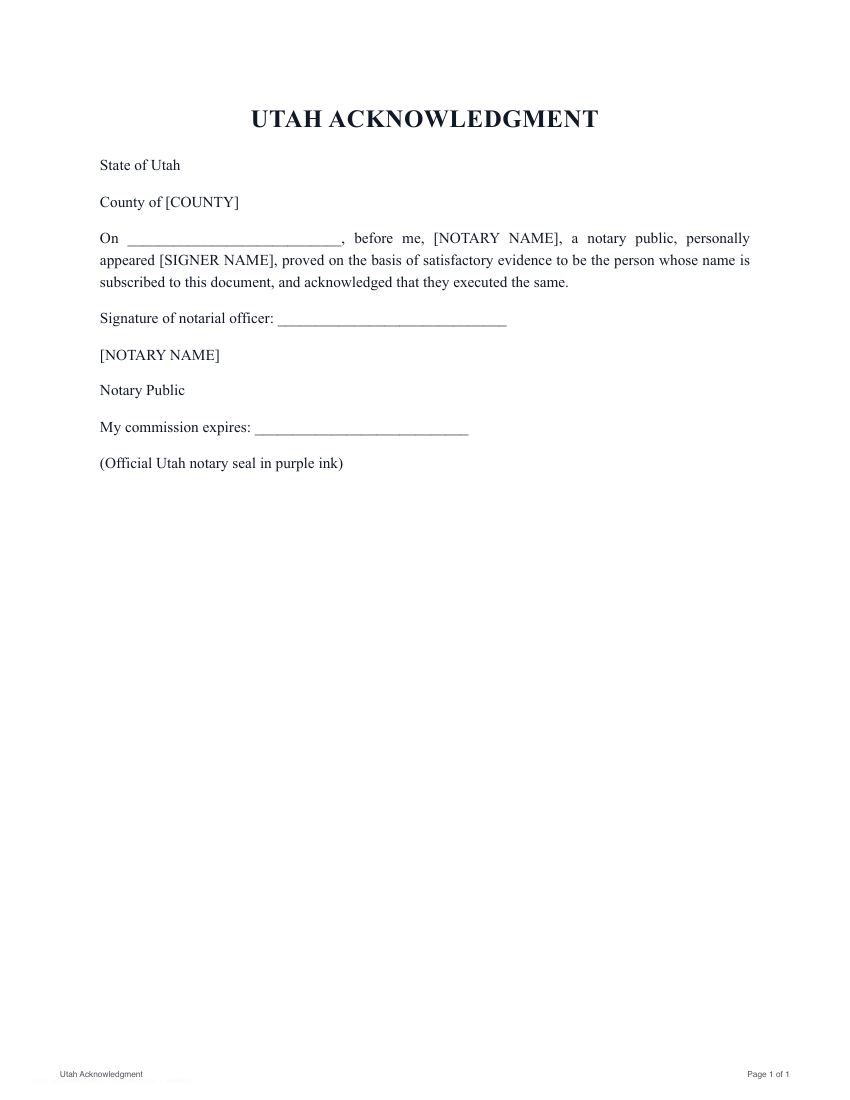
Sample Utah Acknowledgment Certificate
The in-person individual example below includes the acknowledgment recital. Leave the notary’s certification, signature and seal for the notary to complete during the act.
State of Utah
County of ____________________
On ____________________ [date], before me, ____________________ [notary name], a notary public, personally appeared ____________________ [signer name], proved on the basis of satisfactory evidence to be the person whose name is subscribed to this document, and acknowledged that they executed the same.
Signature of notarial officer: ____________________
Printed name: ____________________
Notary Public
My commission expires: ____________________
[Official Utah notary seal in purple ink]
Utah Notary Acknowledgment FAQ
Answers to common questions about notary acknowledgments in Utah, including wording requirements, fees, and notarization procedures.
Official Utah Resources
Use these official resources to verify Utah notary requirements, find a notary, and access state notary forms and information.
Related Utah Documents
Documents commonly used alongside notary acknowledgments in Utah, or that require UT notarization.
Create your Utah Notary Acknowledgment in under 5 minutes.
Prepare a certificate for the notary to review and complete when performing the act.