



Kentucky Notary Acknowledgment Overview
These Kentucky in-person examples describe the notarial act under KRS 423.360(3)(d). They include the actual venue, date, signer, notary signature and name, title, commission number and expiration. They are descriptive certificates rather than a reproduction of the separate statutory acknowledgment forms in KRS 423.160. A notary must select and complete the certificate for the act actually performed.
Use the actual date and location of the notarial act. The notary completes and signs the certificate during the act. Whether a deed, power of attorney, trust or other instrument also needs witnesses or additional formalities depends on its governing law.
Disclosed*
Notarial fee
4 years
Commission term
Authorized
Remote acts with conditions
Electronic acts
Journal required
*See the requirements and fees below for exceptions and applicable categories.
Kentucky Acknowledgment and Jurat Wording
KRS 423.315, 423.360 and 423.370 — official source governs these descriptive certificate examples. They cover in-person acts under KRS 423.360(3)(d), not the separate forms in KRS 423.160. Remote acts need additional certificate wording and procedures.
Individual Acknowledgment
State of Kentucky
County of ____________________
This record was acknowledged before me on ____________________ [date] by ____________________ [name(s) of individual(s)].
Signature of notarial officer: ____________________
Printed name: ____________________
Notary Public
Commission number: ____________________
My commission expires: ____________________
[Official stamp, if used]
Representative Acknowledgment
State of Kentucky
County of ____________________
This record was acknowledged before me on ____________________ [date] by ____________________ [name(s) of individual(s)] as ____________________ [type of authority] of ____________________ [party represented].
Signature of notarial officer: ____________________
Printed name: ____________________
Notary Public
Commission number: ____________________
My commission expires: ____________________
[Official stamp, if used]
Attorney-in-Fact Acknowledgment
State of Kentucky
County of ____________________
This record was acknowledged before me on ____________________ [date] by ____________________ [attorney-in-fact] as attorney-in-fact of ____________________ [principal].
Signature of notarial officer: ____________________
Printed name: ____________________
Notary Public
Commission number: ____________________
My commission expires: ____________________
[Official stamp, if used]
Verification on Oath or Affirmation (Jurat)
State of Kentucky
County of ____________________
Signed and sworn to (or affirmed) before me on ____________________ [date] by ____________________ [name(s) of individual(s) making statement].
Signature of notarial officer: ____________________
Printed name: ____________________
Notary Public
Commission number: ____________________
My commission expires: ____________________
[Official stamp, if used]
Identify each person who actually appears. A jurat requires signing and an oath or affirmation; an acknowledgment serves a different purpose. Confirm the required act with the document recipient or a legal adviser.
Kentucky Notary Requirements
Commission: A Kentucky commission lasts four years under KRS 423.390. Within 30 days of receiving the commission, appear before the county clerk identified in the application to take the oath, file the commission and file the required bond. A notary may act throughout Kentucky only while both the commission and bond remain valid. Renewals require the applicable application, filing, bond and oath; there is no authority to act during a lapse.
Education: The ordinary commission requirements in KRS 423.390 and 30 KAR 8:005 do not impose a general training course or examination. Applicants must meet all eligibility and filing requirements. Electronic acts require registration; remote tangible acts require prior written notice identifying the communication technology. Learn the applicable identity, certificate, security and recordkeeping procedures before offering either service.
Bond: KRS 423.390 requires a $1,000 surety bond from a licensed or authorized provider covering the commission term. File the bond with the county clerk and keep it effective; the bond amount is not its purchase price. KRS 423.430 lists a $10 state application or renewal fee, with separate county-clerk charges for the oath and filing.
Journal: Kentucky does not impose a general journal requirement for ordinary paper acts under these provisions. Electronic acts, including electronic records notarized in person, require a permanent, tamper-evident electronic journal under 30 KAR 8:005 Section 6. Retain the electronic journal at least ten years after its last act. For an electronic notarization, KRS 423.355(5)(c) requires the recording for at least ten years after the applicable transaction or proceeding, or the journal retention period, whichever is longer; also meet the rule’s ten years after recording. Do not automatically delete recordings ten years after the session. A remote tangible act has its own recording minimum of ten years after recording under KRS 423.455 and Section 7. Record the act, signer name and address, identity method and credential dates, and fee. Do not record government-assigned identification numbers or biometric identifiers. Secure the records and backups; recordings must not include images of the underlying signed record.
Kentucky does not require an official stamp. If one is used, KRS 423.370 requires the notary’s name, title, jurisdiction, commission number and expiration in reproducible form. The certificate still needs the commission number and expiration, even without a stamp. Complete and sign the certificate contemporaneously with the act, then securely attach it to the paper record under KRS 423.360.
Remote Notarization in Kentucky
For remote electronic records, register with the Secretary of State, identify the technology and providers, and confirm the registration is effective in the state database. For remote tangible paper records, Section 7 instead requires prior written notice by email or U.S. mail identifying the communication technology capable of recording the act. For electronic acts, use registered technology providers and the required tamper-evident technology. For either remote procedure, the notary must be physically in Kentucky. For an overseas electronic signer, KRS 423.355 requires the signer to confirm the record’s qualifying U.S. connection, with no actual knowledge by the notary of a foreign prohibition. For a tangible record, KRS 423.455 requires the qualifying connection and that the statement or signing not be prohibited where the signer is located.
Follow the separate remote identity standards in KRS 423.325, KRS 423.455 and 30 KAR 8:005 Section 5. For electronic records, the identity choices are personal knowledge, credential presentation and analysis with dynamic knowledge-based authentication, or a qualifying public-key certificate. Tangible records permit personal knowledge, the rule’s identity-proofing process, or a qualified credible witness under the separate statutory conditions. Ordinary paper-ID rules alone do not satisfy the remote process. Use synchronous audio-video communication, confirm the same record, explain and record the session, and restart identity verification when the signer exits the workflow.
The certificate must state that communication technology was used. For electronic acts, protect the electronic signature and optional stamp, keep the electronic journal, and retain the recording for the longer applicable transaction or journal period described below. Tangible acts require their own audiovisual recording, retained for at least ten years after it is made. Protect records and backups. The builder now offers separate remote electronic and tangible certificates, with actual identity choices, commission-number and overseas-signer fields. A credible witness is available only on the tangible route, subject to the listed ID methods being unavailable and the witness’s oath and identification. Preparing either certificate does not perform the notarization.
Official remote-notarization requirements
Prepare a Kentucky remote certificate · 30 KAR 8:005 — electronic and tangible procedures · KRS 423.355 — electronic acts and recording retention
Kentucky Notary Fees
KRS 423.430 requires advance disclosure of a notarial fee and compliance with KRS 64.300. The latter prohibits a fee for a jurat on papers supporting qualifying federal-benefit claims of covered military members or their dependents. Non-notarial service compensation is outside KRS 423.430, so explain separate charges rather than presenting them as statutory notary fees.
| Service or requirement | Fee rule |
|---|---|
| Ordinary acknowledgment or jurat | Disclose the fee clearly in advance; KRS 423.430 does not set a general dollar cap |
| Electronic or remote act | Advance disclosure applies; do not assume a fixed $25 statutory price |
| Qualifying military-benefit claim jurat | No fee under KRS 64.300 |
| State commission application / renewal | $10, plus applicable county-clerk charges |
Kentucky Identification and Recordkeeping
KRS 423.325 permits personal knowledge based on dealings that establish reasonable certainty, or the specified current identification credentials. Acceptable credentials include a non-expired passport, driver’s license or government-issued ID card, or other current government identification containing a signature and photograph and satisfactory to the notary. If those identification methods are unavailable, the statute permits a credible witness’s oath or affirmation under its identification and personal-appearance conditions. A notary may request additional identifying information. Ordinary paper acts require personal appearance; a jurat also requires an oath or affirmation and signing before the notary.
Kentucky does not impose a general journal requirement for ordinary paper acts under these provisions. Electronic acts, including electronic records notarized in person, require a permanent, tamper-evident electronic journal under 30 KAR 8:005 Section 6. Retain the electronic journal at least ten years after its last act. For an electronic notarization, KRS 423.355(5)(c) requires the recording for at least ten years after the applicable transaction or proceeding, or the journal retention period, whichever is longer; also meet the rule’s ten years after recording. Do not automatically delete recordings ten years after the session. A remote tangible act has its own recording minimum of ten years after recording under KRS 423.455 and Section 7. Record the act, signer name and address, identity method and credential dates, and fee. Do not record government-assigned identification numbers or biometric identifiers. Secure the records and backups; recordings must not include images of the underlying signed record.
Current Kentucky notary statutes · Kentucky notary administrative rules
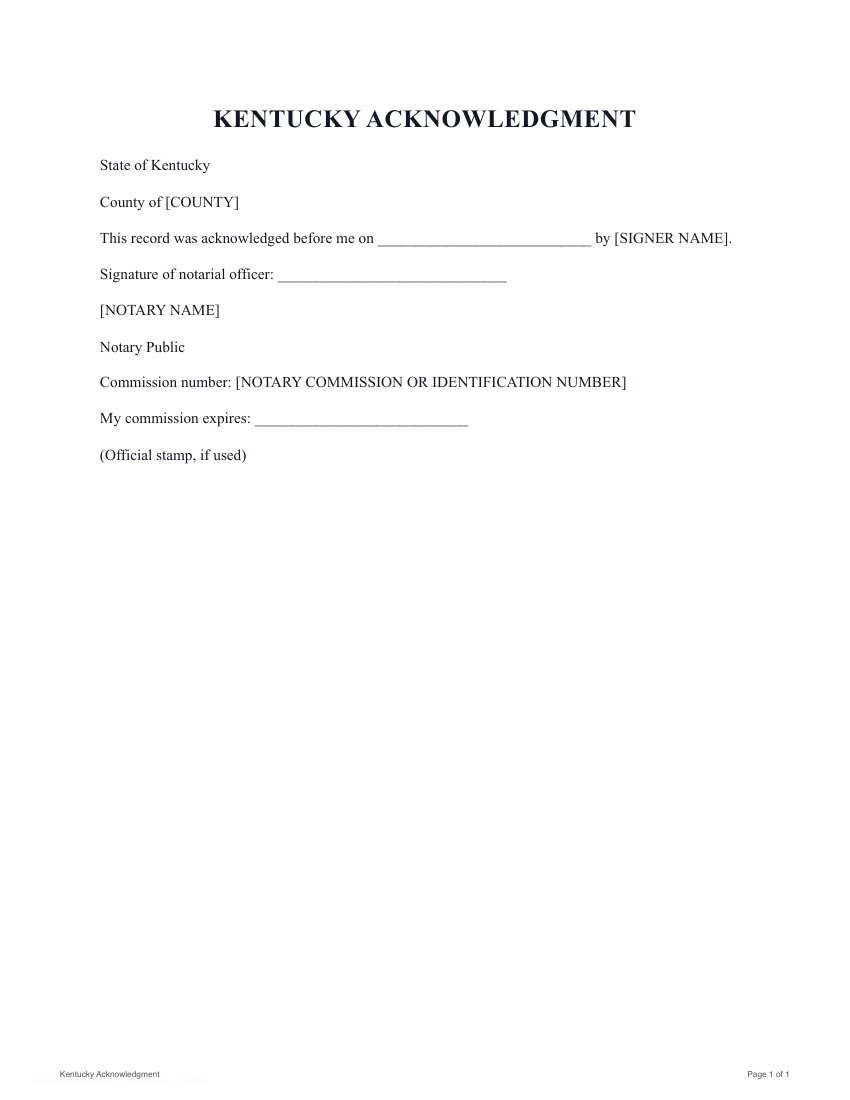
Sample Kentucky Acknowledgment Certificate
The in-person individual example below includes the acknowledgment recital. Leave the notary’s certification, signature and seal for the notary to complete during the act.
State of Kentucky
County of ____________________
This record was acknowledged before me on ____________________ [date] by ____________________ [name(s) of individual(s)].
Signature of notarial officer: ____________________
Printed name: ____________________
Notary Public
Commission number: ____________________
My commission expires: ____________________
[Official stamp, if used]
Kentucky Notary Acknowledgment FAQ
Answers to common questions about notary acknowledgments in Kentucky, including wording requirements, fees, and notarization procedures.
Official Kentucky Resources
Use these official resources to verify Kentucky notary requirements, find a notary, and access state notary forms and information.
Related Kentucky Documents
Documents commonly used alongside notary acknowledgments in Kentucky, or that require KY notarization.
Kentucky Jurat / Verification
Notarial certificate for sworn statements and affidavits
Kentucky Affidavit
Sworn statement requiring notarized jurat
Kentucky Power of Attorney
Execution requirements depend on the type of power of attorney
Kentucky Quitclaim Deed
Property transfer deed requiring notarized acknowledgment
Create your Kentucky Notary Acknowledgment in under 5 minutes.
Prepare a certificate for the notary to review and complete when performing the act.