



Nevada Notary Acknowledgment Overview
Nevada provides separate short forms for an individual acknowledgment, a representative acknowledgment, an attorney-in-fact acknowledgment and a jurat. Each certificate must also meet NRS 240.1655. These examples cover traditional in-person acts by a Nevada notary public and include the actual county of the act, signer, date, notary signature and official ink stamp. Carson City may be entered in the county venue.
Use the actual date and location of the notarial act. The notary completes and signs the certificate during the act. Whether a deed, power of attorney, trust or other instrument also needs witnesses or additional formalities depends on its governing law.
$15*
First ordinary acknowledgment signature
4 years
Commission term
Authorized
Remote acts with conditions
Required
Journal / records
*See the requirements and fees below for exceptions and applicable categories.
Nevada Acknowledgment and Jurat Wording
NRS 240.1655–240.167 — official source provides these short forms. These examples cover in-person acts. Remote acts need additional certificate wording and procedures.
Individual Acknowledgment
State of Nevada
County of ____________________
This instrument was acknowledged before me on ____________________ [date] by ____________________ [name(s) of individual(s)].
Signature of notarial officer: ____________________
Printed name: ____________________
Notary Public
My commission expires: ____________________
[Official Nevada notary ink stamp]
Representative Acknowledgment
State of Nevada
County of ____________________
This instrument was acknowledged before me on ____________________ [date] by ____________________ [name(s) of individual(s)] as ____________________ [type of authority] of ____________________ [party represented].
Signature of notarial officer: ____________________
Printed name: ____________________
Notary Public
My commission expires: ____________________
[Official Nevada notary ink stamp]
Attorney-in-Fact Acknowledgment
State of Nevada
County of ____________________
This instrument was acknowledged before me on ____________________ [date] by ____________________ [attorney-in-fact] as attorney-in-fact for ____________________ [principal].
Signature of notarial officer: ____________________
Printed name: ____________________
Notary Public
My commission expires: ____________________
[Official Nevada notary ink stamp]
Verification on Oath or Affirmation (Jurat)
State of Nevada
County of ____________________
Signed and sworn to (or affirmed) before me on ____________________ [date] by ____________________ [name(s) of individual(s) making statement].
Signature of notarial officer: ____________________
Printed name: ____________________
Notary Public
My commission expires: ____________________
[Official Nevada notary ink stamp]
Identify each person who actually appears. A jurat requires signing and an oath or affirmation; an acknowledgment serves a different purpose. Confirm the required act with the document recipient or a legal adviser.
Nevada Notary Requirements
Commission: NAC 240.215 requires application fingerprints, written authorization and the processing fee. A Nevada notary’s appointment lasts four years under NRS 240.020, unless ended earlier. Authority extends throughout Nevada and does not authorize the notary to act while in another state. Electronic-notary registration ends with the ordinary appointment and must be renewed with it.
Education: NRS 240.018 requires both first-time and renewing applicants to complete the mandatory course. The course includes at least three hours of instruction and an examination. Electronic notarization has additional course and examination requirements under NRS 240.1943–240.195 and the Secretary’s procedures.
Bond: NRS 240.030 requires a $10,000 bond filed with the appropriate county clerk, proof of that filing, the oath and a $35 application fee. The bond must meet NRS 240.033. Electronic registration is an additional process under NRS 240.192, including the required bond and oath compliance and a $50 registration fee; the bond amount is not the insurance premium.
Journal: NRS 240.120 requires a secure bound journal with preprinted page numbers. Record the act at the time it occurs, including the fee, document title, date, signer, identity evidence, oath indication and certificate type. Limited exceptions permit combined entries or omission of a repeat employer/coworker’s signature. If a credible witness is used, record and obtain that witness’s signature as required. The journal is open to public inspection and must be retained until seven years after the notary ceases to hold office. Electronic acts require a separate compliant electronic journal under NRS 240.201; on termination of electronic registration, required notarial records must be kept for seven years, except as otherwise provided by law.
A Nevada notary public must use the photographically reproducible ink stamp described in NRS 240.040. It includes the notary’s name, Nevada notary title, appointment number and expiration; a nonresident notary’s stamp also says nonresident. The short forms’ reference to a seal if any does not remove this stamp duty for a Nevada notary public. Keep the stamp and signature off printed material, and do not notarize an incomplete underlying document.
The notary must have current authority, avoid disqualifying interests, identify the signer, perform the required act, and complete the certificate and official seal or stamp.
Remote Notarization in Nevada
Register as an electronic notary, identify compliant technology and satisfy the additional training requirements and obtain approval and active registration before performing electronic acts using audio-video communication. NAC 240.645 and 240.658 require the Secretary’s approval and active registration, not just an application or payment. The notary must be physically in Nevada. NRS 240.1993 permits signers elsewhere in the United States and conditionally abroad; foreign signers must meet the foreign-law and United States connection conditions.
Use the required electronic signature, electronic seal and a certificate that expressly states when audio-video communication was used. Make the electronic document tamper-evident, apply the identity procedures in NRS 240.1995–240.1997, keep the electronic journal, tell participants the act is being recorded and retain the audiovisual recording for at least seven years even if the act is not completed. NAC 240.708–240.710 require secure backups and a journal whose entries cannot be altered or deleted; do not put the recording or unnecessary personal identifying information in that journal. The separate post-registration retention rule may require keeping records longer. These paper samples alone do not complete a remote notarization.
Official remote-notarization requirements
A Nevada credible witness personally knows both the signer and the notary. The recording must capture how the notary identified the witness and how and for how long the witness knows the signer. For personal knowledge, the notary explains the relationship and its duration on the recording. Direct proofing requires a qualifying photo-and-signature credential, credential analysis and either dynamic knowledge-based authentication or an approved alternative under NAC 240.700.
For a signer abroad, the signer confirms the qualifying U.S. connection and the notary must have no actual knowledge that the act is prohibited at the signer’s location. If a participant exits as described in NAC 240.680, the link breaks or audio-video quality compromises completion, restart the full act and verify identity again. Prepare a Nevada remote electronic acknowledgment.
Nevada Notary Fees
NRS 240.100 governs ordinary acts; NRS 240.197 governs electronic acts. Travel must be requested, explained as an optional additional fee and agreed in advance. Both travel provisions permit a two-hour minimum and require prorating afterward and recording the travel charge and times. A notary who charges ordinary fees must conspicuously post the fee table required by NRS 240.110. State or local government employees cannot charge for electronic acts within their government employment.
| Service or requirement | Fee rule |
|---|---|
| Ordinary acknowledgment | Up to $15 for the first signature of each signer; $7.50 for each additional signature of that signer |
| Ordinary jurat | Up to $15 for each signature on the affidavit |
| Ordinary oath / copy | Up to $7.50 for an oath or affirmation; $7.50 for a certified copy |
| Electronic act | Up to $25 per acknowledgment or jurat signature, or for an oath or affirmation, subject to statutory exceptions |
| Ordinary travel | Agreed beforehand: up to $15/hour from 6 a.m.–7 p.m.; $30/hour from 7 p.m.–6 a.m. |
| Electronic-act travel | Separate NRS 240.197 limits: $10/hour from 6 a.m.–7 p.m.; $25/hour from 7 p.m.–6 a.m. |
Nevada Identification and Recordkeeping
NRS 240.1655 permits personal knowledge, a credible witness’s oath or affirmation, an identifying document containing both signature and photograph, a qualifying consular ID, or the statute’s other specified methods. It also provides limited alternatives for people age 65 or older and incarcerated people who cannot use the ordinary methods. Personal knowledge requires dealings that establish reasonable certainty under NRS 240.062. Do not replace these rules with a blanket statement that every signer needs the same government ID. The signer must personally appear for an ordinary act; a jurat requires an oath or affirmation and signing in the notary’s presence.
NRS 240.120 requires a secure bound journal with preprinted page numbers. Record the act at the time it occurs, including the fee, document title, date, signer, identity evidence, oath indication and certificate type. Limited exceptions permit combined entries or omission of a repeat employer/coworker’s signature. If a credible witness is used, record and obtain that witness’s signature as required. The journal is open to public inspection and must be retained until seven years after the notary ceases to hold office. Electronic acts require a separate compliant electronic journal under NRS 240.201; on termination of electronic registration, required notarial records must be kept for seven years, except as otherwise provided by law.
Current Nevada notary statute · Nevada notary administrative rules
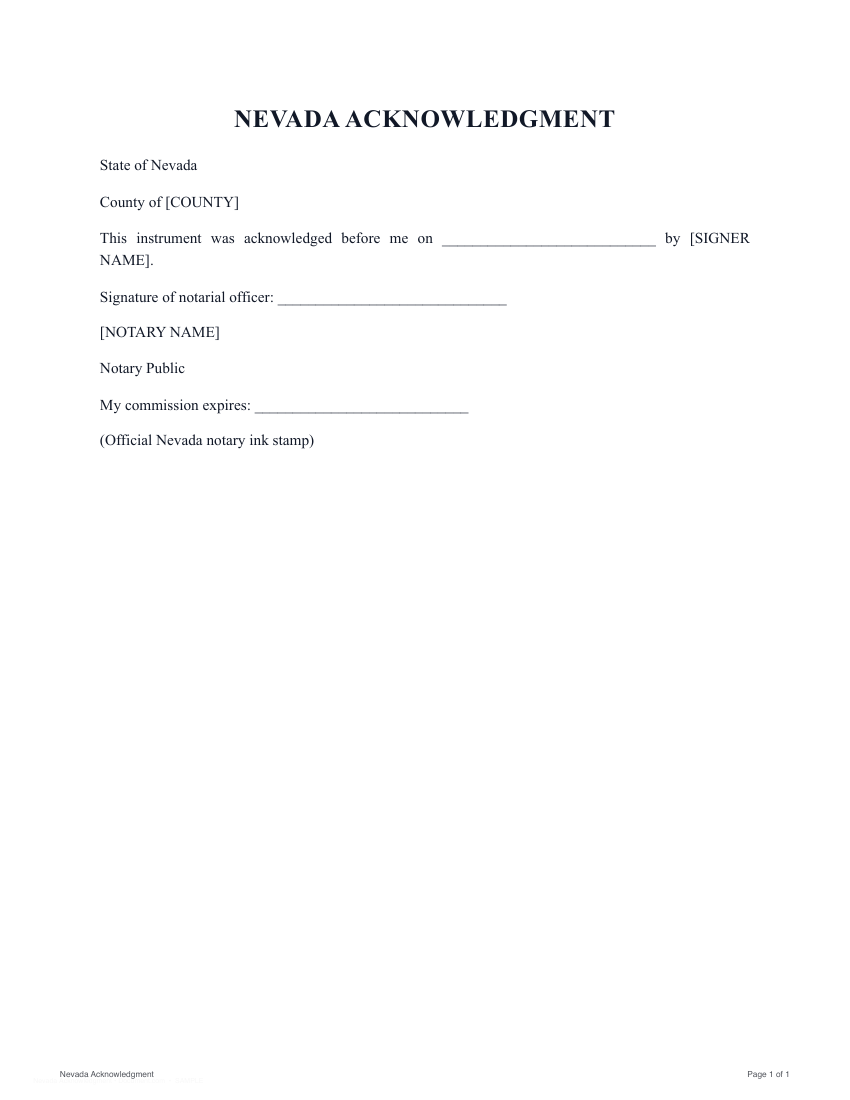
Sample Nevada Acknowledgment Certificate
The in-person individual example below includes the acknowledgment recital. Leave the notary’s certification, signature and seal for the notary to complete during the act.
State of Nevada
County of ____________________
This instrument was acknowledged before me on ____________________ [date] by ____________________ [name(s) of individual(s)].
Signature of notarial officer: ____________________
Printed name: ____________________
Notary Public
My commission expires: ____________________
[Official Nevada notary ink stamp]
Nevada Notary Acknowledgment FAQ
Answers to common questions about notary acknowledgments in Nevada, including wording requirements, fees, and notarization procedures.
Official Nevada Resources
Use these official resources to verify Nevada notary requirements, find a notary, and access state notary forms and information.
Related Nevada Documents
Documents commonly used alongside notary acknowledgments in Nevada, or that require NV notarization.
Nevada Jurat / Verification
Notarial certificate for sworn statements and affidavits
Nevada Affidavit
Sworn statement requiring notarized jurat
Nevada Power of Attorney
Execution requirements depend on the type of power of attorney
Nevada Quitclaim Deed
Property transfer deed requiring notarized acknowledgment
Create your Nevada Notary Acknowledgment in under 5 minutes.
Prepare a certificate for the notary to review and complete when performing the act.