


Michigan Notary Acknowledgment Overview
Michigan uses the Secretary of State’s acknowledgment and jurat examples under MCL 55.285(9). The former statutory short forms in MCL 565.267 were repealed in 2019. The certificate must identify the notary’s county of commission and, when different, the county where the act occurs. These examples cover traditional in-person notarization in Michigan.
Use the actual date and location of the notarial act. The notary completes and signs the certificate during the act. Whether a deed, power of attorney, trust or other instrument also needs witnesses or additional formalities depends on its governing law.
$10
Maximum notarial fee
6–7 years
Commission term
Authorized
Remote acts with conditions
RON required
Journal / records
*See the requirements and fees below for exceptions and applicable categories.
Michigan Acknowledgment and Jurat Wording
Michigan Secretary of State notary manual; MCL 55.285 and 55.287 — official source provides the acknowledgment and jurat examples. The representative example identifies the capacity and party represented under MCL 55.263. These examples cover in-person acts. Remote acts need additional certificate wording and procedures.
Individual Acknowledgment
State of Michigan
County of ____________________
Acknowledged by ____________________ [name] before me on ____________________ [date].
Signature of notarial officer: ____________________
Printed name: ____________________
Notary public, State of Michigan, County of ____________________
My commission expires: ____________________
Acting in the County of ____________________
[Stamp or seal, if used]
Representative Acknowledgment
State of Michigan
County of ____________________
Acknowledged by ____________________ [name] as ____________________ [capacity] on behalf of ____________________ [represented party] before me on ____________________ [date].
Signature of notarial officer: ____________________
Printed name: ____________________
Notary public, State of Michigan, County of ____________________
My commission expires: ____________________
Acting in the County of ____________________
[Stamp or seal, if used]
Verification on Oath or Affirmation (Jurat)
State of Michigan
County of ____________________
Subscribed and sworn to (or affirmed) by ____________________ [name] before me on ____________________ [date].
Signature of notarial officer: ____________________
Printed name: ____________________
Notary public, State of Michigan, County of ____________________
My commission expires: ____________________
Acting in the County of ____________________
[Stamp or seal, if used]
Identify each person who actually appears. A jurat requires signing and an oath or affirmation; an acknowledgment serves a different purpose. Confirm the required act with the document recipient or a legal adviser.
Michigan Notary Requirements
Commission: A Michigan commission lasts six to seven years and ends on the notary’s birthday. Use the expiration date on the state-issued commission, not the bond. A commission permits acts throughout Michigan; it does not authorize acts outside Michigan.
Education: The applicant must declare that they have read the Michigan Law on Notarial Acts and will perform their duties faithfully. Read the current act and Secretary of State guidance before performing an act; electronic and remote methods have additional system requirements.
Bond: A $10,000 surety bond must be filed with the county clerk. Attorneys in good standing with the State Bar of Michigan are exempt from the bond but must take the required oath with the county clerk. A bond protects the public and does not eliminate the notary’s liability.
Journal: A journal is not generally required for traditional paper or in-person electronic notarizations. If those records are kept, retain them for at least ten years. Remote notarizations require a contemporaneous journal retained for at least ten years after its last act, and retained recordings for at least ten years after the act. Follow the Secretary of State’s rules for custody when a commission ends.
The notary must have current authority, avoid disqualifying interests, identify the signer, perform the required act, and complete the certificate. For ordinary paper acts, a Michigan stamp or seal is optional; all required information must be legible and reproducible near the signature. Remote platform standards additionally require the verifiable electronic seal and vendor statement described below.
Remote Notarization in Michigan
Michigan distinguishes in-person electronic acts from remote electronic acts. For remote work, the notary must be physically in Michigan, use a Department-approved platform and obtain approval of the updated application before acting. The temporary ordinary audiovisual exception in MCL 55.286c ended before July 1, 2021; it does not authorize a new paper-counterpart or ordinary video-call procedure.
The March 2026 Department standards require platform credential analysis for remote acts in addition to the notary’s personal-knowledge, credible-witness or credential identification procedure. The unexpired government credential must have a photograph and signature and be lawful to image and record. The platform provides compliant knowledge-based authentication or biometric identity proofing. Personal knowledge or a witness does not remove the standards’ additional credential-analysis step.
The certificate identifies the actual remote platform, commission county, expiration and acting county when different. The approved system applies the notary’s signature as held on file and a unique, verifiable seal containing the required electronic-or-remote technology statement followed by the vendor name. Keep the record tamper-evident. Disclose recording and preservation, obtain consent, and retain the single journal for at least ten years after its last act and the recording for at least ten years after the act. Protect identity data; the notary must not keep raw biometric data or credential copies after the session.
Michigan Notary Fees
Display or expressly disclose the notarial fee before performing the act. Agree any separate travel charge before the trip. The Secretary of State’s acknowledgment guidance also says not to charge a correction fee or a remote/electronic travel or convenience fee.
| Service or requirement | Fee rule |
|---|---|
| Notarial act | No more than $10 for an individual transaction or act |
| Travel | A separate fee may be agreed before travel begins |
| Remote or electronic convenience fee | The Secretary’s guidance does not permit a travel or convenience surcharge for these acts |
Michigan Identification and Recordkeeping
Under MCL 55.285(6), identify the signer by personal knowledge, by the oath or affirmation of a credible witness personally known to the notary who personally knows the signer, or by a current federal- or state-issued license, identification card or record containing the signer’s photograph and signature. Remote acts additionally require platform credential analysis under standard A(3), and the platform’s knowledge-based or biometric identity proofing under B(2); viewing an ID on a video call alone is insufficient.
A journal is not generally required for traditional paper or in-person electronic notarizations. If those records are kept, retain them for at least ten years. Remote notarizations require a contemporaneous journal retained for at least ten years after its last act, and retained recordings for at least ten years after the act. Follow the Secretary of State’s rules for custody when a commission ends.
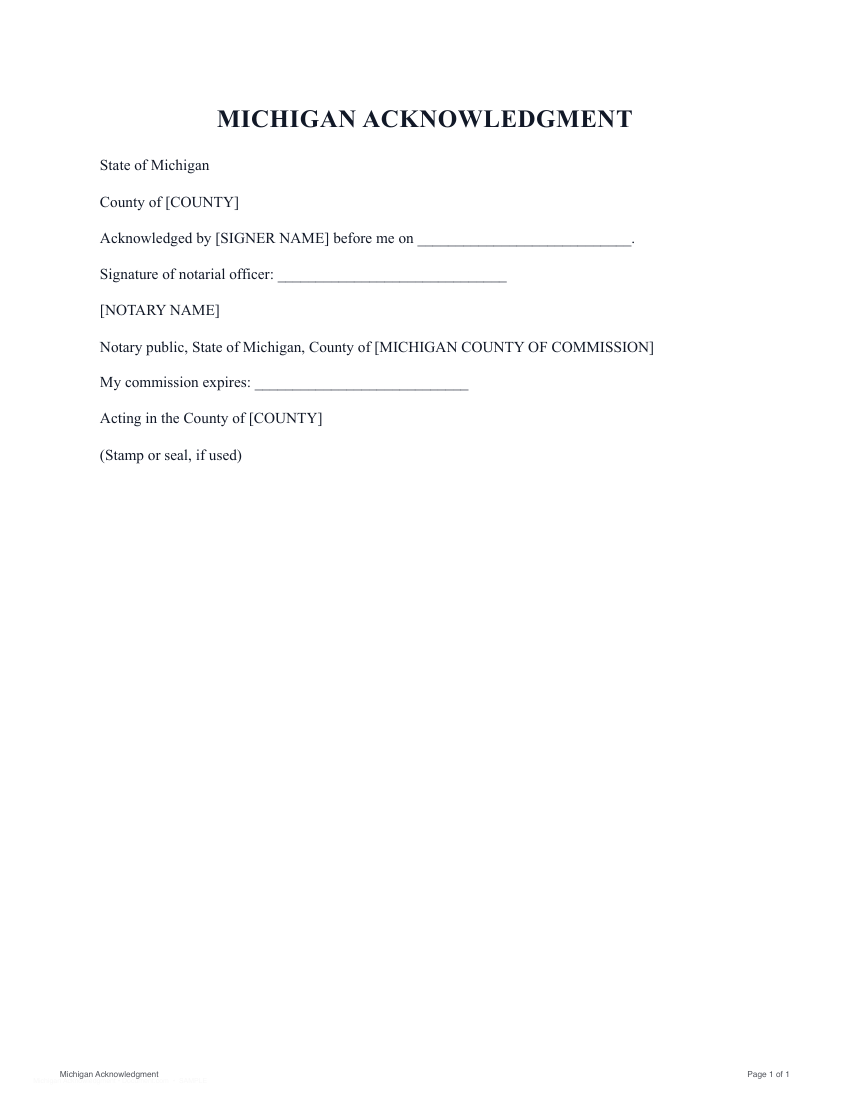
Sample Michigan Acknowledgment Certificate
The in-person individual example below includes the acknowledgment recital. The county in the notary’s commission statement is the commission county; the acting county is the actual location of the act. Leave the notary’s certification and signature for the notary to complete during the act.
State of Michigan
County of ____________________
Acknowledged by ____________________ [name] before me on ____________________ [date].
Signature of notarial officer: ____________________
Printed name: ____________________
Notary public, State of Michigan, County of ____________________
My commission expires: ____________________
Acting in the County of ____________________
[Stamp or seal, if used]
Michigan Notary Acknowledgment FAQ
Answers to common questions about notary acknowledgments in Michigan, including wording requirements, fees, and notarization procedures.
Official Michigan Resources
Use these official resources to verify Michigan notary requirements, find a notary, and access state notary forms and information.
Related Michigan Documents
Documents commonly used alongside notary acknowledgments in Michigan, or that require MI notarization.
Michigan Jurat / Verification
Notarial certificate for sworn statements and affidavits
Michigan Affidavit
Sworn statement requiring notarized jurat
Michigan Power of Attorney
Execution requirements depend on the type of power of attorney
Michigan Quitclaim Deed
Property transfer deed requiring notarized acknowledgment
Create your Michigan Notary Acknowledgment in under 5 minutes.
Prepare a certificate for the notary to review and complete when performing the act.