


Maryland Notary Acknowledgment Overview
An acknowledgment records the signer’s declaration that they signed the record for its stated purposes. The notary verifies the signer’s identity and takes the acknowledgment through the required appearance. It does not certify that the document’s statements are true. A representative also acknowledges the authority and capacity in which they signed.
The underlying instrument determines whether an acknowledgment, verification on oath, witnesses or additional formalities are needed. An acknowledgment does not replace those requirements. Use the correct act for the transaction and confirm the receiving office’s requirements before execution. Preparing this certificate does not perform a notarization.
$8
In-person act cap
4 years
Commission term
Yes
RON allowed
Required
Journal
Maryland Acknowledgment Wording
State Government §18-216 provides short-form certificates for individual and representative acknowledgments. Complete them with the venue, act date, signer, notarial signature and title, commission expiration and required stamp. Section 18-215 permits other lawful forms; the short forms are not the only possible wording.
Maryland Specific Note
Use the venue where the notary actually performs the act, including Baltimore City when applicable. Each named signer must personally appear through a legally permitted procedure and acknowledge the record. Do not include an absent signer. A certificate alone does not guarantee recording or acceptance of the underlying instrument.
Individual Acknowledgment
County/City of _______________
This record was acknowledged before me on the _____ day of _______________, 20_____, by _______________.
___________________________
Signature of notarial officer
Notary Public
[Official stamp]
My commission expires: _______________
Corporate / Representative Acknowledgment
County/City of _______________
This record was acknowledged before me on the _____ day of _______________, 20_____, by _______________ as _______________ [type of authority] of _______________ [party on whose behalf the record was executed].
___________________________
Signature of notarial officer
Notary Public
[Official stamp]
My commission expires: _______________
Multiple Signers Acknowledgment
County/City of _______________
This record was acknowledged before me on the _____ day of _______________, 20_____, by _______________ and _______________.
___________________________
Signature of notarial officer
Notary Public
[Official stamp]
My commission expires: _______________
Maryland Notary Requirements
Maryland has specific requirements for notaries public who perform acknowledgments. Check the notary’s current authority and the procedure for the requested act.
- Commission Term: Maryland notary commissions are valid for 4 years from the date of issuance
- Qualification: The applicant must qualify before the appropriate circuit court clerk within 30 days of the appointment or renewal notice (§18-103)
- Exam: Initial applicants need the approved course and examination; renewal applicants need the course (§18-102)
- Journal: Record all acts contemporaneously and retain the journal for ten years after its last act, subject to the statutory repository options (§18-219)
- Seal/Stamp: For paper, affix or emboss the official stamp. Electronic acts must meet §18-223(f), including the electronic signature and stamp with a valid digital certificate. The stamp identifies the notary, office and county of residence or qualification; include commission expiration in the stamp or certificate (§18-217)
- Max Fee: $8 per original in-person act; $30 per remote act (COMAR 01.02.08.02)
Remote Notarization in Maryland
The notary must be physically in Maryland and submit the required remote-notary notification before beginning. Use the Secretary of State’s online filing process and identify any authorized RON vendors used. Renew the notification when the commission renews and report a vendor change within ten business days. For the route without credential analysis and identity proofing, the notary must acknowledge that identification will use personal knowledge or a properly identified credible witness.
Section 18-214 permits personal knowledge, an identified credible witness’s oath or affirmation, or the credential-presentation, credential-analysis and identity-proofing route. Knowledge-based authentication is not mandatory for every signer. Confirm that the record before the notary is the same record involved in the act. An overseas signer’s record needs the statutory U.S. connection, and the notary must have no actual knowledge of a foreign prohibition.
Paper and electronic records use different completion procedures. Paper already with the notary may be displayed and identified during a remote acknowledgment. Under the statutory send-back procedure, the signer signs the paper and attached declaration on the recording, sends both within three days, and the notary completes the certificate after receiving them, with the required witnessing statement. Electronic acts require the controlled electronic signature and stamp using the valid digital-certificate technology in §18-223(f).
Record the remote act and retain the recording for at least ten years after it is made. Technology must be able to record the entire location and everyone present; people with the signer must identify themselves and their roles. Protect remote records from unauthorized access and provide for retention when a storage contract ends. The certificate must indicate remote appearance and communication technology. The receiving party may decline a remote transaction. This builder currently provides Maryland in-person certificates; it does not perform or supply a Maryland remote notarization.
Maryland remote-notary instructionsMaryland Notary Fees
Maryland regulates the maximum fees notaries may charge for notarial acts. COMAR 01.02.08.02 sets these caps. Additional copies signed simultaneously by the same people have a separate $4-per-signature cap after the original or first copy; reproductions are capped at $2 each and a certified journal copy at $6.
| Service | Fee |
|---|---|
| Original in-person acknowledgment | Up to $8 |
| Original in-person jurat | Up to $8 |
| Oath / Affirmation | Up to $8 |
| Mobile Notary Travel Fee | Prevailing IRS business mileage rate plus up to $5 |
| Remote Online Notarization | Up to $30 per remote act |
Maryland Identification and Journal Requirements
Section 18-206 permits personal knowledge from sufficient prior dealings; a passport, driver’s license, consular identification or government-issued nondriver ID; or another satisfactory government credential containing both photograph and signature. A credible witness may identify the signer by oath or affirmation after appearing and being personally known or identified with the listed credentials. Section 18-206 does not state a blanket expiration cutoff for these credentials. The notary may request more identifying information when needed.
The journal entry records the act’s date and time, record description and act type, each individual’s full name and address, identity method and credential issue/expiration dates when applicable, fee and physical or remote appearance. COMAR 01.02.08.08 also requires the credential’s identification number in the journal when a credential is used. Keep the journal for ten years after its final act. Use a bound, numbered paper journal or a permanent, tamper-evident electronic journal as permitted by §18-219. A notary may not act on a record in which the notary or spouse is a party or has a direct beneficial interest (§18-203).
Maryland identification statuteSample Maryland Acknowledgment Certificate
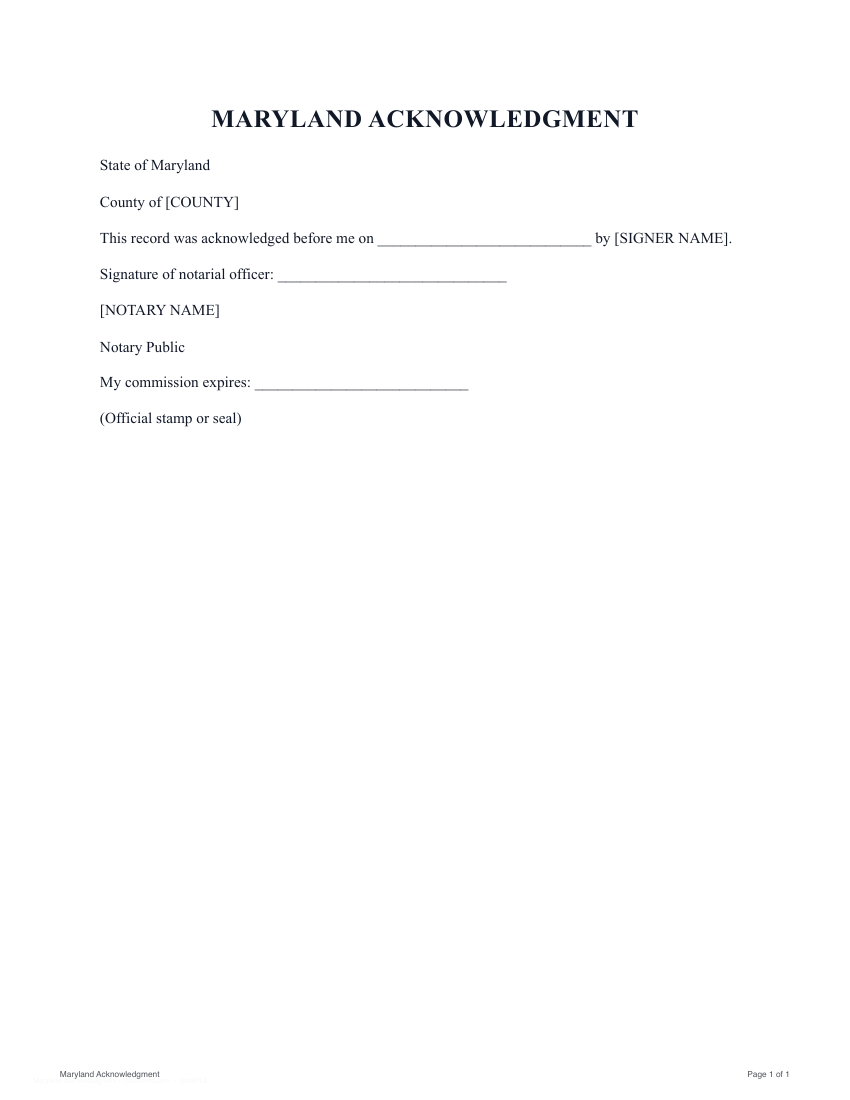
This preview illustrates an individual acknowledgment. The commissioned notary must complete the actual act, signature and stamp, then securely attach the certificate to the paper record. Choose the correct certificate for a representative or a verification on oath.
CERTIFICATE OF ACKNOWLEDGMENT
STATE OF MARYLAND
Individual Acknowledgment
VENUE:
State of Maryland
County/City of [County]
ACKNOWLEDGMENT:
This record was acknowledged before me on [Date] by [Signer’s Name].
NOTARY CERTIFICATION:
Notary Name: [Printed Name]
Title: Notary Public
Commission Expires: [Date]
Signature:
[NOTARY SEAL / STAMP]
Maryland Notary Acknowledgment FAQ
Answers to common questions about notary acknowledgments in Maryland, including wording requirements, fees, and notarization procedures.
Official Maryland Resources
Use these official resources to verify Maryland notary requirements, find a notary, and access state notary forms and information.
Related Maryland Documents
Documents commonly used alongside notary acknowledgments in Maryland, or that require MD notarization.
Maryland Jurat / Verification
Notarial certificate for sworn statements and affidavits
Maryland Affidavit
Sworn statement requiring notarized jurat
Maryland Power of Attorney
Execution requirements depend on the type of authority
Maryland Quitclaim Deed
Property transfer deed requiring notarized acknowledgment
Create your Maryland Notary Acknowledgment in under 5 minutes.
Prepare your certificate, then have a commissioned notary complete the required act. Check the receiving office’s requirements.