



Vermont Notary Acknowledgment Overview
An acknowledgment confirms that the identified signer appeared before the notary and acknowledged the signature for the purposes stated in the record. A representative also acts in the stated capacity for the represented person or entity. A jurat instead involves a statement verified on oath or affirmation; choose the act the underlying document requires.
A commissioned notary must be physically in Vermont. An ordinary commission covers tangible records with the signer physically present; electronic records and remote appearance require the special endorsement. The builder prepares certificate text and does not perform a notarization or verify a document’s legal effect.
Check the underlying document’s execution requirements and the receiving office’s rules. A certificate alone does not establish that a deed, power of attorney, trust or other instrument is valid.
Commission cycle
Electronic and remote acts
Required certificate information
Remote recording retention from act date
Vermont Certificate Wording
The short forms in 26 V.S.A. 5368 are sufficient forms, not an exclusive wording mandate. Other certificates may qualify under section 5367. Preserve the actual signer, act and representative capacity.
Individual acknowledgment
County of __________
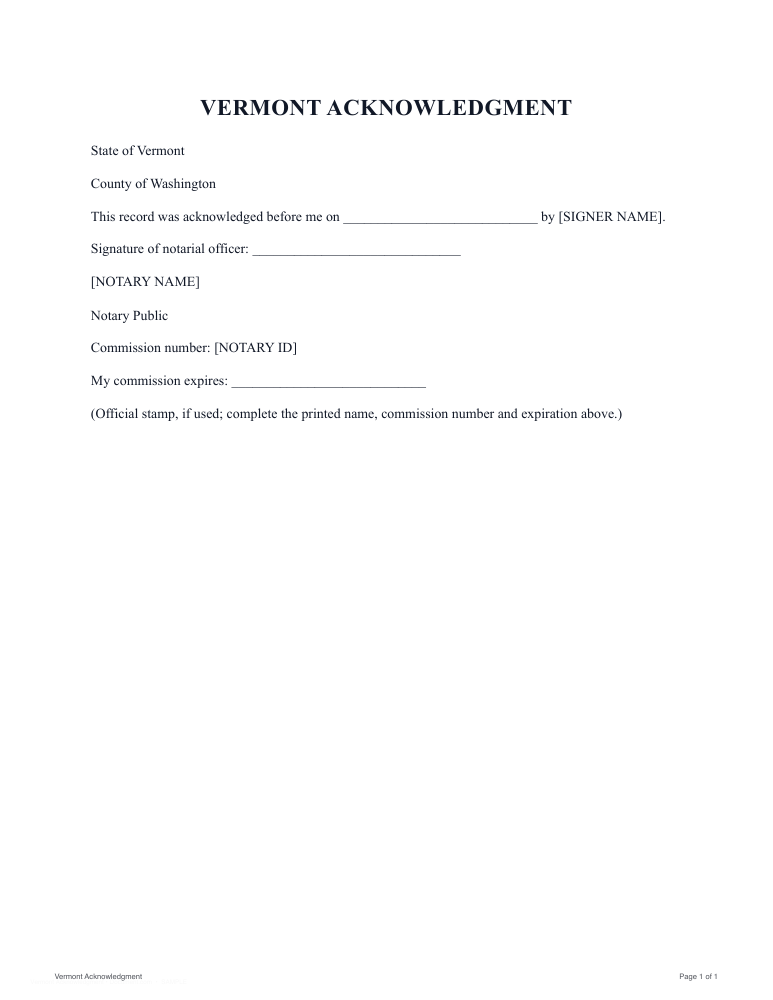
This record was acknowledged before me on __________ by __________.
Notary signature: __________
Printed commissioned name: __________
Notary Public
Commission number: __________
Commission expiration: __________
(Official stamp, if used)
Representative acknowledgment
County of __________
This record was acknowledged before me on __________ by __________ as __________ of __________.
Notary signature: __________
Printed commissioned name: __________
Notary Public
Commission number: __________
Commission expiration: __________
(Official stamp, if used)
Verification on oath or affirmation
County of __________
Signed and sworn to (or affirmed) before me on __________ by __________.
Notary signature: __________
Printed commissioned name: __________
Notary Public
Commission number: __________
Commission expiration: __________
(Official stamp, if used)
The notary must complete and sign the certificate contemporaneously with the act and securely attach it to the record. Electronic and remote certificates need additional statements and technology. A notary must not sign a blank certificate in advance.
Vermont Notary Requirements
The Administrative Rules effective February 26, 2025 govern the current procedures alongside 26 V.S.A. chapter 103.
- Commission: Fixed two-year periods ending January 31 of odd-numbered years, with the initial-issuance exception for credentials issued within 90 days of the period’s end. Verify actual expiration and current status.
- Examination: New applicants generally must pass the approved examination, submit a notarized oath and meet the other eligibility requirements. Rule 4-3 specifies exemptions.
- Continuing education: Generally one hour for commission renewal and one additional hour for endorsement renewal; check the applicable exemptions.
- Certificate: Use the actual act date, venue, signer and notary authority information. Without an official stamp, clearly print or type the notary’s commissioned name, commission number and expiration.
- Stamp: Optional. If used, include the commissioned name, Vermont, Notary Public and commission number. Do not depict the Vermont State Seal.
- Records: An ordinary journal is optional under these rules. Remote acts require a simultaneous audiovisual recording retained for at least seven years from the act date.
- Electronic or remote acts: A commissioned notary needs the special endorsement and compliant technology. This builder does not cover official-duty exemptions.
Remote Electronic Notarization in Vermont
The commissioned notary must be physically in Vermont and hold the special endorsement. Use compliant audiovisual communication, identity verification and tamper-evident technology. Apply the electronic signature and any optional stamp through a valid third-party digital certificate. Registration of a provider to do business in Vermont does not mean the State approves its services.
Identify the signer by personal knowledge, a qualifying sworn credible witness, or credential analysis plus dynamic knowledge-based authentication under Rule 8-6. An ordinary video call and a displayed ID do not themselves complete the remote proofing process. Confirm that the notary and signer are dealing with the same record.
The certificate must state that communication technology was used and that the act was performed electronically on an electronic record. Make the audiovisual recording simultaneously and retain it for at least seven years from the notarial act under Rule 8-2(f). Protect the recording, identity data and signature credentials.
A signer outside the United States needs a qualifying U.S. connection for the record and confirmation that the act is not prohibited where the signer is located. Vermont also authorizes separate tangible-record remote procedures; this electronic builder does not implement them.
Prepare a Vermont remote electronic certificateRead 26 V.S.A. 5379 and Parts 6–8 of the rules before performing the act. Preparing or downloading a certificate does not provide a remote notary service.
Vermont Fees and Costs
Ask the notary for the total charge before booking, including any travel or technology service. Confirm what is included and which charges apply if the notarization cannot be completed.
The former notary fee provision in 32 V.S.A. 1759 was repealed. The $30 commission application fee and $30 special-endorsement application fee in 26 V.S.A. 5324 are licensing charges paid by an applicant, not prices for a customer’s notarization. Applicable exemptions and other current requirements should be checked with the Office.
Vermont Identification Requirements
Under 26 V.S.A. 5365, personal knowledge requires prior dealings sufficient to provide reasonable certainty of identity. Otherwise, satisfactory evidence may use the qualifying credentials or sworn credible witness described below.
- A passport, driver’s license or government-issued nondriver identification card may be current or expired no more than three years.
- Other government identification within the same validity window must contain a signature or photograph and be satisfactory to the notary. Do not assume that every document labeled as identification qualifies.
- A credible witness must personally know the signer, appear before the notary and identify the signer on oath or affirmation. The notary must personally know the witness or identify the witness with a qualifying passport, driver’s license or government-issued nondriver ID.
- The notary may request additional information or credentials. Remote credential analysis and KBA impose additional requirements; the provider must actually validate the credential.
Sample Vermont Acknowledgment Certificate
Below is a preview of our Vermont-specific notary acknowledgment certificate. The selected certificate must be completed by the notary after the actual acknowledgment or oath. Confirm the underlying document’s signing and receiving-office requirements.
CERTIFICATE OF ACKNOWLEDGMENT
STATE OF VERMONT
Individual Acknowledgment
VENUE:
State of Vermont
County of [County]
SIGNER INFORMATION:
Name: [Full Legal Name]
Identity evidence, if recorded: [Actual method]
Date: [Date of Notarization]
NOTARY CERTIFICATION:
Notary Name: [Printed Name]
Commission #: [Number]
Commission Expires: [Date]
Signature:
[OFFICIAL STAMP, IF USED]
Vermont Notary Acknowledgment FAQ
Answers to common questions about notary acknowledgments in Vermont, including wording requirements, fees, and notarization procedures.
Official Vermont Resources
Use these official resources to verify Vermont notary requirements, find a notary, and access state notary forms and information.
Related Vermont Documents
Documents commonly used alongside notary acknowledgments in Vermont, or that require VT notarization.
Vermont Jurat / Verification
Notarial certificate for sworn statements and affidavits
Vermont Affidavit
Sworn statement requiring notarized jurat
Vermont Power of Attorney
Legal authorization requiring notarized acknowledgment
Vermont Quitclaim Deed
Property transfer deed requiring notarized acknowledgment
Create your Vermont Notary Acknowledgment in under 5 minutes.
Answer a few questions and download a Vermont-compliant document, for a notary to complete. Check the receiving office’s requirements before filing.